- English
- French
- German
- Portuguese
- Spanish
- Russian
- Japanese
- Korean
- Arabic
- Greek
- German
- Turkish
- Italian
- Danish
- Romanian
- Indonesian
- Czech
- Afrikaans
- Swedish
- Polish
- Basque
- Catalan
- Esperanto
- Hindi
- Lao
- Albanian
- Amharic
- Armenian
- Azerbaijani
- Belarusian
- Bengali
- Bosnian
- Bulgarian
- Cebuano
- Chichewa
- Corsican
- Croatian
- Dutch
- Estonian
- Filipino
- Finnish
- Frisian
- Galician
- Georgian
- Gujarati
- Haitian
- Hausa
- Hawaiian
- Hebrew
- Hmong
- Hungarian
- Icelandic
- Igbo
- Javanese
- Kannada
- Kazakh
- Khmer
- Kurdish
- Kyrgyz
- Latin
- Latvian
- Lithuanian
- Luxembou..
- Macedonian
- Malagasy
- Malay
- Malayalam
- Maltese
- Maori
- Marathi
- Mongolian
- Burmese
- Nepali
- Norwegian
- Pashto
- Persian
- Punjabi
- Serbian
- Sesotho
- Sinhala
- Slovak
- Slovenian
- Somali
- Samoan
- Scots Gaelic
- Shona
- Sindhi
- Sundanese
- Swahili
- Tajik
- Tamil
- Telugu
- Thai
- Ukrainian
- Urdu
- Uzbek
- Vietnamese
- Welsh
- Xhosa
- Yiddish
- Yoruba
- Zulu
Are there any specific maintenance requirements for m8 titanium rotor bolts?
Yes. M8 titanium rotor bolts need a particular maintenance strategy even though titanium is resistant to corrosion. Clean the threads and make sure the pitch is M8 × 1.25 before each installation. Then, use a calibrated wrench to tighten each bolt to the manufacturer's specifications. Because titanium threads can get stuck on similar metals, only use anti-seize or threadlocker when the maker tells you to. Check the bolts every time you service the brakes, hit something, stop hard, or change the wheels. If a bolt is cracked, has threads that are stripped, or has changed shape, it needs to be replaced. Aluminum hubs that are wet or salty should not come into contact with titanium. This can cause galvanic corrosion.
This guide was made to show engineers, buyers, and workshop leaders what they need to do. It talks about specs, installation, inspection, troubleshooting, and checks on the supplier using information from our Grade 5 product line.
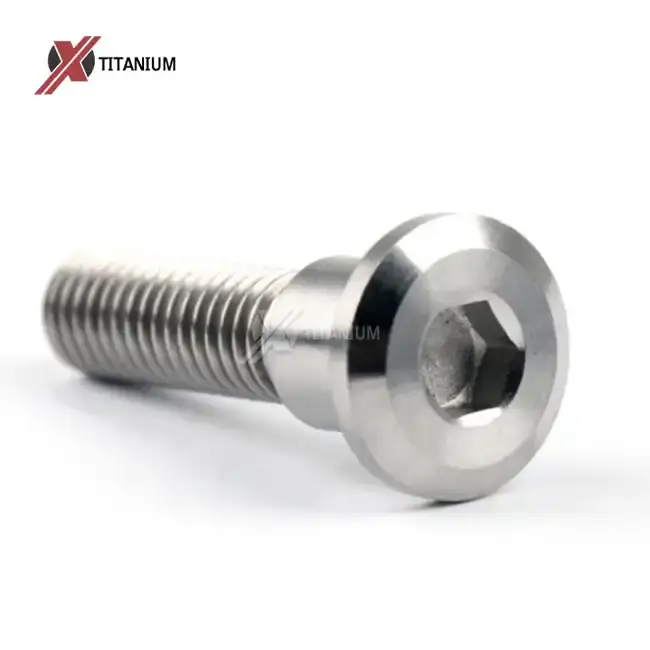
Confirm the Correct M8 Titanium Rotor Bolt Specifications Before Installation
Read the Full Thread and Head Specification
The number "M8" only tells you that the thread is 8 mm wide. Even so, you should still check the pitch, length, and style of the head against the main drawing or service manual. We use a 1.25 mm pitch, and our lengths range from 15 mm to 40 mm. You can make your own heads or get ones that are Torx, Allen, or hex. It can be either a T25 Torx socket or a hex socket for the drive. You should also measure the wheel's diameter, the caliper's shoulder, and the space between it and the wheel. The wrong bolts are still the ones that touch a moving part but fit the thread.
Match Grade 5 Titanium to the Load
Grade 5 titanium alloy (Ti-6Al-4V) is used to make our bolts. This alloy is good for high-load braking joints, and a CNC machine cuts it. These are the most important parts.
| Property | Value |
|---|---|
| Material | Titanium alloy, Gr5 (Ti-6Al-4V) |
| Thread / pitch | M8 / 1.25 mm (standard) |
| Length range | 15 mm–40 mm |
| Tensile strength | ≥ 950 MPa |
| Hardness | ~35 HRC |
| Density | 4.51 g/cm³ |
| Melting point | 1660°C |
| Tolerance | ±0.05 mm |
Tensile strength is a good way to make sure that loads that need to be stopped are safe. There are 7.85 g/cm³ of them, which is about 40% less than steel. People who ride bikes and race teams usually choose titanium because it has a low rotating mass. Maintenance is still needed even if you are strong, so the next steps are still important.
Request Documents Before You Approve a Batch
There is paperwork to protect both sides of a deal. Before you sign off on a lot, make sure you have the drawing, the material certificate, a report on the sizes, and a way to keep track of each batch. We use ISO 7380 and DIN 912 head references or OEM drawings that are made just for you for our bolts. On the product page, it says that it meets ISO 9001, ASTM B348, and RoHS standards. ASTM B348 talks about titanium bars and billets, not bolts that are already made. So, I believe you should read both the material certificate and the inspection report for the finished part.
Follow Correct Installation Procedures to Prevent Early Failure
Prepare Clean Threads and Mating Surfaces
A lot of people don't know how much dirt can make installation hard for M8 titanium rotor bolts. Get rid of oil, brake dust, rust, and old threadlocker from the bolt, the tapped hole, the rotor, and the hub face. Check the threads for any damage, like burrs, cracks, or other flaws. You should either get a new part or fix the thread in the right way. Don't hide a flaw by adding more torque. The clamp load changes because of the friction in the thread. If the rotor is not sitting level, it can come loose when there is vibration.
Control Torque, Lubricant, and Threadlocker
Find the torque value on the rotor, the hub, or the car's make. A general M8 chart can't take into account the material of your hub, washers, or lubricant. A study by John Bickford shows that when you tighten bolted joints, most of the torque is lost to friction and only a small amount is made as clamp load. So, a dry thread and a lubricated thread can have very different clamp forces when the torque is the same. Some metals that are similar to titanium can be made rougher with titanium threads. The manufacturer should tell you when and how to use anti-seize or a medium-strength threadlocker. Also, keep them away from the surface that stops the car.
Tighten in a Cross Pattern and Record the Work
To begin, you need to hand-seat each bolt. Next, use a torque wrench that has been calibrated to tighten in two or three stages, making a cross shape. Staged tightening evens out the clamp load and presses the rotor flat against the hub. For fleets and OEM lines, I believe it is necessary to record the date, the torque value, the tool ID, and the bolt batch number. In that record, a loose bolt is linked to a certain thing or process, which makes the investigation go faster. You can also use anodized colors like blue, green, or gold to show when a service or batch is due.
Build an Inspection, Cleaning, and Protection Schedule
Set Inspection Intervals by Duty Level
Each use should be spaced out at a different time. When it's dry, road bikes don't need to be checked as often as marine brakes, racing motorcycles, or off-road vehicles. It needs to be checked every time the brakes are serviced, the wheels are taken off, or the bike is getting ready for a race. Thread deformation, fretting marks, discoloration, uneven seating, and drive recesses that are coming loose are all things you should look for. After hard stops, hits, crashes, or vibrations that don't seem right, add checks. For safety-important parts, you should replace any bolt that is cracked, severely galling, has threads that are stripped, is permanently deformed, or has an unknown installation history.
Clean Without Damaging Threads or Surfaces
You should use a soft cloth, a nylon brush, and a cleaner made for brake parts when cleaning M8 titanium rotor bolts. If you grind, polish, or use wire brushes that are too strong, you could damage the threads, change the size, or leave marks on the surface. Sticky parts like the brake pads, rotors, and seals should not be touched by lubricants or cleaning sprays. The brakes don't work as well when there is dirt on them. Know what kind of finish your bolts have before you clean them: polished, anodized, or nitrided. They should tell you if your cleaner will work on that finish.
Manage Galvanic Corrosion at Aluminum and Steel Interfaces
It doesn't rust because a thin layer of oxide forms on top of it. Aluminum, on the other hand, is not so great. Sometimes the aluminum breaks first when they touch and there is water or road salt nearby. Metal hubs, steel washers, and coastal service are the most important things to keep an eye on. Let the joint dry, and then clean it of salt. Look for white powder or pits where the two pieces meet. You can add isolation washers or a protective paste that works with the design if it lets you. The titanium bolt itself works well in rough, wet, and coastal places, but the metal next to it is dangerous.
Troubleshoot Problems and Compare Replacement Options
Fix Loose Bolts and Damaged Threads
There are many reasons why a bolt might be loose. It could be because the torque is wrong, the threads are dirty, the engagement is too short, there is vibration, the clamping is bad, or the threadlocker is wrong. Before you put in a new one, find out where the damage is in the bolt, hub, rotor, or insert. It will fail again if you put a new bolt in a hole that is already stripped. If the bolts keep coming loose, stop adjusting the torque and talk to an engineer about the design of the joint, the type of washer, and how the materials are paired. Most of the time, failures that keep happening are caused by a process or compatibility issue, not a bad bolt.
Handle Galling and Stuck Bolts
Don't move if a bolt won't come off. If you push too hard, it can round off the Torx or hex hole or tear the threads. Put the right bit all the way in, like a T25 for a Torx drive, and use the right way to release it for your group. Galling usually starts with threads that are dirty, an assembly that isn't dry, or tightening too quickly. The anti-galling properties in our product data list still work after many assembly cycles. We can talk about nitriding as a surface option for things that will wear out quickly. Even so, I still say that clean threads and approved assembly compounds should be used for every installation.
Compare Titanium With Stainless Steel and Aluminum
M8 titanium rotor bolts don't always need to be made of titanium. You can find stainless steel more easily and it costs less, but it's much denser than Grade 5 titanium, which is 4.51 g/cm³. Aluminum bolts are lighter, but they're not as strong, and the threads don't last as long in joints that move around a lot. Because of this, I wouldn't use them for emergency stopping. Grade 5 titanium is stronger than Grade 2 titanium that is sold in stores. Grade 2 steel doesn't rust as easily and is easier to work with. Take a look at more than just the weight. Consider the load, temperature, environment, service frequency, and cost over the whole life of the item.
Build a Procurement Checklist and Maintenance Workflow
Write a Precise Purchase Specification
People send the wrong parts and waste weeks when you aren't clear about what you want. Head type, drive type, head size, tolerance, color, grade, and thread size and pitch are some of the things that you need to know. List the length and the length of thread that can be used. In this case, you will need to add the washer, coating, and threadlocker needs if the job will be done in a wet, coastal, or chemically exposed area. It's possible to finish bolts in gold, blue, green, purple, black, or rainbow titanium. Techs who work on a busy line can keep track of different groups of parts or service intervals by using color coding. Give your supplier an idea of how much you think they will need so they can plan for future orders.
Evaluate Supplier Quality Control and Capability
Titanium buyers don't usually just pick based on price. There must be proof for the teams that are in charge of quality, engineering, and buying. Checks that are often done are tensile testing, thread gage inspection, surface crack inspection, and chemical composition testing to confirm Ti-6Al-4V. Ask each supplier what checks they carry out and how they keep track of the outcomes. The place where Chuanglian lives is Baoji. People call it the "City of Titanium." For more than ten years, we've used more than a dozen CNC machines to work with titanium. For ISO 9001, we check all of the steps in the production process, from the raw materials to the finished goods.
Use a Standard Workflow for Workshops, Distributors, and OEM Teams
All sites get the same results because of a workflow that can be used again and again. First, look at the new bolt and see if it matches the one in the drawing or service manual. As the next step, check the rotor, hub, threads, washers, and seats for any damage, cracks, or corrosion. First, clean the joint. Next, use only approved compounds. Finally, tighten in the right order with a calibrated wrench. After the first use, look for cracks, noise, or movement and write down what you find. And finally, change how often you check for temperature, vibration, moisture, and how hard the brakes are working.
Conclusion
M8 titanium rotor bolts require specialized maintenance despite their high level of corrosion resistance. First, make sure that the pitch, length, head style, and grade are all correct. Then, making it work requires clean threads, the right amount of torque from the manufacturer, the right assembly compound, and tightening in a cross-pattern pattern. If you check it often, you can find problems like loosening, thread damage, fretting, and corrosion early on. It is important to pay extra attention to the galvanic risk where aluminum and steel meet. Instead of adding more torque, those who are having trouble should check the joint to see what's wrong. Steel, aluminum, and Grade 2 are all shown next to Grade 5 titanium. This shows how important it is to choose the right material for the job and the environment. For buyers, certified documents, traceability, and consistent dimensions help make sure that results are safe and can be repeated.
FAQ
Q1: Do M8 titanium rotor bolts need regular maintenance?
A: Yes. At every brake service, look for signs of wear and tear like thread damage, loosening, and corrosion. Before putting something back together, check the threads for galvanic corrosion and clean them.
Q2: Can I reuse M8 titanium rotor bolts?
A: If a bolt doesn't have any cracks, galling, stripped threads, deformation, or signs of being over-torqued, it can be used again. Check the head and threads every time. You should replace the bolt if you don't know how it was put in.
Q3: Is there one torque value for all M8 titanium rotor bolts?
A: For every pitch, lubricant, washer, hub material, and rotor design, the clamp load is different. Use the value given by the company that made the rotor or piece of equipment.
Q4: Which titanium grade do your bolts use?
A: Our bolts are made from Grade 5 (Ti-6Al-4V). They can be stretched at least 950 MPa and can be off by no more than 0.05 mm.
Contact Chuanglian, an M8 Titanium Rotor Bolts Manufacturer
Grade 5 titanium bolts in sizes M8 × 1.25 are available from Chuanglian. They are made with CNC machines. Heads, finishes, and OEM drawings can be changed to make them unique. Email your drawing, order, and application to info@cltifastener.com or djy6580@aliyun.com if you need a company that makes m8 titanium rotor bolts and has clear paperwork and ISO 9001 certification.
References
1. ASTM B348/B348M, Standard Specification for Titanium and Titanium Alloy Bars and Billets, ASTM International, 2019
2. Titanium: A Technical Guide, 2nd Edition, ASM International, 2000
3. Titanium and Titanium Alloys: Fundamentals and Applications, Wiley-VCH, 2003
4. Introduction to the Design and Behavior of Bolted Joints, 4th Edition, CRC Press, 2007
5. ASM Handbook, Volume 13B: Corrosion: Materials, ASM International, 2005
6. ISO 7380-1, Hexagon Socket Button Head Screws, International Organization for Standardization, 2011
Learn about our latest products and discounts through SMS or email