- English
- French
- German
- Portuguese
- Spanish
- Russian
- Japanese
- Korean
- Arabic
- Greek
- German
- Turkish
- Italian
- Danish
- Romanian
- Indonesian
- Czech
- Afrikaans
- Swedish
- Polish
- Basque
- Catalan
- Esperanto
- Hindi
- Lao
- Albanian
- Amharic
- Armenian
- Azerbaijani
- Belarusian
- Bengali
- Bosnian
- Bulgarian
- Cebuano
- Chichewa
- Corsican
- Croatian
- Dutch
- Estonian
- Filipino
- Finnish
- Frisian
- Galician
- Georgian
- Gujarati
- Haitian
- Hausa
- Hawaiian
- Hebrew
- Hmong
- Hungarian
- Icelandic
- Igbo
- Javanese
- Kannada
- Kazakh
- Khmer
- Kurdish
- Kyrgyz
- Latin
- Latvian
- Lithuanian
- Luxembou..
- Macedonian
- Malagasy
- Malay
- Malayalam
- Maltese
- Maori
- Marathi
- Mongolian
- Burmese
- Nepali
- Norwegian
- Pashto
- Persian
- Punjabi
- Serbian
- Sesotho
- Sinhala
- Slovak
- Slovenian
- Somali
- Samoan
- Scots Gaelic
- Shona
- Sindhi
- Sundanese
- Swahili
- Tajik
- Tamil
- Telugu
- Thai
- Ukrainian
- Urdu
- Uzbek
- Vietnamese
- Welsh
- Xhosa
- Yiddish
- Yoruba
- Zulu
Are titanium bolts safe for critical bicycle components like brake calipers?
Yes, titanium bicycle bolts are safe for critical components like brake calipers when manufactured to aerospace-grade standards and properly installed. Grade 5 titanium alloy (Ti-6Al-4V) delivers a tensile strength of 900 MPa, matching or exceeding high-grade steel while weighing 40% less. The material's non-corrosive nature eliminates seizure risks common in coastal or winter riding conditions, ensuring long-term clamping force integrity. However, safety depends on correct torque application, thread engagement depth, and supplier certification. Rolled threads, rather than cut threads, preserve grain structure and boost fatigue resistance by up to 30%, a critical factor for vibration-prone brake assemblies.
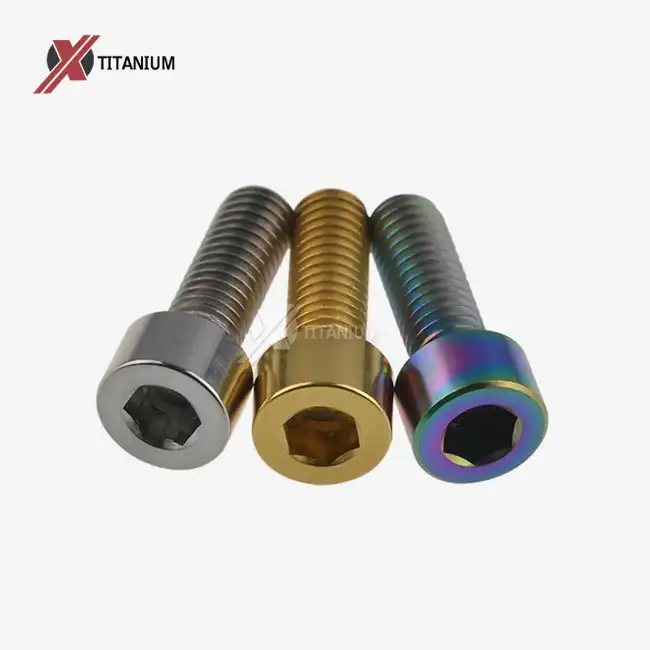
Understanding Titanium Bicycle Bolts and Their Safety for Critical Components
What Makes Titanium Alloy Ideal for Brake Fasteners?
Titanium Grade 5 (Ti-6Al-4V) is mostly made up of titanium (about 90%), aluminum (6%), and vanadium (4%). This mix makes an oxide layer that heals itself, protecting the material from corrosion caused by air, road salts, and sweat. Because aluminum is less dense than steel (7.85 g/cm³), each bolt saves weight without affecting the structure's strength. This is a big benefit when lowering the spinning mass close to the wheel hub.
Mechanical Properties Relevant to Brake Calipers
When you mount a brake caliper, you need titanium bicycle bolts that can handle both shear forces from stopping and tensile loads from roads that aren't level. Titanium bicycle bolts have a yield strength of about 880 MPa, which means they can keep clamping force even when hydraulic brake levels are higher than 10 bar. The material's elastic modulus gives it some bendiness, which lowers the stress levels that make over-torqued metal nuts break easily.
Corrosion Resistance and Long-Term Reliability
Unlike steel bolts that rust and seize up in aluminum brake mounts, titanium doesn't react chemically with time. Standard titanium bicycle bolts corrode within months, making rotor replacement impossible without cutting out stuck bolts. This is a problem for riders who live near water or in places where the roads are treated for winter. Titanium completely gets rid of this upkeep nightmare, so expensive brake systems can still be used.
Titanium Vs Steel and Aluminum Bolts: Safety and Performance Comparison
Strength-to-Weight Analysis
Steel bolts are common in OEM spec sheets because they are cheap and easy to work with, but their 7.8 g/cm³ density makes rotating parts heavier than they need to be. It is lighter to use aluminum bolts, but they can galling (cold weld) against aluminum brake mounts and have low fatigue thresholds.
This hole is filled by titanium, which is as strong as hardened stainless steel but less than half as heavy. A full brake caliper bolt kit, which usually includes six M5x16mm titanium bicycle bolts, weighs 15 to 18 grams less than steel ones and is placed at the outer radius of the wheel, where rotational inertia is most important.
Fatigue Resistance Under Cyclic Loading
When you ride a bike and brake, you create thousands of load cycles. For threaded parts, steel can only handle 400–500 MPa of stress before it starts to fail. Grade 5 titanium, on the other hand, can handle 10^7 cycles of stress levels close to 600 MPa without losing its shape.
Titanium bicycle bolts exemplify this advantage, but the ways that things are made matter here. Thread rolling, instead of thread cutting, is used in high-end titanium bicycle bolts. This keeps the alloy's grain structure and increases wear life by 30%. This is what makes professional-grade fasteners different from cheap ones.
Cost Considerations for Procurement Teams
Titanium raw material costs 5 to 8 times more than steel stock of the same size, and special tools are needed to keep the metal from stiffening during cutting. When buying in bulk, titanium bicycle bolts for brakes will cost $2 to $4 per unit, while steel ones will cost $0.20 to $0.50 per unit.
Lifecycle cost analysis, on the other hand, favors titanium when replacement times, corrosion-related failures, and the cost of work to remove seized fasteners are taken into account. Manufacturers that make a lot of products often agree to custom runs to get the best thread pitch and head profiles for certain caliper designs. This spreads the cost of the tools out over many production batches.
Why Choose Titanium Bolts for Brake Calipers? Benefits and Procurement Insights
Performance Benefits in Critical Applications
The mix of being lightweight and resistant to corrosion directly raises safety gaps. Less unsprung weight makes the suspension more flexible on rough terrain, and steady clamping force keeps the brakes from moving out of alignment. Titanium bicycle bolts are used by competitive downhill and enduro teams because brake rotor temperatures can reach over 300°C during long descents. When aluminum plates and steel bolts are heated at different rates, the bolts can loosen. Titanium's thermal expansion coefficient is more like aluminum's, so torque loading stays the same when temperatures change.
Maintenance Strategies and Common Challenges
To install something correctly, you need torque wrenches that are calibrated for titanium's unique properties. When you over-tighten metal mounts, the threads get stripped, and when you under-tighten them, the mounts can move and worry. For M5 titanium bicycle bolts on brake calipers, the recommended torque is usually between 4.5 and 5.5 Nm, but this can change based on the length of the thread engagement.
Thread locker compounds with a medium strength rating (Loctite 243 or something similar) stop vibrations from loosening things up without making lasting ties. It is best to stay away from anti-seize additives because they change the friction coefficients and cause too much torque.
Supplier Reliability and Customization Options
When choosing suppliers, you should give more weight to those who have ASTM B348 material certifications and ISO 9001 quality systems. Baoji Chuanglian New Metal Material Co., Ltd. uses CNC machining to make custom sizes ranging from M3 to M12, which can fit both normal DIN 912 socket heads and unique button-head shapes.
Some surface treatments, like polishing, anodizing (which comes in natural, gold, blue, green, purple, black, and rainbow finishes), and nitriding, make things last longer and look better at the same time. Custom orders usually take between 6 and 8 weeks to deliver from the time the specifications are approved to the time the order is delivered. This means that buying teams have to plan for extra inventory for test builds and production runs.
How to Ensure Safety When Using Titanium Bolts for Brake Calipers
Torque Specifications and Installation Best Practices
Because titanium has a lower friction coefficient than steel, power specs from makers need to be changed. Always ask titanium bicycle bolts suppliers for exact numbers because clamping force is greatly affected by things like thread pitch, engagement depth, and surface finish. For consistency, use torque wrenches that have been calibrated and have a resolution of 0.5 Nm. When mounting multi-bolt calipers, put the bolts in a star pattern and tighten each one in three steps. This will spread the load evenly and keep the mount from warping.
Material Certifications and Quality Verification
Professional buying processes need to be able to track down materials. Genuine Grade 5 titanium bicycle bolts come with mill certificates that list their chemical make-up and mechanical test results. For uses where failure would have serious effects, ask for certifications that meet ASTM F136 (medical implant grade) or AMS 4928 (aerospace standard). Some companies offer ASTM B117 salt spray testing reports that show corrosion resistance for 1000 hours or more. This is useful proof when trying to explain higher prices to people who are watching their budgets.
Common Installation Pitfalls to Avoid
Both the bolt and clamp threads are destroyed right away by cross-threading. Always start threads by hand to make sure they are straight before applying torque. Galvanic rusting cells are made when you mix fastener materials. Never put titanium bicycle bolts with steel washers or steel washers with titanium bicycle bolts.
When you replace the bolts, check the mounting holes for damaged threads because aluminum that has been stripped needs helicoil inserts before it can be put back in place. Engineers looking at samples from suppliers should use a go/no-go thread gage to check the samples and compare the head shape to DIN or ISO limits to find any machining flaws before committing to production.
Bulk Purchase and Custom Orders: Meeting B2B Procurement Needs
Sourcing Strategies for OEMs and Distributors
Global companies that make bicycle parts usually have dual-source deals in place to avoid problems in the supply chain. When looking at titanium bicycle bolt suppliers, you should look at how much they can produce, how much raw material they have on hand, and how flexible their machines are.
When compared to outsourcing checks, suppliers who have their own material testing labs can speed up batch verification, cutting wait times by 10 to 15 days. Most of the time, volume price starts at 5,000 units, and costs drop by 15-20% per unit at 20,000 units or more. Titanium bicycle bolts are no exception to this pricing structure, and long-term contracts with delivery plans every three months keep cash flow smooth and ensure allocation during gaps in the titanium market.
Customization for Specialized Applications
Boutique frame makers or race teams that need custom thread lengths, head profiles, or coatings usually can't find what they need in standard stock items. CNC cutting lets you make changes like longer shanks for thick carbon fiber mounts, smaller heads for tight spaces, and left-handed threads for use on the pedal side. Anodizing protects against rust and helps brands stand out by matching the color to frame finishes.
Physical Vapor Deposition (PVD) coatings make the surface harder, which keeps wrenches from wearing out on nuts that are repaired often. Custom tooling costs for prototypes will likely be between $500 and $1,500, but these costs will be spread out over production runs of more than 2,000 units.
After-Sales Support and Partnership Reliability
Tier-one suppliers are different from commodity dealers because they can provide technical help. When problems happen in the field, responsive engineering teams help with things like recommending torque, replacing materials, and figuring out what went wrong. Problems can be solved faster when there are clear lines of contact, such as English-language correspondence and help hours that span multiple time zones.
Baoji Chuanglian New Metal Material Co., Ltd. has been making titanium bicycle bolts and fasteners for ten years and serves the aircraft and marine industries with quality systems that have been certified by AS9100 and ISO 9001. Our site in Baoji City, which is known as the "City of Titanium," gives us direct access to sources of raw materials and specialized machining skills that help us consistently deliver high-quality products on time.
Conclusion
Titanium bicycle bolts are a smart upgrade for brake calipers and other safety-critical bicycle parts because they reduce weight while improving structural performance. The 900 MPa tensile strength of Grade 5 titanium, along with its high resistance to corrosion and long wear life, makes it worth the extra cost in challenging situations. Long-term dependability is guarantyd by using measured torque and quality-checked fasteners from approved sources during installation. When looking at titanium bicycle bolts, procurement workers should give more weight to providers that can show they can track materials, make modifications, and provide quick expert help in order to get the most value over the lifecycle of a product.
FAQ
Can titanium bolts handle the stress of hydraulic disc brakes?
Of course. The 900 MPa tensile strength of grade 5 titanium is higher than what is needed for hydraulic brake systems that produce 10+ bar pressure. The material has a yield strength of 880 MPa, which makes sure that titanium bicycle bolts keep their holding force during emergency stopping without permanently deforming. To keep metal bolts from thread stripping or not having enough preload, it's important to use the right amount of torque (usually 4.5 to 5.5 Nm for M5 fasteners).
How do I verify titanium bolt authenticity?
Ask for mill certificates that show the chemical make-up and mechanical properties that meet ASTM B348 standards. Genuine Grade 5 titanium bicycle bolts have a unique shiny sheen and weigh about 45% less than steel nuts of the same size. Reliable suppliers let you track each batch and may even offer testing reports from a third party. When you look closely, you should see rolled threads with smooth grain flow instead of rough-cut surfaces.
What torque specifications should I use?
Because titanium has a lower friction coefficient than steel, values need to be changed. M5 brake caliper bolts usually have a range of 4.5 to 5.5 Nm, while M6 titanium bicycle bolts have a range of 6 to 8 Nm. Always get specific advice from the bolt's maker, since factors like thread pitch, surface finish, and thread locker use can greatly impact clamping force. To make sure the load is spread out evenly, use torque wrenches that have been measured and tighten in steps.
Partner with Chuanglian for Premium Titanium Bicycle Bolts
Chuanglian is an expert at making aerospace-grade titanium bicycle bolts that are specifically designed for high-performance bicycles. Our CNC-machined bolts have rolled threads and are made of ASTM-certified Ti-6Al-4V material. This makes sure that they won't wear out and are the right size, which is important for brake caliper safety. Our engineering team works with you from the concept stage all the way thru production, whether you need standard M5x16mm socket head bolts or custom aluminum finishes to make your brand stand out.
As a reliable source for titanium bicycle bolts, we have strong quality control systems in place and offer low prices for large orders. You can email us at info@cltifastener.com or djy6580@aliyun.com to talk about your needs, or you can go to cl-titanium.com to see all of our products.
References
1. American Society for Testing and Materials. "ASTM F136-13: Standard Specification for Wrought Titanium-6Aluminum-4Vanadium ELI (Extra Low Interstitial) Alloy for Surgical Implant Applications." ASTM International, 2013.
2. Boyer, Rodney, Gerhard Welsch, and E.W. Collings. "Materials Properties Handbook: Titanium Alloys." ASM International, 1994.
3. Deutsches Institut für Normung. "DIN 912: Socket Head Cap Screws with Hexagon Socket." Beuth Verlag GmbH, 2017.
4. Lütjering, Gerd, and James C. Williams. "Titanium: Engineering Materials and Processes." Springer-Verlag Berlin Heidelberg, 2007.
5. SAE International. "AMS 4928: Titanium Alloy, Bars, Wire, Forgings, Rings, and Drawn Shapes 6Al-4V Annealed." Society of Automotive Engineers, 2019.
6. Schutz, R.W., and D.E. Thomas. "Corrosion of Titanium and Titanium Alloys." ASM Handbook Volume 13B: Corrosion: Materials, ASM International, 2005.
Learn about our latest products and discounts through SMS or email