- English
- French
- German
- Portuguese
- Spanish
- Russian
- Japanese
- Korean
- Arabic
- Greek
- German
- Turkish
- Italian
- Danish
- Romanian
- Indonesian
- Czech
- Afrikaans
- Swedish
- Polish
- Basque
- Catalan
- Esperanto
- Hindi
- Lao
- Albanian
- Amharic
- Armenian
- Azerbaijani
- Belarusian
- Bengali
- Bosnian
- Bulgarian
- Cebuano
- Chichewa
- Corsican
- Croatian
- Dutch
- Estonian
- Filipino
- Finnish
- Frisian
- Galician
- Georgian
- Gujarati
- Haitian
- Hausa
- Hawaiian
- Hebrew
- Hmong
- Hungarian
- Icelandic
- Igbo
- Javanese
- Kannada
- Kazakh
- Khmer
- Kurdish
- Kyrgyz
- Latin
- Latvian
- Lithuanian
- Luxembou..
- Macedonian
- Malagasy
- Malay
- Malayalam
- Maltese
- Maori
- Marathi
- Mongolian
- Burmese
- Nepali
- Norwegian
- Pashto
- Persian
- Punjabi
- Serbian
- Sesotho
- Sinhala
- Slovak
- Slovenian
- Somali
- Samoan
- Scots Gaelic
- Shona
- Sindhi
- Sundanese
- Swahili
- Tajik
- Tamil
- Telugu
- Thai
- Ukrainian
- Urdu
- Uzbek
- Vietnamese
- Welsh
- Xhosa
- Yiddish
- Yoruba
- Zulu
How do GR5 titanium screws compare to high-strength steel for bicycle components?
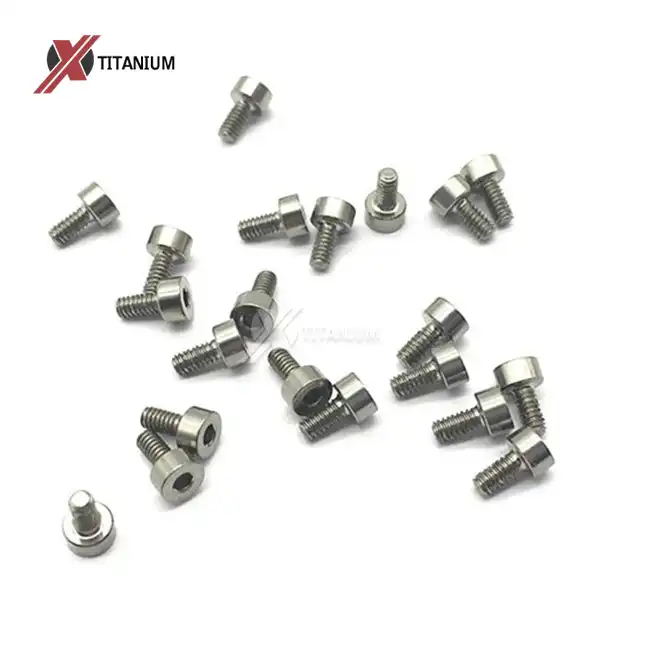
When evaluating fastening solutions for bicycle components, Gr5 titanium bicycle screws consistently outperform high-strength steel alternatives in critical performance metrics. GR5 titanium (Ti-6Al-4V alloy) delivers approximately 40% weight savings compared to steel while maintaining tensile strength between 950-1000 MPa. The naturally occurring oxide layer provides exceptional corrosion immunity without protective coatings, eliminating galvanic corrosion risks between aluminum frames and steel fasteners. Unlike steel screws requiring frequent maintenance in coastal or winter environments, titanium fasteners maintain structural integrity and torque values throughout extended service intervals, addressing key pain points for procurement managers focused on lifecycle cost optimization rather than initial acquisition price alone.
Introduction
Choosing the right material for bicycle fasteners is a big engineering decision that affects how well the whole system works, how often it needs to be maintained, and how different the product is from others. As cycling technology improves to make parts that are lighter and last longer, the difference between Gr5 titanium bicycle screws and high-strength steel becomes more important for people who manage the specifications of parts for competitive cycling, consumer electronics integration, and high-end recreational markets.
Over the past ten years, the bicycle business has gone through a lot of changes. At first, racing teams used titanium screws to save a little weight. However, more people started using them when maintenance departments saw that they were better at resisting corrosion, which made parts last longer and had fewer problems in the field. These days, purchasing managers don't just look at the unit cost of these materials; they also look at things like performance stability, source certification depth, and the total ownership economics.
To understand how Ti-6Al-4V titanium alloy works with different types of steel, you need to look at more than just basic specification sheets. Real-world application settings, like winter travel with road salt and the effects of humidity on touring bikes, show differences in performance that can't be seen in the lab. This analysis gives you the technical background and business background you need to make smart sourcing decisions that meet both engineering needs and business goals.
Understanding GR5 Titanium and High-Strength Steel for Bicycle Screws
Material Composition and Metallurgical Properties
The ASTM B348 standard for Gr5 titanium bicycle screws calls it Ti-6Al-4V. It is made up of a titanium mesh with about 6% aluminium and 4% vanadium. This mix has a density of 4.43 g/cm³ and a yield strength of about 880 MPa. Its final tensile strength is between 950 and 1050 MPa. The aluminium content makes the metal stronger and lighter, and the vanadium stabilises the beta phase, which makes it easier to shape and treat with heat.
Austenitic stainless steels (304/316 grades) and precipitation-hardened variants (17-4PH) are two other types of high-strength steel that are often used in bicycle applications. Stainless steel 316 has a moderate resistance to corrosion. Its tensile strength is between 515 and 620 MPa, and its density is 7.85 g/cm³. When alloy steels are heated, they can reach tensile strengths of 1200 MPa or more, but they lose their ability to fight corrosion. This means that they need to be treated on the outside, which adds thickness to the coating and creates possible weak spots.
The manufacturing processes have a big effect on how well the final product works. Premium titanium screws have rolled threads instead of cut threads, which keeps the grain structure intact and makes them about 30% more resistant to wear. This difference in how the parts were made is very important when you ride a bike because the vibrations and stresses change thousands of times during a ride. Specialised makers that offer CNC cutting can make sure that the dimensions are exact enough to meet DIN 912 and ISO 7380 standards while still preserving the material's natural benefits.
Standardization and Quality Frameworks
The production of titanium fasteners is based on a number of worldwide norms, which ensures that the supply chain is always the same. ASTM B348 sets the standards for bar and billet materials, and AMS 4928 covers aerospace-grade standards that many high-end bicycle makers use. These guidelines spell out the ranges of accepted chemical composition, the lowest level of mechanical property, and the testing procedures that approved suppliers must show through certified lab results.
Quality assurance is more than just certifying the raw materials. While ISO 9001 manufacturing systems provide models for process control, purchasing managers in the aerospace or medical device sectors are asking for AS9100 or ISO 13485 certifications that show better batch paperwork and tracking. Before being shipped, each production lot is checked for dimensions, tensile strength, and surface quality. There are also documentation packages that allow full tracking from the mill certificate to the finished component.
Performance Comparison: GR5 Titanium vs. High-Strength Steel
Corrosion Resistance and Environmental Durability
Titanium naturally forms a solid, adhering oxide layer (TiO₂) that protects against rust and grows back when scratched, while steel's passive layer needs certain chemical conditions to form. These main differences become very clear in coastal areas, where chloride exposure quickly ruins stainless steels into pitting rust, while Gr5 titanium bicycle screws don't show any signs of wear and tear after years of use.
When fastening metals that are not the same, galvanic corrosion is another important thing to think about. When you put together steel screws and aluminium parts, you get electrochemical cells that speed up localised rusting, especially when road salt or sweat is present. Titanium's place in the galvanic series keeps the potential differences between it and aluminium and carbon fibre to a minimum. This stops the seizure problems that make routine maintenance and replacing parts more difficult. Maintenance teams at professional bike teams say that titanium fasteners can be removed even after several seasons, while steel screws often need to be taken out in a damaging way.
The real-world effects include figuring out the total cost of ownership. A bicycle maker that makes 50,000 bikes a year might save $2 to $3 per unit at first by using steel bolts, but they would have to pay an average of $25 to $40 per unit in guarantee claims for failures caused by corrosion. When 3–5% of steel-fastened units need to be fixed, but only 0.1% of titanium options do, the economic situation clearly favours titanium, even though it costs more to buy.
Strength-to-Weight Ratio and Fatigue Performance
If you compare titanium screws to steel ones, you can see that they are 40–45% lighter, which is a clear benefit. When you replace all of a bicycle's steel fasteners with titanium ones, you save about 80 to 120 grams. This may not seem like much, but in the performance margins where competitive benefits are counted, it makes a big difference. The weight saves happen at different connection points along the frame, so the benefit is spread out over the whole structure instead of being concentrated in a few places.
When used in bicycles, fatigue resistance under cyclical loading should be given extra attention. Gr5 titanium has an endurance limit of about 510 to 550 MPa and is better at stopping fatigue cracks from spreading than steels with the same static strength. The higher elastic stiffness of the material lets it bend a little, which spreads out stress points and makes it less likely that cracks will start at thread roots where geometric stress sources are present. Independent tests show that titanium screws that are made correctly can handle two to three times more load cycles before they break than steel screws that are made the same way.
Dynamic loading cases show more differences in speed. Titanium is less thermally conductive than other metals, so when brake wheels go through temperature changes between room temperature and 300°C during steep descents, the heat doesn't move as easily to other parts. The material keeps its mechanical properties better than most steels at high temperatures, which stops the thermal fatigue processes that cause fasteners to loosen and eventually break in high-performance settings.
Procurement and Commercial Considerations for B2B Clients
Cost Analysis and Return on Investment
The biggest difference between Gr5 titanium bicycle screws and steel bolts is the cost of the materials. Titanium requires 3–5 times more money for its raw materials than steel does. Finished component costs can vary by 2 to 4 times, based on the number of parts ordered, how complicated the geometry is, and what surface processes are needed. A full procurement analysis must look at more than just piece-price comparisons. It must also look at the total installed cost, which includes logistics, inventory carrying costs, and performance in the field.
Different materials have very different pricing structures for volume. When you buy more than 10,000 pieces of steel bolts, the price per unit is very low, and the price drops even more when you buy more than 50,000 units. Titanium prices are more affected by volume, with big drops happening at 5,000-piece orders and continuing through 25,000-unit sales. When making blanket purchase agreements with qualified suppliers, procurement managers who want to keep their inventory levels as low as possible should keep these price changes in mind.
When you calculate the return on an investment, you need to take into account both physical and intangible factors. There are real perks, like fewer warranty claims, better brand placement in high-end markets, and longer repair intervals. A touring bike company that markets its bikes to serious cyclists can charge $150 to $200 more for frames that are attached with titanium, even though the actual cost difference is only $40 to $60 in bought parts. The chance to increase the margin is three to four times greater than the cost of the extra material. This turns titanium from an investment to a source of profit.
Supplier Qualification and Partnership Strategies
To find qualified titanium fastener providers, you need to do more than just look at their skill statements. As part of the due diligence process for buying things, material tracking systems that let produced parts be linked to their original mill certificates should be checked. There are risks in the supply chain when suppliers don't keep full records of each batch. These risks are especially high when suppliers work with regulated industries like medical devices or aeroplanes, where changing materials or changing the makeup of a product can lead to expensive recalls.
The skills of the manufacturing process set good providers apart from great partners. The accuracy of CNC machining, the upkeep of thread rolling tools, and the uniformity of surface treatment all have a direct effect on the performance and size conformity of the finished component. There is confidence that documented capabilities reflect actual production consistency rather than theoretical potential when site audits show calibration records, process control charts, and non-conformance tracking systems.
Managing lead time and being flexible with the supply chain are important qualities for a relationship. Titanium's supply chain has fewer material converters than steel's, which means that problems upstream could affect the metal. Mill lead times usually last between 12 and 16 weeks, so suppliers who keep a strategic inventory of popular sizes and specs can protect themselves. Purchasing teams that are in charge of just-in-time production plans can lower their risk by building relationships with makers that have two facilities or by keeping safety stock agreements.
Why Choose GR5 Titanium Screws for Bicycle Components?
Strategic Advantages for Premium Positioning
Gr5 titanium bicycle screws parts make it possible to differentiate products in ways that support high prices and brand placement. Many people think of titanium as high-performance, long-lasting, and technically advanced, all of which appeal to enthusiasts who are willing to pay more for clear benefits. Marketing materials that talk about how titanium screws are used throughout the product are real proof that premium positioning claims are true.
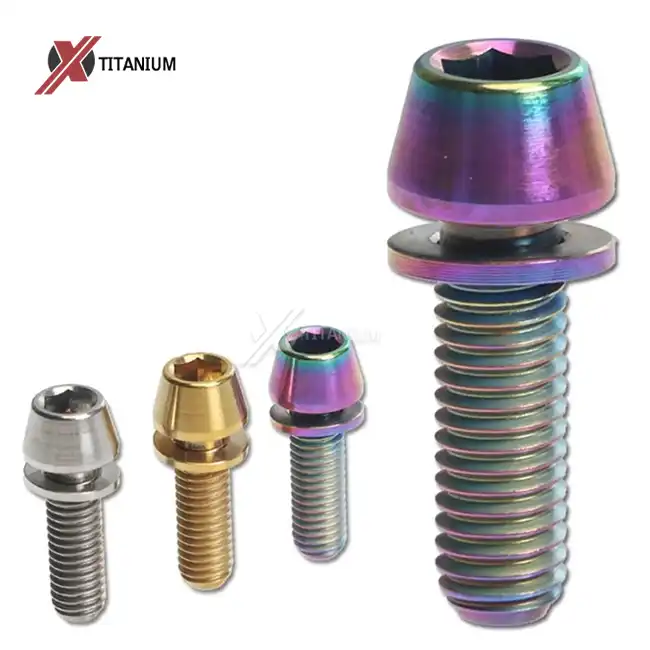
The material's aesthetic versatility, achieved through anodising processes, opens up even more ways to set it apart. Gold, blue, purple, black, and rainbow finishes are just a few of the colours that are available. They can be used to match frame colours or make signature accent details. Anodised titanium doesn't rust even after being scratched, unlike painted or coated steel fasteners where damage to the surface shows the underlying material. This is because the process goes through the surface oxide layer instead of just covering it.
Titanium fasteners are naturally suited to uses that need to be light, such as competition riding, bikepacking, and performance travel. Customers in these groups are actively looking for small improvements and know what makes a product or service technical. Titanium fasteners save a small amount of weight on their own, but together they help optimise the whole system, which is what makes a competitive advantage. Purchasing teams that work with these markets find that titanium standards make products more trustworthy in communities of informed customers.
Performance Trade-offs and Application Suitability
Titanium's main weakness is still that it is sensitive to cost. The material price is too high for entry-level and mid-market bicycles to handle without losing their competitive edge or their profit cushion. Purchasing plans should only use titanium specifications for things where the performance benefits are worth the extra cost, like high-end component groups, premium complete bikes, or aftermarket upgrade parts aimed at cycling enthusiasts.
Complex machining makes it hard to make things, but skilled suppliers can handle it with the right tools and process knowledge. Because titanium tends to gall when fitting, the right oils and cutting speeds are needed. Suppliers who don't know much about titanium may send parts with broken threads or inconsistent sizes, which makes them hard to put together and raises the rate of rejection. Because of this, manufacturing sensitivity makes it even more important to qualify suppliers and build relationships instead of just buying things.
Making the Right Material Choice: A Decision Guide for Procurement Managers
Application-Specific Selection Criteria
Frameworks for making procurement decisions should make sure that the materials chosen meet specific performance needs and market placement goals. When choosing the right materials, keep the following things in mind:
• Competitive racing applications benefit maximally from Gr5 titanium bicycle screws's lighter weight and resistance to fatigue. The higher costs are justified by better performance and a lower chance of failure during important competition events.
• Premium recreational products aimed at enthusiasts use both performance features and differences in appearance to help place their brand.
• Coastal or harsh environment applications save a lot of money over the course of their life because corrosion resistance means less maintenance and longer component service life.
• Value-oriented product lines that cater to price-conscious customers can get a better competitive edge through steel screws, where cost optimisation lets retailers set bold prices.
• High-volume production of entry-level bikes is helped by steel's larger supplier base and well-established supply lines that make transportation easier and lower the cost of keeping inventory on hand.
• Applications with frequent disassembly requirements where screws are used up quickly and not permanently installed might choose steel because it costs less to repair.
Comparative Material Analysis
Gr5 titanium bicycle screws is one choice among a wider range of materials that can be used for bicycle screws. Grade 2 commercially pure titanium is more resistant to corrosion and costs less than GR5 alloy. However, it is not as strong (its tensile strength is only about 345 MPa), so it can only be used for low-stress attachments. Aluminium alloys, such as 7075-T6, have good strength-to-weight ratios and are cheaper than titanium. However, they tend to gall, have lower wear resistance, and are more likely to crack from stress corrosion in harsh conditions.
Depending on the alloy chosen, different grades of stainless steel have different performance profiles. Austenitic 316 stainless steel is reasonably resistant to rust and doesn't cost too much, but it's not as strong or light as titanium. Precipitation-hardened 17-4PH stainless steel gets as strong as titanium, but it needs to be carefully heated and doesn't fight corrosion as well, especially in chloride settings. There isn't a single material that improves all performance dimensions at the same time. This means that buying teams have to prioritise traits that meet the needs of each application.
Supplier Partnership and Procurement Best Practices
To build a good relationship with a supplier, you need to be clear about your technical needs, quality expectations, and business goals. Specifications that are clear and include things like the material grade, relevant standards, dimensional limits, surface finish requirements, and testing methods get rid of the confusion that can cause problems and make relationships tense. As part of the procurement paperwork, ASTM B348, AMS 4928, or similar standards should be used as references, along with any other needs that go beyond meeting the baseline standards.
Evaluation of samples is an important step in making sure everything is correct before starting mass production. Asking for material approvals, dimensional inspection records, and mechanical test data along with actual samples lets you get a good idea of how capable a provider is. Samples should be put through fitness tests in real assembly processes to make sure that their dimensions, thread engagement quality, and surface treatments meet the needs of the real-world application instead of just meeting the limits of the specifications.
Developing long-term partnerships through open communication and fair business terms makes the supply chain stable, which is good for everyone. When suppliers get accurate demand forecasts, reasonable lead time expectations, and fair payment terms, they respond by giving priority scheduling, being open about possible delays, and being ready to meet urgent needs. This way of working together is especially helpful in titanium supply chains, where limited seller bases and changes in the availability of materials can be problems.
Conclusion
When looking at Gr5 titanium bicycle screws and high-strength steel for bicycle fasteners side by side, they show different performance patterns that meet the needs of different market groups and applications. Titanium's benefits in reducing weight, resisting corrosion, withstanding stress, and adapting to different looks make it worth the higher cost for high-performance uses and expensive product placement. Steel alternatives are cheaper options for price-conscious groups where environmental exposure is moderate and weight optimisation is not as important.
When making a purchase choice, you should look at more than just the cost. You should also look at the total ownership economics, the effects on brand positioning, and the quality of the supply chain relationship. In the end, the choice of materials shows bigger strategic decisions about target markets, ways to make products stand out, and how to compete in bicycle markets that are getting more complex. In these markets, technical credibility and real performance drive customer loyalty and premium pricing power.
FAQ
What are the main reasons why GR5 titanium screws are better for bikes than stainless steel screws?
When compared to stainless steel screws, Gr5 titanium bicycle screws are 40% lighter while still being as strong as or stronger than stainless steel screws. The natural oxide layer of the material makes it more resistant to corrosion without the need for protective coatings. This means that galvanic corrosion problems don't have to be a problem when it is combined with aluminium or carbon fibre parts. Titanium screws can still be used after years of being exposed to things like road salt, humidity, and changes in temperature that would break down or seize up stainless steel.
Are titanium bicycle screws available in custom sizes and configurations?
Manufacturers that are qualified can give a wide range of customisation options, such as non-standard lengths, head styles (such as socket cap, button head, and countersunk), thread pitches, and physical changes to meet the needs of specific applications. The ability of CNC machines to make parts that closely match drawings provided by customers is possible. Anodising methods let you change the colour of things to gold, blue, purple, black, and rainbow finishes, which can help you differentiate your style.
How does pricing compare between titanium and steel fasteners for bulk orders?
Titanium fasteners usually cost two to four times as much as steel ones, but the exact cost depends on how many you order, how complicated the shape is, and how you want the surface treated. Volume pricing is more favourable when you buy more than 5,000 pieces, and the prices keep going down until you reach 25,000 units. Even though they cost more to buy, premium product lines are often worth the extra money when you look at the total cost, which includes things like fewer insurance claims and longer service times.
Partner with Chuanglian for Premium Titanium Bicycle Fasteners
Baoji Chuanglian New Metal Material Co., Ltd. makes high-performance Gr5 titanium bicycle screws for OEM partners in the professional cycling, high-end leisure cycling, and speciality application markets. Our factory in Baoji, which is known around the world as the "City of Titanium," has over ten years of experience making titanium, as well as full CNC powers and strict quality systems.
As a company that only makes titanium bicycle fasteners, we strictly follow the ASTM B348 and AMS 4928 standards. Our ISO 9001 approval makes sure that the process is consistent and that all of the materials can be tracked back to their source. Our engineering team offers technical advice to help with choosing the right materials, making the best designs, and making changes that are specific to each application. We can make standard DIN 912 socket cap screws, screws with special threads, or screws with custom anodised finishes. Our production capabilities give you the accuracy and consistency your applications need.
We invite purchasing managers, product engineers, and technical leaders to look into relationship possibilities that will meet your needs for titanium fasteners. You can email our team at info@cltifastener.com or djy6580@aliyun.com to talk about your needs, ask for material certifications and samples, or get full quotes for jobs you have coming up. Visit cl-titanium.com to see our full line of products and technical information that can help you make smart buying choices.
References
1. Boyer, R., Welsch, G., & Collings, E.W. (1994). Materials Properties Handbook: Titanium Alloys. ASM International, Materials Park, Ohio.
2. Donachie, M.J. (2000). Titanium: A Technical Guide, 2nd Edition. ASM International, Materials Park, Ohio.
3. Lutjering, G. & Williams, J.C. (2007). Titanium, 2nd Edition. Springer-Verlag, Berlin Heidelberg.
4. American Society for Testing and Materials (2021). ASTM B348: Standard Specification for Titanium and Titanium Alloy Bars and Billets. ASTM International, West Conshohocken, Pennsylvania.
5. SAE International (2019). AMS 4928: Titanium Alloy Bars, Wire, Forgings, Rings, and Drawn Shapes 6Al-4V Annealed. SAE Aerospace Material Specification, Warrendale, Pennsylvania.
6. Schutz, R.W. & Thomas, D.E. (1987). "Corrosion of Titanium and Titanium Alloys," Metals Handbook, 9th Edition, Volume 13: Corrosion. ASM International, Materials Park, Ohio, pp. 669-706.
Learn about our latest products and discounts through SMS or email