- English
- French
- German
- Portuguese
- Spanish
- Russian
- Japanese
- Korean
- Arabic
- Greek
- German
- Turkish
- Italian
- Danish
- Romanian
- Indonesian
- Czech
- Afrikaans
- Swedish
- Polish
- Basque
- Catalan
- Esperanto
- Hindi
- Lao
- Albanian
- Amharic
- Armenian
- Azerbaijani
- Belarusian
- Bengali
- Bosnian
- Bulgarian
- Cebuano
- Chichewa
- Corsican
- Croatian
- Dutch
- Estonian
- Filipino
- Finnish
- Frisian
- Galician
- Georgian
- Gujarati
- Haitian
- Hausa
- Hawaiian
- Hebrew
- Hmong
- Hungarian
- Icelandic
- Igbo
- Javanese
- Kannada
- Kazakh
- Khmer
- Kurdish
- Kyrgyz
- Latin
- Latvian
- Lithuanian
- Luxembou..
- Macedonian
- Malagasy
- Malay
- Malayalam
- Maltese
- Maori
- Marathi
- Mongolian
- Burmese
- Nepali
- Norwegian
- Pashto
- Persian
- Punjabi
- Serbian
- Sesotho
- Sinhala
- Slovak
- Slovenian
- Somali
- Samoan
- Scots Gaelic
- Shona
- Sindhi
- Sundanese
- Swahili
- Tajik
- Tamil
- Telugu
- Thai
- Ukrainian
- Urdu
- Uzbek
- Vietnamese
- Welsh
- Xhosa
- Yiddish
- Yoruba
- Zulu
Are titanium bolts safe to use with carbon fiber bicycle frames?
Titanium bicycle bolts are not only safe to use with carbon fiber frames — they are arguably the most compatible metal fastener option available. Unlike steel, which poses galvanic corrosion risks, and aluminum, which sacrifices tensile integrity over time, Grade 5 titanium (Ti-6Al-4V) sits at a low galvanic potential relative to carbon fiber composites. This makes it electrochemically inert in most cycling environments. With a tensile strength of 900 MPa and a density of just 4.43 g/cm³, these fasteners deliver structural reliability without compromising the frame's integrity or adding unnecessary mass.
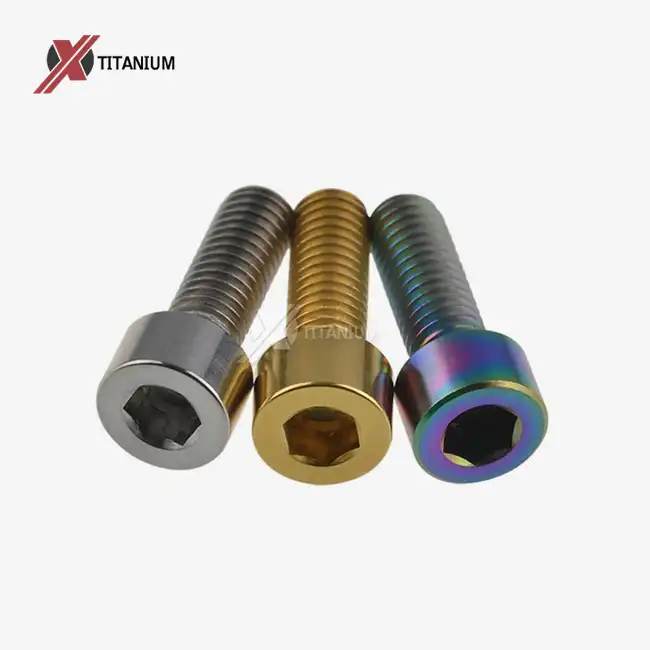
Understanding Titanium Bicycle Bolts and Carbon Fiber Frames
Carbon fiber frames are now the standard for high-performance bikes, from race bikes to top-of-the-line mountain bikes. It is well known that they have a great stiffness-to-weight ratio, but when people talk about buying, they often don't take into account how sensitive they are to hardware interactions. If you use the wrong fastener material, it can cause tiny cracks to appear at interfaces, speed up surface wear, or create galvanic activity that weakens the laminate over thousands of load cycles without being noticed.
What Makes Ti-6Al-4V the Right Alloy Here?
Grade 5 titanium is 90% titanium, 6% aluminum, and 4% vanadium. It has a yield strength of about 830 MPa and weighs about 45% less than steel hardware of the same type. Its oxide layer, which forms naturally on exposed surfaces, protects against corrosion without the need for a coating. This passive film stays steady in pH ranges that would rust steel in weeks. This makes it perfect for riding conditions that are wet, salty, or chemically aggressive.
Thread Compatibility and Size Range
Titanium fasteners are often used in bicycle parts with thread sizes ranging from M3 to M12. These include stem faceplates, seat post clamps, disk rotor bolts, gear limit screws, and brake caliper mounts. Thread rolling, not thread cutting, is the best way to make things because it keeps the grain flow continuous and makes threads last up to 30% longer than milled threads. This difference is important for engineers who are choosing fasteners for load points that are safety-critical.
Are Titanium Bolts Safe to Use with Carbon Fiber Frames?
The simple answer for titanium bicycle bolts is yes, as long as you follow the right steps for activation. Titanium is further along in the galvanic series than carbon fiber, which means that there isn't much electrochemical contact between the two materials when they're working normally. When moisture crosses the contact surface of steel hardware, it can start galvanic cells. The same is true for aluminum bolts, which can crack from stress rust under long-term load.
The Galling Risk and How to Eliminate It
One real worry about titanium fasteners is galling, which is a kind of adhesive wear that happens when titanium surfaces cold-weld during installation because of friction. It is known that this risk is real. The fix is easy: before threading into aluminum or carbon fiber interfaces, always use a copper-based anti-seize compound or a titanium-specific assembly paste. This lowers the friction coefficient just enough to stop galling without lowering the clamp force.
Torque Discipline Is Non-Negotiable
Titanium's modulus of elasticity is about 114 GPa, while steel's is 200 GPa. This means that when the same load is put on it, titanium stretches a little more. This trait can make it feel like something is too tight while it's being installed. When buying titanium fasteners, procurement teams should make sure that accurate torque wrenches are used and that the manufacturer's torque guidelines are followed. For M5 bolts at carbon fiber surfaces, these guidelines usually say that the torque shouldn't be more than 5–6 Nm.
Procurement Considerations for Titanium Bicycle Bolts
It is not a simple matter to find titanium bicycle bolts for carbon fiber bicycle parts. As a result of using the wrong material grade, thread shape, or surface treatment, breakdowns happen in the field, not just poor performance. A number of technical and practical factors should be used by procurement managers to judge suppliers.
Here are the main quality checks that procurement teams with a lot of experience use:
- Chemical spectrometry verification: Confirms Ti-6Al-4V composition versus commercially pure Grade 2, which is insufficient for load-bearing applications. Misrepresentation of grade is a documented industry issue that poses direct safety risks.
- Thread roll inspection: Microscopic analysis of thread roots confirms continuous grain flow from rolling rather than sharp-edged micro-cracks from cutting — a decisive factor in fatigue life.
- Go/No-Go gauging to ISO 7380 or DIN 912: Ensures pitch diameter accuracy, preventing thread stripping at the aluminum or composite interfaces of high-value frames.
- Proof load testing: Random batch sampling under axial tension validates minimum tensile strength compliance at 900 MPa without plastic deformation.
For applications that need to be safe, these steps are required. If a supplier can't show test records that can be tracked for each batch, they are a buying risk as well as a quality risk. Chuanglian's quality control process checks every step of the production process, from checking the raw billet to checking the finished part. Full documentation is available upon request.
Different types of surface treatment have big effects on both performance and durability. Polishing smooths out the surface and makes fitting easier by reducing friction. Anodizing changes the color and delays rust a bit without changing the size of the item. Nitriding with physical vapor deposition (PVD) makes the surface harder and less likely to scratch without weakening the substrate. This makes it the best choice for areas that will be used a lot.
Performance Comparison and Real-World Use Cases
Compared to steel, stainless steel, and aluminum options, Grade 5 titanium bicycle bolts have a set of qualities that no other material can match in all performance areas that matter. Steel is very strong, but it rusts when exposed to sweat, road salt, and cleaning chemicals. This is a problem that keeps happening at cockpit interfaces where riders' sweat drips directly onto stem hardware. Stainless steel is better at resisting rust than titanium, but it is about 40% heavier.
Aluminum is light, but it wears out quickly when loaded and unloaded over and over, and it easily strips at threaded connections. Titanium fixes all three types of failure at the same time. Titanium is a good material for disk brakes because it doesn't carry heat well. This means that heat doesn't move from the rotor to the hub when the brakes are applied for a long time on descents. This is a benefit that is useful and that metal and steel hardware can't match.
Maintenance and Longevity
Titanium fasteners don't need as much upkeep as steel ones, but they're not completely inactive either. It is still important to check the thread connection on a regular basis, especially where the titanium meets the carbon fiber. This isn't because titanium breaks down, but because the composite material around it can micro-fatigue under long-term vibrational load without showing any signs on the surface.
For regular upkeep, cleaning with water and light soap is enough. If you use harsh alkaline degreasers on anodized finishes, the oxide layer can change color after a while of exposure. When anti-seize compound is reapplied at service intervals, bolts that are taken off and put back on during component maintenance don't get galled. Titanium fasteners usually last longer than the frames they hold together if they are properly kept. This is a lifetime benefit that directly lowers the total cost of ownership in fleet, OEM, and distributor operations.
Conclusion
Titanium bicycle bolts represent a technically sound, commercially defensible choice for carbon fiber frame assemblies when properly specified and installed. Their galvanic compatibility, weight advantage, and corrosion immunity address the three primary failure modes associated with steel and aluminum hardware in high-performance cycling contexts. The investment in quality-verified, grade-certified titanium hardware pays returns in reduced warranty claims, extended component service intervals, and improved product reputation — outcomes that matter to procurement professionals operating in competitive manufacturing environments.
FAQ
Q1: Do titanium bolts cause galvanic corrosion on carbon fiber frames?
A: Titanium and carbon fiber don't have a high galvanic potential, so they are one of the safest metal pairs you can find. When they are wet, steel and some aluminum metals are much more likely to conduct electricity.
Q2: Can Grade 2 titanium be used for stem or brake bolts?
A: No, Grade 2 fully pure titanium should only be used for low-stress tasks, like water bottle cage bolts. Stems, brakes, and crank interfaces are all safety-critical load points that need Grade 5 (Ti-6Al-4V) to meet the yield strength threshold.
Q3: What torque should I apply to M5 titanium bolts at carbon fiber interfaces?
A: Follow the manufacturer's instructions, which for M5 bolts are usually 4–6 Nm. Always use an anti-seize compound and a torque wrench that has been calibrated.
Q4: Does PVD coloring weaken titanium fasteners?
A: A good PVD finish doesn't weaken the tensile strength, and it can also make the surface harder and less likely to wear down. Low-quality anodizing, on the other hand, might make the surface look uneven.
Q5: Why are Torx drive heads preferred for titanium bicycle bolts?
A: Because titanium is a hard material, torx profiles spread the torque load over a bigger contact area than hex drives. This makes head rounding much less likely during installation, which is an important thing to keep in mind.
Source Your Titanium Bicycle Bolts from Chuanglian
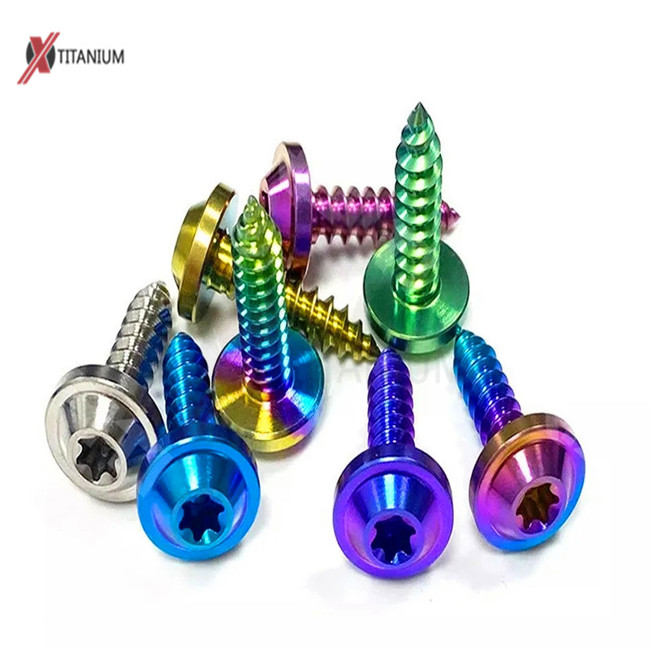
Precision-grade titanium bicycle nuts are made by Chuanglian in Baoji, China, which is known as the world's titanium production center. Our Ti-6Al-4V screws are CNC made and come with thread sizes ranging from M3 to M12. The surfaces can be polished, anodized, or nitrided to give them natural titanium, gold, blue, green, purple, black, or rainbow finishes. Every batch that ships comes with full certification and traceability paperwork for the materials. Get in touch with our technical team to talk about OEM requirements, bulk pricing, or your needs for a custom finish. Email at info@cltifastener.com or djy6580@aliyun.com are ways to get in touch with us.
References
1. Boyer, R. R. (1996). An Overview on the Use of Titanium in the Aerospace Industry. Materials Science and Engineering: A — Elsevier.
2. Lutjering, G., & Williams, J. C. (2007). Titanium (2nd ed.) — Springer Engineering Materials Series.
3. Davis, J. R. (Ed.). (2003). Handbook of Materials for Medical Devices — ASM International.
4. Donachie, M. J. (2000). Titanium: A Technical Guide (2nd ed.) — ASM International.
5. Burr, A., & Shaffer, S. (2014). Fatigue Performance of Cold-Worked Threaded Fasteners in Titanium Alloys — Journal of Materials Engineering and Performance, ASM International.
6. Callister, W. D., & Rethwisch, D. G. (2018). Materials Science and Engineering: An Introduction (10th ed.) — Wiley.
Learn about our latest products and discounts through SMS or email