- English
- French
- German
- Portuguese
- Spanish
- Russian
- Japanese
- Korean
- Arabic
- Greek
- German
- Turkish
- Italian
- Danish
- Romanian
- Indonesian
- Czech
- Afrikaans
- Swedish
- Polish
- Basque
- Catalan
- Esperanto
- Hindi
- Lao
- Albanian
- Amharic
- Armenian
- Azerbaijani
- Belarusian
- Bengali
- Bosnian
- Bulgarian
- Cebuano
- Chichewa
- Corsican
- Croatian
- Dutch
- Estonian
- Filipino
- Finnish
- Frisian
- Galician
- Georgian
- Gujarati
- Haitian
- Hausa
- Hawaiian
- Hebrew
- Hmong
- Hungarian
- Icelandic
- Igbo
- Javanese
- Kannada
- Kazakh
- Khmer
- Kurdish
- Kyrgyz
- Latin
- Latvian
- Lithuanian
- Luxembou..
- Macedonian
- Malagasy
- Malay
- Malayalam
- Maltese
- Maori
- Marathi
- Mongolian
- Burmese
- Nepali
- Norwegian
- Pashto
- Persian
- Punjabi
- Serbian
- Sesotho
- Sinhala
- Slovak
- Slovenian
- Somali
- Samoan
- Scots Gaelic
- Shona
- Sindhi
- Sundanese
- Swahili
- Tajik
- Tamil
- Telugu
- Thai
- Ukrainian
- Urdu
- Uzbek
- Vietnamese
- Welsh
- Xhosa
- Yiddish
- Yoruba
- Zulu
What are the key characteristics of Gr5 titanium alloy?
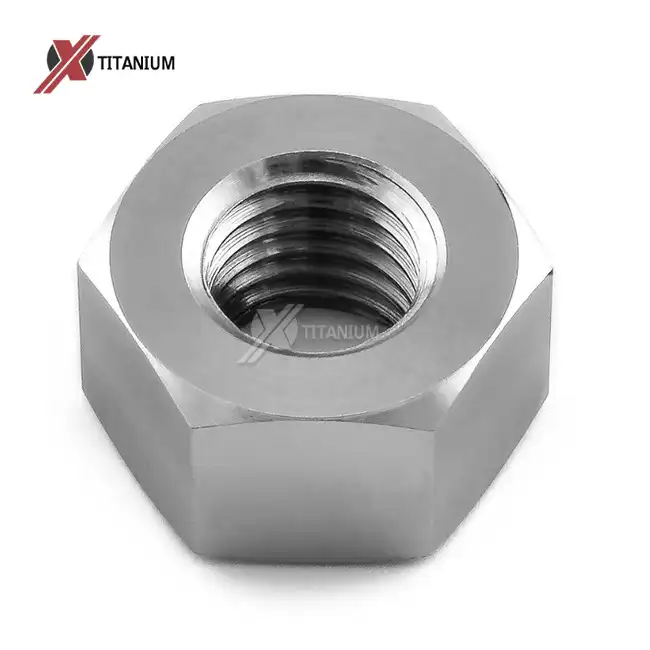
Gr5 titanium alloy, formally designated Ti-6Al-4V, is the most widely used titanium grade in industrial manufacturing, accounting for roughly 50% of total global titanium consumption. Its composition — 90% titanium, 6% aluminum, and 4% vanadium — produces a material with a tensile strength of at least 895 MPa, a density of just 4.43 g/cm³, and hardness reaching 36 HRC. These properties make it the go-to choice for safety-critical components across aerospace, medical, marine, and automotive sectors. A precision-machined Gr5 titanium rear axle nut, for example, demonstrates exactly why engineers and procurement teams continue to specify this alloy over virtually every alternative.
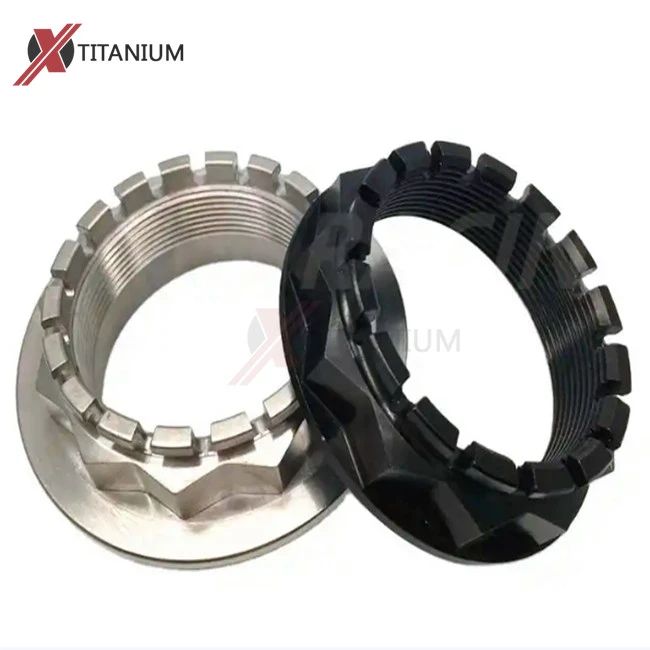
Understanding Gr5 Titanium Alloy – Composition and Specifications
There are two types of lattices in the titanium alloy Ti-6Al-4V. These lattices make the metal easy to form and strong at the same time. Its yield strength is at least 830 MPa, which is much higher than widely pure grades like Gr2 or the leaner metal Gr9. It also doesn't add as much mass. Structure metals don't usually have that mix of metals.
Mechanical and Physical Properties at a Glance
One thing that sets Gr5 apart from other materials used in harsh conditions is its standard shape:Strength in Tensile: at least 895 MPa, but 950–1050 MPa is more typical for parts that were made with great care.
- Tensile Strength: 895 MPa minimum, with typical values reaching 950–1050 MPa in precision-machined components
- Yield Strength: 830 MPa minimum, ensuring minimal plastic deformation under sustained load
- Density: 4.43 g/cm³ — approximately 57% lighter than carbon steel at 7.85 g/cm³
- Hardness: 36 HRC, sufficient for thread integrity under repeated torque cycles
- Corrosion Resistance: Excellent, owing to a self-regenerating TiO₂ oxide film that resists chlorides, acids, and alkalis
This number is the same as the ones in ASTM B348 and AMS 4928, which both cover aerospace-grade Ti-6Al-4V bar and billet stock.
Thread and Surface Finish Options
Chinglish makes Gr5 titanium rear axle nut parts that come in both Metric and Imperial sizes and have thread types that can be changed. Grinding, anodizing, and nitriding are used to treat the surfaces. You can get anodized finishes in gold, blue, green, purple, black, and colorful titanium. These coatings are useful, and they also look good on high-end custom builds and in racing.
Benefits of Using Gr5 Titanium for Rear Axle Nuts
For load-bearing axles, engineers choose titanium fasteners because they are strong, not because they look good. Because it is the only material that can fully copy the properties of the Gr5 titanium rear axle nut, it should be picked.
This part is a popular choice in all fields because it works well in the following ways:
- Weight Reduction Without Structural Compromise: At 4.43 g/cm³, a Gr5 axle nut can weigh up to 45% less than an equivalent steel nut. In motorsport and high-performance cycling — particularly mountain bike and e-bike platforms — reducing unsprung rotational mass directly improves suspension compliance and handling precision.
- Corrosion Immunity in Harsh Environments: Unlike steel, which corrodes and can seize onto axle threads after prolonged exposure to road salt, moisture, or mud, Gr5 titanium maintains a passive oxide layer that prevents rust-welding. This preserves torque calibration over long service intervals and simplifies maintenance.
- Fatigue Resistance Under Cyclic Loading: Titanium alloys have a well-documented fatigue endurance ratio superior to many steels of comparable tensile strength, making them reliable in applications subject to vibration and repeated mechanical stress.
- Acid, Alkali, and Chemical Resistance: The alloy resists a wide range of corrosive media, including dilute hydrochloric acid and seawater — conditions encountered in marine engineering and petrochemical environments.
With all of these perks, buying teams can save money over the course of a product's life with the Gr5 titanium rear axle nut. It takes less time and money to replace parts that don't rust, keep their shape, and can handle cyclic stress. Long-term supply deals are good for OEMs and dealers because this saves them time and money.
Comparing Gr5 Titanium Rear Axle Nuts with Alternatives
It's not always simple to pick the right stuff. When deciding what to buy, you need to think about how much it cost, how long it will last, how much weight you want to lose, and the rules and regulations. It's true that Gr5 is the most expensive bolt on the market, but knowing why will help you decide.
Steel nuts are cheap and easy to find, but they don't hold their shape as well as other materials and rust in places that are wet or have chemicals that are reacting with them. Alloy nuts made of aluminum are lighter, but they don't have the yield strength to handle the pressure needed for safe axle uses. When it comes to titanium, Gr2 (commercially pure titanium) doesn't rust and isn't very strong in tension (about 345 MPa), so it can't be used for high-load fastening jobs. Gr9 (Ti-3Al-2.5V) is in the middle, but it still can't go as high as Gr5. When it comes to strength-to-weight, Gr5 is about the same as Grade 10.9 steel gear. It's also naturally corrosion-proof, so it doesn't need a cover to keep that way. If you compare total costs instead of unit prices to help you decide what to buy, Gr5 is always the better choice in the long run.
Installation and Maintenance of Gr5 Titanium Rear Axle Nuts
When installing screws that are important for safety, they must be done correctly. Since titanium doesn't have the same friction coefficient as steel, an anti-seize solution or copper paste must be used on the thread contact before it can be fitted. Galling is a type of sticky wear that happens when titanium surfaces rub against each other and dry. This stops galling and makes sure that the torque is properly turned into holding force.
The OEM will always tell you what torque to use for a Gr5 titanium rear axle nut. Since steel has a larger elastic modulus than titanium, don't go over the limits that have been set. Also, threads can twist if they are overtorqued. A lot of the time, people check regularly for mechanical damage, thread deformation, or surface wear. This is very important when you're racing and there aren't many breaks for repairs. If the part has a nylon locking piece, make sure it locks properly every time you take it off. Gr5 titanium back axle nuts last longer and cost less than single-use stretch bolts because they can be used more than once.
How to Procure High-Quality Gr5 Titanium Rear Axle Nuts for Your Business?
It's not enough to just compare prices to find good titanium screws. When it comes to safety-critical parts, cost is not the only thing that matters. Material traceability, dimensional verification, and supplier certification are also very important. Material Test Reports (MTRs) from reputable companies that make Gr5 titanium rear axle nuts give information about the alloy's make-up using spectrometry. The reports also include tensile and yield data from production batch testing and records of measurement inspections made by CMM (Coordinate Measuring Machine) equipment. Go/No-Go gages that meet ASTM or ISO thread standards are often used to make sure that a thread is straight.
It is important to find a supplier that has ISO 9001 certification, can make custom thread configurations in both metric and imperial sizes, has proof that they can treat surfaces, and has a history of on-time deliveries that can be checked. You can often get dedicated quality holds and staging options when you buy in bulk for OEM programs. These keep your supply going during long procurement cycles.
Conclusion
To put it simply, Gr5 titanium rear axle nut is one of a kind because it is strong enough for aerospace use, doesn't react badly with chemicals, and is very light. When other materials fail, Ti-6Al-4V is always there to help. It can be used to make a CNC-machined fastener for a race motor, a structural part for naval engineering, or a precise part for medical equipment. Getting to know this alloy's full technical profile is the first thing that procurement workers and engineers who need to define high-performance parts need to do in order to make sure they make smart, confident sourcing decisions.
FAQ
Q1: What thread standards are available for Gr5 titanium fasteners?
A: Threads on Gr5 titanium rear axle nuts can be either Metric (like M24×1.5) or Imperial. Well-known companies that make threads follow ASTM or ISO rules and use thread gages to make sure the sizes are correct. Always make sure you know the exact pitch and major width that your axle needs before you place an order.
Q2: Does Gr5 titanium require any special anti-corrosion coating?
A: There is no need for an outside covering to protect against rust. On its own, Gr5 forms a strong TiO2 oxide film that doesn't react with chlorides, road salts, weak acids, or bases. A lot of the time, surface processes like nitriding and anodizing are used to make things stronger, less likely to gall, or more beautiful. They aren't used to fix flaws in the material.
Q3: How does Gr5 compare to Grade 8.8 and 10.9 steel bolts in strength?
A: Iron gears of Grade 8.8 (830 MPa) and Grade 10.9 (1040 MPa) have tensile strengths between 895 and 1050 MPa, which is about the same for graphite. The main difference is density. Gr5 weighs 4.43 g/cm³, which is about half as much as steel but is just as strong and won't rust.
Q4: Can Gr5 titanium nuts be reused after removal?
A: Yes. It's not necessary to only use Gr5 titanium screws once. They can be used many times. If the part has a nylon locking ring, check how much binding force is left in the locking element after each removal cycle. If it's not working right, replace the insert.
Q5: What surface finishes are available for Gr5 titanium axle nuts?
A: Nickel-titanium coatings come in gold, blue, green, purple, black, rainbow, and natural titanium colors. You can also shine the metal. You can pick which finish you want when you place your order. They are all useful and nice to look at.
Partner with Chuanglian for Precision Gr5 Titanium Fasteners
Chuanglian sells certified Gr5 titanium rear axle nuts to OEMs and wholesalers in the medical, aerospace, automotive, and marine industries. Our more than ten years of experience with CNC machining, full MTR documentation, and quality control that meets ISO 9001 standards allow us to offer consistent performance from prototype to production. Get in touch with us right away to find out what you need and how much it will cost. You can email us at info@cltifastener.com or djy6580@aliyun.com.
References
1. Donachie, M. J. — Titanium: A Technical Guide, ASM International, 2000.
2. Boyer, R., Welsch, G., & Collings, E. W. — Materials Properties Handbook: Titanium Alloys, ASM International, 1994.
3. Lutjering, G., & Williams, J. C. — Titanium, Springer, 2007.
4. ASTM International — ASTM B348: Standard Specification for Titanium and Titanium Alloy Bars and Billets, ASTM International, 2021.
5. Rack, H. J., & Qazi, J. I. — "Titanium Alloys for Biomedical Applications," Materials Science and Engineering: C, Elsevier, 2006.
6. Peters, M., Kumpfert, J., Ward, C. H., & Leyens, C. — "Titanium Alloys for Aerospace Applications," Advanced Engineering Materials, Wiley-VCH, 2003.
Learn about our latest products and discounts through SMS or email