- English
- French
- German
- Portuguese
- Spanish
- Russian
- Japanese
- Korean
- Arabic
- Greek
- German
- Turkish
- Italian
- Danish
- Romanian
- Indonesian
- Czech
- Afrikaans
- Swedish
- Polish
- Basque
- Catalan
- Esperanto
- Hindi
- Lao
- Albanian
- Amharic
- Armenian
- Azerbaijani
- Belarusian
- Bengali
- Bosnian
- Bulgarian
- Cebuano
- Chichewa
- Corsican
- Croatian
- Dutch
- Estonian
- Filipino
- Finnish
- Frisian
- Galician
- Georgian
- Gujarati
- Haitian
- Hausa
- Hawaiian
- Hebrew
- Hmong
- Hungarian
- Icelandic
- Igbo
- Javanese
- Kannada
- Kazakh
- Khmer
- Kurdish
- Kyrgyz
- Latin
- Latvian
- Lithuanian
- Luxembou..
- Macedonian
- Malagasy
- Malay
- Malayalam
- Maltese
- Maori
- Marathi
- Mongolian
- Burmese
- Nepali
- Norwegian
- Pashto
- Persian
- Punjabi
- Serbian
- Sesotho
- Sinhala
- Slovak
- Slovenian
- Somali
- Samoan
- Scots Gaelic
- Shona
- Sindhi
- Sundanese
- Swahili
- Tajik
- Tamil
- Telugu
- Thai
- Ukrainian
- Urdu
- Uzbek
- Vietnamese
- Welsh
- Xhosa
- Yiddish
- Yoruba
- Zulu
Benefits of Gr5 Titanium Bolt Kits for Motorcycle Fleets and OEMs
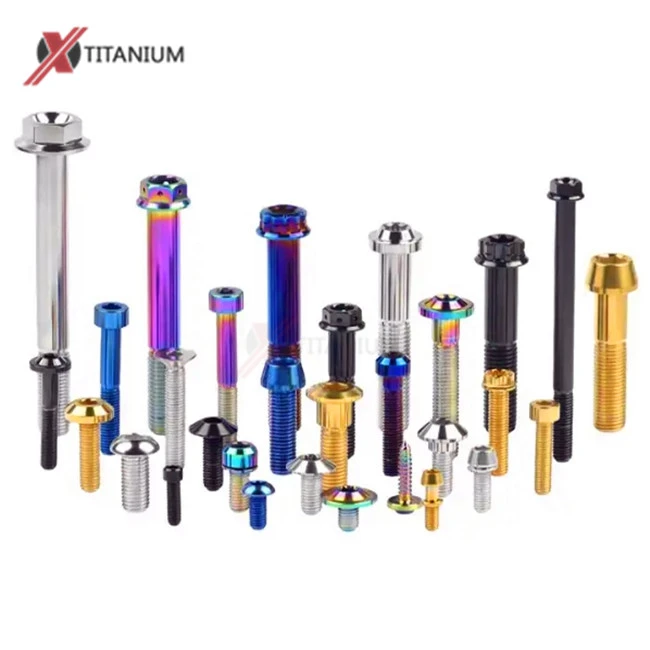
- When fleet operators and OEM procurement teams evaluate fastener upgrades, Gr5 titanium bolt kits for motorcycle applications consistently rise to the top. Manufactured from Ti-6Al-4V alloy, these kits deliver up to 45% weight reduction over steel while maintaining a tensile strength of approximately 1,000 MPa. For motorcycle brands selling full-bike bolt upgrade sets — covering everything from brake calipers to engine casings — the performance and margin advantages are substantial. This guide breaks down what makes Grade 5 titanium the rational choice for serious procurement decisions.
Understanding Gr5 Titanium Bolt Kits: Specifications and Applications
What Makes Ti-6Al-4V the Standard?
Grade 5 titanium, whose full name is Ti-6Al-4V, is an alpha-beta metal with 6% aluminum and 4% vanadium. Because of these ingredients, it has a yield strength of about 880 MPa and a density of only 4.43 g/cm³, which makes it about 40% lighter than similar steel bolts. These numbers are not just guesses. Chemical composition compliance is governed by ASTM B348 certification, and trustworthy manufacturers check each batch using spectrometry to make sure that lower-grade pure titanium is not used instead.
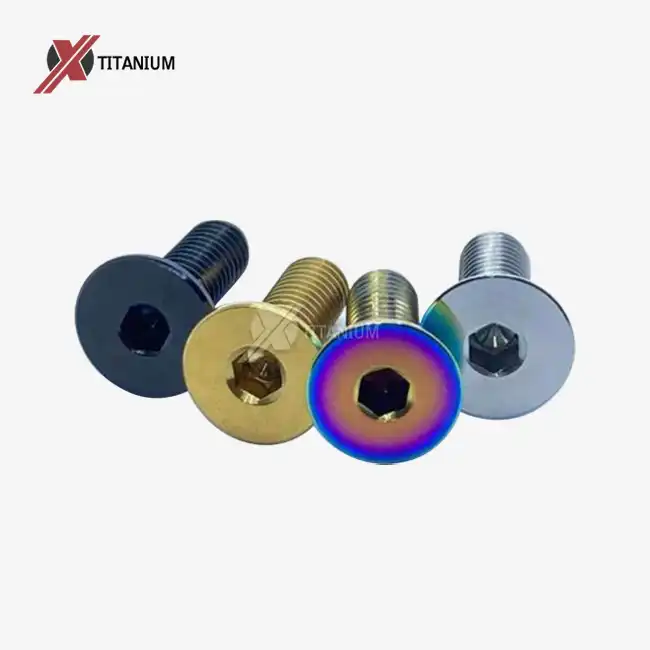
Thread sizes on sport, touring, and adventure bikes usually fall between M6 and M12. This covers almost all structural bolt positions. Surface treatments include grinding, anodizing, and nitriding. These can be done using PVD methods that keep the structure intact and come in colors like natural titanium, gold, blue, green, purple, black, and rainbow.
Gr5 vs. Gr9: Clarifying the Distinction
Grade 9 titanium (Ti-3Al-2.5V) is easier to machine and can be used in low-stress bodywork positions. It doesn't do as well as Grade 5 in high-load areas like brake caliper bolts, axle pinch bolts, suspension linkage, and exhaust manifold studs. For full-bike Gr5 titanium bolt kits for motorcycle sold to fans who want a full structural upgrade, Gr5 is the only standard that can be defended. When you mix grades in a kit, you lose the stability that picky buyers and their customers expect.
Performance Advantages of Gr5 Titanium Bolt Kits for Motorcycle Fleets
One problem that fleet operators who take care of many motorcycles in different climates have to deal with all the time is that standard steel hardware breaks down due to corrosion and fatigue. In marine and high-humidity areas, zinc-plated steel breaks down quickly, causing fasteners to seize up, expensive repairs, and unexpected downtime. Titanium's surface forms a passive oxide layer on its own, protecting it against chlorides, road salts, and acidic chemicals without the need for an extra coating. These features directly lower the maintenance needed for a fleet because important bolts stay loose and physically sound for years instead of seizing up during regular service.
Here are the main performance differences that should be taken into account when evaluating procurement:
- Weight reduction at unsprung and rotational mass points: Applying titanium fasteners at brake calipers, rotor mounts, and sprocket assemblies reduces unsprung weight — a measurable factor in suspension response. A full kit swap across a sport motorcycle can remove 400–600 grams from critical locations.
- Fatigue resistance through rolled thread manufacturing: Premium kits use rolled rather than cut threads, preserving the grain structure of the alloy. This process significantly extends fatigue life under cyclical loads, which matters in suspension and engine mounting applications where vibration is constant.
- Thermal stability in high-heat zones: Exhaust manifold studs and engine casing bolts made from Gr5 resist the thermal cycling that causes standard steel bolts to gall against aluminum blocks. This eliminates one of the most common causes of bolt failure during routine maintenance.
Thermal stability in areas with a lot of heat: Gr5 exhaust manifold studs and engine casing bolts don't break when heated and cooled over and over again, which happens with regular steel bolts and aluminum blocks. This gets rid of one of the main reasons why bolts break during regular servicing.
Cost-Effectiveness and Procurement Considerations for OEMs and Fleet Managers
When you buy Gr5 titanium bolt kits for motorcycle, titanium screws usually cost three to five times more than stainless steel ones. Lifecycle analysis, on the other hand, always chooses titanium when downtime, replacement regularity, and work costs are taken into account. A bolt that never breaks and lasts as long as the motorcycle does away with the need to replace it over and over again.
For OEM procurement teams, there are more things to think about than just unit price. Total procurement risk is affected by the supplier's certifications (ASTM B348 compliance, batch test documents), the stability of color across anodized lots, and the supplier's track record of making custom kits for specific vehicle types. A single color difference in a packaged kit, like one bolt that looks very different from the others, can lead to bad reviews that hurt the whole line of products. MOQ freedom is also important. Manufacturers and suppliers of reputable Gr5 titanium bolt kits can take initial orders of 50 to 100 kits per car type. This lets sellers see if there is a demand in the market before committing to bigger inventory positions. This arrangement works with the normal testing cycle for e-commerce without locking up too much cash.
Installation and Maintenance Guidance for Gr5 Titanium Bolt Kits
Critical Installation Protocol
Titanium can gall, which is a cold-welding reaction that happens when titanium threads rub against other metals or even against each other. Using an anti-seize compound is required, not optional. This risk is taken away by applying a copper or nickel-based anti-seize paste to the threads before fitting. Always use a torque wrench that has been properly adjusted. Gr5 titanium bolts can handle torque levels that are similar to 8.8 and 10.9 grade steel bolts, but it's best to check the manufacturer's rating sheet first.
Ongoing Maintenance Checks
For the first two cycles after installation of Gr5 titanium bolt kits for motorcycle, check the torque retention at regular service intervals. The elastic modulus of titanium is not the same as that of steel, and some bedding-in is normal. Under normal working conditions, these screws usually don't need any more torque adjustments after the initial proof time. Check for mechanical damage instead of corrosion. Surface discoloration on titanium does not mean it is breaking down like it does on steel.
Making the Right Choice: Why OEMs and Motorcycle Fleets Prefer Gr5 Titanium Bolt Kits?
There are three main reasons to buy full-bike titanium fastener kits: mechanical performance that lasts longer than the vehicle; corrosion resistance that removes the need for regular maintenance; and the higher price that a well-packaged, model-specific kit gets at retail. When the product is displayed correctly and all of its parts are present, motorcycle accessory brands that sell vehicle-specific upgrade kits regularly make 60–80% of their profits. These kits include front forks, brake calipers, engine cases, frame mounts, swingarms, and bodywork. People who buy a full upgrade almost never return it; instead, they tell their riding friends about it. Because of this, the quality of the kit is a direct cause of income growth, not just customer happiness.
New advances in titanium surface treatment, such as advanced nitriding methods that make the surface harder without adding weight, are allowing these kits to be used in OEM settings with higher stress levels. Purchasing teams that start working with suppliers now will be better prepared to use these new technologies when they become available to the public.
Conclusion
Gr5 titanium bolt kits for motorcycle are a good way to upgrade motorcycle fleets and OEM procurement operations from a technical and business point of view. Strength, resistance to rust, lighter weight, and the ability to change the color of the anodized coating all work together to meet practical and brand differentiation needs. When online stores are making model-specific lines of products, the kit format helps them make a lot of money and keep a lot of customers. Getting from a trusted, experienced maker is still the most important thing you can do to make sure quality is uniform at scale.
FAQ
Q1: Can Gr5 titanium bolts be torqued to OEM steel specifications?
A: Generally, yes. Gr5 titanium exhibits yield strength comparable to 8.8 and 10.9 grade steel. Always cross-reference the specific manufacturer's torque rating sheet and use a calibrated torque wrench.
Q2: Is anti-seize compound always necessary?
A: It is mandatory. Titanium is prone to galling when threaded against dissimilar metals. Apply a copper or nickel-based anti-seize paste to all threads before installation without exception.
Q3: How do I verify that a kit contains genuine Gr5 material?
A: Request batch certification documents showing ASTM B348 compliance. XRF analysis provides definitive verification. Gr5 is noticeably harder to machine than Grade 2, and a spark test produces bright white sparks — though documentation remains the only procurement-grade confirmation.
Q4: Can these bolts contact carbon fiber components safely?
A: Titanium is chemically compatible with carbon fiber. Contact with magnesium in the presence of moisture may cause galvanic corrosion; use an isolating washer or compound in those applications.
Partner with Chuanglian for Gr5 Titanium Bolt Kits — Custom Kits, Verified Quality
China's Chuanglian makes Gr5 titanium bolt kits for motorcycle brands and fleet owners all over the world. These kits can be fully customized by vehicle type, thread size, and anodized color. Our CNC-machined Ti-6Al-4V screws are made to meet ASTM B348 standards, and each order comes with batch paperwork. We are the best Gr5 titanium bolt kit provider for serious e-commerce brands because we have low minimum order quantities, constant color matching, and dedicated kit development support. To get a sample kit, email us at info@cltifastener.com or djy6580@aliyun.com.
References
1. ASM International — Titanium: A Technical Guide, 2nd Edition, 2000.
2. ASTM International — ASTM B348: Standard Specification for Titanium and Titanium Alloy Strip, Sheet, and Plate, 2019.
3. Boyer, R., Welsch, G., & Collings, E.W. — Materials Properties Handbook: Titanium Alloys, ASM International, 1994.
4. Journal of Materials Engineering and Performance — "Fatigue Behavior of Ti-6Al-4V Fasteners Under Cyclic Loading Conditions," ASM International, 2018.
5. Lutjering, G., & Williams, J.C. — Titanium, 2nd Edition, Springer, 2007.
6. SAE International Technical Paper — "Weight Reduction Strategies Using Titanium Alloy Fasteners in Motorsport Applications," SAE International, 2015.
Learn about our latest products and discounts through SMS or email