- English
- French
- German
- Portuguese
- Spanish
- Russian
- Japanese
- Korean
- Arabic
- Greek
- German
- Turkish
- Italian
- Danish
- Romanian
- Indonesian
- Czech
- Afrikaans
- Swedish
- Polish
- Basque
- Catalan
- Esperanto
- Hindi
- Lao
- Albanian
- Amharic
- Armenian
- Azerbaijani
- Belarusian
- Bengali
- Bosnian
- Bulgarian
- Cebuano
- Chichewa
- Corsican
- Croatian
- Dutch
- Estonian
- Filipino
- Finnish
- Frisian
- Galician
- Georgian
- Gujarati
- Haitian
- Hausa
- Hawaiian
- Hebrew
- Hmong
- Hungarian
- Icelandic
- Igbo
- Javanese
- Kannada
- Kazakh
- Khmer
- Kurdish
- Kyrgyz
- Latin
- Latvian
- Lithuanian
- Luxembou..
- Macedonian
- Malagasy
- Malay
- Malayalam
- Maltese
- Maori
- Marathi
- Mongolian
- Burmese
- Nepali
- Norwegian
- Pashto
- Persian
- Punjabi
- Serbian
- Sesotho
- Sinhala
- Slovak
- Slovenian
- Somali
- Samoan
- Scots Gaelic
- Shona
- Sindhi
- Sundanese
- Swahili
- Tajik
- Tamil
- Telugu
- Thai
- Ukrainian
- Urdu
- Uzbek
- Vietnamese
- Welsh
- Xhosa
- Yiddish
- Yoruba
- Zulu
Gr5 Titanium Double Banjo Bolts Installation Guide for Brake Lines
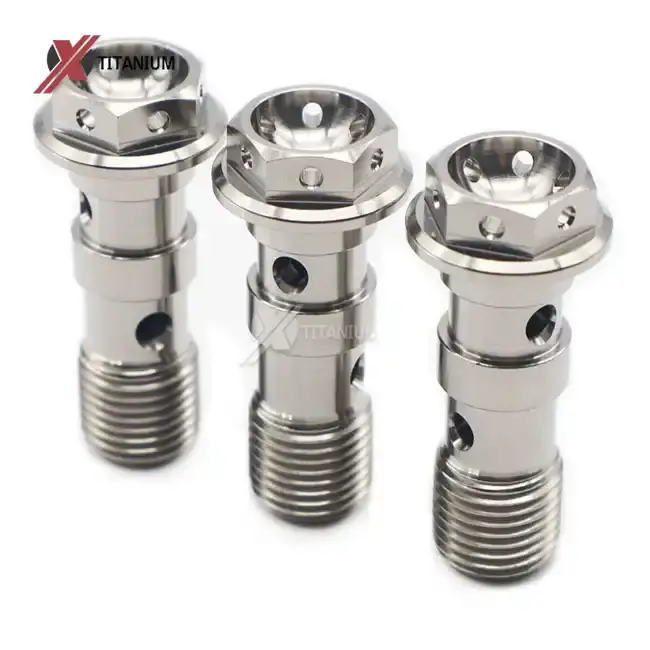
Installing titanium banjo bolts correctly is one of those details that separates a reliable brake system from a dangerous one. Gr5 titanium double banjo bolts — manufactured from Ti-6Al-4V alloy — are precision fasteners engineered for hydraulic brake line connections where two separate lines meet a single caliper port. Their hollow core and cross-drilled oil passages allow simultaneous dual-line fluid flow, while their 950–1000 MPa tensile strength and 45% weight advantage over steel make them the go-to upgrade for serious motorcycle brake builds. This guide walks you through everything: material fundamentals, preparation, installation steps, material comparisons, and procurement strategy.
Understanding Gr5 Titanium Double Banjo Bolts
What Makes Ti-6Al-4V the Right Alloy Here?
About 90% of Ti-6Al-4V (Grade 5) is titanium, 6% is aluminum, and 4% is vanadium. The maximum tensile strength of this mixture is 950–1000 MPa, which is higher than Grade 316 stainless steel. It also has a density of only 4.43 g/cm³. The alloy creates an oxide layer that heals itself and is resistant to brake fluid (DOT 3, 4, and 5.1), road salt, and temperatures up to 400°C. This temperature limit is very important for motorbike brake systems that work with carbon or steel wheels.
Technical Specifications at a Glance
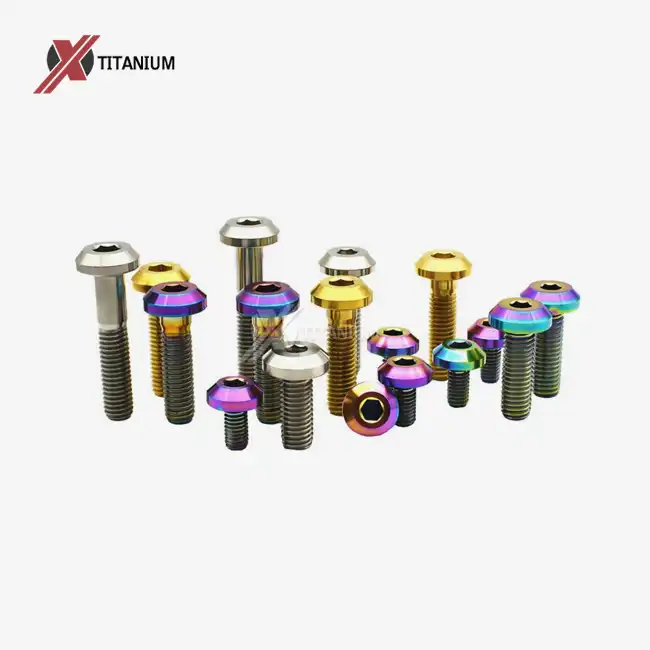
Chuanglian's double banjo bolts are CNC-machined to very precise measurements, and the sealing surfaces are ground to be ≤0.02mm flat, which is very important for a hydraulic coupling with no leaks. Thread sizes available are M10×1.0 and M10×1.25, which are the two most popular motorcycle caliper sizes. Lengths can be changed from 10mm to 100mm. To keep hydraulics from getting stuck, the inside of cross-drill holes are cleaned out and their flow is checked. Titanium can be polished to a natural finish, colored anodized (gold, blue, green, purple, black, rainbow), or nitrided to make the surface harder.
These Gr5 titanium double banjo bolts can be used for motorcycle brakes with two disks, racing master cylinder junctions, marine hydraulic lines, and lightweight aircraft fluid distribution. They can be used anywhere that needs to be resistant to corrosion, light, and reliable hydraulics.
Pre-Installation Preparation for Titanium Banjo Bolts
Methodical planning is the first step to a successful installation. Most of the time, brake line connections leak after the first heat cycle because this step is rushed.
Before you start, get the following:
- Calibrated torque wrench set to the manufacturer's specification (typically 15–25 Nm depending on thread pitch; always confirm with your bolt supplier).
- Fresh copper or aluminum crush washers — never reuse old washers, as deformed sealing faces are the leading cause of post-installation leaks.
- Anti-seize compound formulated for titanium threads. Titanium is susceptible to galling against metal surfaces; a quality anti-seize or PVD/DLC-coated bolt eliminates cold-welding risk entirely.
- Thread gauge (Go/No-Go 6g) to verify thread compatibility with the caliper or master cylinder port before assembly.
- Lint-free rags and brake cleaner to purge contaminants from the port and banjo fittings.
Step-by-Step Installation Process
Removing the Old Bolt Without Line Damage
Put a clean drain tray under the caliper. Loosen the existing banjo bolt slowly, then stop for a moment to let any remaining brake fluid pressure balance. Then, take the bolt out completely. When taking off the brake line, don't jerk it, because steel braided lines don't handle angular stress well at the banjo fitting joint.
Assembling the Double Banjo Configuration
Once you have the first banjo fitting on top of the first crush washer on the bolt shank, slide it into place. First put in the second banjo fitting, then the second crush washer, and finally the last crush washer. The usual way to put things together is washer → banjo 1 → washer → banjo 2 → washer. Before the bolt is threaded into the port, both banjo fittings must be able to freely turn to line up with their own line routing. Only put a thin, even layer of anti-seize on the thread flanks; don't touch the sealing surfaces at all. Make sure there is no cross-threading resistance by hand-threading the bolt in until it is finger-tight. To get the unit to the required torque value, use your torque wrench in a single smooth motion. Do not pulse or ratchet, as this will cause the crush washers to be distorted differently.
Post-Installation Leak Verification
Follow the manufacturer's instructions for Gr5 titanium double banjo bolts to fully bleed the brake system. Hold firm lever pressure for 60 seconds and look at the banjo junction visually after the reservoir has been closed and the system has been pressurized. The seal washers shouldn't have any wet film or fluid leaking around them. Dry the spot with a paper towel and do the pressure hold again. Do a road test with slow stops at the beginning, and then check again after the first heat cycle.
Comparing Gr5 Titanium with Steel and Aluminum Alternatives
Choices about materials have direct effects on the costs over the duration. Here is a review of the three most popular types of banjo bolt materials based on facts:
- Gr5 Titanium vs. Stainless Steel: Ti-6Al-4V offers comparable tensile strength to Grade 316 stainless while weighing 43% less. Stainless corrodes in chloride-heavy environments (coastal riding, track use with chemical tire sealants); titanium's passive oxide film is self-repairing and chemically inert to brake fluids.
- Gr5 Titanium vs. Aluminum: Aluminum banjo bolts (common in lightweight aftermarket kits) carry risk of thread fatigue under repeated torque cycling and lack the thermal stability for high-performance braking. Gr5 titanium retains its mechanical properties at temperatures where aluminum softens measurably.
- Gr5 vs. Gr2 Titanium: Grade 2 (commercially pure) titanium has a UTS of approximately 340 MPa — roughly one-third of Gr5. It is entirely unsuitable for hydraulic brake applications. Any supplier offering "titanium" banjo bolts without specifying Ti-6Al-4V should be queried directly with a PMI (positive material identification) test request.
The more expensive Gr5 titanium gear costs more at first, but it pays for itself over three to five years by not needing to be refinished for rust and not needing to be replaced as often. It also weighs less, which directly improves the unsprung mass dynamics of performance builds.
Procurement Guide for Gr5 Titanium Double Banjo Bolts
Finding safety-critical brake hardware takes more research than finding regular fasteners. The following factors regularly separate trustworthy makers of Gr5 titanium double banjo bolts from those that just sell generic ones. Any first sample order should come with a verified chemical analysis (PMI spectrographic testing). This proves that the alloy is made of Ti-6Al-4V and rules out using a lower-grade alloy instead. It is necessary to have sealing surface roughness certificates (Ra ≤ 0.4 µm) and measurement inspection records for cross-drill bore width. Reliable manufacturers are happy to give these as standard paperwork before shipping.
Customization is a real way to stand out in the procurement process. Different types of motorcycle brake kits often need thread pitches that aren't standard, bleed valves that are built in, or bore diameters that are specific to the purpose. If a maker has their own CNC machines and skilled application engineers, they can meet these needs without having to wait longer for parts. Professional brake hardware brands usually make decisions every six to eight weeks. In the first and second weeks, samples are made and their sizes are checked. In weeks three and four, hydraulic pressure testing (10–15 MPa hold) takes place, and then small-batch trial production (500–1,000 pieces with full inspection) happens before the production goes into full swing.
Conclusion
Gr5 titanium double banjo bolts are not just nice to look at; they are actually better for hydraulic brake systems. Their better sealing, resistance to rust, and lighter weight all deal with the three most common ways that steel gear fails in tough riding and race conditions. When installed correctly, with new crush washers, the right anti-seize, and the right amount of force, the material's efficiency benefits will last for a long time. For sourcing teams making a line of titanium brake gear, the two requirements that suppliers must meet are proof of the material makeup and sealing geometry.
FAQ
Q1: What torque value should I use for M10 titanium banjo bolts?
A: Most M10×1.0 and M10×1.25 titanium banjo bolts require 15–25 Nm, depending on the caliper manufacturer's specification. Always apply torque using a wet torque value with anti-seize applied to the threads. Do not extrapolate high-tensile steel torque tables to titanium without manufacturer confirmation.
Q2: Is galling a real concern with titanium brake bolts?
A: Yes. Titanium galls against metal threads under pressure and rotation. Using an anti-seize compound rated for titanium, or selecting bolts with PVD or nitrided surface treatment, eliminates this risk reliably.
Q3: Can these bolts handle racing brake temperatures?
A: Ti-6Al-4V retains structural integrity up to 400°C. Standard brake fluid (DOT 4) reaches its dry boiling point at 230°C. The bolt is never the thermal limiting factor.
Q4: How do I confirm I'm receiving genuine Gr5 material?
A: Request PMI (positive material identification) spectrographic test reports with your sample order. Reputable suppliers provide these as standard documentation.
Q5: Are custom thread sizes and bore diameters available?
A: Yes. Chuanglian produces custom thread pitches, lengths (10–100mm), and internal oil passage diameters to match specific brake line fitting standards. Contact the engineering team with your technical drawing for a rapid assessment.
Partner with Chuanglian for Your Titanium Brake Hardware Needs
Chuanglian gives brake line names in the US and around the world Gr5 titanium double banjo bolts that are fully CNC precise, have recorded sealing tolerances, and can be made to fit any unique needs. We are a verified producer of Gr5 titanium double banjo bolts with more than ten years of experience in precise machining. We can help with sample proof, small-batch trials, and large-scale production. Get in touch with our tech support team at info@cltifastener.com or djy6580@aliyun.com.
References
1. ASM International. Titanium: A Technical Guide. 2nd ed., 2000.
2. Society of Automotive Engineers. SAE J1401: Road Vehicle — Hydraulic Brake Hose Assemblies. SAE International, 2021.
3. Boyer, R., Welsch, G., & Collings, E. W. Materials Properties Handbook: Titanium Alloys. ASM International, 1994.
4. Motorcyclist Magazine. "Brake Line Upgrades: Steel vs. Titanium Hardware." 2022.
5. ASTM International. ASTM B348: Standard Specification for Titanium and Titanium Alloy Bars and Billets. ASTM, 2021.
6. Donachie, M. J. Titanium: A Technical Guide. ASM International, 2000.
Learn about our latest products and discounts through SMS or email