- English
- French
- German
- Portuguese
- Spanish
- Russian
- Japanese
- Korean
- Arabic
- Greek
- German
- Turkish
- Italian
- Danish
- Romanian
- Indonesian
- Czech
- Afrikaans
- Swedish
- Polish
- Basque
- Catalan
- Esperanto
- Hindi
- Lao
- Albanian
- Amharic
- Armenian
- Azerbaijani
- Belarusian
- Bengali
- Bosnian
- Bulgarian
- Cebuano
- Chichewa
- Corsican
- Croatian
- Dutch
- Estonian
- Filipino
- Finnish
- Frisian
- Galician
- Georgian
- Gujarati
- Haitian
- Hausa
- Hawaiian
- Hebrew
- Hmong
- Hungarian
- Icelandic
- Igbo
- Javanese
- Kannada
- Kazakh
- Khmer
- Kurdish
- Kyrgyz
- Latin
- Latvian
- Lithuanian
- Luxembou..
- Macedonian
- Malagasy
- Malay
- Malayalam
- Maltese
- Maori
- Marathi
- Mongolian
- Burmese
- Nepali
- Norwegian
- Pashto
- Persian
- Punjabi
- Serbian
- Sesotho
- Sinhala
- Slovak
- Slovenian
- Somali
- Samoan
- Scots Gaelic
- Shona
- Sindhi
- Sundanese
- Swahili
- Tajik
- Tamil
- Telugu
- Thai
- Ukrainian
- Urdu
- Uzbek
- Vietnamese
- Welsh
- Xhosa
- Yiddish
- Yoruba
- Zulu
Best Gr5 Titanium Flat Washers for Aerospace & Racing
Gr5 Titanium Flat Washers are the best for aircraft and racing uses where accuracy is important and failure is not a choice. These washers are made from a Ti-6Al-4V alloy, which gives them a great strength-to-weight ratio, excellent corrosion protection, and dependability in harsh circumstances. Engineers have chosen titanium washers to solve important problems like keeping parts from breaking in places with a lot of stress, making assemblies lighter without losing their structural integrity, and getting rid of galvanic corrosion which happens in mixed-metal assemblies. It tells procurement managers, quality engineers, and project leaders everything they need to know to rate, define, and find these mission-critical parts.
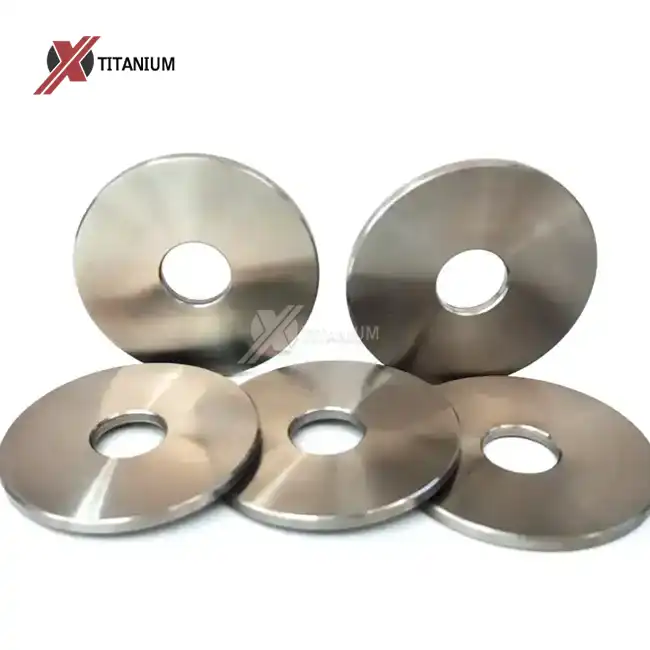
Understanding Gr5 Titanium Flat Washers: Properties and Benefits
Why Ti-6Al-4V Outperforms Other Titanium Grades?
The tensile strength of the Ti-6Al-4V alloy is between 895 and 1000 MPa, and the yield strength is around 828 MPa. This is a lot higher than the strength of widely pure Grade 2 titanium. This mechanical advantage keeps the washer from deforming in the 5–15 Nm pressure ranges that are common in aircraft fastening systems. It has an alpha-beta microstructure that stays stable in size even when heated and cooled many times, like in aircraft engine chambers and race exhaust systems. This is because the aluminum and vanadium provide heat resistance.
Core Material Advantages
Because they have a density of 4.43 g/cm³, Gr5 Titanium Flat Washers are about 45% lighter than stainless steel options while still being able to distribute load similar. Titanium oxide (TiO₂) forms an inactive layer on its own, which makes it more resistant to corrosion than 300-series stainless steel in chloride-rich environments, like those caused by saltwater contact or chemicals used to melt snow on the roads. We have proof that marine-grade stainless steel washers broke within 18 months, but titanium counterparts didn't show any signs of wear after five years of the same exposure.
Thermal and Chemical Stability
There are differences in how much carbon fiber materials, metal structural parts, and titanium fasteners expand and contract when heated or cooled. Gr5 washers can handle these changes without losing their binding power or causing stress to build up. The material doesn't react chemically with hydraulic fluids, jet fuels, or industrial cleaning solvents. This keeps it from breaking down chemically or hydrogenally, which can happen to steel bolts in the same situations.
These benefits lead to measured performance gains, such as shorter maintenance intervals, the elimination of the need to change fasteners during planned checks, and higher safety margins in systems that are under a lot of stress. Racing teams say that the power stays the same throughout the season, so they don't have to make any changes in the middle of races, which wastes important track time.
Comparing Gr5 Titanium Flat Washers with Alternative Materials
Titanium Versus Stainless Steel
Even though 316 stainless steel screws are about 40–50% less expensive than Gr5 Titanium Flat Washers, the total cost of ownership changes a lot when you consider how often they need to be replaced and how much heavier they are. Titanium washers weigh 0.4 to 0.5 grams, while normal M6 steel washers weigh 0.8 to 1 gram. If all the fasteners in a typical racing motorcycle assembly are replaced, the weight saves add up to 50 to 80 grams. Stainless steel breaks down quickly in high-chloride settings because it is prone to crevice rust. This is especially a problem in brake caliper mountings where heat speeds up the breakdown.
Aluminum and Copper Alternatives
Aluminum washers are lighter than steel ones, but they aren't strong enough for high-torque uses. Because aluminum tends to move under long-term load, joints become loose, which is bad for their stability. Copper is a good conductor of heat, but it oxidizes quickly and isn't very good at holding its shape. Neither material is strong enough, doesn't rust, and stays stable at high temperatures to meet the requirements for aircraft approval.
Grade Comparison Within Titanium Family
Grade 2 titanium is easier to shape than Grade 1, but its tensile strength is only 345 MPa, which is too low for structural use. Palladium is added to Grade 7 to make it more resistant to rust, but it's not needed in some situations because Gr5's natural passivation is enough. Grade 23 (Ti-6Al-4V ELI) has slightly better fracture toughness because it has fewer interstitial elements, but this standard is mostly useful for medical devices and not for aircraft bolts. Gr5 has the best balance of performance and cost for tough industry uses.
Comprehensive Guide to Specifications, Dimensions, and Measurement
Industry Standards and Certifications
Gr5 Titanium Flat Washers meet dimensions set by DIN 125, ISO 7089, and AS568, and their materials must meet the requirements of AMS 4928 (for sheets and strips) or ASTM B348 (for bars and billets). These standards should be clearly mentioned in procurement documents, and test results for materials should include chemical makeup information from X-ray fluorescence spectroscopy or optical emission spectrometry.
Critical Dimensions and Tolerances
Correct measuring methods make sure that the inner circle clearance is enough to fit bolt shanks without binding. For M6 applications, this clearance is usually between 6.2 and 6.4 mm, with a range of ±0.1 mm. The outer diameter needs to have enough bearing surface area to keep other parts from moving. Depending on the load, the outer diameter usually ranges from 12mm to 18mm. Thickness limits of ±0.05mm make sure that the clamping force is spread out evenly and stop uneven compression that could damage carbon fiber or composite surfaces.
For accurate measurements, you need micrometers that are calibrated and have a precision of 0.01 mm. The measurements must also be checked at controlled temperatures (20°C ±2°C) to get rid of mistakes caused by thermal expansion. For important tasks, surface smoothness shouldn't be less than 0.05 mm off across the bearing surface. This can be checked with optical comparators or coordinate measuring tools.
Manufacturing Process Quality Indicators
Instead of being made from pressed sheets, premium washers are made from forged or rolled bar stock, which gives them better grain structure and mechanical qualities. CNC machining guarantees consistent dimensions that pressing can't, which is especially important for keeping the inner and outer sizes in the same place. The alpha-beta microstructure is improved by heat treatment to the solution-annealed and aged (STA) state. This can be seen by metallography or hardness tests, which gives a result of 30-35 HRC on the Rockwell C scale.
Surface finish standards usually call for 1.6 μm Ra or better to avoid surface flaws that could cause sensitive substrates to crack. Burrs that could damage carbon fiber laminates during assembly can be avoided by breaking or chamfering the edges. Visual inspection is complemented by touch verification or automatic optical inspection systems.
Procurement Considerations: How to Source the Best Gr5 Titanium Flat Washers?
Supplier Qualification Criteria
Gr5 Titanium Flat Washers suppliers you can trust have quality management systems that are approved to AS9100 (aerospace) or ISO 9001 standards. This shows that they have a method for controlling the process and keeping track of it. As part of verification, the certification scope should be looked over, the production capabilities should be evaluated through facility checks whenever possible, and existing relationships with aerospace OEMs or Tier 1 suppliers should be confirmed. Material traceability paperwork needs to link each batch to mill certifications that prove the alloy's make-up and mechanical qualities.
Established providers offer expert support that goes beyond just fulfilling orders. For example, they can help with choosing materials through application engineering, finite element analysis for better load distribution, and failure analysis when problems happen in the field. This partnership method works especially well when making a new product, since design specs are always changing and material swaps need to be evaluated quickly.
Pricing and Lead Time Management
Titanium washer prices are based on the cost of the raw materials, which change based on the supply of titanium sponge around the world. For Gr5 mill goods, these costs usually range from USD 45 to USD 75 per kilogram. The price of a component depends on its size, number, and the level of accuracy that is needed. For example, small-batch custom orders cost 30–50% more than regular catalog items. For yearly contracts with more than 10,000 pieces, volume agreements let you discuss prices that are close to the cost of raw materials.
Lead times for standard sizes from approved sources are usually between 4 and 6 weeks for orders of less than 1,000 pieces. For custom sizes that need new tools, the time frame goes up to 8 to 12 weeks. When strategic buyers use just-in-time shipping for standard hardware and keep a safety stock for important uses, they balance the costs of keeping inventory with the risks of production interruption. For pressing needs, you can still get expedited processing, but fees may add 25–40% to the normal price.
Global Logistics and Supply Chain Reliability
Suppliers that sell to foreign markets keep distribution networks that allow deliveries to be made in North America within 5–7 business days and around the world within 2–3 weeks through established freight forwarders who know how to handle precision parts. Protecting fragile surface finishes from damage during shipping is an important part of packaging. Lot-coded labels that can stand up to shipping and storage conditions are also needed to keep track of items.
For custom orders, it's best if providers let you choose the minimum order quantity based on the needs of the project, rather than setting random volume limits. This adaptability is very important for making prototypes, providing service support, and doing small amounts of production, since equipment amortization would make titanium too expensive to use otherwise.
Applications and Performance Verification of Gr5 Titanium Washers
Aerospace Assembly Applications
Gr5 Titanium Flat Washers are widely used by aircraft makers in airframe structures to reduce weight, which directly improves fuel economy and payload capacity. Titanium's wear resistance makes it useful for landing gear parts that are loaded and unloaded many times, and its thermal stability makes it useful for engine pylon connections that are used in high-temperature areas. Titanium fasteners are used to connect cockpit instruments and electronics so that electromagnetic interference problems caused by ferromagnetic materials don't happen.
Case studies from commercial flying show that titanium fastener assemblies can last more than 20,000 flight hours without showing any signs of wear. For comparison, steel versions need to be replaced every 8,000 to 12,000 hours. This longer service life cuts down on repair breaks and part replacement costs, which more than makes up for the higher cost of the materials at the start.
High-Performance Racing Applications
Motorsports teams make sure that every part is as light as possible and works well in harsh circumstances. Gr5 washers keep brake pads in place in places where temperatures are close to 300°C and vibration rates are higher than 200 Hz. This is an environment that would wear down steel gear in just one race season. When combined with aluminum rockers and steel bearings, titanium's resistance to galvanic corrosion makes suspension linkages work better. This means that gear doesn't get stuck, which makes normal maintenance easier.
Professional racing teams report measurable gains in lap times due to weight savings from switching full fastener systems to titanium. On motorcycle platforms, weight savings add up to 500–800 grams, and on GT racing cars, they add up to 2–3 kilos. Not only does stable torque retention save weight, it also stops mid-race changes in the shape of the suspension that make it less predictable how it will handle.
Laboratory Performance Validation
Standardized corrosion tests according to ASTM G48 (ferric chloride pitting) and ASTM B117 (salt spray) show that titanium is more resistant than 316 stainless steel. After 1,000 hours of contact, there is no measurable rust, while 316 stainless steel shows surface pitting within 200 hours. Testing at temperatures ranging from -40°C to 400°C shows that the dimensions stay the same within 0.02mm for 500 passes, proving that the product is reliable in high-temperature settings.
Testing with mechanical loads shows that washers of the right size spread compressive forces evenly across bearing surfaces. This stops stress clusters that lead to bolt holes stretching in aluminum structures and delamination in carbon fiber laminates. When engineering teams choose titanium parts for mission-critical tasks where failure could endanger people's safety or hurt their ability to compete, they can be sure that the parts will work as expected.
Conclusion
When used in aircraft and racing, Gr5 Titanium Flat Washers are a smart investment in terms of efficiency, dependability, and long-term value. The material's high strength-to-weight ratio, resistance to corrosion, and thermal stability solve important technical problems while lowering lifetime costs by allowing longer periods of service. For procurement to go well, companies need to work with qualified suppliers that have strict quality control systems, make it easy to track down materials, and offer professional help for the best application engineering. This guide explains the specifications, measurement protocols, and supplier evaluation criteria that are needed to make smart choices that balance performance needs with business needs. This way, you can be sure that your assemblies meet the high standards needed for safety-critical aerospace applications and competitive racing settings.
FAQ
Q1: How Do Titanium Washers Enhance Aerospace Safety?
A: Gr5 Titanium Flat Washers' high strength-to-weight ratio lets engineers lower the total weight of an airplane without sacrificing the structural safety gaps that government agencies need. The fatigue strength of the material stops cracks from starting at fastener holes, which is a typical way for metal structures to fail. Corrosion resistance gets rid of damage that isn't obvious and can't be seen, and thermal stability keeps joints together in all the different temperatures that are found in flight.
Q2: Can Specifications Be Changed to Fit Different Uses?
A: To meet the needs of engineers, manufacturers can make parts with special sizes, different thicknesses, and different surface processes, such as anodizing or passivation. For custom sales, engineering sketches are usually needed to show the required tolerances, surface finish, and material approval. Lead times are longer than usual for standard goods because of the time it takes to prepare the tools, but established sources are still flexible for small amounts and development projects.
Q3: What Lead Times Should Procurement Teams Expect?
A: For orders of less than 1,000 pieces, standard catalog items from qualifying sellers ship within 4 to 6 weeks. Custom specs that need new tools make the lead time 8 to 12 weeks. For pressing needs, expedited handling can be used with a turnaround time of two to three weeks, but there are rush fees. Strategic buyers set up blanket purchase orders with planned releases to make sure that the supply of materials matches up with production plans and that the costs of keeping stockpiles low are kept to a minimum.
Partner with Chuanglian for Certified Gr5 Titanium Flat Washers
Baoji Chuanglian New Metal Material Co., Ltd. has been making Gr5 Titanium Flat Washers for over ten years and can help aerospace and racing teams find trusted providers of these components. In Baoji City, which is known around the world as the "City of Titanium," our plant has strict quality control methods that make sure every washer meets international standards like ISO and ASTM B348. Our twelve CNC machining centers allow for precise manufacturing with errors measured in microns. Our material testing laboratory confirms the chemical makeup and mechanical properties of all materials so that they can be fully tracked.
We work with aerospace companies, racing teams, and high-performance engineering firms in North America and around the world. Our minimum order amounts are open enough to meet the needs of both prototype development and large-scale production. During the whole process of choosing a material, our expert team helps you with application engineering to make sure you get the best specs for your unique loading conditions and environmental exposures. You can email our purchasing agents at info@cltifastener.com or djy6580@aliyun.com to talk about your Gr5 titanium flat washer needs, ask for material certifications, or get quotes for unique sizes that are made to your engineering specs.
References
1. Peters, M. and Leyens, C. (2003). Titanium and Titanium Alloys: Fundamentals and Applications. Wiley-VCH Verlag GmbH & Co.
2. Donachie, M.J. (2000). Titanium: A Technical Guide, 2nd Edition. ASM International Materials Park, Ohio.
3. Boyer, R., Welsch, G., and Collings, E.W. (1994). Materials Properties Handbook: Titanium Alloys. ASM International.
4. Lutjering, G. and Williams, J.C. (2007). Titanium: Engineering Materials and Processes, 2nd Edition. Springer-Verlag Berlin Heidelberg.
5. American Society for Testing and Materials (2021). ASTM B348-21: Standard Specification for Titanium and Titanium Alloy Bars and Billets. ASTM International.
6. SAE International (2019). AMS 4928P: Titanium Alloy, Sheet, Strip, and Plate 6Al-4V Annealed. SAE Aerospace Material Specification.
Learn about our latest products and discounts through SMS or email