- English
- French
- German
- Portuguese
- Spanish
- Russian
- Japanese
- Korean
- Arabic
- Greek
- German
- Turkish
- Italian
- Danish
- Romanian
- Indonesian
- Czech
- Afrikaans
- Swedish
- Polish
- Basque
- Catalan
- Esperanto
- Hindi
- Lao
- Albanian
- Amharic
- Armenian
- Azerbaijani
- Belarusian
- Bengali
- Bosnian
- Bulgarian
- Cebuano
- Chichewa
- Corsican
- Croatian
- Dutch
- Estonian
- Filipino
- Finnish
- Frisian
- Galician
- Georgian
- Gujarati
- Haitian
- Hausa
- Hawaiian
- Hebrew
- Hmong
- Hungarian
- Icelandic
- Igbo
- Javanese
- Kannada
- Kazakh
- Khmer
- Kurdish
- Kyrgyz
- Latin
- Latvian
- Lithuanian
- Luxembou..
- Macedonian
- Malagasy
- Malay
- Malayalam
- Maltese
- Maori
- Marathi
- Mongolian
- Burmese
- Nepali
- Norwegian
- Pashto
- Persian
- Punjabi
- Serbian
- Sesotho
- Sinhala
- Slovak
- Slovenian
- Somali
- Samoan
- Scots Gaelic
- Shona
- Sindhi
- Sundanese
- Swahili
- Tajik
- Tamil
- Telugu
- Thai
- Ukrainian
- Urdu
- Uzbek
- Vietnamese
- Welsh
- Xhosa
- Yiddish
- Yoruba
- Zulu
Titanium Forging vs Casting: Key Differences Explained
Picking between titanium forgings and molds when making high-performance parts will directly impact how stable the product is, how well it stays together, and how much it costs to run in the long term. To make titanium forgings, controlled compression forces are applied to hot titanium billets. The billets change shape and align the grain structures inside them with the part's shape. This method gets rid of pores and raises the resistance to wear, which are important traits for medical implants, tools used underground, and engine parts. For casting, on the other hand, frames are filled with melted titanium. This gives you more shape options, but it often means less exact accuracy. If buying teams know about these differences, they can match production methods with performance and quality standards.
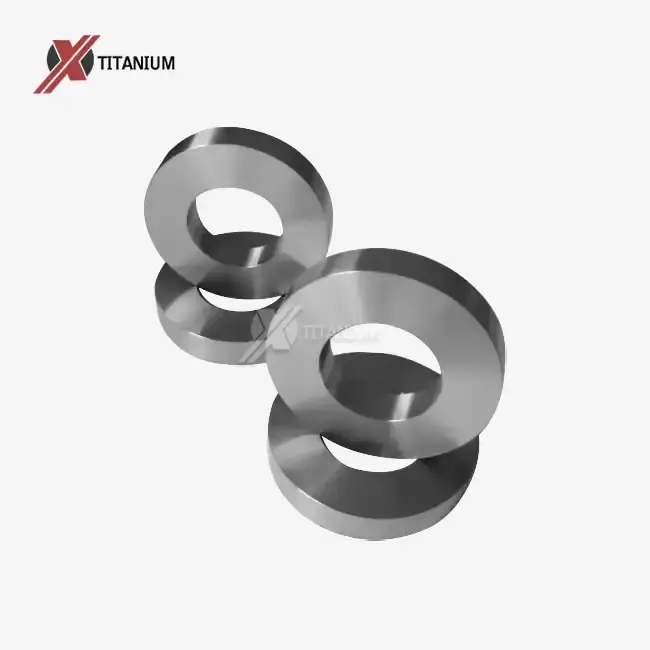
What Are Titanium Forgings and Castings?
Defining Titanium Forgings
titanium forgings are very strong parts that are made by putting a lot of pressure on titanium alloys, usually Ti-6Al-4V or commercially pure (CP) titanium grades. First, the raw material is heated to a temperature close to or above its beta transus temperature. Next, tools hammer, press, or roll it. The internal grain flow of the metal is lined up with the shape of the finished part when it is stretched. This makes the part strong enough to handle the loads it will face in service.
Though, forging fixes small holes and makes the base stronger, which makes the metal last longer and be harder to break. The process fixes some of the most important issues in applications where safety is very important. For example, it gets rid of the metallurgical porosity that is common in cast parts, makes them stronger against cycle loads, and makes the best use of materials by making near-net-shapes. This means that less expensive titanium feedstock is wasted during cutting.
Understanding Titanium Casting
It takes about 1,668°C of pure titanium to melt the metal so that it can be made. The metal is then put into molds made of clay or graphite that are shaped to look like the metal. Because the metal cools inside the mold, it forms complicated shapes that would be hard to make from any other material. There are some issues with this method, but it is great for making parts with deep holes, thin walls, or complicated forms. When something solidifies, pores can form when gases that were dissolved escape or the material shrinks, creating small holes that collect stress.
Also, when parts are cooled, the grain structures become harder than when the parts are formed. In other words, the parts are weaker in tension and are more likely to crack and spread. Titanium reacts heavily with air when it is very hot, which makes things even more complicated. Vacuum or neutral environment casting is needed to keep the material from getting messed up, which would hurt its quality.
Key Application Environments
The place where the part will be used needs to match the way it was made. When used in airplanes, rotor discs and landing gear parts have to deal with high-cycle wear from being stressed over and over again, temperature changes of hundreds of degrees, and safety rules that say they can't just break. It's important that the cast parts have a fine grain structure and good forward and backward strength in this case. The problems that come up when oil and gas tasks are done offshore are different.
For many years, underwater equipment has had to stay strong even though it is exposed to high-pressure, acidic seawater. Both crevice corrosion and stress corrosion cracks can be stopped better with forged titanium stress joints and upper parts than with cast ones. Companies that make medical implants care a lot about biocompatibility and making sure their products don't have any flaws inside. This is because even small flaws can cause implants to fail inside the body. When something is forged, the properties of all the pieces are made the same, and any holes that could let germs grow or cause wear cracks when the piece is put through regular physiological loads are filled.
Titanium Forging vs Casting: Process and Quality Differences
Forging Process Parameters
There are a lot of things that you need to be able to precisely control in order to make titanium forgings. The most important thing is to control the temperature. Forging below the beta transus (the temperature at which titanium's crystal structure changes) keeps a two-phase lattice that makes the metal strong and flexible at the same time. If you forge above this point, the fracture hardness will go up, but the tensile qualities may go down. This is how fast force is applied. The shift rate changes both the fineness of the grains and the spread of internal stresses.
That stuff could break if it moves too fast, and it won't be warm everywhere if it moves too slowly. Heat the dies up first to keep the flow of the material even and avoid temperature shock. How well the grain structure is cleaned depends on how many passes are made through the forge. With open-die forging, the metal can easily move between flat or shaped dies. This makes it easy to make bigger rings or blocks. When closed-die forging, the metal is pushed into a shaped hole. This lets you make forms that are more complicated and fit together more closely, but it costs more and needs a lot of press force.
Casting Process Challenges
Some places in the world are the only ones that have the right tools and skills to make titanium. So that oxygen doesn't get into the metal and make an alpha case that is easy to break, it needs to be melted in a vacuum or under inert gas. In this case, chemical grinding is needed to get rid of the oxygen-rich top layer. The walls should be thick enough to fill the mold fully. The gates should be set up properly to control the flow of metal, and the steps should be placed so that the metal can shrink as it hardens.
When different parts of the casting cool at different rates, their features change in ways that can make the structure weaker. Layers that cool quickly may close up holes, while layers that cool slowly can make the grains bigger. When it comes to investment casting, the lost-wax method gives the most exact measurements. However, it has a lot of steps that can introduce errors, such as making a wax pattern, building a clay shell, burning out the pattern, casting, and taking off the shell. A lot of non-destructive tests, like X-rays and ultrasounds, are done on things that are made before they can be used to make sure they are safe on the inside.
Comparative Mechanical Performance
To find out how long and how reliable a part will work, you can compare the qualities of forged and cast titanium. The tensile strength of forged Ti-6Al-4V is usually 130–140 ksi, and the stretch value is 10–15%. This proves that it is strong enough and bendy enough not to break quickly. Cast shapes made of the same metal might only have a tensile strength of 110–120 ksi and not be able to stretch as much. This makes them more likely to break in a weak way. When it comes to wear resistance, there is an even bigger difference.
Parts that are forged can handle millions of stress cycles at loads that would break parts that are cast in just thousands of cycles. This is because the forged material has a more even grain structure and no holes inside, so there aren't any small stress points where cracks can form from wear. About 30–40% more fracture toughness is found in forgings than in casts. Fracture toughness is a material's ability to stop cracks from growing after a flaw has been found. Standards for airplanes say that forged parts must be used for major load-bearing structures, even though casting might be cheaper for less important tasks.
Advantages of Titanium Forgings Over Castings
Superior Structural Integrity
The best thing about titanium forgings is that they don't have any flaws inside that would make parts less reliable. Some cast parts are weak because they have holes in them that can cause stress to build up and cause cracks to form when the parts are loaded and removed many times. A single gap of only 0.5 mm can cut fatigue life by ten times in high-stress scenarios. When you forge something, compression forces fill in these gaps and join the inside sides of the part together, making it thick all the way through.
The mechanical working also breaks up any different places where alloying elements may have gathered when the ingot was first solidifying. This makes certain that each chemical is the same. With this even makeup, weak spots that could break too soon don't get made. The fine, directional grain structure makes the part work even better by aligning the material's stronger crystalline lines with the main stress directions it will face in use. It takes an engine minute after minute to stretch and crush a connecting rod thousands of times. Cracks don't grow along the length of the grain because of how it's aligned.
Economic Lifecycle Value
Sometimes it costs more to make forged parts than cast ones at first, but for important uses, forging is often the better choice in the long run. Parts that are better made do not need to be changed as often because they last longer. This saves money on both parts and the time and money needed to take parts apart and put them back together again. This stability is very important to aerospace operators because taking out an engine without notice can cost hundreds of thousands of dollars in lost revenue and maintenance work. This is a lot more than any savings that could be made by picking cast turbine parts over forged ones.
When there are fewer problems in forged parts, they cost less to check and less scrap is wasted. It might take a lot of non-destructive tests to make sure that cast parts are safe on the inside. If the form is complicated, the refusal rate can reach 10-15%. Most forgings have acceptance rates above 95% on the first pass. This speeds up quality control and makes it easier to plan for production. Parts that are almost exactly round can now be made with modern forging methods. This has also lowered the cost of cutting because many forged parts only need to be finished ground instead of having a lot of material removed.
Manufacturing Flexibility and Scalability
Contrary to what most people think, forging gives you a lot of ways to make samples and make more of your products. Helpful computer programs now make it simple to quickly make die shapes better. This lets you try things out in small, low-cost runs before committing to big-scale production. Once the choices for the process are made, forging is very reliable from one batch to the next. Because of this, parts made months apart will have the same traits. This is important for quality testing and for being able to swap parts over time.
Well-equipped forging shops can go from making a few dozen parts a month for testing to making thousands of parts a month for finished projects without having to deal with the changes in properties that happen in casting shops when production goes up. Lean production methods and smart stockpiles of raw materials have helped cut down on wait times for forged parts by a big amount. For custom forgings, the wait time used to be 16 to 20 weeks. Now, approved sources can usually deliver in 8 to 12 weeks, and for urgent needs, work can be sped up.
Titanium Forgings vs Other Metal Forgings: A Comparison for B2B Buyers
Titanium vs Aluminum Forgings
Most of the time, aluminum forgings are used when average strength is enough and cost is the most important issue. titanium forgings, on the other hand, are used when better speed is needed than what aluminum can offer. It is about 40% stronger than 7075-T6 aluminum, which is the strongest common aluminum alloy, when you divide its strength by its mass. This shows how titanium can help. The loss of weight in flying structures is directly affected by this. For every pound lost from wing parts, the plane will use less fuel over its entire life.
Corrosion protection shows an even bigger difference. This layer of aluminum breaks down in salt water or when it comes in touch with metals that are not the same. This means they need protective coats, which are bulkier and need more care. The oxide layer on titanium stays steady in a bigger range of situations, so it doesn't need a coating to keep it from rusting. This difference in how well things hold up against heat is also important. Aluminum forgings lose their strength quickly above 150°C, but titanium can handle temperatures of 400°C or higher, so it can be used in places where aluminum would fail, like near engines or in vehicles that go back into space.
Titanium vs Steel Forgings
Steel forgings are just as strong as titanium forgings, if not stronger. However, they are much heavier, so they can't be used where weight is important. A 4340 steel landing gear part might be just as strong as one made of Ti-10V-2Fe-3Al, but it will weigh about 70% more, which adds to the plane's unsprung mass and slows it down. The difference in weight is spread out across the frame because bigger landing gear needs better connection points, which adds more weight and makes a chain effect. To say it again, titanium doesn't rust like steel does. To keep steel from rusting, it needs to be painted, plated, or mixed with other metals to make "stainless grades.
But even then, stress corrosion can cause it to crack in salt conditions. Since titanium doesn't break in these ways, this is one less thing that needs to be maintained for defense and chemical handling equipment. Titanium costs 5–10 times as much as steel, so you can't ignore the price difference. The rewards at the system level must be weighed against this, though. The performance needs are more important than the cost of the material in high-performance cases where titanium can be shaped in ways that steel would not be able to.
Selecting Appropriate Alloy Grades
Since titanium can be made from many different metals, each of which is best for a certain set of functions, it is very helpful. Grades 1 through 4 of commercially pure (CP) titanium don't rust and are easy to shape, but they're not very strong. Because of this, they work great in heat exchanges, equipment for processing chemicals, and other places where resistance to rust is more important than strength. Ti-6Al-4V, which makes up about half of all titanium used, is an alloy that is strong, tough, and easy to work with. This makes it a good choice for spaceships, medical tools, and military parts.
Even after being used for a long time at temperatures up to 300°C, which is high enough for most business needs, it keeps its quality. Solution treatment and aging can make beta-stabilized metals like Ti-10V-2Fe-3Al stronger (they can hit 180 ksi in tensile strength). These metals are used when the strongest material is needed, even though they cost more and need to be heated in a more difficult way. As temperatures rise, near-alpha alloys like Ti-6Al-2Sn-4Zr-2Mo keep their shape. This makes them the best choice for parts of jet engines that work at 400°C to 500°C. Materials experts and suppliers should help buying managers pick a metal that is strong enough for their needs, can handle high temperatures, won't rust, and can be welded.
How to Source and Procure High-Quality Titanium Forgings?
Supplier Qualification Criteria
You need to look at more than just how well they can make things to find skilled titanium forgings providers. The most well-known aerospace quality standards certification is AS9100D. It shows that a seller knows how to keep up with the strict process controls, tracking systems, and paperwork needs of safety-critical applications. Medical device makers should make sure that their goods are certified by ISO 13485. Defense companies, on the other hand, need to be listed with ITAR and make sure that their buildings have security clearances. When they review the manufacturing capabilities, they look at more than just lists of machines. It also checks to see if the provider has actually made things like this before, like whether they've made forms that are similar.
How many different sizes can they handle? Is there always enough space in the press for the forces your part needs? More attention should be paid to metalworking skills. We have tight control over the heating processes that determine the end properties because we do the heat treatment in-house. We also have our own testing labs so we can quickly check the mechanical properties. Traceability systems need to keep track of every forging, from the raw material's heat number all the way through its processing. This makes a never-ending chain of paperwork that helps with reviewing mistakes and following the rules. We keep full records of all material certifications that can be traced back to the test results from the mill.
Understanding Pricing Structures
There are a few things that buying teams need to know about titanium forgings prices in order to deal well and make good budgets. For most forms, 40–50% of the cost of the part is the raw material. Every market, order, and form determines the price of a Ti-6Al-4V block, which ranges from $15 to $25 per pound. Die costs can be as low as $5,000 for simple open-die tools and as high as $50,000 or more for closed-die designs that are very complicated. Costs are spread out over the number of pieces made, which makes the price per piece very different for orders with few pieces. Because forging titanium takes a lot of skill, the process takes a long time and costs a lot.
Real-time changes are made by skilled workers based on how the material responds. It gets even more expensive to heat treat, grind, and test. Most of the time, there are minimum order amounts. Orders of less than 25 to 50 pieces may not be cost-effective because of the time and money needed to set up the dies. Some sources, though, charge more for "quick-turn" cells that are only used for prototypes. For most metals and shapes, the lead time is between 8 and 14 weeks. It could take up to sixteen to twenty weeks if there are special tests to be done or if unique dies need to be made. For faster shipping, you can expect to pay a 20% to 30% rush fee.
Technical Collaboration and Custom Development
The best ways to buy titanium forgings are through expert teams where everyone works together, not just purchase orders. The cost of production is greatly affected by the tolerances for sizes. For instance, if the margins are too small, the machine has to do more work, which loses expensive materials and extends the wait time. You can ask a provider who knows a lot about applications engineering to lower tolerances in places that aren't necessary. This will save money without making it less useful. Processing prices are also affected by the guidelines for surface finish. For example, it takes twice as long to grind when you ask for a 32 Ra finish when a 63 Ra finish will do.
Suppliers can help make the part's shape better for forging if they are involved early on in the planning process. This could get rid of the need for cutting steps or make the die easier. You might not be able to make some features, like undercuts or re-entrant angles, that aren't important in made parts. This means that the design needs to be changed. Getting information from suppliers is another good way to choose materials. For instance, a different metal might meet the needs while being simpler to shape or taking less time to make. As the plans are being made, our engineering team often works with buyers to make sure the product can be easily made and still meet performance standards.
Conclusion
The price at which the item was bought is not the only thing that counts when picking between titanium forgings and casts. It's also important to think about the application needs, performance goals, and total career costs. Parts that are forged are more durable, less likely to break down over time, and don't have any flaws inside that could make them less effective in medical, military, or industrial settings where safety is important. But because the qualities change and the structure isn't always stable, casting isn't a good choice for main parts that hold a lot of weight. Buyers shouldn't just look at price quotes; they should also look at the seller's credentials, metalworking skills, and desire to work with other experts. Finding the right source for titanium forging is important because of how long it lasts and how well it works. This choice will affect how well the product works years after it is bought.
FAQ
Q1: What mechanical advantages do titanium forgings offer over cast components?
A: Why are titanium forgings better than made parts from a technical point of view? Most of the time, forged titanium parts are 15 to 25 percent stronger than cast titanium parts when it comes to mechanical strength. Also, they last a lot longer—often 5 to 10 times longer in very heavy use. When the part is forged, the holes are closed up and the structure of the grains is improved. This makes the whole part the same. So cracks are less likely to start and spread. This is very important for safety in medical and aviation uses where a broken part could lead to bad things.
Q2: What lead times should we expect for bulk titanium forging orders?
A: Tell us how long it will take to get our big orders for titanium forgings. When you place a standard titanium forging order with well-known dies, it generally takes 8 to 12 weeks to get it to you. Getting the ingredients, forging, heat treating, and checking for quality all take this much time. For unique forms that need new dies to be made, lead times are 14–18 weeks longer. The schedule is changed by the amount of pieces being made. For orders with more than 500 pieces, the pieces may have to be sent out in steps. We keep a smart stock of raw materials on hand and offer fast processing options that can cut wait times by 30 to 40 percent when you need them right away and can afford the extra cost.
Q3: Can custom titanium forgings meet aerospace certification standards?
A: Yes, titanium forgings that are made properly generally meet the toughest airplane standards, like AMS standards for the strength and composition of the material. The provider must be qualified to AS9100D quality standards, the material must be fully tracked from the mill where it was made to the final review, and the process controls must be written down and include forging temperatures, cooling rates, and heat treatment cycles. We keep our airplane approvals up to date and make forgings for a number of OEM projects. Each package comes with all the papers needed to clear the goods and test them.
Partner with Chuanglian for Precision Titanium Forging Solutions
A company called Baoji Chuanglian New Metal Material Co., Ltd. makes titanium forgings that are tough enough to be used in military, medical, and commercial settings. Being known as the "City of Titanium" around the world, Baoji City is home to our plant. It combines over ten years of experience working with titanium with quality systems that meet AS9100 standards and the ability to test everything. To make one-of-a-kind forged parts, we use Ti-6Al-4V, CP titanium, and other special metals.
We also keep all the papers for licensing and keeping track of them. Our engineering team works with buying experts to make sure that plans are made in a way that makes production easier, cuts down on wait times, and follows all the rules. Whether you need a small amount for a sample or a steady supply for production, we can give you stable quality backed by strict checking methods. Talk to our scientific staff about your titanium forging needs at info@cltifastener.com or djy6580@aliyun.com. Being a well-known business that sells titanium forgings, we can offer fair prices, consistent shipping times, and the help with applications that difficult projects need. Go to cl-titanium.com to find out more about what we can do and get a quote for your next part.
References
1. Boyer, R., Welsch, G., & Collings, E.W. (1994). Materials Properties Handbook: Titanium Alloys. ASM International.
2. Donachie, M.J. (2000). Titanium: A Technical Guide (2nd Edition). ASM International.
3. Lutjering, G., & Williams, J.C. (2007). Titanium (2nd Edition). Springer-Verlag Berlin Heidelberg.
4. Semiatin, S.L., & Lahoti, G.D. (1985). Forging of Titanium Alloys: An Overview. Materials Research and Applications, Society for Materials Science.
5. Froes, F.H., & Eylon, D. (1990). Titanium Technology: Present Status and Future Trends. Titanium Development Association.
6. Bania, P.J. (1994). Beta Titanium Alloys and Their Role in the Titanium Industry. Journal of the Minerals, Metals and Materials Society, Vol. 46, No. 7.
Learn about our latest products and discounts through SMS or email