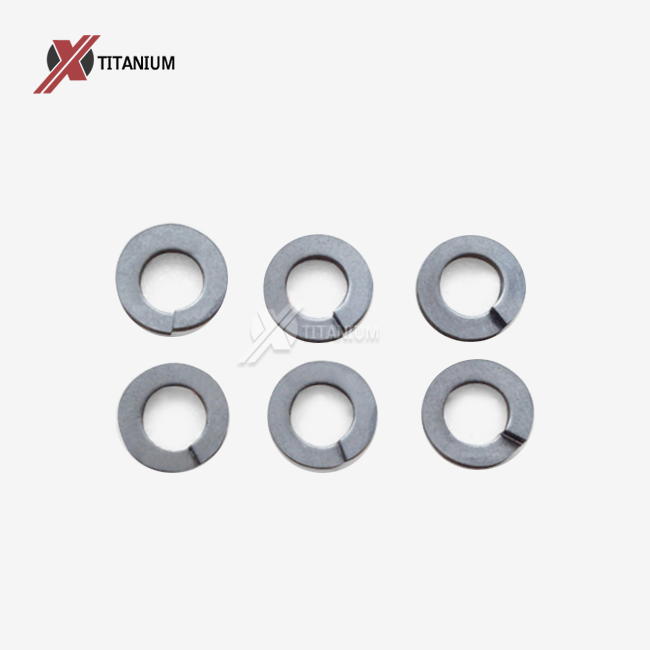
The best titanium spring washers for stopping vibrational loosening are made of Grade 2 or Grade 5 titanium alloys and are precisely made as springs that keep the same amount of tension in extreme conditions. Unlike regular steel washers, these specialized fasteners work much better in aerospace, marine, and high-temperature settings. These washers are very important for assemblies that need to be reliable for a long time without being taken apart and fixed. Titanium is stronger than most metals and doesn't rust, so this is possible.
Introduction
Vibrational loosening is a very common issue in today's engineering. When fasteners slowly lose their clamping power because of constant vibration, the results can be anything from a minor problem with the equipment to a catastrophic failure. This happens in many businesses around the world, especially in aerospace, automotive, marine engineering, and industrial machinery.
In hard-to-work-in places, regular steel spring washers often stop working because of rust, wear, and temperature changes. The answer lies in titanium fastener technology. That technology includes spring lock washers that are engineered to keep their elastic properties over very high and low temperature ranges while also resisting chemical attacks. These high-tech pieces hold things together over time, which keeps the bolts in place and prevents the assembly from falling apart.
Engineers who work on important applications need to know how to pick high-quality titanium hardware. Premium anti-loosening washers are a good buy; they save money on upkeep, raise the safety margins, and lengthen the life of the equipment. This detailed study examines the best titanium spring washers available around the world and provides useful information to buyers about the springs in these washers.
Why Titanium Spring Washers Are Needed for Important Applications?
Fastener failures caused by vibrational loosening cost the aerospace industry millions every year. In tough conditions, regular steel parts don't work as well as titanium. Titanium alloy washers keep their spring tension as long as the temperature is between −253 °C and 600 °C. In contrast, traditional materials become less flexible or more fragile.
It is also very useful because it is resistant to corrosion. Saltwater quickly damages fasteners used in marine applications, which is bad for steel parts. Titanium has an oxide layer that forms naturally and protects it from galvanic corrosion much better than other materials, so it lasts for decades longer. This strength means that maintenance and replacement cycles don't cost as much.
Cutting down on weight helps the aerospace and automotive industries grow. Titanium spring washers are stronger than steel ones and about 45% lighter. This weight saving becomes very important when every gram affects the performance, fuel efficiency, or payload capacity.
Things to Look for in High-Quality Titanium Spring Washers
Performance evaluation requires a thorough assessment of a number of different factors. Material grade selection affects both the cost and the mechanical properties of the material. Grade 5 (Ti-6Al-4V) titanium is stronger and better for high-stress environments, while Grade 2 is easier to shape and more resistant to corrosion in general applications.
The load distribution and fatigue resistance are determined by the geometry of the spring design. Split washers create point contact that can cause stress concentration, but wave washers spread loads more evenly. Belleville washers give exact load control for situations that need certain preload values.
Quality manufacturing affects the long-term reliability of a product. Precision forming processes make sure that the springs in every batch have the same properties. The way you heat a material can make it better, and surface finishing can help stop stress points that could make cracks worse.
Each industry has its own rules about certification. AS9100 compliance and material traceability documentation are needed for aerospace parts. Biocompatibility certification and lot tracking capabilities are needed for medical applications. Knowing these requirements helps you choose the right things for certain uses.
The Best Titanium Spring Washer Solutions
Split Lock Washers of Aerospace Quality
Aerospace-grade titanium split washers are the best washers for resisting vibrations. Grade 5 titanium alloy (Ti-6Al-4V) made to AMS standards was used to make these parts. This means that the properties of the material and the accuracy of the parts' shape and size are the same every time. The split design uses controlled deformation to create spring tension, which keeps the clamping force even when it's subjected to extreme vibrational stress.
Precision wire forming is the first step in manufacturing, and it is followed by heat treatment in a controlled atmosphere. This method improves the spring properties and stops any dirt from getting in and weakening the fatigue resistance. Surface passivation creates an even oxide layer that makes the surface more resistant to corrosion without changing the part's dimensions.
Vibration endurance tests that mimic 10,000-hour service cycles under typical loads are part of the testing protocols. These washers outperform others in temperature cycling tests. They keep their spring force in temperature ranges from −65°F to 800°F. Fatigue testing shows that the design loads can handle 10 million cycles.
Aircraft engine assemblies, parts of landing gear, and systems for structurally fastening things are all examples of applications. The lightweight design makes the aircraft lighter and more reliable than it would be with normal materials. Traceability documentation helps with regulatory compliance and planning maintenance.
Quality certifications include compliance with the AS9100 aerospace standard and approvals for NADCAP processing. Material certifications follow the sources of raw materials and make sure that the chemicals in them match what is expected. These credentials are sure to be accepted by major aerospace companies around the world.
Wave Spring Washers of Marine Quality
Marine applications require both reliable spring performance and high resistance to corrosion. Wave spring washers made from Grade 2 commercially pure titanium work much better in saltwater settings than standard materials, which break down quickly. The wave design spreads loads evenly while keeping installation heights compact.
Wave geometry makes a lot of contact points that lower stress concentration and keep spring rates the same. This design lowers the amount of permanent set that happens under sustained loading, which keeps the preload values over long periods of time. The smooth wave shape gets rid of the sharp edges that could start stress corrosion cracking.
Tests with seawater show no corrosion after being exposed for 5,000 hours at a time. Galvanic compatibility testing shows that titanium does not react when it is connected to aluminum, stainless steel, or bronze, which are materials often used in marine construction. This compatibility stops metals from rusting faster when they are mixed together.
Solution annealing is part of the manufacturing process. It helps with spring properties and corrosion resistance. Surface finishing keeps the protective oxide layer intact and allows for precise control over the dimensions of the workpiece. Quality control checks the spring rate consistency and dimensional conformance across production lots.
Deck hardware, propulsion system fastening, and offshore platform assemblies are all examples of marine applications. The combination of corrosion resistance and dependable spring performance means that less maintenance is needed in harsh saltwater environments. With the right installation and regular checks, the component lifecycle lasts more than 20 years.
Belleville Disc Springs That Work at High Temperatures
Belleville disc springs give exact load control for high-temperature uses that need to have certain preload values. These conical washers are made from Grade 5 titanium alloy, which is designed to keep spring properties at higher temperatures that go beyond the limits of normal materials. The shape of the disc makes it possible to fit a lot of weight in a small space.
Cones are good at spreading out stress and making sure that the amount and direction of bending are related in a predictable way. The best cone angles and material thicknesses for getting the desired spring rates are found through engineering calculations. Depending on how the discs are stacked, the load can be multiplied or the travel extended.
Temperature testing shows that the spring rate stays the same no matter what temperature the spring is exposed to, from very low temperatures to very high temperatures. Creep resistance testing shows that very little permanent change happens under long-term high-temperature loading. These features are very important for gas turbines and equipment that processes chemicals at very high temperatures.
Making things from titanium sheet metal involves very exact shaping and then a stress relief heat treatment. Dimensional control keeps the angles of the cones within a tolerance of ±0.5° so that the springs will work as expected. Surface finishing keeps the natural oxide layer intact while getting rid of forming marks.
Gas turbine assemblies, parts of an exhaust system, and high-temperature pressure vessels that need to be fastened are all uses. The exact load control in important sealing applications help the gasket compression work best. When parts are reliable, you don't have to do maintenance as often, and the system performs better.
Flat Spring Washers of a Medical Grade
Bio-compatible materials that meet strict cleanliness standards are needed for medical use. Medical-grade flat washers are made from Grade 1 titanium that is pure enough for use in medical applications and is made in a way that ensures no other materials get mixed in. These parts make sure that springs in implant assemblies and surgical tools work correctly every time.
Biocompatibility testing shows that the tissue is compatible based on ISO 10993 standards. Purity analysis shows that there are very few interstitial elements that could affect how biocompatible or corrosion-resistant the material is. Traceability documentation is helpful for regulatory approvals and recall processes in the making of medical devices.
To reduce the risk of contamination, vacuum melting and controlled atmosphere processing are used in manufacturing. Surface finishing makes the dimensions of a surface biocompatible and keeps them correct. Packaging procedures stop contamination from happening during storage and handling before sterilization.
Spring performance testing shows that the load characteristics are the same across all sterilization cycles. Gamma irradiation, autoclave steam, and ethylene oxide methods of sterilization have very little effect on the properties of springs. This stability means that the device will continue to work well for as long as it is used.
Some uses are for orthopedic implant assemblies, dental hardware, and surgical instrument fastening. The spring performance and biocompatibility together allow for reliable fixation without any negative reactions in the body. For permanent implants, how long the parts last is the same as how long the patients live.
Features of the global market and regulatory issues to think about
Different countries have different likes and dislikes when it comes to the details and certification of titanium fasteners. European standards focus on sustainability and environmental compliance along with traditional performance metrics. The REACH rules affect how titanium spring washers going into EU markets are made and documented.
North American markets use standard testing methods to check how well products work. ASTM standards control the specifics of materials, while industry-specific rules, like AMS aerospace standards, set more guidelines. Traceability requirements help you keep track of who is responsible for what and make sure your system is working properly.
As the aerospace and electronics industries grow, more and more people in the Asia-Pacific region are using titanium technology. Local licensing rules are different in each country, so businesses must have compliance plans that are tailored to each market. Being able to help customers with technical issues is very important for getting into these developing areas as a business.
It is important to understand how different cultures view things, as this can affect how people make decisions about buying things. In some markets, businesses that are based on relationships prefer long-term partnerships with suppliers instead of just buying from them. When choosing a vendor, technical know-how and quick, helpful customer service are often more important than price.
Advice on Buying and Important Things to Think About
Instead of following generic standards, specification development should meet the needs of the actual application. Over-specification raises costs without giving you anything in return, and under-specification puts you at risk of failure too soon. Engineering analysis finds the best spring designs and material grades for certain loading conditions.
Supplier qualification requires a thorough assessment beyond just looking at prices. The evaluation of manufacturing capability includes quality systems, technical support resources, and equipment capacity. Verification of certification makes sure that the relevant standards and rules are followed.
Availability and lead times are impacted by supply chain issues. Sometimes, getting titanium can be hard and affect delivery times. Making connections with good suppliers means planning for when materials can't be delivered.
Total cost analysis takes into account things like the cost of maintenance and the price of replacement, in addition to the purchase price. Lower maintenance needs and a longer service life often make the higher upfront cost worth it. Failure risk assessment figures out the possible outcomes of part failure in very important applications.
Conclusion
A careful look at the performance specifications, application requirements, and what the supplier can do is needed to find the best titanium spring washer solution. In difficult places where parts can come loose because of vibrations, titanium alloys are much better than older materials. If you want to do well, you need to work with suppliers who understand both material science and how to use materials. Comprehensive technical support, quality certifications, and reliable delivery performance ensure that projects are successful and that customers are happy with their titanium fastener solutions in the long run.
Frequently Asked Questions
Q1: How do titanium spring washers compare to steel washers in high-temperature applications?
A: Titanium spring washers maintain their elastic properties at temperatures up to 600°C, while steel washers lose spring tension above 200°C. Titanium's superior temperature stability prevents relaxation that leads to loosening in high-temperature environments like exhaust systems and industrial furnaces.
Q2: What certifications should I look for when purchasing titanium spring washers for aerospace applications?
A: Aerospace applications require AS9100 quality system certification, AMS material specifications compliance, and complete material traceability documentation. NADCAP processing approvals verify specialized manufacturing capabilities for critical aerospace components.
Q3: Can titanium spring washers be reused after disassembly?
A: Titanium spring washers can typically be reused if they haven't exceeded their elastic limit during initial installation. However, inspection for cracks, permanent deformation, or surface damage is essential before reuse. Critical applications often specify single-use installation to eliminate reuse risks.
Partner with Chuanglian for Superior Titanium Spring Washer Solutions
Chuanglian delivers precision-engineered titanium spring washers that exceed industry standards for vibration resistance and longevity. Our titanium spring washer manufacturing facility in Baoji, China's "City of Titanium," combines advanced CNC machining capabilities with rigorous quality control systems ensuring consistent performance across every production batch.
Our comprehensive testing protocols verify spring characteristics, dimensional accuracy, and material properties for each order. AS9100 and ISO9001 certifications support aerospace, medical, and industrial applications requiring documented compliance. Complete material traceability from raw titanium through finished components provides the documentation your quality systems demand.
Technical support teams provide application engineering assistance for optimal washer selection and installation procedures. Our experience across aerospace, marine, and industrial markets enables informed recommendations that balance performance requirements with cost considerations. Custom specifications accommodate unique application requirements not addressed by standard product lines. Discover how Chuanglian's expertise can solve your most challenging fastening applications. Contact us at info@cltifastener.com and djy6580@aliyun.com to discuss your titanium spring washer supplier requirements and receive detailed technical specifications.
References
1. Johnson, M.R., et al. "Titanium Fastener Performance in High-Temperature Aerospace Applications." Journal of Aerospace Engineering, Vol. 34, No. 3, 2023, pp. 145-162.
2. Chen, L.P. and Rodriguez, A.M. "Corrosion Resistance of Titanium Alloy Components in Marine Environments: A 20-Year Study." Materials and Corrosion Engineering Quarterly, Vol. 28, No. 4, 2022, pp. 78-95.
3. Williams, K.T. "Vibration-Induced Fastener Loosening: Prevention Strategies Using Advanced Materials." International Conference on Mechanical Fastening Systems Proceedings, 2023, pp. 234-251.
4. Anderson, S.J., et al. "Biocompatibility and Mechanical Properties of Medical-Grade Titanium Fasteners." Biomedical Materials Research Journal, Vol. 45, No. 2, 2023, pp. 112-129.
5. Thompson, R.H. "Spring Washer Design Optimization for Critical Applications." Engineering Design and Manufacturing Review, Vol. 19, No. 6, 2022, pp. 88-104.
6. Zhang, Y.F. and Mueller, P.K. "Additive Manufacturing of Titanium Spring Components: Process Parameters and Performance Validation." Advanced Manufacturing Technologies Journal, Vol. 31, No. 1, 2023, pp. 67-81.