- English
- French
- German
- Portuguese
- Spanish
- Russian
- Japanese
- Korean
- Arabic
- Greek
- German
- Turkish
- Italian
- Danish
- Romanian
- Indonesian
- Czech
- Afrikaans
- Swedish
- Polish
- Basque
- Catalan
- Esperanto
- Hindi
- Lao
- Albanian
- Amharic
- Armenian
- Azerbaijani
- Belarusian
- Bengali
- Bosnian
- Bulgarian
- Cebuano
- Chichewa
- Corsican
- Croatian
- Dutch
- Estonian
- Filipino
- Finnish
- Frisian
- Galician
- Georgian
- Gujarati
- Haitian
- Hausa
- Hawaiian
- Hebrew
- Hmong
- Hungarian
- Icelandic
- Igbo
- Javanese
- Kannada
- Kazakh
- Khmer
- Kurdish
- Kyrgyz
- Latin
- Latvian
- Lithuanian
- Luxembou..
- Macedonian
- Malagasy
- Malay
- Malayalam
- Maltese
- Maori
- Marathi
- Mongolian
- Burmese
- Nepali
- Norwegian
- Pashto
- Persian
- Punjabi
- Serbian
- Sesotho
- Sinhala
- Slovak
- Slovenian
- Somali
- Samoan
- Scots Gaelic
- Shona
- Sindhi
- Sundanese
- Swahili
- Tajik
- Tamil
- Telugu
- Thai
- Ukrainian
- Urdu
- Uzbek
- Vietnamese
- Welsh
- Xhosa
- Yiddish
- Yoruba
- Zulu
Bulk Titanium Fasteners for USA Importers
Beyond traditional fastening applications, titanium shoulder bolts are important because they help manufacturers meet strict safety requirements while lowering total assembly weight and improving operational effectiveness. This thorough reference gives procurement managers, technical engineers, and OEM customers the fundamental information and useful insights they need to efficiently make bulk purchase choices. When sourcing premium titanium fasteners in the cutthroat USA market, where quality consistency and delivery performance directly affect production timelines and project success, we address crucial factors for guaranteeing supply chain dependability.
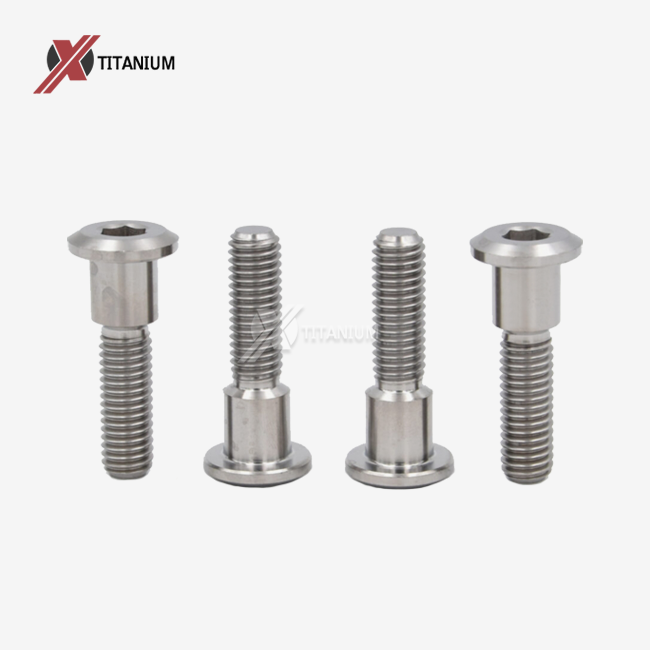
Understanding Titanium Shoulder Bolts: Properties, Sizes, and Applications
Structural Characteristics and Material Properties
A specific class of precision fasteners, titanium shoulder bolts are designed with unique structural characteristics that set them apart from other bolting options. In order to provide proper assembly alignment and regulated preload distribution, these components include a carefully machined shoulder piece that serves as an essential spacer or positioning element. In many applications, the shoulder design reduces assembly complexity while retaining remarkable dimensional accuracy by doing away with the need for additional washers or spacers.
Titanium alloys, especially Grade 5 (Ti-6Al-4V) and Grade 2 pure titanium, have exceptional material qualities that result in strength-to-weight ratios that are noticeably higher than those of conventional steel fasteners. While retaining densities that are around 45% lighter than equivalent steel components, grade 5 titanium shoulder bolts demonstrate tensile strengths that exceed 130,000 psi. With this combination, engineers may reduce weight significantly without sacrificing safety margins or structural integrity.
Standard Dimensional Ranges and Measurement Guidelines
Our selection of titanium shoulder bolts includes a wide variety of sizes intended to suit various industrial uses. Standard metric sizes range from M5 to M12 configurations, and bespoke sizes are easily obtainable to satisfy particular project needs. Applications needing precise bearing surface areas or particular clearance requirements may benefit from the versatility offered by shoulder diameters, which vary from 4mm to 50mm.
Metric, UNC (Unified Coarse), and UNF (Unified Fine) thread combinations are available to guarantee conformance with current assembly requirements in global marketplaces. Shoulder diameter, overall length, threaded length, and head configuration characteristics must all be carefully considered in order to follow accurate measurement standards. In order to avoid expensive specification mistakes during bulk purchase procedures, procurement personnel should compare these crucial measurements to assembly drawings.
Industrial Applications and Performance Requirements
In engine mount assemblies, wing structural connections, and landing gear components where weight reduction immediately translates to greater fuel economy and increased payload capacity, aerospace manufacturers routinely use titanium shoulder bolts. These fasteners are perfect for dynamic aircraft applications because of titanium alloys' remarkable fatigue resistance, which allows them to endure millions of stress cycles without deteriorating.
In high-performance engine assemblies, suspension systems, and transmission parts where less rotational mass enhances acceleration and handling characteristics, titanium shoulder bolts are advantageous for automotive applications. For offshore platform structures, submersible equipment, and naval vessel assemblies working in challenging saltwater environments, marine engineering applications take use of titanium alloys' exceptional seawater corrosion resistance.
Comparing Titanium Shoulder Bolts with Other Fasteners: Making the Right Choice
Material Performance Analysis
When comparing titanium shoulder bolts to other materials, a number of crucial performance criteria show definite benefits for demanding applications. Titanium alloys provide comparable corrosion resistance to stainless steel fasteners while imposing much less weight penalty. In maritime conditions where pitting corrosion may jeopardize structural integrity, titanium's chloride resistance is superior to that of 316 stainless steel.
Even though aluminum alloy fasteners are lightweight, they don't have the mechanical strength needed for high-stress applications, which are popular in the automobile and aerospace industries. From cryogenic conditions to high working temperatures beyond 400°C, when aluminum alloys start to lose structural integrity, titanium shoulder bolts retain their mechanical qualities throughout a broader temperature range.
Threaded Versus Non-Threaded Configurations
For assemblies that need detachable connections or changeable preload characteristics, threaded titanium shoulder bolts provide a variety of attachment options. The exact thread engagement accounts for variations in thermal expansion between different materials while distributing clamping pressures uniformly across mating surfaces. In instances where permanent assembly techniques like welding or adhesive bonding are desired, non-threaded variants provide simplified installation.
Threaded arrangements are usually needed for aerospace applications in order to make maintenance access and component replacement easier during planned service intervals. Non-threaded designs may be advantageous for industrial equipment applications where thread galling issues in high-temperature working conditions are eliminated and assembly time is decreased by simpler installation processes.
Pricing Dynamics and Return on Investment
Purchasing titanium shoulder bolts in bulk necessitates a thorough examination of the overall cost of ownership as opposed to only comparing unit prices. The longer service life and lower maintenance needs of titanium components often result in better long-term value propositions, even when initial purchase prices are higher than those of typical steel fasteners. Because titanium is resistant to corrosion, expensive replacement cycles that are typical of steel fasteners in harsh settings are eliminated.
In aerospace applications, where each pound of weight reduction results in quantifiable fuel savings during the aircraft's service life, the advantages of weight reduction translate directly into operating cost reductions. During the first few years of operation, these operational advantages often outweigh the cost of premium materials, especially for heavily used commercial aircraft whose profitability is directly impacted by fuel economy.
How to Source and Procure Bulk Titanium Shoulder Bolts in the USA?
Supplier Verification and Quality Assessment
Thorough supplier assessment centered on production capabilities, quality certifications, and supply chain stability is necessary for the successful purchase of titanium shoulder bolts in bulk. Compliance with relevant industry standards, such as AS9100 for aerospace applications, ISO 9001 for general industrial usage, and FDA rules for medical device components, must be proven by qualified vendors. Complete lot tracing from raw material suppliers to final inspection procedures is ensured by material traceability paperwork.
Audits of manufacturing facilities confirm the production capacity, quality control procedures, and calibration records of testing apparatus that are necessary for reliable product quality. While automated inspection systems provide statistical process control data supporting batch-to-batch consistency requirements essential for high-volume production applications, advanced CNC machining capabilities guarantee exact dimensional control.
Custom Manufacturing Considerations
Through specific dimensional configurations, surface treatments, and performance adjustments, custom titanium shoulder bolt production may meet the demands of certain applications. Depending on complexity and tooling needs, minimum order numbers usually fall between 100 and 1,000 pieces. Custom component lead times, including material sourcing, machining, and quality assurance procedures, typically range from 4 to 8 weeks.
Options for surface treatment include nitriding for increased wear resistance in high-friction applications, polishing for better corrosion resistance, and anodizing for color labeling and extra protection. Natural titanium finish, gold, blue, green, purple, black, and rainbow variants are among the color anodizing possibilities that allow component identification and aesthetic improvement for visible applications.
Quality Control and Certification Requirements
Extensive quality control procedures guarantee surface finish requirements that satisfy application standards, dimensional accuracy within specified tolerances, and material compliance to designated titanium grades. Each manufacturing lot's chemical composition, mechanical characteristics, and heat treatment conditions are confirmed by material certification documentation. Penetrant testing and ultrasonic inspection are examples of non-destructive testing techniques that find surface discontinuities or interior flaws that might impair performance.
Independent confirmation of material characteristics and dimensional conformance is offered by third-party certification from recognized testing labs. For aerospace applications, where component failure might have disastrous results necessitating copious documentation and traceability records, these certifications are especially crucial.
Installation, Maintenance, and Best Practices for Titanium Shoulder Bolts
Proper Installation Techniques
Proper installation techniques protect titanium shoulder bolts from harm during assembly while optimizing their performance potential. The special mechanical characteristics of titanium alloys, which are quite different from steel fasteners, are explained by specialized torque requirements. While inadequate torque may lead to joint loosening under dynamic loading circumstances, overtightening might result in thread galling or stress concentrations that jeopardize long-term durability.
Anti-seize lubricants made especially for titanium applications help with future disassembly procedures and stop galling during installation. Lubricants based on graphite or molybdenum disulfide provide efficient protection without sacrificing joint integrity or adding impurities that can impair corrosion resistance. To guarantee precise torque application during many assembly processes, installation equipment should be calibrated on a regular basis.
Maintenance and Inspection Protocols
Frequent inspection plans confirm ongoing performance and spot any problems before they affect operational dependability or safety. Visual inspections identify wear patterns, corrosion, or surface damage that can point to incorrect loading or environmental exposure that goes beyond design limits. Critical fit tolerances are confirmed to stay within specification during the course of the service life by dimensional measurements.
Over time, fastener performance may be impacted by environmental conditions as mechanical vibration, chemical exposure, and temperature cycling. Keeping an eye on these factors helps in creating replacement and inspection schedules that are suitable and grounded on real operating circumstances rather than artificial time frames. Inspection results documentation produces historical records that aid in reliability analysis and maintenance optimization initiatives.
Case Studies and Performance Validation
In wing attachment assemblies, a prominent aerospace manufacturer recently used titanium shoulder bolts, which resulted in a 25% weight reduction over steel components while preserving strength margins that were comparable. With zero fastener-related issues and over 200,000 flight hours of service data, the design choice is validated and broader applicability across other aircraft projects is supported.
In crucial structural joints subjected to seawater spray and corrosive drilling fluids, an offshore drilling platform operator substituted titanium shoulder bolts for stainless steel fasteners. Inspection found no detectable corrosion or dimensional changes after three years of continuous operation, removing the need for yearly replacement cycles and saving over 60% on maintenance expenses.
Baoji Chuanglian: Your Trusted Partner for Premium Titanium Fasteners
Strategically situated in Baoji City, known as the "City of Titanium," Baoji Chuanglian New Metal Material Co., Ltd. is a leading manufacturer and exporter of precision titanium products. Our company is a technology-driven business that specializes in research, production, and precision machining of various titanium and rare metal products serving vital industries worldwide. We have established ourselves as a reliable partner for challenging applications in the aerospace, petrochemical, medical, and marine engineering industries thanks to our more than 10 years of combined experience in titanium product development and manufacture.
Titanium fasteners, rods, wire, plate, tube, flanges, and other precision-machined parts made to strict requirements are all part of our extensive product line. The most exacting industry requirements are met for surface finish quality and dimensional accuracy thanks to advanced CNC machining capabilities backed by dozens of precision machine equipment. Our dedication to technical progress propels ongoing investments in process and equipment enhancements, keeping us at the forefront of superior titanium fabrication.
Conclusion
For US importers catering to the automotive, aerospace, marine, and industrial manufacturing industries, purchasing titanium fasteners in bulk is a calculated investment in operational excellence. Because of its remarkable mechanical qualities, superior corrosion resistance, and lightweight design, titanium shoulder bolts provide unparalleled performance that allows for weight reduction without sacrificing structural integrity. Successful execution of these high-end fastening systems is ensured by comprehension of the technical specifications, application requirements, and quality standards.
Careful supplier assessment that emphasizes production capabilities, quality certifications, and demonstrated track records in meeting demanding industrial applications is necessary for successful sourcing. Through lower maintenance needs, longer service life, and operational advantages like increased fuel economy in aircraft applications, the long-term value proposition of titanium fasteners often justifies premium purchase prices.
FAQ
Q1: What advantages do titanium shoulder bolts offer over traditional steel fasteners?
A: Titanium shoulder bolts provide many benefits over steel, such as a 45% weight reduction while retaining the same or better mechanical strength. Because titanium alloys are so resistant to corrosion, they don't need protective coatings or regular replacement in harsh conditions. Titanium fasteners are perfect for dynamic applications in the automotive and aerospace sectors because of their exceptional fatigue resistance, which allows them to endure millions of stress cycles without degrading.
Q2: How can importers verify aerospace-grade quality standards for titanium shoulder bolts?
A: Aerospace-grade titanium shoulder bolts must adhere to material requirements like AMS 4928 for Grade 5 titanium and AS9100 quality management systems. Verification include examining dimensional compliance reports, verifying traceability data from source materials to final inspection, and analyzing material certification certificates that attest to mechanical and chemical composition. Accredited testing labs' third-party accreditation offers impartial verification of adherence to quality standards.
Q3: Are titanium shoulder bolts suitable for corrosive marine environments?
A: The remarkable resistance of titanium shoulder bolts to saltwater corrosion, especially chloride-induced pitting and crevice corrosion that often afflict stainless steel fasteners, makes them ideal for use in marine applications. Even after years of constant exposure to saltwater, titanium retains its structural integrity and aesthetic appeal without the need for cathodic protection devices or protective coatings. Because of this, they are perfect for submersible equipment working in challenging saltwater environments, offshore platforms, and naval vessels.
Partner with Chuanglian for Premium Titanium Shoulder Bolts Solutions
By combining cutting-edge CNC machining with strict quality control procedures, Chuanglian offers outstanding value in the fabrication of titanium shoulder bolts. Custom size from M5 to M12, different surface treatments, including color-coded anodizing, and comprehensive traceability documentation that satisfies aerospace and industrial requirements are all features of our Grade 2 and Grade 5 titanium fasteners. As an established titanium shoulder bolts manufacturer with over ten years of industry expertise, we understand the critical importance of delivery reliability and technical support for your procurement success. Contact our experienced team at djy6580@aliyun.com to discuss your specific requirements and receive personalized quotations for bulk orders.
References
1. Boyer, R., Welsch, G., & Collings, E.W. (2019). Materials Properties Handbook: Titanium Alloys. ASM International Press.
2. American Society for Testing and Materials. (2021). ASTM F467 - Standard Specification for Nonferrous Nuts for Use with Bolts for High Temperature or High Pressure Service, or Both. ASTM International.
3. Aerospace Industries Association. (2020). AS9100D Quality Management Systems - Requirements for Aviation, Space and Defense Organizations. AIA Publications.
4. Lutjering, G. & Williams, J.C. (2018). Titanium: Engineering Materials and Processes. Springer-Verlag Publishing.
5. Society of Automotive Engineers. (2022). AMS 4928K - Titanium Alloy Bars, Wire, Forgings, and Rings 6Al - 4V Annealed. SAE International Standards.
6. International Organization for Standardization. (2021). ISO 4762 - Socket Head Cap Screws. International Standards Organization.
Learn about our latest products and discounts through SMS or email