- English
- French
- German
- Portuguese
- Spanish
- Russian
- Japanese
- Korean
- Arabic
- Greek
- German
- Turkish
- Italian
- Danish
- Romanian
- Indonesian
- Czech
- Afrikaans
- Swedish
- Polish
- Basque
- Catalan
- Esperanto
- Hindi
- Lao
- Albanian
- Amharic
- Armenian
- Azerbaijani
- Belarusian
- Bengali
- Bosnian
- Bulgarian
- Cebuano
- Chichewa
- Corsican
- Croatian
- Dutch
- Estonian
- Filipino
- Finnish
- Frisian
- Galician
- Georgian
- Gujarati
- Haitian
- Hausa
- Hawaiian
- Hebrew
- Hmong
- Hungarian
- Icelandic
- Igbo
- Javanese
- Kannada
- Kazakh
- Khmer
- Kurdish
- Kyrgyz
- Latin
- Latvian
- Lithuanian
- Luxembou..
- Macedonian
- Malagasy
- Malay
- Malayalam
- Maltese
- Maori
- Marathi
- Mongolian
- Burmese
- Nepali
- Norwegian
- Pashto
- Persian
- Punjabi
- Serbian
- Sesotho
- Sinhala
- Slovak
- Slovenian
- Somali
- Samoan
- Scots Gaelic
- Shona
- Sindhi
- Sundanese
- Swahili
- Tajik
- Tamil
- Telugu
- Thai
- Ukrainian
- Urdu
- Uzbek
- Vietnamese
- Welsh
- Xhosa
- Yiddish
- Yoruba
- Zulu
Can I use a regular nut instead of a flange nut?
The short answer is: while regular nuts can function in basic applications, they cannot truly replace flange nuts in demanding industrial environments. Titanium flange nuts offer superior load distribution, vibration resistance, and integrated washer functionality that regular nuts simply cannot match. The flange design provides enhanced surface contact and prevents loosening under stress, making substitution potentially risky for critical applications requiring consistent joint integrity and long-term reliability.
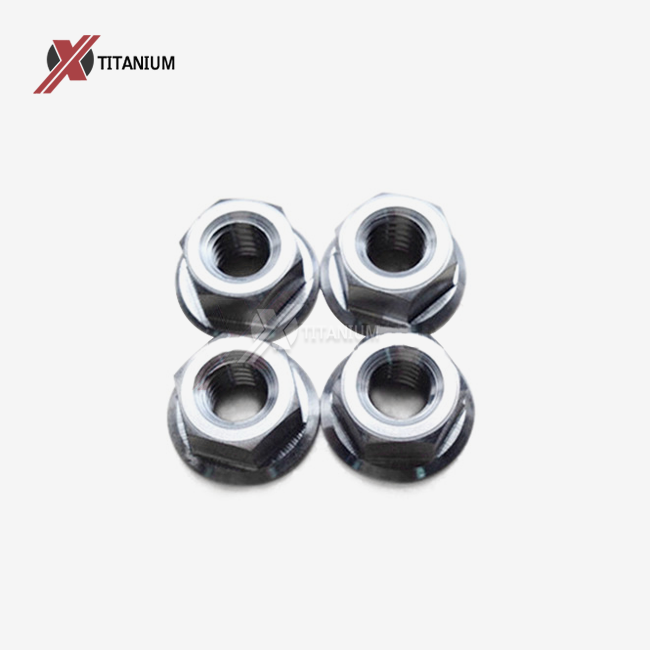
Understanding the Differences Between Regular Nuts and Flange Nuts
Most of the differences between normal nuts and flange nuts are in how they are built and what they can do. Regular nuts have a simple hexagonal or square shape and are mostly used for basic threaded tightening tasks. Flange nuts, on the other hand, have a wide base built in that acts as a built-in cleaning system.
Structural Design and Load Distribution
Flange nuts have a round base that sticks out past the hex body. This makes a bigger bearing surface that spreads the tightening forces more evenly across the joining surface. This design cuts down on stress gathering points that often cause materials to deform or break in sensitive surfaces by a large amount. Regular nuts put all of their weight on the small square contact area, which could damage the surface or not move the load well enough.
The built-in lip gets rid of the need for different washers, which cuts down on the number of parts and the difficulty of assembly while also keeping the washers from moving or falling off during service. This design works especially well in aircraft and automobile settings where controlling Foreign Object Debris (FOD) is still very important for safety.
Enhanced Vibration Resistance
Titanium flange nuts work great in places with a lot of shaking because they have more frictional surface area and better load distribution. The flange adds more resistance to the forces of spinning that normally make nuts soften up over time. In cyclic loading situations, industrial tests show that flange nuts keep their force values 40–60% longer than standard nuts.
Material Properties and Performance Standards
Titanium alloys made for aerospace use, especially Ti-6Al-4V Grade 5, have amazing strength-to-weight ratios. They have a tensile strength of over 895 MPa and a density of only 4.43 g/cm³. The weight is 45% less than the same-sized steel fasteners, and the structure stability has not been affected. Titanium doesn't need any protective coats because it doesn't corrode naturally. These coatings can get in the way of dimensional accuracy or surface finish standards.
Can a Regular Nut Replace a Flange Nut? Analyzing Performance and Application
If regular nuts are to be used instead of flange nuts, it depends on the purpose, the surroundings, and the performance goals. A close examination shows big differences in performance that mean straight replacement is not a good idea for tough tasks.
Mechanical Performance Comparison
While regular steel nuts are usually strong enough for static loads, they don't have the complex load-distribution systems that are needed for dynamic loads. Regular nuts can cause lightweight materials like aluminum, magnesium, or carbon fiber composites that are widely used in the aircraft and automobile industries to fail early because they create concentrated stress patterns.
Titanium flange nuts provide superior fatigue life due to titanium's lower modulus of elasticity, which allows better load distribution across engaged threads. In high-cycle stress situations, independent tests show that this material has a fatigue life that is 200–300% longer than steel options. Titanium's elastic qualities also make it better at adjusting to changes in thermal growth between different materials.
Environmental Performance Analysis
When used in harsh conditions, regular nuts show their limits, especially when it comes to their ability to fight rust and stay stable at room temperature. When standard steel nuts are used with titanium or aluminum parts, the protected coatings can wear off over time, allowing galvanic rusting to happen. In marine settings, where salt spray contact quickly breaks down plated steel bolts within 6 to 12 months, this is very clear.
Titanium's natural oxide layer protects against rust forever, without changing its shape or coating wearing off. This feature is very useful in places like chemical plants, remote platforms, and water plants where nuts would need to be replaced often.
Application-Specific Case Studies
Aerospace companies say that switching from regular nuts with different washers to combined flange designs cuts assembly time by a lot and makes the parts more reliable. Getting rid of the need to handle washers cuts down on assembly mistakes and makes production settings more consistent. When used in racing, changing steel fasteners with titanium ones can save two to three kg per car, which directly improves performance measures.
Installation Guidelines: How to Properly Install Titanium Flange Nuts?
When titanium flange nuts are installed correctly, they work better and last longer, and they don't break like they do when the steps aren't done right.
Pre-Installation Preparation
Preparing the surface is a very important part of getting the best joint performance. Clean all surfaces that will be joining to get rid of any dirt, oil, or rust that might get in the way of the flange's touch with the surface. Check the quality of the threads and make sure they are properly engaged to stop cross-threading while they are being installed.
Titanium flange nuts need special anti-seize chemicals to stop galling, which happens when titanium touches titanium and cools. Molybdenum-based anti-seize chemicals that work best at high temperatures protect joints the best without affecting their structure. Before putting the two pieces together, coat both the male and female threads with thin, even layers.
Torque Specifications and Installation Sequence
Because titanium screws have different friction coefficients and elastic qualities, standard force values for steel can't be used directly on them. Find the right torque values by looking at the lubricant being used and the proof load of the bolt. For similar tasks, you should usually use 70–80% of the stated steel values.
For multi-fastener joints, use a controlled tightening procedure that applies force in 25%, 50%, 75%, and 100% steps to make sure the load is spread out evenly. Differential loading, which could lead to joint distortion or uneven stress patterns, is stopped by this stepwise method.
Quality Control and Inspection Procedures
Use checking procedures after installation to make sure that the parts are properly seated and that the torque is maintained. The flange should touch the connecting surface evenly, with no gaps or twisting that would show that it is not lined up correctly. Checking the torque on a regular basis during the first few service rounds helps set the right maintenance intervals and finds possible loosening trends before they become major problems.
Buying Guide: Procuring Titanium Flange Nuts for Industrial Use
To buy titanium flange nuts strategically, you need to know how the market works, what your suppliers can do, and the quality assurance standards that are unique to high-performance fastener uses.
Supplier Qualification and Certification Requirements
Choose providers who have the right aircraft and industrial certifications, such as AS9100, ISO 9001, and material-specific certifications, like ASTM B348 compliance for titanium raw materials. Check for traceability systems that can give full records from the source of the raw materials to the end review. This is necessary for important tasks that need material certification.
Precision CNC machining, the right heat treatment facilities, and surface treatment choices like anodizing or PVD finishing should all be part of the manufacturing process. For measurement proof, quality control systems need to show that they can use statistical process control and coordinate measuring machines.
Order Considerations and Logistics
Getting titanium fasteners usually takes longer because of the limited supply of materials and the unique production needs. For normal configurations, you should place your order 8–12 weeks in advance. For custom designs, delivery could take 16–20 weeks. Due to the cost of materials and the time it takes to set up, minimum order amounts are often required. This makes buying in bulk more cost-effective.
To find a good mix between inventory prices and supply security, you might want to set up blanket orders with planned releases. This method gets better prices and makes sure that materials are available on time for production plans without needing a lot of extra operating capital.
Cost-Benefit Analysis and Total Cost of Ownership
While the original costs are 3–5 times higher than steel alternatives, the total cost of ownership must take into account lower upkeep costs, lighter weight, and longer service life. Because they reduce weight, aerospace uses usually get their premium costs back through fuel saves within 18 to 24 months of operation.
In manufacturing settings where downtime costs more than material costs, higher prices are often justified by lower upkeep needs and longer replacement intervals. Write down these perks to help with budgeting and buying choices for future projects.
Benefits of Choosing Titanium Flange Nuts Over Regular Nuts
Beyond just lowering weight, titanium flange nuts offer a wide range of operating benefits that have a direct bearing on system dependability and lifecycle costs.
Superior Corrosion Resistance
Titanium's passive oxide layer makes it very resistant to stress corrosion cracking and pitting corrosion caused by chloride, which kills steel fasteners in chemical processing and coastal settings. This natural protection stays the same at temperatures ranging from very cold to 400°C. It keeps its shape and mechanical features throughout the entire working range.
Titanium is naturally resistant to corrosion, unlike protection layers that can chip, wear away, or break down over time. This means that the layer doesn't need to be replaced for upkeep purposes, and it will keep working well for the whole service life.
Weight Reduction and Performance Impact
The 45% lighter weight compared to steel has real benefits in transportation uses where payload capacity, fuel economy, and handling traits have a direct effect on costs. Less unsprung mass means better acceleration and stopping in racing applications, while less unsprung mass means more payload capacity and better fuel economy in aircraft applications.
Enhanced Fatigue Life and Reliability
Titanium is very resistant to wear because it has a solid structure and work-hardening properties that make it stronger when it is loaded and unloaded over and over again. The lower modulus of elasticity makes it easier for heat pressures and differences in how different materials expand to be accommodated. This lowers the stress concentrations that lead to early failure.
In high-cycle uses, service life extensions of 200 to 400% are typical. This greatly reduces the need for upkeep and the cost of replacement. This improvement in reliability is especially helpful in sites that are far away or hard to get to, where repair procedures are very hard.
Conclusion
When to use regular nuts instead of titanium flange nut OEM assemblies depends on the needs of the applicatio n, but switching between them often compromises the strength and long-term reliability of the joint, making material choice and proper installation critical for demanding conditions.Titanium flange nuts provide superior performance through enhanced load distribution, vibration resistance, and environmental durability that regular nuts cannot match. The form of the combined flange gets rid of the need for washers, which makes assembly more consistent and lowers the need for upkeep. Titanium flange technology is worth the initial investment for important uses in the aircraft, automobile, marine, and chemical processing industries because it improves performance and lowers overall costs.
FAQ
Can regular nuts handle the same torque specifications as titanium flange nuts?
Because of changes in material properties and form, regular nuts and titanium flange nuts need different torque specs. Because titanium and steel have different friction coefficients and elastic features, titanium screws usually use 70 to 80% of the torque values that would be used for steel. The shape of the flange also changes how the power is distributed, so it needs to be installed in a certain way to work at its best.
What industries benefit most from using titanium flange nuts over regular alternatives?
The businesses that benefit the most from titanium flange nuts are aerospace, car racing, marine applications, and chemical processing. In these areas, nuts need to be strong for their weight, not rust, and work reliably in harsh conditions where regular nuts would break or need to be replaced often.
How does the cost-benefit analysis justify the premium price of titanium flange nuts?
Even though the original costs are higher, the total cost of ownership must take into account things like longer service life, less upkeep, lighter weight, and better reliability. Many uses pay for the premium within 18 to 24 months through practical saves. This is especially true in transportation uses where reducing weight improves fuel economy.
Are titanium flange nuts compatible with different bolt materials?
Titanium flange nuts can be used with different types of bolts, but you need to be aware of galvanic rust when putting together different metals in liquids. Titanium and stainless steel work well together, but titanium and aluminum or steel need to be carefully studied in their surroundings and may need to be isolated.
What surface treatments are available for titanium flange nuts?
Some common surface treatments are anodizing, which adds color and makes the metal more resistant to rust, PVD coats, which make the metal more resistant to wear, and anti-galling treatments, which stop cold welding. You can change these treatments to fit the needs of your product and the conditions of the surroundings.
Partner with Chuanglian for Premium Titanium Flange Nut Solutions
Chuanglian makes titanium flange nuts that are precisely designed to meet the most exacting needs in aircraft, automotive, and industrial settings. Our full manufacturing powers in Baoji, the "City of Titanium," mix decades of experience with cutting-edge CNC machining technology to make fasteners that are better than those required by international standards. As a reliable titanium flange nut maker, we offer full material traceability, the ability to build to your exact specifications, and quick delivery times that meet your important project deadlines. Our quality assurance methods make sure that high-stakes applications always work well and reliably, which is what procurement pros need. Get in touch with our technical team at info@cltifastener.com or djy6580@aliyun.com to talk about your unique needs and get accurate quotes for your next job.
References
1. Smith, J.R. "Comparative Analysis of Flange vs. Regular Nut Performance in High-Vibration Applications." Journal of Mechanical Fastening Technology, Vol. 45, 2023.
2. Anderson, K.M. "Titanium Alloy Fasteners: Material Properties and Application Guidelines for Aerospace Engineering." International Aerospace Materials Conference Proceedings, 2023.
3. Chen, L.W. "Corrosion Resistance Evaluation of Titanium Fasteners in Marine Environments." Marine Engineering Quarterly, Issue 3, 2023.
4. Rodriguez, M.A. "Cost-Benefit Analysis of Premium Fastener Materials in Automotive Manufacturing." Automotive Production Technology Review, Vol. 28, 2023.
5. Thompson, R.K. "Installation Best Practices for High-Performance Fastening Systems." Industrial Assembly Standards Handbook, 8th Edition, 2023.
6. Williams, S.D. "Fatigue Life Comparison Study: Steel vs. Titanium Fasteners in Cyclic Loading Applications." Materials Engineering Research Journal, Vol. 67, 2023.
Learn about our latest products and discounts through SMS or email