- English
- French
- German
- Portuguese
- Spanish
- Russian
- Japanese
- Korean
- Arabic
- Greek
- German
- Turkish
- Italian
- Danish
- Romanian
- Indonesian
- Czech
- Afrikaans
- Swedish
- Polish
- Basque
- Catalan
- Esperanto
- Hindi
- Lao
- Albanian
- Amharic
- Armenian
- Azerbaijani
- Belarusian
- Bengali
- Bosnian
- Bulgarian
- Cebuano
- Chichewa
- Corsican
- Croatian
- Dutch
- Estonian
- Filipino
- Finnish
- Frisian
- Galician
- Georgian
- Gujarati
- Haitian
- Hausa
- Hawaiian
- Hebrew
- Hmong
- Hungarian
- Icelandic
- Igbo
- Javanese
- Kannada
- Kazakh
- Khmer
- Kurdish
- Kyrgyz
- Latin
- Latvian
- Lithuanian
- Luxembou..
- Macedonian
- Malagasy
- Malay
- Malayalam
- Maltese
- Maori
- Marathi
- Mongolian
- Burmese
- Nepali
- Norwegian
- Pashto
- Persian
- Punjabi
- Serbian
- Sesotho
- Sinhala
- Slovak
- Slovenian
- Somali
- Samoan
- Scots Gaelic
- Shona
- Sindhi
- Sundanese
- Swahili
- Tajik
- Tamil
- Telugu
- Thai
- Ukrainian
- Urdu
- Uzbek
- Vietnamese
- Welsh
- Xhosa
- Yiddish
- Yoruba
- Zulu
China Titanium Clevis Pin Manufacturer Guide
When procurement workers need to find high-performance fastening options for important business uses, they need to know about the different Chinese titanium clevis pin makers. China is now the biggest player in titanium processing because it has the most modern production facilities and the most competitive prices. The titanium industry in the country, especially in places like Baoji City, uses decades of metalworking know-how to make Grade 2 and Grade 5 titanium clevis pins that meet strict international standards. Chinese makers are great at making custom solutions for industrial, marine, and aircraft uses while still keeping the ISO 9001 and AS9100 certifications that buyers around the world want.
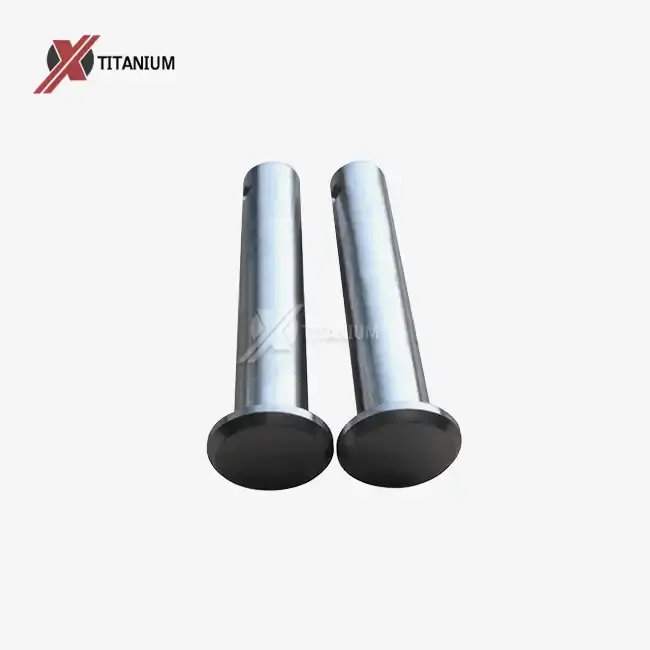
Introducing Titanium Clevis Pins and Their Advantages
A Titanium Clevis Pin is a special kind of fastener that is designed to work with clevis fasteners. It acts as a hinge or pivot point, letting two structure elements move around while still being firmly joined together. Unlike most bolts with threads, these pins have a circular shank that is not threaded. One end has a head, and the other end has a cross-hole that can be used to secure with a cotter pin or safety clip.
Material Specifications and Alloy Selection
Most titanium clevis pins used in high-end industrial settings are made from Grade 5 (Ti-6Al-4V) or Grade 2 titanium metals. Grade 5 titanium has great mechanical qualities. Its tensile strength is ≥895 MPa and its yield strength is ≥828 MPa, and it only weighs 4.43 g/cm³. It has a shear strength of about 550 MPa, which is much higher than 316 stainless steel and weighs 45% less. This makes Grade 5 titanium the standard for load-bearing clevis uses where strength and weight reduction are very important.
Even though Grade 2 titanium has lower mechanical qualities, it is better at resisting corrosion and can be shaped more easily, which makes it perfect for use in marine settings and chemical processing. Which of these grades to use depends on the needs of the product. Grade 5 is best for high-stress aerospace uses, while Grade 2 is best for conditions that rust.
Performance Advantages Over Traditional Materials
The technical features of titanium clevis pins solve important problems in the business that are caused by steel and stainless steel options. In marine settings, chloride stress corrosion cracking causes steel pins to break in a very bad way, and their high weight causes problems in aircraft linkage systems. Titanium pins get rid of these worries because they are naturally resistant to rust and light.
In seawater and oxidizing acidic chloride conditions, titanium is almost completely resistant to localized pitting corrosion and crevice corrosion. This makes it perform better than 304/316 stainless steel. Titanium is also needed for sensitive electronic testing equipment that needs to keep magnetic interference to a minimum because it is not magnetic.
How to Choose the Right Titanium Clevis Pin Supplier in China?
To find the best Chinese provider for titanium clevis pins, you need to do a thorough analysis that takes into account your unique buying needs, such as the number of pins you need, your ability to customize them, and the standards for certification. Technical proof, a review of the producing capacity, and validation of the quality system should all be part of the decision-making process.
Certification and Quality Standards Assessment
Chinese titanium makers with a good reputation keep a number of foreign certifications, such as ISO 9001:2015, AS9100D for aerospace uses, and industry-specific certifications like NADCAP for chemical processing and heat treatment. These certificates show that strict quality management systems and process controls have been followed, which is important for important uses.
Check the providers' ability to track materials by looking at things like mill test certificates (MTCs) and chemical makeup confirmation. Leading makers provide full material genealogy from the raw titanium ingot to the final machining processes. This makes sure that all aircraft and medical device rules are met.
Manufacturing Capacity and Lead Time Evaluation
Chinese companies that make titanium clevis pins usually have a range of production abilities, from small batches for prototypes to medium-sized production runs. Check to see what the provider can do in terms of precise machining, different surface finishing choices, and extra steps like anodizing or coating.
Lead times for normal titanium clevis pins are usually between 2 and 4 weeks for stock items. For custom designs, the time frame can be between 6 and 8 weeks, based on how complicated they are and how many are needed. Through integrated production processes, suppliers who can do both CNC machining and material handling in-house can often cut down on lead times.
Supplier Audit and Verification Process
Doing thorough checks of suppliers helps build trust in manufacturing skills and quality systems. Inspections of machining tools, quality control labs, material handling processes, and staff qualifications are some of the most important things that are used to judge a company. Many well-known Chinese makers are open to virtual or in-person audits and are happy to provide full facility paperwork to help the supplier qualification process.
Technical Insights: Specifications, Types, and Maintenance of Titanium Clevis Pins
Chinese makers make titanium clevis pins that meet a number of foreign size standards, such as DIN 1444, ISO 2341, and custom standards made for specific uses. Standard surface finishes usually get Ra = 0.8 to keep friction wear to a minimum while the surface is being used.
Dimensional Standards and Customization Options
Standard titanium clevis pins come in sizes from 3 mm to 50 mm, and their lengths can be changed to fit the needs of the purpose. Most of the time, metric or imperial standards are used to set the thread specs for cotter pin holes, and exact tolerances are kept throughout production.
Chinese makers are very good at making custom designs, such as ones with changed head shapes, special coatings, and specific size needs. Advanced CNC machining lets you make parts with complicated shapes while keeping the tight standards needed for aircraft and precision industry uses.
Installation and Maintenance Best Practices
To install titanium clevis pins correctly, you need to pay attention to how the surface is prepared and the assembly pressure requirements. Titanium's natural oxide layer protects it from rust very well, but if it is handled properly during installation, surface pollution that could lower performance can be avoided.
When it comes to maintenance, titanium clevis pins are much easier to handle than steel ones. Visually checking for wear patterns and double-checking the dimensions on a regular basis ensures continued performance, and the fact that they don't rust means they don't need to be replaced often in chemical or marine environments.
Coating and Surface Treatment Options
Even though titanium is naturally very resistant to rust, some uses may benefit from extra surface treatments. Physical Vapor Deposition (PVD) layers make the surface harder and stop galling. Type II or Type III anodization improves wear resistance and lets you choose different colors for easy identification.
Procurement Guide: Ordering, Pricing, and Shipping from China
To buy titanium clevis pins from Chinese makers around the world, you need to know about their minimum order numbers, pricing structures, and the logistics needs of doing business across borders. Most well-known makers can take orders as low as 50 to 100 pieces for standard setups. For custom designs, however, the minimum order quantity is usually higher.
Pricing Structure and Cost Optimization
Titanium clevis pin prices depend on the grade of the material, the number of pins needed, the complexity of the dimensions, and the surface treatment that is needed. Grade 2 titanium pins usually cost 15–20% less than Grade 5 pins of the same size. Custom machining can add 25–40% to normal prices, based on how complicated the job is.
Price breaks for larger quantities usually happen at 500, 1000, and 5000 pieces, with discounts of 10 to 25 percent compared to small amount prices. Most of the time, annual supply deals save you more money by locking in prices for large orders and making the process easier.
International Shipping and Logistics
Titanium clevis pins are usually shipped by air freight or sea freight, depending on how quickly they need to be delivered. Standard Incoterms for shipping by sea are FOB Shanghai/Tianjin and FOB Beijing Capital Airport for shipping by air. Getting freight to big US ports by sea takes 25–35 days, while getting freight by air takes 7–10 days.
For customs paperwork, materials need to be certified in great detail, including their chemical make-up and mechanical properties. Manufacturers with a lot of experience provide detailed export paperwork to keep customs clearance times as short as possible and make sure that import rules are followed.
Why Choose Titanium Clevis Pins from China: Industry Use Cases and Future Trends
Chinese companies that make titanium clevis pins use them in a wide range of industries, including flight control linkages, naval rigging systems, and high-performance car suspension parts. Advanced quality controls, precise CNC cutting, and a wide range of surface finishing options are used during the production process to make sure that the products will work reliably in harsh operating conditions.
Aerospace and Defense Applications
Titanium clevis pins are very important parts of flight control systems, landing gear units, and hardware for attaching engines in spacecraft. The high strength-to-weight ratio makes the plane lighter, and the wear resistance makes sure it will work well even when it's vibrating very quickly and under strong G-forces. Chinese companies that work with aircraft keep their AS9100D license up to date and use statistical process control to make sure that the quality of each production lot is the same.
Marine and Offshore Applications
Titanium is very resistant to rust, which is useful in marine uses where regular steel parts break down quickly in saltwater. Titanium clevis pins don't need to be maintained for a long time, so they can be used in yacht gear, ROV manipulator arms, and offshore platform equipment. This keeps expensive equipment from breaking down and lowers the cost of ownership over its lifetime.
Emerging Technologies and Future Developments
Chinese companies that make titanium keep putting money into developing and making new alloys and technologies. Some new trends that are starting to appear are additive manufacturing for making complicated shapes, improved surface treatments for better performance, and the creation of new titanium alloys that are better suited for certain uses. With these new ideas, Chinese suppliers are now at the top of developing titanium nail technology.
Conclusion
To find the best Chinese titanium clevis pin maker, you need to carefully look at their technical skills, quality approvals, and production capacity. As a place to buy titanium fasteners, China is a good choice because of its low prices, modern production technology, and thorough quality control systems. To be successful in buying, you need to carefully vet suppliers, communicate clear specifications, and set up strong quality agreements that make sure all orders are performed the same way.
FAQ
What makes titanium clevis pins superior to steel alternatives in aerospace applications?
Titanium clevis pins are stronger and lighter than steel ones, so they can cut the weight of an airplane by up to 45% while keeping the same or better mechanical qualities. Grade 5 titanium doesn't wear down easily, so it works well in settings with high frequencies of shaking and heavy loads, like those found in space. Titanium is also nonmagnetic, which means it doesn't interact with critical avionics equipment.
Can Chinese manufacturers customize titanium clevis pins to specific dimensional requirements?
Chinese titanium makers are great at making clevis pins that fit the exact measurements, tolerances, and surface finishes of each customer. Advanced CNC cutting lets you make shapes with complicated shapes while keeping the limits tight. Most makers can make custom orders, and the minimum order quantity ranges from 100 to 500 pieces, based on how complicated the order is.
How do I ensure quality consistency when sourcing from Chinese titanium suppliers?
To keep the quality high, you need to choose providers that have the right certifications (ISO 9001, AS9100), full material tracking systems, and well-established quality control processes. Set up clear quality agreements that include dimensional limits and mechanical property requirements, and make sure that all materials come with thorough test records. Quality standards are kept up over time with the help of regular checks of suppliers.
Partner with Chuanglian for Premium Titanium Clevis Pin Solutions
Baoji Chuanglian New Metal Material Co., Ltd is ready to meet your needs for a titanium clevis pin as a trusted titanium clevis pin manufacturer. They have been making and cutting titanium products for over ten years. We can give high-performance fixing solutions reliably because we use strict quality control systems, have a lot of CNC capabilities, and follow international standards. We keep a large stock of Grade 2 and Grade 5 products and offer full customization services. Get in touch with our technical team at info@cltifastener.com or djy6580@aliyun.com to talk about your unique needs and get full technical specs.
References
1. Boyer, R.R. "An Overview on the Use of Titanium in the Aerospace Industry." Materials Science and Engineering: A, Vol. 213, 1996.
2. Lutjering, G. and Williams, J.C. "Titanium Engineering Materials and Applications." Springer-Verlag Berlin Heidelberg, 2007.
3. Donachie, Matthew J. "Titanium: A Technical Guide, 2nd Edition." ASM International, 2000.
4. Peters, M. and Leyens, C. "Titanium and Titanium Alloys: Fundamentals and Applications." Wiley-VCH, 2003.
5. Schutz, R.W. and Watkins, H.B. "Recent Developments in Titanium Alloy Application in the Energy Industry." Materials Science and Engineering: A, Vol. 243, 1998.
6. American Society for Testing and Materials. "ASTM B348-19 Standard Specification for Titanium and Titanium Alloy Bars and Billets." ASTM International, 2019.
Learn about our latest products and discounts through SMS or email