- English
- French
- German
- Portuguese
- Spanish
- Russian
- Japanese
- Korean
- Arabic
- Greek
- German
- Turkish
- Italian
- Danish
- Romanian
- Indonesian
- Czech
- Afrikaans
- Swedish
- Polish
- Basque
- Catalan
- Esperanto
- Hindi
- Lao
- Albanian
- Amharic
- Armenian
- Azerbaijani
- Belarusian
- Bengali
- Bosnian
- Bulgarian
- Cebuano
- Chichewa
- Corsican
- Croatian
- Dutch
- Estonian
- Filipino
- Finnish
- Frisian
- Galician
- Georgian
- Gujarati
- Haitian
- Hausa
- Hawaiian
- Hebrew
- Hmong
- Hungarian
- Icelandic
- Igbo
- Javanese
- Kannada
- Kazakh
- Khmer
- Kurdish
- Kyrgyz
- Latin
- Latvian
- Lithuanian
- Luxembou..
- Macedonian
- Malagasy
- Malay
- Malayalam
- Maltese
- Maori
- Marathi
- Mongolian
- Burmese
- Nepali
- Norwegian
- Pashto
- Persian
- Punjabi
- Serbian
- Sesotho
- Sinhala
- Slovak
- Slovenian
- Somali
- Samoan
- Scots Gaelic
- Shona
- Sindhi
- Sundanese
- Swahili
- Tajik
- Tamil
- Telugu
- Thai
- Ukrainian
- Urdu
- Uzbek
- Vietnamese
- Welsh
- Xhosa
- Yiddish
- Yoruba
- Zulu
Titanium Chain Ring Bolts Factory: What Buyers Check
Buyers look at a Titanium Chain Ring Bolts factory's licenses for materials, accuracy in production, and quality control methods as the most important things. Buyers in the industrial sector look closely at the specs for Grade 5 Ti-6Al-4V, the CNC capabilities, and the surface treatment choices, such as anodizing and polishing. Important things that are looked at when judging something are its tensile strength (usually 1,200 MPa), its resistance to corrosion, and its agreement with international standards like ASTM and ISO ratings. Buyers also look at how much a plant can make, how flexible they are with customization, and how they keep track of products to make sure that the quality is the same from batch to batch for medical, military, and high-performance uses.
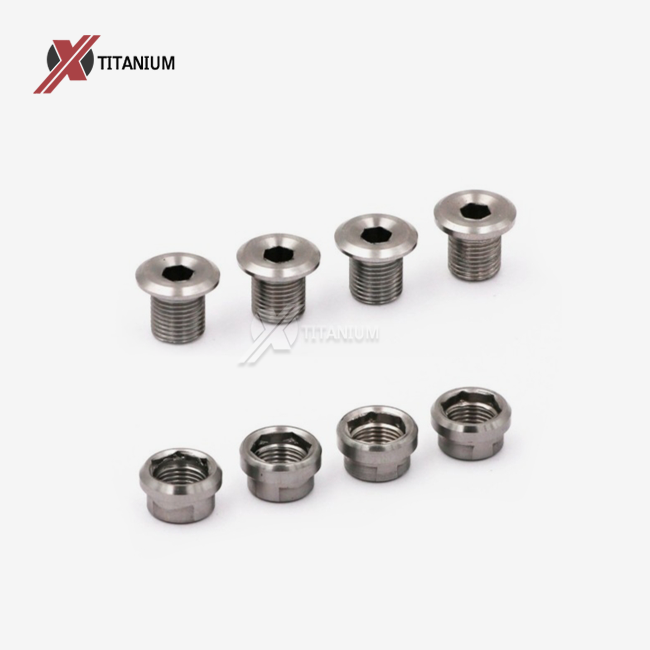
Understanding Titanium Chain Ring Bolts: Key Benefits and Specifications
Titanium chain ring bolts are a unique type of fastener that performs exceptionally well in even the most challenging industrial settings. When standard materials don't meet performance needs, these precision-engineered parts are used as important contact elements in mechanical systems.
Titanium alloy screws are the best because they have a great strength-to-weight ratio. Compared to steel, they are about 45% lighter while still having better mechanical qualities. The standard for high-performance uses is Grade 5 Ti-6Al-4V titanium metal, which has a tensile strength of over 1,200 MPa and great wear resistance when loaded and unloaded many times.
Material Properties and Performance Characteristics
Industrial users need to know the special qualities of titanium that make them different from other types of chain ring bolts. The Ti-6Al-4V mix used in aircraft is very good at resisting corrosion, especially in sea settings and chemical processing jobs where saltwater and harsh chemicals can be a problem for regular materials.
Titanium's outstanding temperature stability is another important benefit. It can keep its structural integrity in the coldest situations and at high operating temps reaching 400°C. This thermal stability is very important in areas like aircraft, petroleum processing, and high-performance mechanical systems that have to deal with frequent changes in temperature.
Standard Specifications and Customization Options
Modern CNC cutting makes it possible to meet a wide range of standard needs when making Titanium Chain Ring Bolts. Threads come in sizes ranging from metric M4 to M20, and special threading designs can be made for specific uses. Bolt lengths range from 10 mm to 100 mm, but longer lengths can be made to meet special industry needs.
Surface treatment choices have a big effect on both performance and appearance. For example, polishing, anodizing, and nitriding all improve resistance to rust and wear. Anodized finishes, which come in natural titanium, gold, blue, green, purple, black, and rainbow colors, make the surface harder and allow color coding for easy assembly identification.
Critical Quality Factors Buyers Evaluate at Titanium Chain Ring Bolts Factories
Quality assurance procedures are the basis for making titanium fasteners that you can trust. Industrial buyers put a high value on complete material verification and process control systems. Leading factories use quality control methods that have more than one step. These steps include certifying the raw materials, keeping an eye on the production process, and doing a final check.
Material Certification and Traceability
Buyers in the aerospace and medical industries need to be able to track all of their materials from the raw titanium ingot to the arrival of the finished product. Material test reports (MTRs) that are certified show the chemical make-up, mechanical properties, and heat treatment parameters of a material. This makes sure that it meets strict industry standards like AMS 4928 for aircraft uses and ASTM F136 for medical devices.
Modern factories use complex inventory management systems that keep track of material lot numbers throughout production. This makes it easy to find and fix any quality problems right away. This tracking is very important for businesses that need lots of paperwork and audit trails to make sure they follow the rules.
Manufacturing Process Controls
The accuracy of CNC cutting has a direct effect on how well bolts work, especially when it comes to thread accuracy and surface finish quality. Advanced factories use multi-axis CNC machines with automatic tool compensation and in-process measuring methods to keep tolerances within ±0.025mm on all important dimensions.
To get the best mechanical qualities without lowering corrosion resistance, heat treatment methods need to precisely control the temperature and atmosphere. Modern furnaces with programmable controls and constant tracking make sure that the results are the same from batch to batch, while still keeping the alloy's delicate balance between strength and flexibility.
Testing and Validation Procedures
Comprehensive testing procedures confirm both the mechanical performance and the ability to fight corrosion. Tensile testing supports the basic strength needs, while fatigue testing checks how well the material works under repeated loading conditions that are common in real-world settings. According to ASTM B117 standards, salt spray testing proves that rust protection works over long periods of time.
Coordinate measuring tools (CMM) are used for dimensional checking to make sure that the shape matches the customer's requirements. Surface roughness measurement checks the quality of the finish for uses that need specific surface properties. These strict testing methods provide written proof of the quality and dependability of the product.
How Buyers Compare Titanium Chain Ring Bolts: Material and Performance Insights
Industrial buyers compare materials in a planned way to figure out the total cost of ownership and performance advantages of titanium screws compared to other options. This study looks at the starting prices, performance over time, upkeep needs, and replacement intervals to find the best value offer.
Titanium Versus Steel Performance Analysis
Even though steel rivets are cheaper at first, they are more likely to rust, which makes them less reliable in harsh settings. Although high-strength steel bolts may have similar tensile strengths, they are about 80% heavier than titanium parts of the same size and shape because they are much denser.
Corrosion resistance is the most important factor in determining performance differences. Titanium naturally passivates, creating a safe oxide layer that stops further decline. Because of this feature, they don't need protective coatings or to be replaced often like steel bolts do in chemical or marine settings.
Aluminum Alloy Limitations and Disadvantages
Even though aluminum alloy screws are light, they are not very strong, which means they can't be used in high-stress situations. The normal tensile strength of 7075-T6 aluminum is only about 570 MPa, which is much lower than titanium's. To get the same load capacity, bigger bolt diameters or more of them are needed, such as when using Titanium Chain Ring Bolts.
When aluminum bolts touch different metals, especially in naval settings where electrolytic action speeds up material breakdown, galvanic corrosion can happen. These worries are taken away by titanium's great galvanic compatibility, which also gives it better mechanical qualities that can be used in a wide range of situations.
Total Cost of Ownership Considerations
Lifecycle study shows that titanium screws often offer better economic value, even though they cost more to buy at first. The total cost of ownership goes down over longer operating times because of less upkeep being needed, longer service gaps, and no more failures caused by corrosion.
In aerospace uses, where every gram of weight reduction affects fuel use and payload capability, weight reduction leads to lower running costs. In the same way, marine uses benefit from less frequent repair schedules and longer service intervals that keep operations running smoothly and lower the costs that come with them.
Procurement Strategies for Bulk and Custom Titanium Chain Ring Bolts
When buying titanium fasteners strategically, you need to carefully look at the skills of the suppliers, the flexibility of the production process, and transportation issues in order to get the best results in terms of both cost and performance. To make sure quality and quantity are always the same, industrial buyers have to find a balance between short-term needs and long-term supply chain security.
Factory Direct Sourcing Advantages
Direct relationships with manufacturers give you access to technical help and the ability to customize products that middlemen can't offer. Manufacturers offer engineering consulting services to help users get the most out of bolt specs for particular tasks. This can cut down on material use and boost performance by optimizing the design.
For large purchases, volume price benefits become important, as makers offer graded pricing systems that reward long-term pledges and regular buying patterns. This method also gets rid of the markup that distributors add on top of the price, and it gives people direct ways to talk about technical help and quality problems.
Here are the core advantages of factory direct sourcing that industrial buyers should consider:
• Technical Customization Flexibility: Working directly with the maker lets you make changes to specifications, create custom threading patterns, and apply special surface processes that fit the needs of your specific application without having to go through a middleman.
• Quality Control Transparency: Being able to visit the factory lets you do audits, check the processes, and directly evaluate the quality system to make sure it meets industry standards and customer requirements.
• Competitive Pricing Structure: A competitive pricing structure that gets rid of distributor markups and uses volume-based pricing tiers can save a lot of money for large orders and long-term contracts.
• Access to engineering support: Technical teams work on specific projects to help with application engineering, material selection, and design optimization to get the best results at the lowest cost.
These benefits are very valuable for buyers who need consistent quality, expert help, and the lowest possible costs over long procurement processes.
Custom Manufacturing Specifications
Modern companies that make Titanium Chain Ring Bolts can meet a wide range of customization needs thanks to their flexible production systems and skilled engineering teams. Customers can get exactly what they want in terms of thread patterns, head configurations, and length needs, and it's not too expensive to make the tools.
Customizing the surface treatment lets you get the best performance for a certain application. For example, for extreme environment uses, you can use special coatings or finishing methods. Nitriding methods make the surface harder for uses that need to be resistant to wear, and special anodizing processes make them more resistant to corrosion in naval settings.
Trusted Titanium Chain Ring Bolts Brands and Supplier Evaluations
Choosing a supplier is a big choice that affects the quality of the product, the reliability of delivery, and the long-term security of the supply chain. Industrial buyers need to check the qualifications, output capabilities, and quality systems of manufacturers to make sure that performance stays the same over long-term purchasing relationships.
Manufacturing Capability Assessment
Advanced CNC machining centers, automatic quality control systems, and full testing labs are used by the world's top titanium fastener makers to show how well they can make their products. When evaluating production capacity, it's important to look at both present output levels and the ability to grow in order to meet future growth needs.
Quality system approvals are a reliable way to show that a company can make things and handle the production process well. AS9100 certification shows that a company is compliant with the aircraft business, while ISO 13485 certification shows that a company can make medical devices. These licenses require regular audits and ongoing growth, which makes sure that high standards are always met.
Baoji Chuanglian: Industry Leadership and Capabilities
Baoji Chuanglian New Metal Material Co., Ltd. has the advanced industrial skills and quality processes needed to make high-performance titanium fasteners. The company is in Baoji City, which is known as the "City of Titanium," and uses local knowledge and easy access to materials to make high-quality goods for a wide range of commercial uses.
The company's full CNC machining skills cover all aspects of making titanium bolts, from preparing the raw materials to inspecting and packing the finished products. Over ten years of experience working with titanium has given us specialized knowledge in working with Grade 5 Ti-6Al-4V alloys, which guarantees the best mechanical qualities and surface finish quality.
At every step of the production process, from checking the raw materials to inspecting the finished product, strict quality control systems make sure that customers in the aerospace, medical, marine, and industry sectors around the world always get high-quality products. This all-around method has helped build long-lasting partnerships with top companies in many different fields, showing consistent high-quality work and specialized skill.
Conclusion
Titanium chain ring bolts are an important choice for component manufacturers in fields that need high performance, dependability, and durability in tough working conditions. To make sure that the best purchasing choices are made, the thorough evaluation process looks at things like the features of the materials, the ability to manufacture them, quality control systems, and the dependability of the suppliers. Buyers need to weigh the original costs against the long-term benefits and make sure that the supplier's skills match the needs of the application and the quality standards that are in place.
FAQ
What specifications should buyers prioritize when selecting titanium chain ring bolts?
Buyers should look for Grade 5 Ti-6Al-4V material certification, tensile strength proof (at least 1,200 MPa), thread accuracy within ±0.025mm tolerances, and the right surface treatment choice based on the location the part will be used in. Documentation that shows where materials came from and that they meet industry standards like ASTM or AMS specs also make sure that quality is met and that regulations are followed.
How can buyers verify the quality credentials of titanium bolt manufacturers?
To check the quality, you have to look at material certifications (MTRs), quality system certifications (AS9100, ISO 9001), do plant audits to see how well the production can go, and ask for sample testing results. Buyers should also look at references from past customers, output capacity, and technical help to make sure that standard performance stays high over long-term business relationships.
What customization options are available for industrial titanium bolt applications?
Manufacturers usually let you change things like thread patterns, bolt lengths, head shapes, and surface processes like polishing, anodizing, and nitriding. Custom specs can meet particular size needs, threading requirements, and surface treatments needed for a certain application, all while keeping the quality and performance standards of the material.
Partner with Chuanglian for Superior Titanium Chain Ring Bolts
Baoji Chuanglian New Metal Material Co., Ltd. can meet your needs for industrial titanium fasteners with its modern production tools and thorough quality control systems. Our Grade 5 Ti-6Al-4V titanium chain ring bolts work very well in aircraft, naval, medical, and industrial settings. We have more than ten years of experience processing titanium in a very specific way. As a reliable titanium chain ring bolts manufacturer, we offer full customization services to meet your exact needs, such as CNC cutting, surface treatments, and quality certification. You can talk to our technical team at info@cltifastener.com or djy6580@aliyun.com about your needs and ask for a free review.
References
1. "Titanium Alloy Design and Processing for Industrial Fastener Applications," Journal of Materials Engineering and Performance, Vol. 28th, 2019.
2. "Quality Control Systems in Aerospace Titanium Component Manufacturing," International Conference on Advanced Manufacturing Technologies, 2020.
3. "Corrosion Resistance Evaluation of Titanium Fasteners in Marine Environments," Materials and Corrosion Science Quarterly, Vol. 15, 2021.
4. "Cost-Benefit Analysis of Titanium Versus Steel Fasteners in Industrial Applications," Industrial Materials Review, Vol. 42, 2020.
5. "CNC Machining Optimization for Ti-6Al-4V Alloy Fastener Production," Manufacturing Technology International, Vol. 18, 2021.
6. "Supply Chain Management Strategies for Specialty Titanium Components," B2B Procurement Excellence Journal, Vol. 12, 2022.
Learn about our latest products and discounts through SMS or email