- English
- French
- German
- Portuguese
- Spanish
- Russian
- Japanese
- Korean
- Arabic
- Greek
- German
- Turkish
- Italian
- Danish
- Romanian
- Indonesian
- Czech
- Afrikaans
- Swedish
- Polish
- Basque
- Catalan
- Esperanto
- Hindi
- Lao
- Albanian
- Amharic
- Armenian
- Azerbaijani
- Belarusian
- Bengali
- Bosnian
- Bulgarian
- Cebuano
- Chichewa
- Corsican
- Croatian
- Dutch
- Estonian
- Filipino
- Finnish
- Frisian
- Galician
- Georgian
- Gujarati
- Haitian
- Hausa
- Hawaiian
- Hebrew
- Hmong
- Hungarian
- Icelandic
- Igbo
- Javanese
- Kannada
- Kazakh
- Khmer
- Kurdish
- Kyrgyz
- Latin
- Latvian
- Lithuanian
- Luxembou..
- Macedonian
- Malagasy
- Malay
- Malayalam
- Maltese
- Maori
- Marathi
- Mongolian
- Burmese
- Nepali
- Norwegian
- Pashto
- Persian
- Punjabi
- Serbian
- Sesotho
- Sinhala
- Slovak
- Slovenian
- Somali
- Samoan
- Scots Gaelic
- Shona
- Sindhi
- Sundanese
- Swahili
- Tajik
- Tamil
- Telugu
- Thai
- Ukrainian
- Urdu
- Uzbek
- Vietnamese
- Welsh
- Xhosa
- Yiddish
- Yoruba
- Zulu
China Titanium Torx Screws: Wholesale Buying Guide
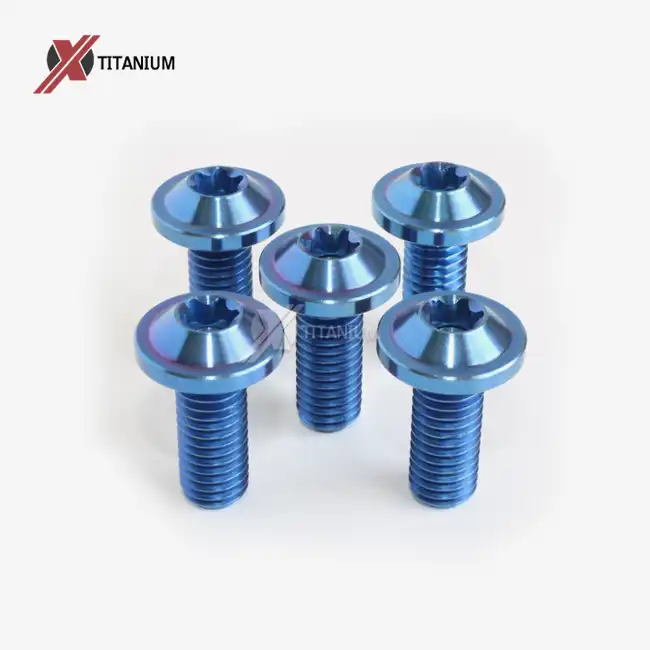
China titanium torx screws represent the pinnacle of precision fastening technology, combining the great properties of titanium metals with the hexalobular drive system's better power transfer capabilities. These specialized screws have changed the way businesses that need solutions that are strong, light, and resistant to corrosion work. It's important for procurement workers in aerospace, medical, marine, and high-performance industries to understand how to get high-quality titanium torx screws from Chinese makers as the demand for advanced materials continues to rise around the world.
Understanding China Titanium Torx Screws: Properties and Applications
China's titanium manufacturing industry has become a top maker of high-quality titanium torx screws by using its advanced metalworking knowledge and cutting-edge production facilities. These unique screws are the result of a complex combination of materials science and mechanical engineering. They have performance features that have never been seen before and solve important problems in the industrial world.
Material Science Excellence
Careful choice and handling of titanium alloys is what makes great titanium torx screws possible. Grade 5 titanium (Ti-6Al-4V) is the most popular because it has a tensile strength of 895–1000 MPa and a mass of only 4.43 g/cm³. This combination of alpha and beta alloys gives it an amazing strength-to-weight ratio that is about 45% lighter than standard steel bolts without affecting their structural integrity.
Commercially pure titanium grade 2 is better at resisting rust and being compatible with living things. This makes it essential for use in medical settings and chemical processing areas. These screws are almost completely protected against rust, chlorides, and oxidizing acids because they form a passive oxide film (TiO2) on their own when they are exposed to air.
Advanced Drive Technology
The hexalobular internal drive system, or Torx, changes the way things are installed because of the way its shapes are made. Unlike regular Phillips or hex drives, the star-shaped design has a 15-degree drive angle that changes rotational force into tangential force. This makes it much less likely for tools to come loose and increases their life. This design is especially useful when working with China titanium torx screws, which are naturally soft, because it keeps the head from deforming during high-torque tasks.
Industrial Applications
Titanium torx screws are used by aerospace companies for important tasks like fixing electronics, airframe panels, and engine parts that need to be stable at high temperatures (-200°C to +400°C) and not magnetic. Because they can withstand vibrations thanks to their high clamp load retention, these screws are necessary for UAV systems and satellite parts.
Titanium is used by medical device makers to make external support devices, surgery tools, and MRI-compatible gear because it is biocompatible. The Torx drive system is easier to clean than Phillips heads because it has fewer cracks. This makes it suitable for healthcare settings with strict cleaning standards.
These screws are used in high-performance racing and cycling to reduce extra weight on brake calipers, disc rotors, and other important parts that need to be serviced often and need to connect with the drive reliably without the heads coming off.
How to Identify Genuine China Titanium Torx Screws?
To prove that titanium torx screws are real, you need to know a lot about the material's properties, how it's made, and how to spot poor quality. Because fake goods pose big safety risks and don't work right, verification procedures are very important for successful buying.
Material Certification Standards
Genuine titanium torx screws must meet standards that are known all over the world, such as ASTM B348, ISO 5832, and DIN 17851. These certificates make sure that the strict quality standards are met in terms of chemical composition, mechanical properties, and production methods. Material test certificates (MTCs) from reputable Chinese makers include chemical analysis, tensile strength, and dimensional limits.
Visual Inspection Criteria
When you look at them, real titanium screws can be told apart from fake ones by certain visual traits. The finish on the surface should have smooth, even cutting lines that aren't pitted, discolored, or textured in an odd way. Grade 5 titanium usually looks a little darker than Grade 2 titanium, and anodized finishes should have even coloring that doesn't streak or fade.
Manufacturing Process Verification
Knowing what kinds of things China can make gives you an idea of the standard levels you can expect. Precision CNC machining, controlled atmosphere heat treatment, and automatic testing systems are all used in the best facilities. Forging titanium screws needs special tools that can deal with the way titanium hardens during the process, and thread rolling needs to be done with very close tolerances to avoid galling during installation.
Quality Assurance Protocols
China's well-known manufacturers use complete quality control systems, such as ISO 9001, AS9100 for aircraft uses, and ISO 13485 for medical products. These certificates show that the company is committed to maintaining quality control throughout all stages of production. Traceability systems should keep track of raw materials from the ingot to the end product. This way, all the necessary paperwork can be kept for important uses.
Comparing China Titanium Torx Screws With Other Fastening Options
To choose the right fastening options, you need to carefully look at their performance, costs over their entire life, and the needs of your particular application. Titanium torx screws are at the top of the fastening ranking for a reason: they offer benefits that make them worth the extra cost.
Mechanical Performance Analysis
Titanium Grade 5 screws have the same tensile strength as 8.8 or 10.9 grade steel, but they are a lot lighter. But titanium might not be strong enough for uses that need Class 12.9 steel strength levels unless it is specially designed with rolled threads and optimized shank sizes. China titanium torx screws offer a solution for applications requiring high precision and torque resistance. Titanium has a modulus of flexibility of 114 GPa, while steel has a modulus of 200 GPa. This changes how joints behave when they are loaded and unloaded quickly.
Even though stainless steel screws are resistant to corrosion, titanium is better in naval settings where chloride contact causes pitting and crevice corrosion. Aluminum screws are lighter than other materials, but they aren't strong or durable enough for high-stress situations.
Corrosion Resistance Superiority
Titanium surfaces form an inactive oxide layer that protects them from external damage like no other. In the lab, it was shown that titanium keeps its shape after 10,000 hours of contact to salt spray, but stainless steel breaks down in a way that can be seen. This resistance to corrosion directly means lower upkeep costs and a longer working life.
Total Cost of Ownership
Titanium screws are more expensive at first than steel or stainless steel screws, but when you look at the total cost of ownership, you can see that they are much better. Lower lifecycle costs are caused by things like longer service life, less upkeep, and no more breakdowns caused by corrosion. When industries that work in harsh settings switch to titanium fastening systems, they report upkeep costs going down by 30 to 50 percent.
Wholesale Procurement Guide for China Titanium Torx Screws
To get around in the Chinese titanium fastener market, you need to know what suppliers can do, how quality systems work, and the best ways to buy things. Building ties with producers who show they are technically competent and reliable is key to success.
Supplier Evaluation Criteria
There are a few things that set leading Chinese titanium producers apart that show they can consistently offer high quality. To keep titanium from getting mixed up with other alloys, factories should have tools just for handling titanium. Precision measurements and a smooth surface are made possible by CNC machines that are set up to work with titanium's special cutting properties.
Quality management systems include more than just basic ISO certifications. They also include standards specific to the business, like AS9100 for aircraft or FDA registration for medical uses. According to international standards, well-known providers keep complete testing labs that can do chemical analysis, mechanical testing, and dimensional proof.
Order Specifications and Customization
For a procurement to go well, detailed specifications must be made, including the grade of titanium, the size and shape standards, the drive size, the thread specs, and the surface treatments. Chinese makers usually can handle requests for custom lengths, head shapes, and surface coatings like PVD or anodizing to improve performance or make the product easier to identify.
Different sources have very different minimum order amounts. For normal setups, established makers usually need between 1,000 and 5,000 pieces. Due to setup costs and material optimization concerns, custom specs may cause minimum amounts to go up. Lead times for basic goods are usually between 4 and 8 weeks, and they can go up to 12 to 16 weeks for complex customizations.
Logistics and Quality Assurance
To keep the purity of the goods and the accuracy of the paperwork, international shipping needs to be carefully coordinated. Reliable providers offer complete packing that keeps items safe during shipping and allows for tracking through lot numbering systems. Each package, including China titanium torx screws, should come with material certificates, dimensional reports, and shipping paperwork to make it easier to get through customs and pass through the receiving check.
Payment terms are usually the same as they are around the world, and for big orders, letters of credit or bank transfers are favored. Suppliers often accept sample orders with faster payment terms to make the acceptance and review processes go more smoothly.
Making the Right Decision: How to Choose the Best China Titanium Torx Screws for Your Needs?
When choosing strategic fasteners, you need to look at the needs of the application, the skills of the supplier, and the possibility of a long-term relationship. Technical standards, quality assurance, and the dependability of the supply chain should all be taken into account during the decision-making process.
Technical Requirements Assessment
The first step in application analysis is to look at the environmental variables, such as temperature changes, chemical exposure, and patterns of mechanical stress. Grade 5 titanium may be needed for aerospace applications to get the best strength, while Grade 2 titanium is better for medical uses because it is more biocompatible. To avoid galling or cross-threading, thread standards must take into account the materials that will be used to mate them and how they will be put together.
The drive size you choose affects both the power you can use and the tools you need. Larger Torx drives can handle higher mounting torques, while smaller ones are better for situations where room is limited. Surface treatments like PVD coating lower friction coefficients and stop cold welding, which is very important for uses that need to take parts apart a lot.
Supplier Partnership Development
Successful buying relationships include more than just transactions. They also include expert cooperation and efforts to make things better all the time. Preferred providers show they are willing to help with application engineering, which helps choose the best fasteners for each job. By working together, people often find ways to cut costs by standardizing things or coming up with different requirements.
Long-term relationships let suppliers keep dedicated stock levels, which cuts down on lead times for regular orders and ensures uniform quality through set production methods. Regular checks and reviews of suppliers' work keep relationships in good shape and find ways to make things better.
Clear performance measures, such as delivery dates, quality levels, and contact methods, should be set out in quality agreements. These deals set rules for how to solve problems while keeping output going.
Conclusion
When traditional fixings don't work well in tough situations, China titanium torx screws are a high-tech answer. The unique qualities of titanium and the modern Torx drive system work together to make fasteners that can stay in place in the toughest conditions. To be good at procurement, you need to know about material science, manufacturing methods, and the skills of your suppliers so that you can make decisions that improve performance while keeping costs low. Buying good titanium fasteners is a smart move because they last longer, need less upkeep, and are more reliable in high-performance, medical, aircraft, and marine settings.
FAQ
What grades of titanium are commonly used in Chinese torx screws?
The most popular materials used to make torx screws are Grade 2 economically pure titanium and Grade 5 (Ti-6Al-4V) alloy. Grade 2 is great for medical and chemical processing uses because it is highly resistant to rust and doesn't harm living things. Grade 5 has better strength properties, with a tensile strength of up to 1000 MPa. It is good for aerospace and high-performance uses that need the highest strength-to-weight ratios.
How can I verify compliance with international quality standards?
Reliable Chinese makers give full material test certificates (MTCs) that show the chemical make-up, mechanical qualities, and size tolerances that meet ASTM, ISO, or DIN standards. The chemical makeup and hardness of different types of titanium can be checked independently by third-party testing services using X-ray fluorescence (XRF) research. Quality management standards like ISO 9001, AS9100, or ISO 13485 show that quality control methods are organized and well-run.
What are typical lead times for bulk titanium torx screw orders?
Standard setups usually take between 4 and 8 weeks to make, while custom designs can take up to 12 to 16 weeks, based on how complicated they are. Lead times are affected by things like the size of the order, the level of customization needed, the surface treatment, and the current production plan. Suppliers that have been around for a while usually keep extras of popular setups in stock. This can cut down on delivery times for regular orders. Customers who place orders in a hurry may be able to get them faster and for a higher price.
Why do titanium torx screws sometimes experience galling during installation?
Titanium tends to cold join, which leads to galling when metal surfaces freeze up during installation. For this to happen, titanium needs to be chemically reactive and not very hard compared to steel. Some ways to stop this from happening are to use anti-seize compounds, choose PVD or DLC coatings that have low friction coefficients, and make sure you always use the right installation force specs. When compared to hex drives, the Torx drive system spreads installation forces over a larger contact area, which helps reduce galling.
Are titanium torx screws suitable for magnetic-sensitive applications?
Titanium has paramagnetic properties, which means that it is not magnetic in real life. This quality is very important for MRI machines, electronic instruments, and guidance systems that need to keep magnetic interference to a minimum. Unlike ferromagnetic materials like steel, titanium screws won't mess up compass readings or sensitive computer parts. This makes them the best choice for use in medical devices and spacecraft.
Partner with Chuanglian for Premium China Titanium Torx Screws
You can trust Chuanglian as a China titanium torx screws manufacturer. They have more than ten years of experience making and creating titanium fasteners. We are in Baoji City, which is known as the 'City of Titanium,' and our fasteners are better than worldwide standards because we use modern manufacturing techniques and strict quality control systems. Our extensive CNC machine facilities and dedicated technical team make sure that even the most difficult jobs are completed with consistent quality and exact measurements.
Our knowledge of titanium metallurgy and precision production means that we can give you the best solutions for your project, whether you need standard setups or unique specs. Get in touch with our knowledgeable staff at info@cltifastener.com or djy6580@aliyun.com to talk about your specific requirements and get accurate quotes for high-quality titanium torx screws that work amazingly well and are very reliable.
References
1. Davis, J.R. "Titanium: A Technical Guide, 2nd Edition." ASM International Materials Reference Series, 2006.
2. Boyer, R., Welsch, G., and Collings, E.W. "Materials Properties Handbook: Titanium Alloys." ASM International, 1994.
3. Lutjering, G. and Williams, J.C. "Titanium, 2nd Edition: Engineering Materials and Processes." Springer-Verlag Berlin Heidelberg, 2007.
4. American Society for Testing and Materials. "ASTM B348 - Standard Specification for Titanium and Titanium Alloy Bars and Billets." ASTM International, 2019.
5. International Organization for Standardization. "ISO 10664:2005 - Hexalobular socket head cap screws." ISO Standards Catalogue, 2005.
6. Schutz, R.W. and Thomas, D.E. "Corrosion of Titanium and Titanium Alloys." Metals Handbook, Volume 13: Corrosion, ASM International, 1987.
Learn about our latest products and discounts through SMS or email