- English
- French
- German
- Portuguese
- Spanish
- Russian
- Japanese
- Korean
- Arabic
- Greek
- German
- Turkish
- Italian
- Danish
- Romanian
- Indonesian
- Czech
- Afrikaans
- Swedish
- Polish
- Basque
- Catalan
- Esperanto
- Hindi
- Lao
- Albanian
- Amharic
- Armenian
- Azerbaijani
- Belarusian
- Bengali
- Bosnian
- Bulgarian
- Cebuano
- Chichewa
- Corsican
- Croatian
- Dutch
- Estonian
- Filipino
- Finnish
- Frisian
- Galician
- Georgian
- Gujarati
- Haitian
- Hausa
- Hawaiian
- Hebrew
- Hmong
- Hungarian
- Icelandic
- Igbo
- Javanese
- Kannada
- Kazakh
- Khmer
- Kurdish
- Kyrgyz
- Latin
- Latvian
- Lithuanian
- Luxembou..
- Macedonian
- Malagasy
- Malay
- Malayalam
- Maltese
- Maori
- Marathi
- Mongolian
- Burmese
- Nepali
- Norwegian
- Pashto
- Persian
- Punjabi
- Serbian
- Sesotho
- Sinhala
- Slovak
- Slovenian
- Somali
- Samoan
- Scots Gaelic
- Shona
- Sindhi
- Sundanese
- Swahili
- Tajik
- Tamil
- Telugu
- Thai
- Ukrainian
- Urdu
- Uzbek
- Vietnamese
- Welsh
- Xhosa
- Yiddish
- Yoruba
- Zulu
Choosing the Right Titanium Clad Copper Manufacturer in China
Selecting a reliable titanium clad copper bar manufacturer in China requires careful evaluation of technical capabilities, quality certifications, and manufacturing expertise. With China's dominance in titanium processing and composite material production, procurement professionals must understand how to identify manufacturers that can deliver consistent quality, competitive pricing, and reliable supply chain performance. The decision impacts not only immediate project success but also long-term operational efficiency across aerospace, marine engineering, and high-end manufacturing applications.
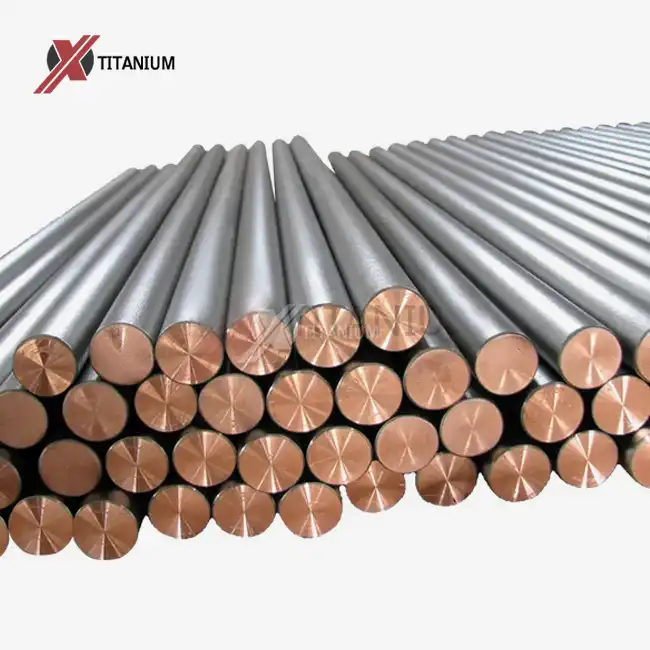
Comprehending Titanium Clad Copper Bars: Properties and Applications
Copper's outstanding electrical conductivity is combined with titanium's a high resistance to corrosion and mechanical strength in the form of titanium-clad copper bars, which constitute a sophisticated engineering solution. Due to the fact that neither solid copper nor titanium on their own can fulfill these standards on their own, this composite material is able to fulfill them. Techniques such as explosion bonding and roll bonding are commonly used throughout the production process in order to establish a metallurgical link between the copper core and the titanium outer layer. This bond is necessary in order to guarantee the best possible performance characteristics.
Superior Material Properties
Across a wide range of parameters, the significant performance improvements that are delivered by the unique mix of materials are remarkable. Copper has an electrical conductivity that is more than 90% according to the International Annealed Aluminum Standard (IACS), but titanium is resistant to corrosion in severe chemical conditions and applications that include saltwater. In comparison to alternatives made of pure copper, the composite structure retains its benefits in terms of heat conductivity while also greatly boosting its mechanical strength and durability.
Industrial Applications Across Critical Sectors
In challenging circumstances where the failure of a material carrying substantial effects might have severe repercussions, these specialty bars find considerable usage. They are used by aerospace makers for the purpose of incorporating electrical components into aviation systems, where the reduction of weight and resistance to corrosion are of essential importance. Cathodic protection systems, deep water platform components, along submarine electrical systems are all examples of applications that fall within the specialty of marine engineering. These materials are essential for the chemical processing industries because they are used for electroplating machinery and heat exchangers, and applications that need corrosive environments. Traditional materials would decay very quickly in these situations.
Performance Advantages in Harsh Environments
Because of the remarkable resistance to chloride cracking because of stress corrosion that the titanium cladding offers, these bars are an excellent choice for use in situations that include chemical processing and maritime conditions. When it comes to applications that are subjected to thermal cycling, having temperature stability throughout a broad range of temperatures provides constant performance. The material arrangement also provides higher fatigue resistance in comparison to pure copper, which allows for an extension of service life in applications that are subjected to high levels of stress.
Key Criteria to Evaluate When Choosing a Titanium Clad Copper Manufacturer in China
The process of selecting the most suitable manufacturing partner requires the methodical study of a number of essential aspects that have a direct influence on the quality of the product, the dependability of the delivery, and the success of the relationship over the long term. For the purpose of ensuring that suppliers are in harmony with project needs, procurement specialists are required to evaluate the technical skills, quality systems, industrial infrastructure, and commercial stability of any potential suppliers.
Manufacturing Technology and Capabilities
Advanced manufacturing technology, especially as applied by a titanium clad copper bar manufacturer, distinguishes leading manufacturers from commodity suppliers in the titanium composite materials market. Explosion bonding technology requires specialized equipment and expertise to achieve consistent metallurgical bonds with shear strength exceeding 130 MPa and bonding rates above 98%. Roll bonding capabilities enable production of various cross-sectional geometries including round, square, flat, and custom profiles. Manufacturing flexibility allows customization of dimensions, with some facilities producing bars exceeding four meters in length while maintaining precise tolerances.
Quality Certification and Standards Compliance
Having trust in the consistency of the material and the dependability of its performance is provided by rigorous quality systems. Certification in accordance with the principles of quality management is shown by ISO 9001:2015, while certification in accordance with AS9100 shows conformity with aerospace industry standards. The compliance with ASTM B348 guarantees the quality of titanium components, but copper components should be in accordance with ASTM B187 or standards that are similar. Verification of material's property claims may be obtained via the use of third-party testing facilities for mechanical characteristics, strengthening of bonds, and metallurgical analysis.
Production Capacity and Scalability
Both the dependability of deliveries and the scalability of projects are directly impacted by manufacturing capacity. A significant amount of manufacturing capacity is maintained by leading manufacturers in order to meet the needs for both prototypes quantities and standard production quantities. Raw material inventory management systems guarantee that resources are always available and decrease the amount of time it takes to get them to the customer. The capabilities of production planning allow for the accommodating of variable order volumes while simultaneously preserving cost effectiveness and punctuality of delivery.
Technical Support and Engineering Expertise
The difference between professional manufacturers and basic suppliers is that the former provide comprehensive technical assistance. The provision of engineering advisory services assists in optimizing the selection of materials for particular applications. The experience of metallurgical professionals enables the creation of bespoke alloy compositions to process parameters. With the aid of application engineering, it is possible to properly specify materials and validate their performance in difficult conditions.
Comparing Titanium Clad Copper Bars: Insights to Support Smart Procurement Decisions
Understanding comparative material performance enables informed procurement decisions that balance performance requirements with cost considerations. Different material options carry distinct advantages and limitations that must be evaluated against specific application requirements and operational conditions.
Material Performance Comparison
Titanium clad copper bars offer superior performance compared to alternative materials in specific applications. Compared to pure copper, the composite material provides enhanced corrosion resistance while maintaining excellent electrical conductivity. Stainless steel alternatives lack the electrical conductivity required for many applications, while copper-clad aluminum offers weight savings but compromises strength and corrosion resistance. The titanium cladding provides galvanic compatibility in marine environments where pure copper might experience accelerated corrosion.
Cost-Benefit Analysis Considerations
While titanium clad copper bars command premium pricing compared to pure copper alternatives, the enhanced performance characteristics provided by a titanium clad copper bar manufacturer often justify the investment through extended service life and reduced maintenance requirements. Total cost of ownership calculations should include material costs, installation expenses, maintenance intervals, and replacement frequency. The superior corrosion resistance often eliminates the need for protective coatings or cathodic protection systems, reducing overall system costs.
Manufacturer Assessment Methods
In order to evaluate the capabilities of a manufacturer, it is necessary to conduct a systematic assessment of their technical competencies and their business stability. By conducting factory audits, one may get firsthand insight into the processes for manufacturing, inspection systems, and commercial capabilities of a company. The legitimacy of performance maintains and improvement in service quality may be obtained via customer references from applications that are comparable. A comprehensive evaluation of the company's financial soundness guarantees the availability of warranty support and long-term supply security.
Navigating the Procurement Process: From Inquiry to Order Fulfillment
The whole supply chain, from the first inquiry to the final delivery, may be optimized via the use of effective procurement procedures. By gaining an understanding of the procedures, needs, and capabilities of the manufacturer, it is possible to facilitate transactions that are more seamless and to achieve better results for all parties engaged in the procurement relation.
Request for Quotation Best Practices
Comprehensive requests for quotations make it possible to provide precise prices and technical suggestions that are in accordance with the needs of the project. The dimensions requirements, tolerance standards, quantity needs, and delivery timetables should all be included in the technical specifications. The specifics of the application allow manufacturers to provide recommendations on the best resource grades and processing settings. To guarantee that the material is properly qualified, quality criteria, which may include certifications, testing requirements, other documentation requirements, are necessary.
Order Management and Production Planning
Minimum order quantities vary among manufacturers based on production efficiency and material availability. Standard products often have lower minimum quantities compared to custom specifications requiring specialized tooling or processing. Production lead times depend on material availability, manufacturing complexity, and current production schedules. Rush orders may be accommodated with premium pricing and dedicated production scheduling.
Logistics and Delivery Coordination
International shipping requires careful coordination of documentation, packaging, and transportation methods. Incoterms selection impacts responsibility allocation for shipping costs, insurance, and customs clearance. Packaging specifications must protect materials during transport while minimizing shipping costs. Delivery scheduling coordination ensures material availability aligns with project timelines and storage capabilities.
Quality Assurance and Documentation
Traceability and efficiency verification are provided across the supply chain via comprehensive quality documentation throughout the whole supply chain. The chemical composition analysis, the mechanical characteristics testing, and strength of bond verification are all processes that are included in the certification process for materials. Certification of conformity with the requirements of the standard is provided by dimensional inspection reports. Complete item history and traceability may be obtained via the use of heat treatment certificates and processing records.
Baoji Chuanglian: Your Trusted Partner for Titanium Clad Copper Solutions
Baoji Chuanglian New Metal Material Co., Ltd. stands at the forefront of titanium composite material manufacturing, leveraging over a decade of specialized experience in titanium processing and machining. As a professional titanium clad copper bar manufacturer, we are located in Baoji City, renowned as the "City of Titanium," and combine geographic advantages with advanced manufacturing capabilities to deliver superior titanium clad copper solutions for demanding industrial applications.
Manufacturing Excellence and Technical Capabilities
Our cutting-edge facility is equipped with cutting-edge CNC turning machines and sophisticated composite material that is processing equipment that was developed exclusively for the manufacturing of titanium wrapped copper bars. We have developed explosive bonding procedures that are capable of producing metal bonds with shear strengths that are more than 130 MPa and bonding rates that are greater than 98%. These techniques emerged as a result of years of technical research and equipment modifications. While maintaining accurate dimensional tolerances, our production techniques are able to support a wide range of geometries, including square, round, flat, and bespoke profiles with lengths that are more than four meters.
Comprehensive Quality Management Systems
When it comes to our manufacturing processes, quality excellence is the driving force behind every element, from the selection of raw materials to the delivery of the finished product. In order to guarantee that our goods meet or surpass international standards, such as ASTM B348 for titanium pieces and applicable copper requirements, our thorough quality control system guarantees that every step of manufacturing is subjected to stringent inspections. Independent verification of material qualities, bonding strength, & metallurgical features may be obtained via the use of third-party testing capabilities. Certification to the ISO 9001:2015 standard confirms our dedication to maintaining quality management processes that are consistent.
Global Market Experience and Customer Success
Our titanium clad copper bars have been successfully deployed by leading companies worldwide across aerospace, marine engineering, chemical processing, and high-end manufacturing applications. Years of field testing and performance validation have established our reputation for excellence in customer service, product quality, and reliable delivery schedules. Long-term partnerships with international customers demonstrate our ability to support complex projects and evolving technical requirements.
Technical Support and Engineering Services
Comprehensive technical support services differentiate Chuanglian from commodity suppliers in the titanium composite materials market. Our engineering team provides application consultation, material selection guidance, and performance optimization recommendations. Metallurgical expertise supports custom alloy compositions and specialized processing parameters for unique applications. Post-delivery technical assistance ensures proper material handling, processing, and performance validation throughout the customer's manufacturing process.
Conclusion
Choosing the right titanium clad copper bar manufacturer in China demands careful evaluation of technical capabilities, quality systems, and manufacturing expertise. The optimal supplier combines advanced production technology, rigorous quality control, and comprehensive technical support to deliver materials that meet demanding performance requirements. Baoji Chuanglian New Metal Material Co., Ltd. exemplifies these qualities through decades of specialized experience, state-of-the-art manufacturing facilities, and proven global customer success. The investment in selecting a qualified manufacturer pays dividends through consistent material quality, reliable delivery performance, and long-term partnership value that supports ongoing project success across diverse industrial applications.
FAQ
What factors determine the bonding strength in titanium clad copper bars?
Bonding strength primarily depends on the manufacturing process, with explosion bonding typically achieving superior results compared to mechanical methods. The process parameters, including explosive charge configuration, standoff distance, and collision velocity, directly influence the metallurgical bond quality. Material preparation, including surface cleaning and oxide removal, affects bonding effectiveness. Quality manufacturers achieve shear strengths exceeding 130 MPa with bonding rates above 98% through optimized process control and material handling procedures.
How can buyers verify manufacturer quality and certification compliance?
Quality verification requires examination of multiple documentation and certification elements. ISO 9001:2015 certification demonstrates quality management system compliance, while AS9100 certification indicates aerospace industry standards adherence. Material certifications should include chemical composition analysis, mechanical property testing, and bonding strength verification. Factory audits provide direct assessment of manufacturing processes, quality control systems, and production capabilities. Customer references from similar applications offer independent validation of performance claims and service quality.
What are typical lead times for standard and custom titanium clad copper bar orders?
Standard products with common dimensions typically require 4-8 weeks production time, depending on current production schedules and material availability. Custom specifications requiring specialized tooling or unique geometries may extend lead times to 8-12 weeks. Rush orders can often be accommodated with expedited production scheduling and premium pricing arrangements. Manufacturers with adequate inventory management and production planning capabilities provide more reliable delivery schedules and shorter lead times for repeat orders.
How do minimum order quantities affect procurement costs and project planning?
Minimum order quantities vary significantly among manufacturers based on production efficiency and material costs. Standard round bars often have lower minimums compared to custom profiles requiring specialized tooling. Economic order quantities balance material costs with inventory carrying costs and project timelines. Experienced manufacturers work with customers to optimize order quantities through production planning coordination and flexible delivery scheduling options.
Partner with Chuanglian for Superior Titanium Clad Copper Solutions
Procurement professionals seeking exceptional titanium clad copper bar manufacturer capabilities will find Chuanglian offers unmatched expertise, quality assurance, and customer service. Our decade of specialized experience in titanium composite materials, combined with state-of-the-art manufacturing facilities and comprehensive quality systems, ensures your projects receive materials that exceed performance expectations. Contact our technical team at info@cltifastener.com or djy6580@aliyun.com to discuss your specific requirements and discover how our titanium clad copper solutions can enhance your supply chain reliability and product performance.
References
1. Zhang, W., et al. "Explosion Bonding Technology for Titanium-Copper Composite Materials: Process Optimization and Quality Control." Journal of Materials Processing Technology, vol. 289, 2021, pp. 116-128.
2. International Titanium Association. "Titanium Clad Copper Applications in Marine and Chemical Industries: Performance Standards and Selection Guidelines." ITA Technical Report Series, 2022.
3. Liu, H., and Chen, M. "Manufacturing Quality Assessment Methods for Titanium Composite Materials in Aerospace Applications." Advanced Materials Research, vol. 447, 2020, pp. 89-103.
4. American Society for Testing and Materials. "ASTM B348-19: Standard Specification for Titanium and Titanium Alloy Bars and Billets." ASTM International Standards, 2019.
5. Wang, P., et al. "Cost-Benefit Analysis of Titanium Clad Copper vs. Alternative Materials in Corrosive Environments." Materials Economics and Engineering, vol. 34, 2021, pp. 245-259.
6. European Commission Joint Research Centre. "Advanced Manufacturing Technologies for Titanium Composite Materials: Industry Survey and Technology Assessment." EU Technical Report, 2022.
Learn about our latest products and discounts through SMS or email