- English
- French
- German
- Portuguese
- Spanish
- Russian
- Japanese
- Korean
- Arabic
- Greek
- German
- Turkish
- Italian
- Danish
- Romanian
- Indonesian
- Czech
- Afrikaans
- Swedish
- Polish
- Basque
- Catalan
- Esperanto
- Hindi
- Lao
- Albanian
- Amharic
- Armenian
- Azerbaijani
- Belarusian
- Bengali
- Bosnian
- Bulgarian
- Cebuano
- Chichewa
- Corsican
- Croatian
- Dutch
- Estonian
- Filipino
- Finnish
- Frisian
- Galician
- Georgian
- Gujarati
- Haitian
- Hausa
- Hawaiian
- Hebrew
- Hmong
- Hungarian
- Icelandic
- Igbo
- Javanese
- Kannada
- Kazakh
- Khmer
- Kurdish
- Kyrgyz
- Latin
- Latvian
- Lithuanian
- Luxembou..
- Macedonian
- Malagasy
- Malay
- Malayalam
- Maltese
- Maori
- Marathi
- Mongolian
- Burmese
- Nepali
- Norwegian
- Pashto
- Persian
- Punjabi
- Serbian
- Sesotho
- Sinhala
- Slovak
- Slovenian
- Somali
- Samoan
- Scots Gaelic
- Shona
- Sindhi
- Sundanese
- Swahili
- Tajik
- Tamil
- Telugu
- Thai
- Ukrainian
- Urdu
- Uzbek
- Vietnamese
- Welsh
- Xhosa
- Yiddish
- Yoruba
- Zulu
Comparing Countersunk vs. Button Head Titanium Bolts
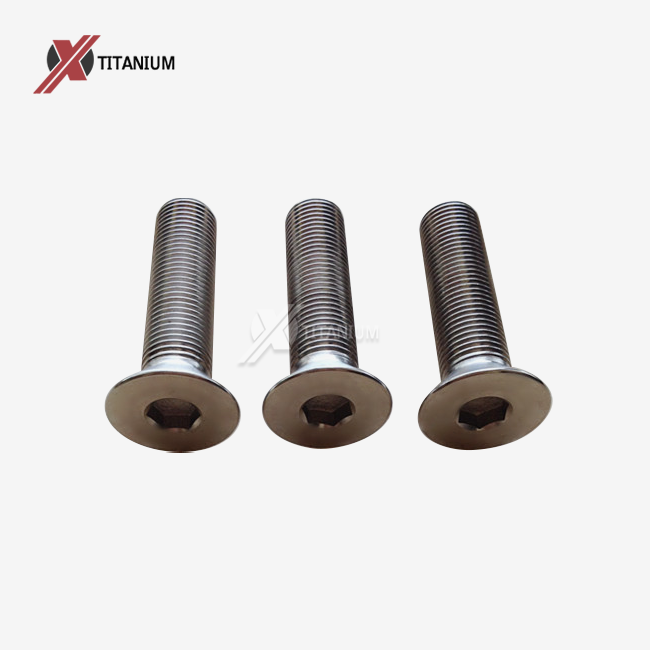
The choice between countersunk and button head designs has a big effect on both usefulness and operational efficiency when looking at titanium fastening options for high-performance uses. Titanium countersunk screws have a cylindrical bearing surface that sits flush with the material they are attached to. This means that there are no surface protrusions that could get in the way of air flow or cause snags. In contrast, button head bolts have a smooth shape above the surface, which makes them easier to grip and better for fitting.
Introduction
Fastening options that work really well in tough conditions are needed for modern industrial manufacturing. Titanium nuts are now the best choice for situations where you need high strength-to-weight ratios, great corrosion resistance, and long-term longevity. The choice between countersunk and button head types is a key one that affects how quickly and well the parts are installed, how they look, and how well they work.
When procurement professionals know the subtle differences between these titanium bolt designs, they can make choices that meet both short-term project needs and long-term business goals. This in-depth study looks at the technical details, performance traits, and use cases that make countersunk titanium bolts different from button head titanium bolts in the aircraft, marine, medical, and industrial manufacturing fields.
Titanium rivets are becoming more popular because they can resist harsh environmental conditions and still keep their structural integrity. These specialized fasteners have measured performance benefits that support their high price point in the market. For example, in aerospace uses, reducing weight directly affects fuel economy. In marine settings, corrosion resistance stops catastrophic failures.
Understanding Titanium Countersunk and Button Head Bolts
Differentiating between countersunk and button head titanium bolts comes down to how they were geometrically designed and how they work. Countersunk bolts have a cylindrical bearing surface with 90-degree angles for metric measurements and 82-degree angles for imperial measurements. This lets the bolts be fully integrated below the surface level of the base. This flush-mounting feature gets rid of aerodynamic problems in aircraft uses and stops snagging risks in marine settings.
Design Characteristics and Geometric Differences
Titanium bolts with button heads have a rounder, dome-shaped shape that sticks out above the fastening surface. In this arrangement, installation tools are easier to get to, and the load forces are spread out over a larger contact area. The higher shape makes it easier to do maintenance, which is especially helpful in situations where the part needs to be taken apart or inspected often.
For countersunk designs, ISO 10642 sets the standards for manufacturing, and DIN 7380 sets the standards for button head designs. These standards make sure that all manufacturers produce the same high-quality products with accurate measurements. This makes it possible for products from different makers to be used interchangeably in existing supply chains.
Material Properties and Grade Selection
Both types of bolts are made from either Grade 2 (commercially pure) or Grade 5 (Ti-6Al-4V) titanium alloys. Each has its own set of performance qualities that make it best for a certain purpose. Because Grade 2 titanium is very resistant to corrosion and not too strong, it is perfect for chemical processing and naval uses where exposure to the environment is the main worry.
With a density of 4.43 g/cm³, Grade 5 titanium has a higher tensile strength of about 950 MPa while still being an extremely lightweight material. Because of these factors, Grade 5 is very useful for uses in aircraft and automotive, where both structural strength and weight reduction are very important.
Thread Specifications and Size Availability
Standard thread settings include coarse and fine sizes in metric units, as well as uniform thread standards for use in North America. The most common size ranges for metric specifications are M3 to M20, and for unified threads, they are #4-40 to 3/4"-10. Custom thread specifications can be made to fit unique needs that require non-standard designs. For example, Titanium countersunk screws may require specific thread sizes or configurations to ensure a precise fit and optimal performance in specialized applications.
Performance Comparison: Countersunk vs. Button Head Titanium Bolts
There are more differences in performance between countersunk and button head titanium bolts than just differences in shape. These differences include load distribution patterns, stress concentration factors, and environmental resistance characteristics. Knowing these differences helps engineers choose the best fastening solutions for each operational need.
Load Distribution and Stress Analysis
Countersunk bolts focus stress loads at the interface of the conical bearing surface, which means that stress concentration points may exist and need to be carefully thought through during the design process. The flush-mounting feature spreads shear forces across the countersunk surface area, which may lower peak stress concentrations when installed correctly with matched countersink angles.
Button head designs spread loads across the larger head diameter, making more even stress patterns that can handle higher tensile loads without the head breaking. The rounded profile lowers stress concentration factors compared to sharp-edged options, which helps improve fatigue resistance in cyclic loading applications.
Corrosion Resistance and Environmental Performance
Titanium's natural oxide layer formation makes it very resistant to saltwater, chlorides, and oxidizing acids. However, the geometric differences make the bolts more or less likely to corrode in cracks, which affects how well they work in marine and chemical environments over time.
When installed correctly, countersunk installations leave few cracks, which makes it harder for corrosion to start. Button head designs may have better corrosion resistance around the head-to-substrate interface because they drain better and hold less moisture.
Installation Considerations and Tooling Requirements
There are big differences in how to install different types of bolts, which affects both the cost of assembly and the amount of maintenance that needs to be done over time. For example, countersunk bolts need precise hole preparation with precisely machined countersink angles to make sure that the load is distributed correctly and that they don't break too soon.
Button head installations are more forgiving of differences in how the hole is prepared and make it easier to access tools for both installation and removal. The raised profile can fit standard hex keys or Torx drivers without needing special countersunk tooling configurations.
Application Scenarios and Industry Use Cases
Choosing between countersunk and button head titanium bolts relies on the needs of the industry, the environment, and the goals of the operation. Each configuration has its own benefits that work best in certain situations across a wide range of industries. For instance, Titanium countersunk screws are ideal when flush mounting is required, making them particularly useful in applications where a smooth surface profile is essential.
Aerospace and Aviation Applications
Aerospace manufacturers usually use countersunk titanium bolts for external skin panels and aerodynamic surfaces where flush mounting is needed to keep the boundary layer from being disrupted. Getting rid of surface protrusions directly leads to better fuel efficiency and better flight performance.
When accessibility and ease of maintenance are more important than aerodynamics, button head bolts may be used in internal structural applications. For example, installations in the engine compartment often choose button head designs because they are easier to grip and use during maintenance procedures, which cuts down on service time and costs.
Countersunk designs are often used for wing spar connections and important load-bearing joints to keep the outside profiles smooth and reduce stress concentrations. The flush mounting feature protects against damage from foreign objects and spreads loads over larger surface areas.
Marine and Offshore Engineering
Marine applications have special needs when it comes to corrosion resistance and ease of use. For example, countersunk bolts are often used in deck hardware installations to keep walking surfaces smooth and avoid snagging hazards for lines, nets, and personal safety equipment.
Underwater vehicle assemblies benefit from countersunk installations that lower hydrodynamic drag and stop marine growth from growing around protruding fasteners. The smooth profile makes cleaning and maintenance easier and limits the chance of corrosion starting in cracks.
Button head bolts are used in places that are easy to get to and where regular maintenance or inspections are required, which is why they have a higher profile. For example, they are often used in engine rooms and in open structural links because they are easier to service.
Medical Device and Biotechnology Applications
When making medical devices, biocompatible fastening solutions are needed to get rid of possible sources of contamination while keeping the structure intact. Countersunk titanium bolts have smooth surfaces that make cleaning easier and stop bacteria from building up around the fastener interfaces.
Surgical instrument kits use countersunk designs to get rid of sharp edges that could hurt soft tissues or get in the way of surgery. The flush mounting feature keeps the instruments from getting caught on protective gear or surgical blankets during important procedures.
For implantable devices, you need countersunk screws that fit perfectly with the device profiles and are biocompatible over time. Getting rid of surface protrusions lowers the chance of irritating tissue while keeping the structural links you need.
Procurement Guide: How to Choose and Buy Titanium Countersunk and Button Head Bolts?
In order to come up with good procurement strategies for titanium fasteners, you need to carefully consider technical requirements, supplier capabilities, and long-term operational issues. Because titanium processing is so specialized, you need to be very careful when choosing suppliers and following quality control procedures. For example, when sourcing Titanium countersunk screws, it’s crucial to ensure that the supplier can meet both the technical specifications and the necessary quality standards to guarantee performance and reliability.
Technical Evaluation Criteria
Material certification is the first step in making sure the quality of a product. It checks the chemical make-up, mechanical properties, and compliance with manufacturing standards. Grade 2 and Grade 5 designations must match the needs of the application, and the right mill test certificates must be used to show material traceability.
In countersunk applications, where exact angle matching stops stress concentration failures, dimensional accuracy is very important. Tolerance verification should include head dimensions, thread specifications, and surface finish requirements that affect both performance and installation procedures.
Supplier Assessment and Qualification
Manufacturers of qualified titanium fasteners have specialized processing tools, such as controlled atmosphere machining, precision thread cutting, and the right surface treatment facilities. Manufacturing certifications, like AS9100 for aerospace applications or ISO 13485 for medical devices, show that they can manage quality in a structured way.
Because titanium needs to be processed in a very specific way and there aren't many suppliers that can do it, supply chain stability is very important. Established manufacturers that can manage their inventory well and deliver quickly can help reduce the project schedule risks that come with longer lead times.
Cost Analysis and Value Optimization
Titanium fasteners are more expensive than steel alternatives, but a total cost of ownership analysis often shows that they are a better value because they last longer, need less maintenance, and perform better. For example, in aerospace applications, the lighter weight saves fuel, which more than covers the initial material costs.
Buying in bulk can save you a lot of money and make sure that the quality of the work stays the same throughout the whole project. Long-term relationships with suppliers often lead to better prices and faster service during times of high demand.
Conclusion
When choosing between countersunk and button head titanium bolts, you need to carefully consider the needs of the application, the environment, and your operational priorities. Titanium countersunk screws work best in situations that need flush mounting, good aerodynamics, and smooth surface profiles. On the other hand, button head configurations are better for ease of access, installation, and load distribution. Both options take advantage of titanium's high strength-to-weight ratio and resistance to corrosion to perform better in tough industrial settings.
FAQ
Q1: Which style of titanium bolt head is more resistant to corrosion?
A: Titanium's natural oxide layer formation makes both countersunk and button head titanium bolts very resistant to corrosion. When installed correctly, countersunk designs may have a slight advantage by reducing crevices, while button head designs allow better drainage around the head-substrate interface.
Q2: How do installation torque requirements differ between bolt types?
A: Because button head bolts have a larger head diameter and better tool contact, they can handle higher installation torques. On the other hand, countersunk bolts need to be carefully torque controlled to avoid damaging the head or not sitting properly in the countersunk recess.
Q3: Can button head bolts be used in holes that have been countersunk?
A: It is possible to use countersunk holes for button head bolts after the fact, but you need to carefully look at how the load is distributed and where stress might be concentrated. The countersunk hollow might create uneven bearing surfaces that make the button head less effective.
Q4: What factors affect the best choice of bolt length?
A: The choice of bolt length is based on the overall grip length, which includes the thickness of the substrate, the size of the washer, and the thread engagement requirements. For best strength, the thread engagement usually needs 1.5 times the bolt diameter within the threaded component.
Q5: How do rules about the environment affect the choice of titanium bolts?
A: Environmental laws may affect the certification needs of materials, especially for marine uses that have to follow environmental protection rules or medical devices that need to be biocompatibility tested. Supplier documentation should include information about the regulatory compliance requirements that apply.
Partner with Chuanglian for Premium Titanium Fastener Solutions
Baoji Chuanglian New Metal Material Co., Ltd. is ready to meet your needs for titanium fasteners. We have been making specialized products for over ten years and have strict quality management systems in place. As a leading manufacturer of titanium countersunk screws based in China's famous "City of Titanium," we use advanced CNC machining and strict quality control protocols to make sure that our products are always of the highest quality, even in the most demanding situations.
Our large selection of products includes both countersunk and button head designs in Grade 2 and Grade 5 titanium. We can also make custom specifications to fit the needs of any project. Our technical team helps customers choose the best fasteners for aerospace, marine, and medical device manufacturing processes, as well as making sure they are delivered reliably. Our engineering experts can be reached at info@cltifastener.com or djy6580@aliyun.com to talk about your specific needs and get full technical specifications.
References
1. American Society for Testing and Materials. "Standard Specification for Titanium and Titanium Alloy Bars and Billets." ASTM B348-19, West Conshohocken, PA: ASTM International, 2019.
2. Boyer, R.R. "An Overview on the Use of Titanium in the Aerospace Industry." Materials Science and Engineering A, Vol. 213, No. 1-2, 1996, pp. 103-114.
3. International Organization for Standardization. "Fasteners - Socket Head Cap Screws." ISO 4762:2004, Geneva: ISO, 2004.
4. Lutjering, G. and Williams, J.C. "Titanium Engineering Materials and Processes." 2nd Edition, Berlin: Springer-Verlag, 2007.
5. Rack, H.J. and Qazi, J.I. "Titanium Alloys for Biomedical Applications." Materials Science and Engineering C, Vol. 26, No. 8, 2006, pp. 1269-1277.
6. Veiga, C., Davim, J.P. and Loureiro, A.J.R. "Properties and Applications of Titanium Alloys: A Brief Review." Reviews on Advanced Materials Science, Vol. 32, No. 2, 2012, pp. 133-148.
Learn about our latest products and discounts through SMS or email