- English
- French
- German
- Portuguese
- Spanish
- Russian
- Japanese
- Korean
- Arabic
- Greek
- German
- Turkish
- Italian
- Danish
- Romanian
- Indonesian
- Czech
- Afrikaans
- Swedish
- Polish
- Basque
- Catalan
- Esperanto
- Hindi
- Lao
- Albanian
- Amharic
- Armenian
- Azerbaijani
- Belarusian
- Bengali
- Bosnian
- Bulgarian
- Cebuano
- Chichewa
- Corsican
- Croatian
- Dutch
- Estonian
- Filipino
- Finnish
- Frisian
- Galician
- Georgian
- Gujarati
- Haitian
- Hausa
- Hawaiian
- Hebrew
- Hmong
- Hungarian
- Icelandic
- Igbo
- Javanese
- Kannada
- Kazakh
- Khmer
- Kurdish
- Kyrgyz
- Latin
- Latvian
- Lithuanian
- Luxembou..
- Macedonian
- Malagasy
- Malay
- Malayalam
- Maltese
- Maori
- Marathi
- Mongolian
- Burmese
- Nepali
- Norwegian
- Pashto
- Persian
- Punjabi
- Serbian
- Sesotho
- Sinhala
- Slovak
- Slovenian
- Somali
- Samoan
- Scots Gaelic
- Shona
- Sindhi
- Sundanese
- Swahili
- Tajik
- Tamil
- Telugu
- Thai
- Ukrainian
- Urdu
- Uzbek
- Vietnamese
- Welsh
- Xhosa
- Yiddish
- Yoruba
- Zulu
Comparison of titanium anode baskets for industrial electrolysis
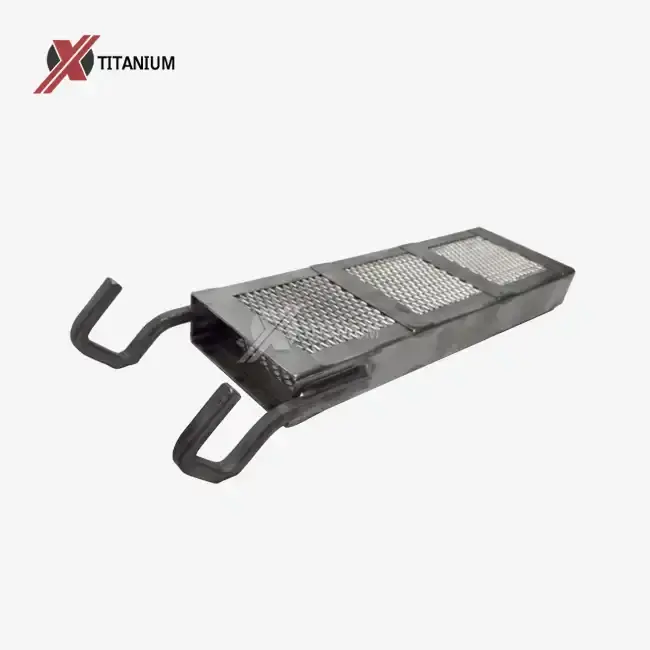
Titanium anode baskets are one of the most important parts of electrochemical tools used in industrial processes. Asbestos-free high-purity titanium (usually ASTM B265 Grade 1 or Grade 2) is used to make these unique clamps. They hold liquid anode materials like nickel, copper, or zinc balls during electroplating and metal finishing processes. Unlike traditional solid anodes, these baskets keep the anode surface area constant while letting the metal inside dissolve slowly. This makes sure that the current flows evenly and stops the line from having to be shut down often to change the anode.
Understanding Titanium Anode Baskets in Industrial Electrolysis
The Fundamental Role in Electrochemical Processes
In electrolytic tubs, titanium anode baskets carry current without actively moving it. When the titanium surface is submerged in strong electrolyte solutions, it creates a thin film of titanium dioxide that protects it and stops the basket from joining the electrochemical reaction. This anodic passivity lets current move only through contact points to the anode material inside. This solves a problem that has been bothering the electroplating industry for a long time: how to keep the quality of the plating stable as the anodes break down.
The design solves a number of important practical problems. The breakdown patterns of traditional slab anodes aren't even, which leads to "sword tips" that waste material and throw off the bath chemistry. Also, they need to be replaced often, which slows down production and costs money in work. Anode baskets, on the other hand, let workers replace metal balls or slugs without stopping the line. This keeps production going while cutting scrap rates by up to 35% compared to traditional methods.
Material Grades and Construction Specifications
To make these baskets, you need to be very good at engineering so that you can match structure stability with electrical performance. We get commercially pure titanium sheets or bars of high quality. These go through cold rolling and hot rolling methods to get the right mechanical qualities. Which grade of material to use depends on the type of liquid and the temperature at which it will be used. The best rust protection is in Grade 1, which is used in the harshest conditions. For heavy-duty uses, Grade 2 is better because it has a little more power.
Precision cutting and shaping of titanium anode baskets are done according to exact specs during the manufacturing process. Next, advanced TIG welding methods are used to make structures that are strong and smooth. Acid cleaning, sanding, or grinding the surface improves performance and durability by getting rid of surface impurities and making the best conditions for the inactive oxide layer to form. To make sure it meets international standards like ASTM B265, each basket goes through a strict quality check that includes strength tests, bending tests, and hydraulic tests.
Basket designs are very different depending on the use. For rotogravure cylinder plating, cylindrical shapes work well because the anode-to-cathode distance stays the same thanks to the circular layout. When making PCBs, where accuracy is important, rectangular baskets are especially useful because they keep the spacing between vertical continuous plating lines to a minimum. Custom forms can be made to fit specific tank shapes or methods. Different mesh sizes are also available. Woven mesh is better for smaller materials or situations where specific electrolyte flow properties are needed, while expanding mesh gives structure strength to heavy copper balls.
Advantages Over Alternative Anode Materials
When you look at titanium next to other materials, you can see why it is used so much in industrial electrolysis. Even though graphite anodes are cheap, they are mechanically weak and the carbon in the soldering bath makes quality control a headache. Platinum is a better conductor than titanium, but it is too expensive for most uses. For example, platinum is often 50 to 100 times more expensive than titanium for the same amount of surface area. Lead anodes are bad for the environment and people's health, and they don't follow current safety rules or companies' goals for sustainability.
At first glance, stainless steel seems like a good deal, but it fails horribly in acidic solutions, releasing iron contamination that destroys the quality of finishing and makes bath cleaning expensive. Mixed metal oxide (MMO) coated anodes are useful for certain tasks in the production of chlor-alkali, but they aren't as flexible mechanically or easy to fix as titanium baskets. Titanium is the best material for tough industrial settings because it doesn't rust, is low in density (about 60% lighter than steel for the same strength), is very stable at high temperatures, and has been used continuously for more than 10 to 15 years without any problems.
Comparative Analysis of Titanium Anode Baskets and Alternatives
Performance Under Corrosive Conditions
When electrolysis is used in industry, the chemicals are very hard on the equipment. Copper coating baths with sulfuric acid work at pH levels below 1.0, while zinc and nickel baths with alkaline materials work at pH levels above 13.0. When the temperature changes from room temperature to 70°C and the current density reaches 100 ASF or higher, it breaks down less durable materials very quickly.
Titanium does well in these conditions because its oxide layer can heal itself. When small scratches or abrasions happen, the passive film heals itself right away because most fluids contain air or oxidizing agents. This is very different from stainless steel, which corrodes in chloride-containing liquids, or graphite, which wears away over time due to electrolytic oxidation. Fluoride ions are the only important exception because they attack titanium's protection layer very strongly. In these very rare situations, zirconium can be used instead, though it costs a lot more money.
Long-term performance studies from car electroplating plants show that titanium baskets can be used for more than 120,000 hours without breaking down or changing significantly in size. Graphite anodes need to be replaced every 6 to 12 months, but treated titanium can keep working for 10 years or more, which changes the total cost of ownership figure in a big way.
Conductivity and Current Efficiency
Electrical conductivity has a direct effect on how much energy is used and how well the plating works. Titanium's electrical resistance (about 420 nΩ·m at 20°C) is lower than that of stainless steel but much higher than that of graphite or copper. However, the total system design makes up for this by optimizing the contact shape. Since the basket is not the main anode but rather a current collector, the conductivity needs are different from those for solid electrode uses.
Keeping the electrical lines clean is very important for efficiency. The titanium-to-busbar contact needs to be checked often to make sure that voltage doesn't drop because of rust or loosening. Titanium-clad copper hooks are used in many processes because they combine the better conductivity of copper with the rust protection of titanium at the liquid contact. This combined method protects the stability of the link while transferring the most current.
As of now, tests of efficiency from PCB plating processes show that titanium basket systems that are well taken care of can achieve 98–99% efficiency for copper coating, which is the same as or better than other designs. The important thing is to make sure there are enough touch points between the anode material and the basket walls. This is more of an upkeep issue than a problem of the material itself.
Lifecycle Cost Analysis
The total cost of ownership is becoming more and more important in purchasing decisions, over the initial purchase price. Titanium has economic benefits, even though it costs more up front, as shown by a full lifetime study. In a normal electroplating plant with three shifts a year, a set of $15,000 titanium anode baskets works consistently for 12 to 15 years with only minor upkeep like cleaning and replacing the hooks every so often.
Graphite anodes need to be replaced every nine months, which costs $3,000 per set. This adds up to $48,000 over twelve years, which is more than three times the titanium investment. The difference is made bigger by hidden costs like production stopping for anode changes, labor for installation and removal, bath cleaning to get rid of contaminants from graphite breaking down, and higher scrap rates because graphite breaking down causes current distribution to become less stable.
Thinking about the environment adds even more value. Titanium is very easy to recycle, doesn't contain any harmful chemicals, and doesn't create any dangerous garbage. These properties are in line with companies' efforts to be more environmentally friendly and with stricter environmental laws. As carbon footprints are closely looked at and producer responsibility laws are made stricter, the environmental impact of process equipment becomes a strategic issue that goes beyond simple financial numbers.
How to Choose the Best Titanium Anode Basket for Your Industrial Needs?
Application-Specific Design Criteria
To choose the right anode basket configurations, you need to carefully look at your unique electrochemical process. For through-hole filling, PCB makers who use acid copper vertical plating lines need rectangular baskets with very tight size standards to keep the anode-cathode gap as small as possible. The height of the basket needs to be big enough to hold enough copper balls to last for several shifts before it needs to be refilled. The mesh size keeps the balls from getting through but doesn't stop the flow of electrolytes.
Different things need to be done for artistic metal work on cars. Baskets that can handle high temperatures (50–60°C) and strong mechanical stirring are needed for these multistage methods that use semi-bright nickel, bright nickel, and microporous nickel. When stronger gauge material or extra support ribs are used to strengthen the structure, the basket doesn't bend under the weight of the metal rounds, and it keeps its shape through heat expansion cycles.
Chlor-alkali and metal recovery uses involving valuable metals may require cylindrical shapes with special mesh patterns that make the best use of current flow for certain cell shapes. The width, height, and wall curve of the basket must fit the shape of the cathode while still allowing enough space for gas flow and electrolyte flow.
Evaluating Supplier Capabilities and Quality Assurance
When buying important process tools, you have to think about more than just the product specs. You also have to think about the skills of the suppliers and their support system. Quality management certifications, like ISO 9001 for structured process control, give you a basic level of confidence. Industry-specific standards, like AS9100 for aircraft uses or ISO 13485 for medical components, show that you have particular skills.
Another important factor is the ability to track materials. Manufacturers with a good reputation keep all the paperwork, from mill certificates for the raw titanium to records of the manufacturing process and final inspection reports. This makes it possible to track things, which is very helpful for quality investigations and meets the needs of audits in controlled industries. Permanent labels should be put on each basket that connect it to test data, factory records, and heat lot numbers.
The ability to provide technical help sets key partners apart from basic providers when it comes to titanium anode baskets. Suppliers who know about water chemistry, current distribution models, and process optimization can help with complex electrochemical processes. Working together on unique designs, helping with application engineering, and providing fast prototyping services all add a lot of value that goes beyond the actual result. When problems with the process happen, like voltage drift, uneven plating, or premature basket wear, having access to knowledgeable expert resources speeds up the fix process and limits the effect on production.
Maintenance Strategies for Extended Service Life
To get the best return on your investment, you need strategic repair plans that are specific to your working conditions. At regular times, the structural stability of the basket should be checked to see if there is any mesh damage, weld cracks, or hook wear. When you look at the surface, you can see that organic leftovers, salt crystals, or metallic layers have built up and are making the electrical resistance higher and the performance worse.
Cleaning methods depend on the job, but usually involve taking something out of service, cleaning it to get rid of big messes, and treating it with the right chemicals. Acidic electrolytes can leave behind metal hydroxides that need to be broken down in diluted acid. On the other hand, alkaline baths remove carbonate or organic films by cleaning with alkaline acid and then neutralizing the acid. Ultrasonic cleaning gets rid of tough deposits from mesh gaps without damaging the mesh itself.
Maintaining contact points is very important for transferring current properly. "Bumping" or moving the baskets every so often helps the anode balls settle down and makes new contact areas. Hook and busbar connection points need to be cleaned regularly to get rid of oxide buildup. Light rubbing with Scotch-Brite pads followed by fluid degreasing keeps electrical lines with low resistance.
When baskets get damaged, it's often cheaper to fix them than to buy new ones. Titanium is very easy to weld, so professionals can use TIG welding to fix broken hooks, fix torn mesh, or rebuild worn areas with Grade 2 filler rod. This ability to be fixed greatly increases the useful life of an object compared to materials like graphite or plastic-coated steel, which need to be replaced completely when they get harmed.
Market Overview: Pricing, Availability, and Procurement Options
Understanding Price Determinants
Titanium anode basket prices depend on a lot of different factors that smart buying teams need to know about in order to correctly evaluate quotes. The price of raw materials changes based on the state of the global titanium sponge market. For industrial grade material, the price usually falls between $8 and $12 per pound. Making something more complicated takes a lot more work. For example, making a simple rectangular basket with basic expanded mesh takes a lot more work than making a perfectly curved circular design with strengthened construction and many soldered parts.
Cost is also affected by the details of the surface process. As a starting point, standard cleaning is free. Mirror polishing or special finishes for harsh working conditions cost extra. Customization fees are charged for non-standard sizes, mesh patterns, or adding unique features such as internal vents or built-in anode contacts.
The number of orders has a big effect on unit price. Batch processing helps manufacturers make more things quickly, so buying 10 to 20 units at a time usually gets better prices than buying one item at a time. Prices may drop by 15–25% compared to spot purchases if you commit to buying a certain amount of goods on a quarterly or yearly basis. However, you need to be very good at predicting demand to avoid having to pay too much for extra merchandise.
Standard rectangular baskets (300mm x 150mm x 450mm, Grade 2 titanium, expanded mesh) usually cost between $450 and $700 per unit, based on the size and number of units needed. Because of the technical material and small production runs, customized setups for one-of-a-kind uses may cost $1,500 to $3,000 per basket.
Identifying Reliable Manufacturers
There are many companies around the world that make titanium, and their skills range. In China's Shaanxi province, especially in Baoji City, which is known as the "Titanium Capital," there is a lot of skill in handling titanium. Companies like Chuanglian have decades of experience in this field. For buyers in the region who value short lead times and easy transportation, North American and European manufacturers are conveniently located close by.
When looking at possible providers, you need to see what kind of production they can do. Having CNC machining equipment, welding certifications, testing facilities, and quality control infrastructure all show that they are technically competent. Site trips or virtual factory tours reveal operational maturity and capacity to handle your volume requirements. Customer examples from businesses in the same industry are very helpful for figuring out how well a company will perform in the real world, how reliable their deliveries are, and how quickly they can solve problems.
Portfolios of certifications show that you are committed to high standards. Besides basic ISO 9001, you should also look for skills specific to your business that are useful for your job. NADCAP certification is important for supply lines in the aircraft industry, while FDA registration shows that the product can be used in food or medicine. Material test results from approved labs that follow ASTM, DIN, or JIS standards show that the titanium that is provided has the right chemical make-up and mechanical qualities.
Practical Procurement Considerations
Different providers have different minimum order amounts because of how they run their businesses and when they make things. Large makers may need at least 10 to 20 pieces to cover their setup costs, while specialized designers may be willing to work with smaller amounts but charge more. By combining needs across different production lines or working with other companies to meet MOQ limits, understanding these factors can help improve buying strategies.
Lead times for titanium anode baskets depend on whether the specs are the same as stock items or if they need to be made to order. Stock items or small changes to current designs may ship within two to three weeks. However, fully custom baskets that need engineering, tools, and special processing may take eight to twelve weeks. Including these dates in the planning stages of a project keeps production from being held up, which can be very expensive when adding new lines or increasing capacity.
Logistics for international shipping make things more complicated and need close attention. Titanium goods are usually shipped by ocean freight for large orders. Because of the higher cost, plane express is only used for urgent needs. Damage during shipping can be avoided with the right packing. Individual wrapping, strengthened crates, and moisture shields all help protect against rust during long shipping times. Customs paperwork needs to correctly label things with the right HS codes (usually 8108.90) so they can be cleared and taxes can be calculated.
The terms of payment are standard of foreign business. When a new customer starts working with a supplier, they are often asked to pay ahead of time or send a letter of credit as insurance. Once a partnership has been established and shown to be reliable, it may move on to net terms. If the value of the currency changes between the order and the delivery, it can affect the actual price. For big contracts, currency hedges or fixed-rate deals may be a good idea.
Case Studies and Application Success Stories
Automotive Electroplating Efficiency Improvement
Using standard nickel anode bars, a Tier 1 car supplier with a high-volume ornamental chrome plant had to deal with consistent quality problems and high upkeep costs. Plating thickness variations across complicated bumper shapes were higher than what was allowed by standard, which led to 12% scrap rates and a lot of customer complaints. It took the repair team about 15 hours a week to replace the melted anodes, which directly reduced the amount of work that could be done.
When the business switched to titanium anode baskets with sulfur-bearing nickel rounds, things got better right away. The regularity of plating thickness got better by 40%, and scrap dropped to less than 4%. The stable anode surface area got rid of the changes in current density that used to make thin spots on complicated shapes. The weekly maintenance time dropped to less than three hours, because all that needed to be done was to fill up the baskets with new nickel material instead of taking out, throwing away, and putting back in heavy anode bars, which was a lot of work.
An study of the finances showed impressive results: the $28,000 spent on titanium baskets saved more than $95,000 a year through less trash, less upkeep work, less nickel waste, and higher output rates. This was one of the best capital improvements made that year because it paid for itself in just 3.5 months.
PCB Manufacturing Quality Enhancement
A company that makes printed circuit boards for medical devices and military users had a hard time meeting the strict copper finishing standards for high-reliability uses. Their vertical continuous plating line with copper bars caused through-hole filling to vary in ways that were not acceptable, especially for vias with a high aspect ratio (10:1 or more). As the bars broke down, the anode shape changed, which caused changes in the current distribution that made plating less regular.
Using carefully designed rectangular titanium baskets with phosphorised copper balls changed how well it worked. During the coating cycle, the set anode shape kept the current spread stable. The regularity of the through-hole filling got a lot better. Statistical process control data showed that capability indices (Cpk) went from 0.89 to 1.67, which means they went from being barely capable to highly capable.
Aside from better quality, other perks also showed up. Getting rid of the need to handle copper bars lowered the stress on operators' bodies and made things safer. The amount of bar impurities in the bath got less, so the time between carbon treatments went from six weeks to four months. The customer reached their goal of becoming a chosen source for mission-critical aircraft PCBs. This opened up new business possibilities worth millions of dollars every year.
Conclusion
When compared to competing materials, titanium anode baskets clearly outperform them in terms of rust resistance, working longevity, and lifecycle economics. Even though the starting costs are higher than easier options, a full study shows that the overall cost of ownership is much lower due to longer service life, less upkeep, and better process performance. Because the shapes can be changed to fit different uses, and titanium has special electrical and chemical qualities, these parts are better thought of as investments than as purchases of goods. Titanium anode basket technology fits perfectly with the buying habits and operational goals of companies that value consistent quality, practical dependability, and long-term supply relationships.
FAQ
What determines titanium anode basket lifespan in industrial applications?
Service life is mostly determined by the chemistry of the liquid, the working temperature, the current density, and how well the equipment is maintained. If you keep the baskets in sulfuric acid copper or Watts nickel baths in good shape, they can work nonstop for 10 to 15 years. One important exception is electrolytes that contain fluoride. These electrolytes attack titanium's protective oxide layer very strongly, so zirconium replacements are needed.
Can standard baskets be modified for non-standard tank configurations?
Customization is one of the main skills that experienced makers have. Changes could be made to the sizes, the patterns of the mesh, the hooks to fit different busbar connections, or the structure to support big loads. Giving exact details like the size of the tank, the distance between the anode and cathode, the makeup of the electrolyte, the working temperature, and the current density helps engineering teams come up with the best solutions. Prototyping services let you test your ideas before committing to large amounts of production.
How do international shipping logistics affect procurement planning?
Titanium baskets usually take 4 to 6 weeks to ship from one port to another by ocean, plus extra time for transporting them within the country and clearing customs. Air express cuts travel time to 5–7 days, but it costs a lot more and is only practical for pressing needs. Planning purchase cycles around these facts keeps output from stopping. Setting up contract inventory agreements with key sources or keeping strategic stock levels in check can lower the risk of wait times while keeping moving costs in check.
Partner with Chuanglian for Premium Titanium Anode Basket Solutions
Baoji Chuanglian New Metal Material Co., Ltd. has more than ten years of experience making things out of titanium and can help you with your industrial electrolysis needs. We're in Baoji City, which is known around the world as the "Titanium Capital," and we use advanced CNC machining methods and strict quality control methods to make sure that every basket meets the highest standards. Our engineering team works closely with sourcing experts and process engineers to create custom solutions that are best for your electrolyte chemistry, tank shape, and performance goals.
We have strict tests and material tracking processes that meet the highest standards in the business. Because Chuanglian is a trusted provider, you can get titanium anode baskets in both standard setups and custom designs made just for your needs. Contact our technical sales team at info@cltifastener.com or djy6580@aliyun.com to talk about your needs and get detailed quotes backed by a history of high-quality manufacturing.
References
1. Schlesinger, M. & Paunovic, M. (2010). Modern Electroplating, Fifth Edition. John Wiley & Sons, New York.
2. American Society for Testing and Materials. (2018). ASTM B265-15: Standard Specification for Titanium and Titanium Alloy Strip, Sheet, and Plate. ASTM International, West Conshohocken, PA.
3. Pourbaix, M. (1974). Atlas of Electrochemical Equilibria in Aqueous Solutions. National Association of Corrosion Engineers, Houston, TX.
4. Titanium Development Association. (2015). Guidelines for the Design and Fabrication of Titanium Equipment for Electrochemical Processes. Technical Report TDA-105, Denver, CO.
5. Lowenheim, F.A. (1978). Electroplating: Fundamentals of Surface Finishing. McGraw-Hill Book Company, New York.
6. International Titanium Association. (2019). Titanium Design and Fabrication Handbook for Industrial Applications. ITA Technical Committee Publication, Broomfield, CO.
Learn about our latest products and discounts through SMS or email