- English
- French
- German
- Portuguese
- Spanish
- Russian
- Japanese
- Korean
- Arabic
- Greek
- German
- Turkish
- Italian
- Danish
- Romanian
- Indonesian
- Czech
- Afrikaans
- Swedish
- Polish
- Basque
- Catalan
- Esperanto
- Hindi
- Lao
- Albanian
- Amharic
- Armenian
- Azerbaijani
- Belarusian
- Bengali
- Bosnian
- Bulgarian
- Cebuano
- Chichewa
- Corsican
- Croatian
- Dutch
- Estonian
- Filipino
- Finnish
- Frisian
- Galician
- Georgian
- Gujarati
- Haitian
- Hausa
- Hawaiian
- Hebrew
- Hmong
- Hungarian
- Icelandic
- Igbo
- Javanese
- Kannada
- Kazakh
- Khmer
- Kurdish
- Kyrgyz
- Latin
- Latvian
- Lithuanian
- Luxembou..
- Macedonian
- Malagasy
- Malay
- Malayalam
- Maltese
- Maori
- Marathi
- Mongolian
- Burmese
- Nepali
- Norwegian
- Pashto
- Persian
- Punjabi
- Serbian
- Sesotho
- Sinhala
- Slovak
- Slovenian
- Somali
- Samoan
- Scots Gaelic
- Shona
- Sindhi
- Sundanese
- Swahili
- Tajik
- Tamil
- Telugu
- Thai
- Ukrainian
- Urdu
- Uzbek
- Vietnamese
- Welsh
- Xhosa
- Yiddish
- Yoruba
- Zulu
Difference between titanium and stainless steel countersunk washers for outdoor applications?
Titanium or stainless steel countersunk screws have big differences in how well they work, how long they last, and how much they cost to own when choosing fixing parts for outdoor projects. The titanium countersunk washer is very resistant to rust and reduces weight, which makes it perfect for use in marine, aircraft, and chemical processing settings where salt exposure, acidic conditions, or weight restrictions are important. Stainless steel options work well and cost less at first, but they may have problems with galvanic rust and extra weight in harsh outdoor situations. By knowing these differences, buying teams can perfectly match the traits of materials to the needs of the application. This ensures that structures stay strong and work reliably for a long time.
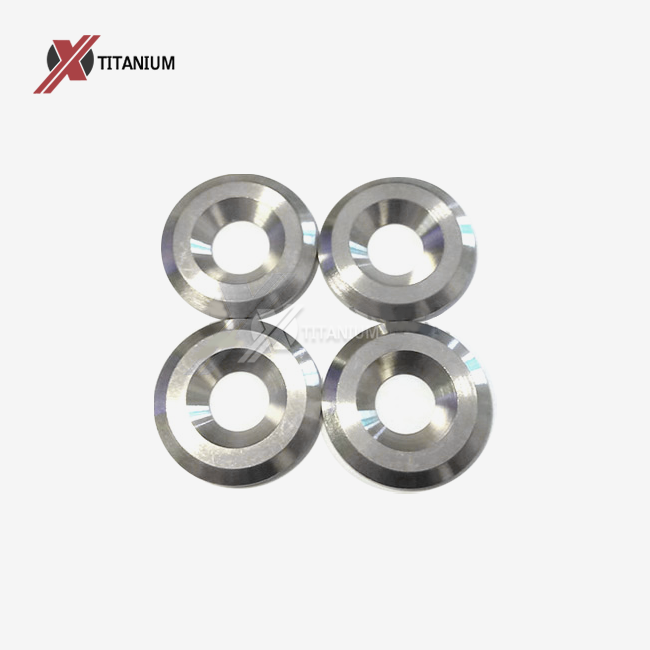
Understanding Titanium and Stainless Steel Countersunk Washers
Material Properties and Alloy Compositions
Most titanium countersunk washers are made from either Grade 5 (Ti-6Al-4V) metal or Grade 2 commercially pure titanium. Grade 2 has a density of 4.51 g/cm³, can be shaped very well, and is highly resistant to rust. Its tensile strength is 275 MPa and its yield strength is 250 MPa. Aluminum and vanadium are added to Grade 5 titanium alloy to make its mechanical qualities much better. Its tensile strength can reach 895 MPa and its yield strength can reach 828 MPa. This type of metal keeps titanium's great resistance to rust while also having a hardness level of 349 HV, making it perfect for high-stress structure uses.
Most stainless steel countersunk screws are made from grades 304 or 316. The 304 type has 18% chromium and 8% nickel, which makes it moderately resistant to rust for use outside. Marine-grade 316 stainless steel has an extra 2% to 3% molybdenum added to it. This makes it more resistant to chlorine attack and pitting rust in saltwater. Even with these safe alloying elements, stainless steel washers have a density of about 8.0 g/cm³, which is about 45% more than titanium washers of the same size.
Dimensional Standards and Precision Machining
Both types of materials can be made in unique shapes and sizes to fit the needs of a project. Titanium countersunk washers from companies like Chuanglian are carefully CNC made to fit sizes from M3 to M20. Their outer diameters range from 6mm to 50mm, their inner diameters range from 3mm to 20mm, and their thicknesses range from 0.5mm and 5mm. The cylindrical bearing surface usually has an angle of 90° or 100°, which lets countersunk screws fit snugly.
Surface processes make titanium washers even more different. When you polish, you make the bearing surfaces smooth, which reduces friction during fitting. Anodizing makes the surface harder and gives it colors like natural titanium gray, gold, blue, green, purple, black, and rainbow finishes. The nitriding process makes parts that are put together and taken apart many times less likely to wear out. These finishing choices offer benefits in both function and style that normal stainless steel parts don't have.
Industrial Applications Across Sectors
Marine engineering is one of the main areas where titanium's ability to prevent rust is very useful. Titanium doesn't crack when exposed to salt, which makes it useful for offshore platform gear, boat deck fittings, and underwater vehicle parts. A single rusted stainless steel screw can weaken the watertightness, letting water in and causing damage that will cost thousands of dollars to fix.
For aircraft panels and inner parts where smooth surfaces keep thermal efficiency, aerospace makers require titanium countersunk washers. The better gas mileage and higher payload ability are directly linked to the weight saves. Titanium washers are used in pipe systems that handle acidic media in chemical processing plants. The material's resistance to sulfuric acid, hydrochloric acid, and other harsh chemicals makes maintenance times longer and cuts down on unplanned downtime.
Key Differences Between Titanium and Stainless Steel Countersunk Washers
Corrosion Resistance in Harsh Environments
Titanium forms a solid, self-healing oxide layer (TiO₂) that quickly repairs after being scratched or abraded. This makes it very resistant to rust from air, water, and chemicals. Titanium can survive over 3,000 hours of constant contact to salt spray in the lab without showing any signs of rusting. This passive film stays solid in most commercial settings, where the pH runs from 3 to 12.
Stainless steel relies on chromium oxide to protect it from rust. This compound works well in normal situations but breaks down when exposed to salt for a long time. In naval settings, crevice rust often starts at the point where the washer meets the ground, especially when air levels change. Even though Grade 316 stainless steel works better than Grade 304, it still gets pitting rust after being in saltwater for a long time. In seaside sites, maintenance teams often find rust stains around stainless steel bolts, which shows that the materials are breaking down over time.
Strength-to-Weight Ratio Analysis
When you compare strength-to-weight rates, you can see how mechanically efficient titanium is. The tensile strength of Grade 5 titanium alloy is close to 900 MPa, even though it has a mass of only 4.51 g/cm³. This means that it has a specific strength about 1.3 times that of 316 stainless steel. Titanium countersunk washers can be used instead of stainless steel washers to cut their weight by 40 to 45%. This is helpful in uses that need to keep the weight down.
Engineers in the aerospace industry say that removing one kilogram from an airplane's body weight saves about 3,000 liters of fuel over the course of its life. Similar benefits can be seen in race cars, where lowering the unsprung mass makes the cars handle better and respond faster to acceleration. Even in structures that stay in one place, lighter parts are easier to handle during building and put less stress on the supports that hold up the structure.
Cost Considerations and Procurement Logistics
Because of the high cost of raw materials, titanium washers are 3 to 5 times more expensive than stainless steel parts that are the same. This difference is because titanium requires a lot of energy to be extracted and is harder to machine. Because it has more alloying elements and preparation steps, Grade 5 titanium alloy costs more than widely pure Grade 2.
When procurement teams look at the total lifetime costs, they have to compare the original purchase price to the costs of repairs, replacements, and downtime. In naval settings, a titanium countersunk washer installation might not need any upkeep for 20 to 30 years. Stainless steel options, on the other hand, usually need to be inspected, cleaned, or replaced every 5 to 10 years. Break-even analysis often recommends titanium for important uses where a broken part could cause safety issues or costly business interruptions.
Patterns of availability are different for each material. Stainless steel washers are easy to find through wholesalers and have short wait times. On the other hand, titanium parts usually need to be made by specialized makers. Depending on the needs, the lowest number of handmade titanium washers that can be ordered at once is between 100 and 1,000 pieces. Strategic buyers build ties with qualified titanium bolt providers to make sure that the quality is always the same and that delivery times are always known.
How to Choose the Best Countersunk Washer Material for Outdoor Applications?
Environmental Exposure Assessment
The choosing process starts with a full study of the surroundings. Exposure to saltwater highly suggests titanium standard, especially for areas that are exposed to high tides, splash zones, or parts that are fully underwater. Titanium's chemical stability is also helped by atmospheric rusting in industrial areas that release sulfur dioxide or nitrogen oxide pollution.
Extreme temperatures affect the choice of material. Titanium keeps its shape from very low temperatures to around 400°C, while austenitic stainless steels change phases at high and low temperatures, which changes their mechanical properties. Titanium countersunk washers have a lower rate of thermal expansion that makes them better for uses that involve thermal cycling because it lowers thermal stress at the surfaces of parts.
Weight Limitations and Structural Requirements
Titanium's high cost is justified in projects with strict weight limits, which can be caused by payload limits, structural capacity, or performance goals. There are many uses for lightweight materials that are very important, like in racing bicycle frames, drone systems, and compact medical tools. Structural studies show that using lighter washers makes it possible to use smaller bolts and threads, which saves weight all over the system.
The right material grade is found through load research. Grade 2 titanium is best for non-structural uses in acidic settings because it is easy to shape and doesn't rust. The higher tensile and yield strengths of Grade 5 metal are needed for high-stress structure parts. Stainless steel can still be used for moderate-load indoor or outdoor uses in protected areas where the risk of rusting is low.
Budget Constraints and Maintenance Planning
In addition to the purchase price, financial analysis looks at things like how often the item needs to be inspected, the cost of upkeep work, new parts, and the costs of business interruption. Titanium is very reliable, which is very helpful for facilities that are in hard-to-reach or rural places because repair visits cost money and cause output to stop. For example, access to offshore wind sites is limited by the weather, which makes long-lasting parts even more important.
Companies that have proactive repair programs and sites that are easy to get to may be willing to change stainless steel parts more often as a cost savings measure. When choosing washer materials for outdoor setups, the decision grid should include the organization's risk tolerance, the safety effects, and the performance promises that come with the contract.
Performance Comparison: Titanium vs Stainless Steel Countersunk Washers in Outdoor Conditions
Laboratory Testing and Field Validation
Accelerated rust tests according to ASTM B117 guidelines shows that titanium is very resistant to the climate. After being exposed to salt spray for 3,000 hours, samples of Grade 2 and Grade 5 titanium washers have no mass loss and no obvious corrosion. On the other hand, after 1,500 hours, samples of 316 stainless steel show pitting corrosion and measurable mass loss. These controlled lab settings are similar to how things work in real sea environments.
Real-world studies that track the longevity of fastener systems on business ships back up what was predicted in the lab. Titanium washers that have been used in saltwater pipe systems for 15 years show very little surface rust and are still exactly the same size. Comparable stainless steel parts show pocket rust, isolated pitting, and lower load-bearing ability, so they need to be replaced at regular maintenance times.
Installation and Maintenance Strategies
No matter what material you choose, the titanium countersunk washer will work best if it is installed correctly. The qualities of the material must be taken into account when quoting torque. For example, titanium has a lower modulus of elasticity than steel, which changes how the preload is calculated. When titanium nuts are paired with titanium bolts, anti-seize chemicals keep them from galling. However, different metal combinations need to be carefully checked for galvanic compatibility.
Maintenance plans for outdoor systems should include checking the parts visually, checking the torque, and replacing parts based on how long they've been used. Titanium systems usually have longer review periods because they are more reliable. This means that less upkeep work is needed over the lifecycle of the asset. Traceability and quality assurance are made possible for important uses by keeping records of material certificates, measurement inspection reports, and surface treatment standards.
Procurement and Supply Considerations for Titanium and Stainless Steel Countersunk Washers
Supplier Qualification and Certification
To get precision-engineered titanium countersunk washers, you have to work with makers who have the right quality system certifications. AS9100 approval means that the quality control system is up to aircraft standards and can be used for mission-critical tasks. Getting ISO 9001 approval shows that you follow basic quality control methods that are good enough for general business use. For medical devices, sellers must have ISO 13485 approval and be able to track materials back to approved titanium sources.
Based in Baoji City, which is known as the "City of Titanium" in China, Chuanglian has strict quality control methods that include checking the raw materials, inspecting the work in progress, and making sure the finished product meets all standards. The company has CNC cutting and surface treatment facilities that let them make personalized titanium washers that meet performance and size requirements in the chemical, medical, aerospace, and marine industries.
Bulk Pricing and Order Customization
Titanium parts that are priced by the volume usually have unit costs that go down as the number goes up. Orders of less than 100 pieces may have setup fees and higher prices, but orders of 1,000 or more pieces usually save 20 to 30 percent per unit. Strategic buyers combine the needs of several projects into one so they can get bulk deals and lower the cost of buying each component separately.
You can customize more than just the sizes; you can also choose the surface finish, the type of material, and the packing. When buying teams and manufacturing experts work together technically, they can make sure that the specs of parts are exactly what the application needs. Suppliers that offer design consulting services can help you choose the best washer shape, materials, and surface processes to get the best performance at the lowest cost.
Lead Time Management and Supply Chain Reliability
Standard stainless steel washers can be shipped within days from stock at a wholesaler. Custom titanium parts, on the other hand, take 4 to 8 weeks to deliver from the time an order is placed, based on how complicated they are and how many are needed. These differences in lead times are taken into account in strategic buying planning, which keeps project plans on track and avoids critical path delays during the installation stages.
As global transportation trends change, supply chain robustness becomes more important. Having ties with several qualified suppliers gives you choices in case one of your suppliers goes out of business. When you work with certified titanium fastener makers for a long time, you can make framework agreements that spell out quality standards, pricing structures, and delivery promises. These agreements make it easier to plan your buying across multiple project cycles.
Conclusion
To choose between titanium countersunk washers and stainless steel countersunk screws, you need to carefully consider the climate, the technical needs, the weight limits, and the cost over the product's entire life. Titanium works especially well in salty, chemically-rich outdoor settings. Its high resistance to these elements makes the higher original cost worthwhile because it lasts longer and requires less upkeep.
The material has a great strength-to-weight ratio, which makes it useful in weight-sensitive industries like aircraft, marine, and performance equipment. Stainless steel is still a good choice for modest weather exposure when cost is more important than long-term performance. Procurement workers get the best results when they work with qualified makers that offer technical support, the ability to customize products, and recorded quality systems that make sure parts will work reliably in harsh outdoor conditions.
FAQ
When Does Titanium's Cost Justify the Investment Over Stainless Steel?
The break-even study suggests that titanium is a better choice for uses where a failed part could cause a safety risk, an expensive halt in operations, or trouble getting to for repair. Titanium's 3–5 times higher cost is usually justified by its longer service life and lower lifetime costs in marine settings, chemical processing plants, and aircraft parts.
What Lead Times Should Procurement Teams Expect for Bulk Orders?
For orders of 100 to 1,000 pieces, custom titanium countersunk washers usually take 4 to 8 weeks to make. For urgent projects, work can be sped up. Stainless steel alternatives can be shipped within days from stock at a wholesaler, but wait times may be extended to two to three weeks for special orders.
How Does Titanium Perform Under High-Temperature Outdoor Conditions?
At temperatures close to 400°C, Grade 5 titanium metal keeps its shape and doesn't rust, making it better than stainless steel in thermal cycle uses. The lower rate of thermal expansion of the material lowers thermal stress at the surfaces of parts, making them more reliable in open settings where temperatures change often.
Partner With a Certified Titanium Countersunk Washer Manufacturer
Working with well-known titanium component experts is helpful for procurement managers and design engineers who need reliable solutions for outdoor fixing applications. Chuanglian makes precise CNC-machined titanium countersunk washers in Grade 2 and Grade 5 metals. The sizes can be changed from M3 to M20, and the surface can be treated in a number of ways, such as by grinding, anodizing, or nitriding. Our Baoji factory follows strict quality standards that make sure the parts are the right size, the materials are certified, and the parts work well in chemical, medical, aircraft, and marine environments. You can email our expert team at info@cltifastener.com or djy6580@aliyun.com to talk about the needs of your specific project, ask for material approvals, or get full quotes for large orders.
References
1. Davis, J.R. (2000). Corrosion of Titanium and Titanium Alloys. ASM International Handbook Committee.
2. Boyer, R., Welsch, G., & Collings, E.W. (1994). Materials Properties Handbook: Titanium Alloys. ASM International.
3. Schutz, R.W. & Thomas, D.E. (1987). "Corrosion of Titanium and Titanium Alloys," Metals Handbook, Vol. 13, Corrosion, ASM International.
4. Donachie, M.J. (2000). Titanium: A Technical Guide, 2nd Edition. ASM International.
5. Cotton, J.D. & Boyer, R.R. (2010). "The Use of Titanium in Commercial and Military Aerospace Applications," Journal of Materials Engineering and Performance, Vol. 19.
6. Sedriks, A.J. (1996). Corrosion of Stainless Steels, 2nd Edition. John Wiley & Sons, New York.
Learn about our latest products and discounts through SMS or email