- English
- French
- German
- Portuguese
- Spanish
- Russian
- Japanese
- Korean
- Arabic
- Greek
- German
- Turkish
- Italian
- Danish
- Romanian
- Indonesian
- Czech
- Afrikaans
- Swedish
- Polish
- Basque
- Catalan
- Esperanto
- Hindi
- Lao
- Albanian
- Amharic
- Armenian
- Azerbaijani
- Belarusian
- Bengali
- Bosnian
- Bulgarian
- Cebuano
- Chichewa
- Corsican
- Croatian
- Dutch
- Estonian
- Filipino
- Finnish
- Frisian
- Galician
- Georgian
- Gujarati
- Haitian
- Hausa
- Hawaiian
- Hebrew
- Hmong
- Hungarian
- Icelandic
- Igbo
- Javanese
- Kannada
- Kazakh
- Khmer
- Kurdish
- Kyrgyz
- Latin
- Latvian
- Lithuanian
- Luxembou..
- Macedonian
- Malagasy
- Malay
- Malayalam
- Maltese
- Maori
- Marathi
- Mongolian
- Burmese
- Nepali
- Norwegian
- Pashto
- Persian
- Punjabi
- Serbian
- Sesotho
- Sinhala
- Slovak
- Slovenian
- Somali
- Samoan
- Scots Gaelic
- Shona
- Sindhi
- Sundanese
- Swahili
- Tajik
- Tamil
- Telugu
- Thai
- Ukrainian
- Urdu
- Uzbek
- Vietnamese
- Welsh
- Xhosa
- Yiddish
- Yoruba
- Zulu
Corrosion-Resistant Lightweight Titanium Washers
When engineers choose fastening parts for mission-critical systems, the type of washer material they use often affects whether the project meets its performance goals or has to deal with expensive fails in the field. Lightweight titanium washers that don't rust, especially the titanium countersunk washer type, have become the standard in the aircraft, naval, petrochemical, and medical device industries. These specialized parts solve a problem that has been bothering industries for a long time: how to put things flush on a surface while keeping the structure strong in acidic environments without adding extra weight? Unlike steel or aluminum options, which have to choose between weight and chemical protection, titanium countersunk washers have both qualities at the same time.
Their cone-shaped bearing surface evenly spreads fastener loads while sitting flush with the substrate. This means that there are no surface protrusions that can mess up aerodynamic profiles or cause snag risks. More and more, industrial buying teams know that choosing the right washer grade and surface treatment directly leads to fewer maintenance cycles, longer component lifespans, and higher operating safety in tough environments.
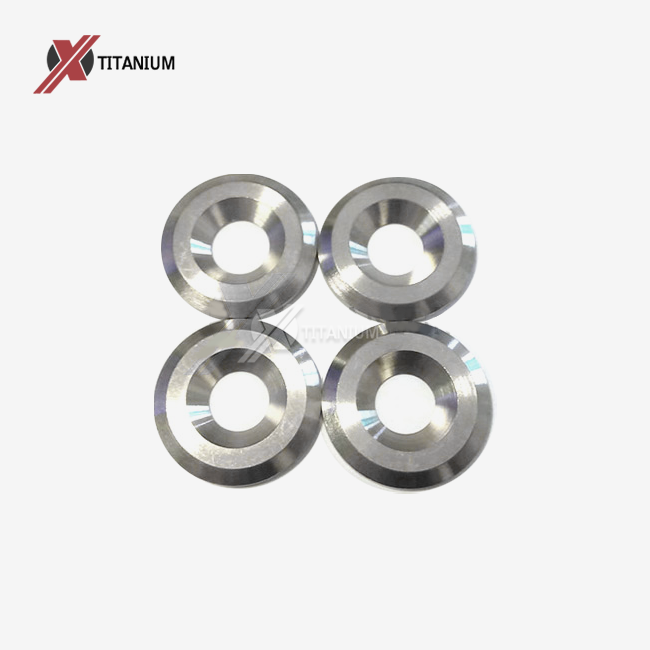
Understanding Titanium Countersunk Washers: Material and Benefits
What Defines a Titanium Countersunk Washer
A titanium countersunk washer is a precision-engineered fixing part with a circular bearing surface that is made to fit screws or bolts with countersunk holes. The washer can sit flush with or below the mating surface thanks to its angular shape, which is usually made to 90° or 100° standards. This creates a smooth finish that is important for situations where surface consistency is important.
This design solves several engineering problems at once: it increases the bearing area to protect the substrate, gets rid of the aerodynamic or hydrodynamic drag that comes from hardware that sticks out, and stops galvanic corrosion when titanium fasteners touch different materials, such as carbon fiber composites or aluminum structures.
Material Composition and Grade Selection
How well these washers work depends a lot on the type of titanium that is chosen. Titanium grade 2 is very resistant to rust. It has a mass of 4.51 g/cm³, a tensile strength of 275 MPa, and a yield strength of 250 MPa. This grade works really well in places that process chemicals because it is resistant to chlorides and acidic solutions, which is more important than being able to handle heavy mechanical loads.
Grade 5 titanium alloy (Ti6Al4V) has much better mechanical qualities, with a tensile strength of 895 MPa and a yield strength of 828 MPa. This makes it the best choice for high-stress car parts and aerospace structures. What's different about Grade 2 (160 HV) and Grade 5 (349 HV) in terms of hardness has a direct effect on how resistant they are to wear and how they handle thread galling during installation.
Core Performance Advantages
When you combine the qualities of a material, you get real practical benefits. Titanium's natural oxide layer grows back right away after being scratched, giving it better rust protection than stainless steel in places with a lot of salt. When compared to steel fasteners, they are 40% lighter, which can save fuel in aerospace uses and make vehicles handle better in racing. Unlike aluminum, titanium's mechanical traits don't change when the temperature does, from very cold to 400°C working temperatures. The biocompatibility of the material meets ISO 10993 standards, which means it can be used in medical implants and surgery tools without the risk of tissue rejection or metal ions leaking.
How to Choose the Right Titanium Countersunk Washer for Your Project?
Matching Washer Grade to Application Requirements
Choosing the right titanium countersunk washer grade for the job begins with looking at the mechanical loads and weather conditions that your unit will be exposed to. Chemical manufacturing equipment that works at stress levels below 100 MPa benefits from Grade 2's higher chemical inertness and lower cost. Grade 5's higher yield strength and resistance to wear are needed for aerospace structural parts that carry repetitive flight loads to keep them from deforming during vibration. Marine deck gear that is exposed to saltwater spray needs to be resistant to crevice rust at Grade 2. Racing suspension parts need to be stiff at Grade 5 so they stay stable under lateral loads.
Dimensional Specifications and Tolerances
For proper fitting, you need to pay attention to three important factors. It is important that the outer diameter has enough bearing surface area—usually 2.5 to 3 times the diameter of the bolt hole—so that the compression stress doesn't go over the substrate's breaking point. Inner diameter tolerances have a direct effect on centering accuracy. To make sure load lines are concentric, aircraft standards often call for H7 hole tolerances. The choice of thickness combines the need to spread loads evenly with the depth of the countersink.
If the thickness is too thin, stress can build up at the edge of the countersink, and if it's too thick, fasteners may not be able to connect properly. Different project needs can be met by the available size ranges. Sizes range from M3 threads to M20 threads, with outside diameters of 6mm to 50mm, inside diameters of 3mm to 20mm, and thicknesses ranging from 0.5mm to 5mm. When normal parts can't do what's needed for a specific purpose, custom dimensions are used.
Surface Treatment Selection
CNC-machined surfaces have very tight standards, but they may have tool marks that cause stress risers. Polishing gets rid of surface flaws and lowers friction ratios, which is useful for tasks that need to take things apart and put them back together again and again. Anodizing makes a controlled oxide layer that makes the metal harder and more resistant to wear. It also lets you use color coding to make sure the assembly is correct.
For example, gold, blue, green, purple, black, and rainbow finishes can be used to help identify parts in complicated assemblies. Nitriding spreads nitrogen into the surface, making a case that is harder and less likely to gall and seize up in high-torque situations. The choice depends on whether you care most about the finish's look, its ability to withstand wear, or its ability to help people find it.
Applications and Performance: Where Titanium Countersunk Washers Excel
Aerospace and Aviation Applications
Manufacturers of airplanes use titanium countersunk washers in the body panels and internal cabin parts where flush finishing keeps the plane's aerodynamic efficiency high. These nuts are very important because they connect titanium screws to carbon fiber composite skins and spread stress around the structure to keep it from coming apart.
Manufacturers of engine parts use Grade 5 washers in hot section systems, which are places where temperatures can hit 350°C and vibration rates are higher than 10,000 Hz. The lower weight directly lowers running costs. For example, switching from steel washers to titanium equivalents in a single commercial airplane can remove more than 50 kilograms of structural weight, which saves more than $15,000 a year per aircraft in fuel costs.
Marine and Offshore Engineering
Titanium countersunk washers are used by racing boat builders for deck gear and hull fittings where flush mounting keeps the water flow smooth and stops line snags. The substance doesn't rust in saltwater, so it doesn't leak rust like stainless steel does. This keeps the structure strong and the material looking good. Manufacturers of subsea equipment use these washers in offshore platform structures and remotely controlled vehicle systems where it is hard to get to parts for upkeep and parts must be reliable at all times. Titanium keeps all of its mechanical qualities after being submerged in saltwater for 10,000 hours, but stainless steel loses strength over time due to pitting rust.
Automotive and Motorsport Components
Titanium countersunk washers are used by companies that make performance vehicles in brake cooling ducts, body panel mounting, and suspension links. The cylindrical bearing surface helps keep the fastener's preload even when it's vibrating at a high frequency. This stops backing-out fails that could be dangerous. Less unsprung mass in the suspension parts makes it easier to control the wheels and improves the ride. Racing teams like it when they can save weight and be sure that the car will work every time. A full titanium bolt change that includes washers can cut the vehicle's weight by 8 to 12 kilograms while also making it more consistent over multiple-hour endurance races.
Chemical Processing and Business Tools
Grade 2 titanium washers are used in petrochemical plants to protect pressure tank assemblies, heat exchanger mounting, and pipe flange joints that are exposed to process streams that are acidic. The flush fitting stops cracks from forming where fluids could pool and cause localized rusting. The substance can handle sulfuric acid, hydrochloric acid, and chlorine chemicals, which are known to quickly damage stainless steel. Leaks at gasket interfaces are stopped by dimensional stability across temperature cycles. This cuts down on unexpected shutdowns and maintenance costs.
Procurement Guide: Sourcing High-Quality Titanium Countersunk Washers
Evaluating Supplier Capabilities
To be successful in procurement, you need to find producers who have a track record of handling titanium well. Find providers who use CNC cutting centers that can keep tolerances within ±0.05mm during all production runs. Quality management certifications make sure that processes are always the same. For example, AS9100 certification shows that the quality systems are up to aerospace standards, ISO 9001 shows that the manufacturing skills are general, and FDA registration or ISO 13485 certification proves that the manufacturing skills are for medical devices. Suppliers should give mill certificates for each production lot that show the chemical and mechanical qualities of the materials and show where they came from.
Custom Manufacturing and Standard Inventory
Standard catalog titanium countersunk washers are available right away and cost less per unit, making them good for maintenance stockpiles and less important uses. When the dimensions don't fit into a normal range or when a special finish is needed on the surface, custom manufacturing is needed. Custom orders usually have a wait time of 4 to 8 weeks, but this depends on how complicated they are and how many of them there are. Suppliers who have ties with titanium mills may be able to get materials faster. Validation tests can be done on prototype numbers before moving to production volumes.
Pricing Structures and Volume Considerations
Titanium material prices change based on supply and demand around the world. For Grade 2, prices are usually between $15 and $35 per kilogram, and for Grade 5, they are between $25 and $45 per kilogram. The cost of machining depends on how complicated the part is. For example, simple titanium countersunk washers may add $0.50 to $2.00 per piece in small orders, but sales of 10,000 or more pieces can cut costs by 40 to 60% per unit. Surface processes raise the price: cleaning costs an extra $0.10 to $0.30 per piece, anodizing costs an extra $0.20 to $0.50, and nitriding costs an extra $0.40 to $0.80. Total landed costs for Grade 5 washers in the M8 size run from $2 to $5 per piece for small orders to $0.80 to $1.50 per piece for orders over 50,000 pieces.
Verification and Quality Assurance
For production samples, you should ask for dimensional inspection records that list the measures for the outer diameter, inner diameter, thickness, and countersink angle. When a material is certified, it should have a chemistry analysis to make sure it meets the grade specifications and mechanical tests results to make sure it has the right tensile strength and yield strength. As proof of surface treatment, covering thickness measures for anodized parts or hardness tests for nitrided surfaces may be used. Reliable providers give you these papers without being asked, but if they don't want to give you test data, you should be worried about how well the process is being controlled.
Comparison Insights: Why Choose Titanium Countersunk Washers?
Performance Comparison with Stainless Steel
Stainless steel 316 is good at resisting rust and doesn't cost as much, so it can be used in less demanding situations. But side-by-side testing shows important differences. A titanium countersunk washer works better in chloride settings; ASTM B117 salt spray tests show that titanium doesn't corrode after 2000 hours, while 316 stainless starts to get surface damage. Titanium has a density of 4.51 g/cm³, while stainless steel has a density of 8.0 g/cm³. This means that titanium is 44% lighter than stainless steel for the same shape.
Titanium has a much better strength-to-weight ratio than stainless steel. Grade 5 titanium gives 198 MPa per g/cm³, while stainless steel only gives 75 MPa per g/cm³. When lifecycle costs are taken into account, the difference in price becomes smaller. Titanium's longer service life and lower replacement frequency often make the original price premium worth it in important applications.
Advantages Over Aluminum Alloys
Aluminum 7075 is famous in non-corrosive settings because it is strong for its weight and doesn't cost much. Titanium is better than metal in a number of important ways. Aluminum needs to be anodized or coated to survive sea contact, and these layers wear away over time. Titanium's oxide layer, on the other hand, heals itself and lasts forever. Aluminum's mechanical qualities quickly lose their strength above 150°C, which means it can't be used in high-temperature situations where titanium can stay strong up to 400°C.
When you want to connect different types of materials together, galvanic compatibility is important. Titanium has almost no galvanic potential with carbon fiber composites and most metal alloys, but aluminum can speed up the rusting of steel parts. The difference in modulus of elasticity affects how stiff a joint is; titanium's 110 GPa compared to aluminum's 70 GPa makes high-stress structures more stable by better distributing load.
Long-Term Value and Return on Investment
The initial costs of buying titanium parts are usually 200–400% higher than those of other options. Lifecycle cost study, on the other hand, shows a different view. Longer periods of time between replacements lower maintenance costs. Aerospace operators say that titanium fastener systems last 3–5 times longer than steel versions in corrosive conditions.
Saving weight has long-lasting operating benefits; lower fuel costs for business aircraft can cover the premium for titanium within two to three years of operation. Avoiding downtime is also valuable because unplanned repair due to rust failures in chemical plants or offshore platforms can cost 10 to 50 times as much as replacing the part. Because of these things, buying managers in businesses with a lot at stake always choose titanium, even though it costs more.
Conclusion
Choosing lightweight titanium countersunk washers that don't rust is a smart choice that will affect how well the product works, how much it costs to maintain, and how reliable it is over its entire lifecycle. This specialized washer is designed to work in tough situations where flush fitting, weight reduction, and chemical protection are all needed at the same time. Procurement teams can choose parts that offer measured value if they know the differences in performance between Grade 2 and Grade 5 materials, how surface treatments can improve certain qualities, and how to balance dimensional needs with application loads.
Titanium has been proven to be better than other materials in fields ranging from flight engineering to naval engineering. Partnering with makers who can show quality certifications, material traceability, and expert help skills is good for the buying process. Lifecycle analysis always shows a good return on investment through longer service intervals, less maintenance, and better operational uptime, even though the starting costs are higher than options.
FAQ
Q1: What dimensional tolerances should I specify for countersunk titanium washers in aerospace applications?
A: To make sure there is enough clearance and no extra play, aerospace parts usually need thickness tolerances of ±0.08mm, outer diameter tolerances of ±0.10mm, and inner diameter tolerances of +0.05/-0.00mm. Hold the countersink angle at ±1° to make sure it fits properly with the heads of the fasteners. These tighter limits keep the preload the same across all bolt patterns and stop loads from concentrating.
Q2: How do titanium countersunk washers perform in marine environments compared to stainless steel?
A: A titanium countersunk washer works better than other metals in saltwater uses. ASTM B117 salt spray tests show that titanium doesn't corrode after 2000 hours or more of contact, but 316 stainless steel does develop surface pitting and fissure corrosion. Titanium's self-healing oxide layer grows back right away when it gets broken, giving it long-lasting security that doesn't need coatings or replacements as often as stainless steel does in marine use.
Q3: Can anodized titanium washers be used in high-temperature applications?
A: Anodized coats stay stable up to about 400°C, which is the same temperature range that the titanium itself can handle. When the temperature changes, the metal layer doesn't break down or flake off. Anodizing, on the other hand, is mostly used for recognition and looks, not to improve performance. If you need the best wear protection at high temperatures, nitriding might be a good choice. It makes a harder diffusion layer that keeps its qualities above the temperature range of anodizing.
Partner with a Trusted Titanium Countersunk Washer Manufacturer
Chuanglian makes titanium countersunk washers with great care and accuracy, and they have more than ten years of experience making titanium parts. We have direct access to high-quality raw materials because we are located in Baoji City, which is known around the world as the "City of Titanium." We also work with top titanium mills to make sure that the materials are consistent across production runs. Our factory has several CNC machining centers that can hold ±0.05mm limits on important measurements. They are backed up by strict quality control systems that check each production lot before it is sent out.
We have Grade 2 and Grade 5 titanium washers in normal sizes ranging from M3 to M20, and we can also make washers in any size to fit your needs. Polishing, Type II and Type III anodizing in a variety of colors, and nitriding for better wear protection are all surface treatments that can be done. Our manufacturing capacity is flexible enough to handle projects of any size, from small prototypes for proof testing to large production runs of over 100,000 pieces. Our dedication to aerospace-grade quality standards is shown by our AS9100 and ISO 9001 certifications, and every shipment comes with full material tracking paperwork. Get in touch with our tech support team at info@cltifastener.com or djy6580@aliyun.com to talk about your needs for titanium countersunk washers.
References
1. Boyer, R., Welsch, G., & Collings, E.W. (1994). Materials Properties Handbook: Titanium Alloys. ASM International.
2. Donachie, M.J. (2000). Titanium: A Technical Guide (2nd ed.). ASM International.
3. Lutjering, G., & Williams, J.C. (2007). Titanium (2nd ed.). Springer-Verlag Berlin Heidelberg.
4. Schutz, R.W., & Thomas, D.E. (1987). "Corrosion of Titanium and Titanium Alloys." Metals Handbook (9th ed., Vol. 13). ASM International.
5. Peters, M., Kumpfert, J., Ward, C.H., & Leyens, C. (2003). "Titanium Alloys for Aerospace Applications." Advanced Engineering Materials, 5(6), 419-427.
6. American Society for Testing and Materials. (2021). ASTM B265-20a: Standard Specification for Titanium and Titanium Alloy Strip, Sheet, and Plate. ASTM International.
Learn about our latest products and discounts through SMS or email