- English
- French
- German
- Portuguese
- Spanish
- Russian
- Japanese
- Korean
- Arabic
- Greek
- German
- Turkish
- Italian
- Danish
- Romanian
- Indonesian
- Czech
- Afrikaans
- Swedish
- Polish
- Basque
- Catalan
- Esperanto
- Hindi
- Lao
- Albanian
- Amharic
- Armenian
- Azerbaijani
- Belarusian
- Bengali
- Bosnian
- Bulgarian
- Cebuano
- Chichewa
- Corsican
- Croatian
- Dutch
- Estonian
- Filipino
- Finnish
- Frisian
- Galician
- Georgian
- Gujarati
- Haitian
- Hausa
- Hawaiian
- Hebrew
- Hmong
- Hungarian
- Icelandic
- Igbo
- Javanese
- Kannada
- Kazakh
- Khmer
- Kurdish
- Kyrgyz
- Latin
- Latvian
- Lithuanian
- Luxembou..
- Macedonian
- Malagasy
- Malay
- Malayalam
- Maltese
- Maori
- Marathi
- Mongolian
- Burmese
- Nepali
- Norwegian
- Pashto
- Persian
- Punjabi
- Serbian
- Sesotho
- Sinhala
- Slovak
- Slovenian
- Somali
- Samoan
- Scots Gaelic
- Shona
- Sindhi
- Sundanese
- Swahili
- Tajik
- Tamil
- Telugu
- Thai
- Ukrainian
- Urdu
- Uzbek
- Vietnamese
- Welsh
- Xhosa
- Yiddish
- Yoruba
- Zulu
Custom titanium bolt kits for mountain bikes
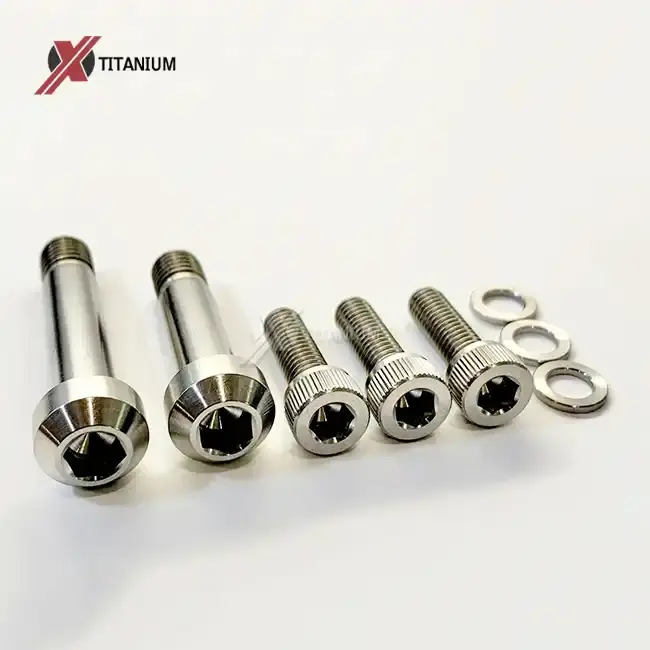
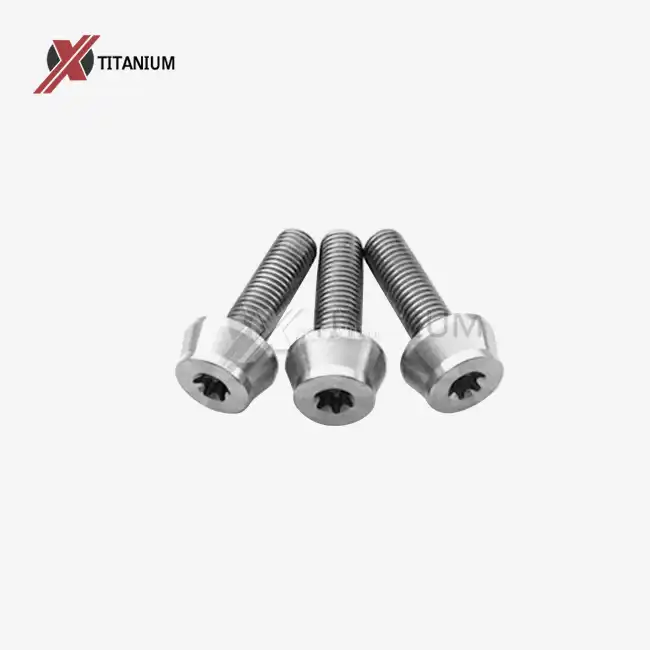
Custom mountain bike titanium bolt kits are a unique technical answer that use precision-machined Grade 5 titanium fasteners to improve the performance of regular MTBs. Mountain bike titanium bolt kits are up to 40% lighter than steel bolt kits while still having a tensile strength of over 900 MPa. This makes them essential for riders who want to gain an edge in XC races, enduro races, and tricky trail riding. These kits usually include Ti-6Al-4V titanium alloy bolts with rolled threads and advanced surface treatments. These bolts meet the important needs of professional riders and OEM manufacturers for reducing weight, resisting corrosion, and being mechanically reliable.
Understanding Titanium Bolt Kits for Mountain Bikes
Mountain bike titanium bolt kits are based on Grade 5 titanium alloy (Ti-6Al-4V), which is made up of 90% titanium, 6% aluminum, and 4% vanadium. This material has its own special qualities. This mixture meets the requirements of ASTM B348 and makes fasteners with exceptional mechanical properties that are perfect for the high-stress levels that come up during rough trail rides.
Core Material Properties and Manufacturing Standards
Grade 5 titanium fasteners have a density of only 4.43 g/cm³, while steel has a density of 7.85 g/cm³. This means that weight savings can be made right away without affecting the strength of the structure. The yield strength is around 880 MPa, and the tensile strength is between 950 and 1050 MPa. Based on these specifications, titanium screws perform about the same as Grade 10.9 steel nuts, but they weigh almost half as much. CNC machining methods make sure that the dimensions are accurate within the ISO 965-2 6g class limits. This guarantees accurate thread engagement that doesn't come loose when the trail vibrates at high frequencies.
Premium titanium screws are different from cheaper options because of how well they are made. Instead of cut threads, we use rolled thread technology, which keeps the grain structure intact throughout the fastener. When compared to machined threads, this method of manufacturing increases fatigue resistance by about 30%. This makes high-stress mounting places like stem faceplate bolts and brake caliper mounts last longer.
Surface Treatment Technologies
Titanium fasteners work much better than they would normally because of processes that are applied to their surfaces. Anodizing adds a colorful oxide layer that comes in natural titanium, gold, blue, green, purple, black, and rainbow finishes. This layer also protects against scratches. By raising the surface hardness to around 2000 HV, vacuum nitriding lowers the coefficients of friction and stops galling during installation. PVD coating choices let you change the way something looks and make it more resistant to wear without affecting the critical dimensions needed for applying pressure correctly.
The polishing process gets rid of surface flaws that could act as stress collection points. This makes the fatigue life better in applications that are loaded and unloaded all the time. Each surface treatment is designed to meet specific performance goals that go beyond looks, solving technical issues that come up in real-world riding situations.
How to Choose the Right Titanium Bolt Kit for Your Mountain Bikes?
To choose the right mountain bike titanium bolt kits, you need to know what the mechanical needs of each mounting spot are and then match those needs with the right metal grades and design specifications. The choice to buy goes beyond just matching sizes; it also takes into account material certifications, signs of manufacturing quality, and the technical skills of the seller.
Material Grade Selection and Performance Requirements
Grade 5 titanium (Ti-6Al-4V) is still the standard for structural uses like stem bolts, seatpost clamps, brake mounts, and hardware for suspension linkages. This alloy is strong enough for applications that need to handle high pressure and stress. Grade 2 commercially pure titanium is more flexible and resistant to corrosion, but it's not strong enough for structural fixing points. It should only be used for items that don't hold weight, like bottle cage bolts or cable guides. When considering sources, make sure to ask for material certifications that show they meet ASTM B348 standards. The results of the mechanical property tests should show that the tensile strength is more than 900 MPa and the yield strength is more than 850 MPa. With these written limits, you can be sure that the fasteners will work well even when they are loaded and unloaded many times during aggressive rides.
Customization Capabilities and OEM Collaboration
In Baoji, China, our factory has several CNC machines that can make custom bolt setups that fit specific frame shapes and component connections. Baoji is known as the "City of Titanium" in China. You can customize socket head cap screws, button head bolts, countersunk fasteners, and special head types made for fitting in recessed areas. To meet exact OEM requirements, thread pitches, shank lengths, and head sizes can be changed. Our variable minimum order amounts and ability to make prototypes quickly help bulk purchasing strategies. Technical teamwork during the design phase makes sure that the properties of the fasteners match the properties of the frame material. This stops galvanic corrosion problems and improves the way power is transferred. We help with engineering throughout the whole creation process, from the first idea to quality control and production proof.
Comparative Analysis with Alternative Materials
Even though aluminum bolts are lighter, they have a much lower tensile strength (about 300–400 MPa) and poor fatigue resistance, which means they can't be used for important fixing places. Stainless steel A2 and A4 bolts are good at resisting rust, but they still weigh more than ferrous materials, which means that riders who are trying to save weight won't get the speed benefits they're looking for. Titanium fasteners are in the best situation in terms of performance in a number of areas. The natural resistance to rust of the material gets rid of the galvanic compatibility problems that can happen when steel screws are used in aluminum parts. Because it isn't magnetic, it can work without interruption near power meters and electrical shifting systems. A long-term lifetime cost study shows that titanium's durability and long service life with no upkeep provide a better return on investment than replacing steel fasteners that are rusting all the time.
Installation and Maintenance of Titanium Bolt Kits on Mountain Bikes
If you follow the right steps for installing mountain bike titanium bolt kits, they will work better and last longer, and you won't make any mistakes that could damage their structure. Knowing titanium's special tribological features helps you put things together correctly.
Installation Procedures and Torque Specifications
Preparing the threads is the first and most important step in installing a titanium bolt. Both male and female threads should have a thin, even layer of a good anti-seize substance or a titanium-specific thread preparation product applied to them. This barrier stops galling, a cold-welding problem where titanium's desire to stick together with itself or aluminum can stop the thread from moving when it's being tightened or taken off later.
Stick to the torque recommendations given by the part's maker. For stem faceplate bolts, these are usually between 4-6 Nm, while for seatpost clamps, they are between 5-7 Nm, and 6-8 Nm for brake caliper mounts. To make sure you apply the setup correctly, use a torque wrench that has been calibrated. Titanium doesn't have the same friction properties as steel, so it's important to use the right lubricant to get correct torque-tension ratios. Friction between threads can take torque energy if they are not properly prepared, resulting in fasteners that are not properly tensioned even though they meet the required torque values.
Maintenance Protocols and Inspection Intervals
Regular inspections make sure that problems are found early, before they become unsafe or affect efficiency. Check titanium fasteners for leftover dirt in socket recesses and around bolt heads after wet runs or bike washing. Don't use strong alkaline cleaners on anodized finishes; instead, use soft brushes and a light soap solution to clean.
Every 50 to 100 hours of riding, based on the conditions, take off any important fasteners, clean the threads well, look for signs of damage or wear, reapply thread preparation compound, and put the fasteners back on with the right amount of pressure. This regular maintenance keeps threaded surfaces from rusting and makes sure that screws keep the right preload even when they're exposed to vibrations on the trail and changes in temperature. Keep track of torque values and check dates to build a maintenance history that can be used for quality assurance programs and guarantee claims.
Market Insights and Procurement Strategies for Titanium Bolt Kits
Knowing the global supply chain for mountain bike titanium bolt kits helps you make smart buying choices that balance the need to keep quality high with the need to keep costs low. There are specialized manufacturers, general industrial fastener sources that offer titanium options, and aftermarket MTB component names that sell kits that are already put together.
Supplier Evaluation Criteria and Quality Certifications
Titanium fastener companies with a good reputation have complete quality management systems that include ISO 9001 certification as a minimum. The best suppliers also have AS9100 aerospace certifications, which show that they have advanced process controls. Each production batch should come with material traceability documents, such as mill test records that prove the chemical makeup and mechanical properties. The site of a factory affects both the costs and the technical skills of the company. In China's Shaanxi Province, Baoji City is home to a lot of titanium processing experts who have worked together with the aerospace and military industries for decades. Because of this regional specialization, our plant has access to high-quality titanium feedstock, specialized machining knowledge, and quality control standards that have been improved through rigorous aerospace applications.
Potential providers should be judged on how technical they are during pre-sales consultation, whether they are ready to provide material certifications and test data, and whether they have shown they understand the unique needs of your application. When compared to simple catalog sales operations, suppliers who offer engineering teamwork during product creation show that they have a higher level of technical knowledge.
Pricing Structures and ROI Considerations
Titanium fasteners are more expensive than steel or aluminum options. Depending on the specifications and order quantity, they can be anywhere from 3 to 8 times the cost of similar steel bolts. This initial investment pays off by extending the product's useful life, preventing the need for replacements due to corrosion, and improving performance. These benefits can help makers compete in races or set their MTB products apart as special items.
Strategies for buying in bulk cut per-unit costs by a large amount. Our flexible production schedule works for both small batches of prototypes for developing new models and large batches of production to meet yearly needs. When you work directly with a manufacturer, you avoid the markups that distributors add on top of the price. You also get stable quality and solid lead times, which are usually between 3 and 4 weeks for standard configurations and 6 to 8 weeks for custom specifications that need tooling development.
Why Custom Titanium Bolt Kits Are the Preferred Choice for Mountain Bikes?
Performance-oriented riders and expensive MTB makers have long preferred mountain bike titanium bolt kits. This is because the material has a unique set of qualities that can't be found in any other material. Knowing these benefits helps you make choices about investments and helps you place your products effectively in the market.
Performance Advantages in Tough Situations
In three important high-stress situations that are frequently met in fast riding, titanium bolt kits perform admirably. Titanium's high vibration dampening properties make cockpit and control parts like stems, handlebar clamps, and seatpost collars more durable. This is because rigid connections that are exposed to constant trail chatter have less fastener wear. Putting the weight savings high on the bike lowers the center of gravity, which makes it easier to control, especially when climbing and falling steeply.
Titanium's low thermal conductivity is used in brake caliper fixing bolts and rotor bolts, which stops heat from moving to hub assemblies and frame surfaces during long descents. This thermal separation helps keep the system's structure and stops performance loss caused by heat during heavy use. Titanium is very resistant to corrosion, as shown by drivetrain fixing points and parts that are exposed to mud, track grit, and cleaning agents. The non-reactive nature of the material stops chemical bonding and thread seizure that can happen when steel screws are put into aluminum threads. This makes upkeep and part replacement easier over the bike's lifetime.
Addressing Common Misconceptions
Some procurement professionals worry that titanium is too fragile or that it will be hard to install because they don't fully understand the technology behind it. Grade 5 titanium alloy is very ductile, and its elongation at break is more than 10%. This gives you enough time to prepare for failure instead of a quick, brittle break. Problems with installation aren't caused by the limits of the material itself, but by bad methods, especially threads that aren't properly prepared, which can cause galling. When placed according to the right steps and with the right kind of anti-seize, titanium screws are just as easy to put in and take out as steel ones, but they last longer and are more reliable.
Conclusion
With their high strength-to-weight ratios, better corrosion resistance, and longer service life in harsh trail conditions, custom mountain bike titanium bolt kits make a real difference in how well mountain bikes work. When compared to steel fasteners, Grade 5 titanium alloy (Ti-6Al-4V) is up to 40% lighter while still having the mechanical qualities needed for structural uses. The right choice of material, good manufacturing methods (like rolled threads), and the right surface treatments all work together to make sure that important mounting points like cockpit components and brake systems work reliably. To do good buying, you need to look at providers' technical skills, quality certifications, and ability to make changes instead of just price.
FAQ
Q1: What distinguishes Grade 5 titanium from Grade 2 for mountain bike applications?
A: Grade 5 titanium (Ti-6Al-4V) has aluminum and vanadium alloying elements that raise its tensile strength to 900–1050 MPa. This makes it perfect for high-stress structural bolts. Commercially pure titanium grade 2 is better at resisting rust, but it's not strong enough (about 340–450 MPa tensile) for load-bearing uses. Grade 5 should be used for stems, brakes, seatposts, and suspension links. Grade 2 should only be used for items that aren't structural.
Q2: How do rolled threads improve titanium bolt performance compared to machined threads?
A: In rolled thread production, threads are cold-formed through pressure instead of cutting away material. This keeps the grain flow constant throughout the fastener. This process makes the material about 30% more resistant to wear and gets rid of the micro-stress concentrations that happen when cutting across grain limits. Rolled threads are much better at performing in high-cycle stress situations like those that happen when trail riding.
Q3: What causes titanium bolts to fail during installation?
A: Failures in installation are usually caused by three things: not using enough Grade 2 titanium in high-torque areas, not lubricating the threads enough to prevent galling and false torque readings, or cut threads that create stress concentrations. These problems can be avoided by using the right anti-seize chemicals and specifying Grade 5 alloy with rolled threads. This also makes sure that the torque-tension relationships are correct during assembly.
Partner with Chuanglian for Premium Mountain Bike Titanium Bolt Kits
Baoji Chuanglian New Metal Material Co., Ltd. has been making titanium products for over ten years and has advanced CNC machining tools that allow them to make custom mountain bike titanium bolt kits that meet the strictest OEM requirements. Our position in Baoji City, China's titanium manufacturing hub, gives us direct access to high-quality Grade 5 titanium feedstock and a lot of technical know-how. Our strict quality control systems make sure that all of our materials are the same, from the raw materials we use to the final review of our products. These systems are backed up by ASTM B348 certifications and full paperwork that shows where all of our materials come from.
Our production capacity is flexible enough to allow for both prototype development and large-scale production. We offer competitive bulk price models that are meant to foster long-term partnerships. Technical teamwork throughout the entire product development cycle makes sure that the fastener specifications perfectly match the frame shapes and performance goals. Contact our purchasing team at info@cltifastener.com or djy6580@aliyun.com to talk about your unique titanium bolt needs and get full technical specifications. Discover how working with an experienced manufacturer that makes mountain bike titanium bolt kits can help your products stand out and give your customers the stability they want.
References
1. Boyer, R., Welsch, G., & Collings, E.W. (1994). Materials Properties Handbook: Titanium Alloys. ASM International, Materials Park, Ohio.
2. Donachie, M.J. (2000). Titanium: A Technical Guide, 2nd Edition. ASM International, Materials Park, Ohio.
3. Schutz, R.W. & Thomas, D.E. (1987). Corrosion of Titanium and Titanium Alloys. ASM Handbook Volume 13: Corrosion, ASM International.
4. Lutjering, G. & Williams, J.C. (2007). Titanium, 2nd Edition. Springer-Verlag, Berlin Heidelberg.
5. Peters, M., Kumpfert, J., Ward, C.H., & Leyens, C. (2003). Titanium Alloys for Aerospace Applications. Advanced Engineering Materials, Volume 5, Issue 6.
6. American Society for Testing and Materials (2013). ASTM B348: Standard Specification for Titanium and Titanium Alloy Bars and Billets. ASTM International, West Conshohocken, Pennsylvania.
Learn about our latest products and discounts through SMS or email