- English
- French
- German
- Portuguese
- Spanish
- Russian
- Japanese
- Korean
- Arabic
- Greek
- German
- Turkish
- Italian
- Danish
- Romanian
- Indonesian
- Czech
- Afrikaans
- Swedish
- Polish
- Basque
- Catalan
- Esperanto
- Hindi
- Lao
- Albanian
- Amharic
- Armenian
- Azerbaijani
- Belarusian
- Bengali
- Bosnian
- Bulgarian
- Cebuano
- Chichewa
- Corsican
- Croatian
- Dutch
- Estonian
- Filipino
- Finnish
- Frisian
- Galician
- Georgian
- Gujarati
- Haitian
- Hausa
- Hawaiian
- Hebrew
- Hmong
- Hungarian
- Icelandic
- Igbo
- Javanese
- Kannada
- Kazakh
- Khmer
- Kurdish
- Kyrgyz
- Latin
- Latvian
- Lithuanian
- Luxembou..
- Macedonian
- Malagasy
- Malay
- Malayalam
- Maltese
- Maori
- Marathi
- Mongolian
- Burmese
- Nepali
- Norwegian
- Pashto
- Persian
- Punjabi
- Serbian
- Sesotho
- Sinhala
- Slovak
- Slovenian
- Somali
- Samoan
- Scots Gaelic
- Shona
- Sindhi
- Sundanese
- Swahili
- Tajik
- Tamil
- Telugu
- Thai
- Ukrainian
- Urdu
- Uzbek
- Vietnamese
- Welsh
- Xhosa
- Yiddish
- Yoruba
- Zulu
Differences between GR5 and other grades of titanium rear axle nuts
When selecting fastening components for high-performance applications, understanding material grades becomes critical to operational success. The Gr5 Titanium Rear Axle Nut stands apart from alternative titanium grades and traditional materials through its unique combination of mechanical strength, corrosion immunity, and weight efficiency. Manufactured from Ti-6Al-4V alloy, this aerospace-grade component delivers tensile strength exceeding 895 MPa while maintaining a density of just 4.43 g/cm³—approximately 45% lighter than steel equivalents.
Unlike commercially pure titanium grades such as GR2, which prioritize corrosion resistance over mechanical performance, GR5 offers superior load-bearing capacity essential for rear axle applications subjected to cyclical stress and vibration. This metallurgical advantage eliminates the common failure modes associated with steel nuts, including corrosion-induced seizure and thread stripping under high torque conditions, while outperforming aluminum alternatives that lack sufficient shear strength for safety-critical fastening applications.
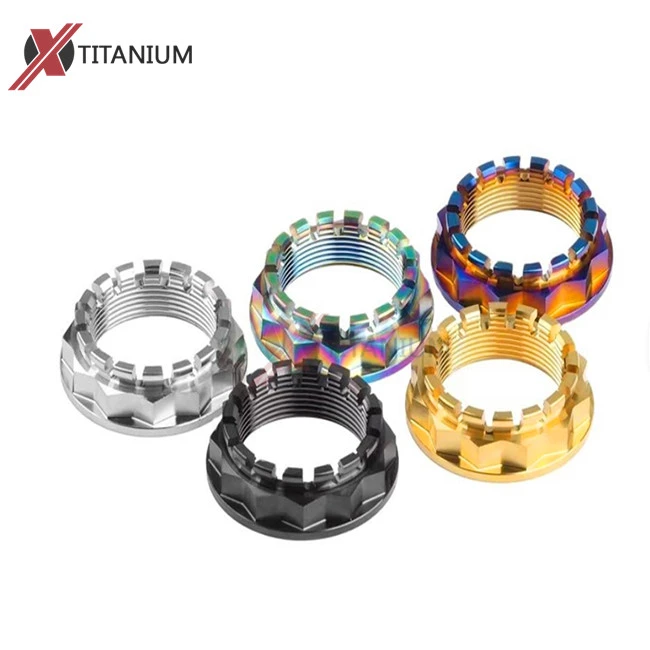
Understanding GR5 Titanium Rear Axle Nuts
Material Composition and Metallurgical Properties
The microstructure of Gr5 Titanium Rear Axle Nut alloy, which is made up of 90% titanium, 6% aluminium, and 4% vanadium, gives it great mechanical performance. The aluminium part makes it stronger and less dense, and the vanadium part stabilises the beta phase, which makes it more resistant to heat and easier to work with. Because of this exact chemical balance, Gr5 has a yield strength of at least 830 MPa and a hardness grade of 36 HRC. This makes it the best material for parts that need to be both tough and flexible.
Most of the time, CNC machining is used to make these fasteners from forged bar stock instead of casting. This makes sure that the grains flow in a way that makes them as resistant to fatigue as possible. Fully rolled threads, not cut threads, keep stress from building up at the thread root, which is very important when parts are loaded and unloaded many times. Surface treatments like polishing, anodising, and nitriding improve performance even more. Anodised finishes come in natural titanium, gold, blue, green, purple, black, and rainbow colours, which can be used for both function and style.
Performance Advantages in Critical Applications
Because of its high strength-to-weight ratio, Ti-6Al-4V alloy directly leads to better performance in motorsports and aerospace. By switching from steel axle nuts to titanium ones, you can lower the vehicle's unsprung mass. This lets the suspension systems react faster to changes in the road surface, which improves driving skill and makes drivers less tired. Teams in motorsports have seen their lap times get faster because the weight of many titanium parts has gone down.
Another practical benefit is that it is stable at high temperatures. Gr5 titanium keeps its mechanical properties even at temperatures as high as 400°C, which stops it from losing strength over time like aluminium alloys do when exposed to heat for a long time. This quality is very important in situations where the bolt is close to brakes and heat from the wheels could damage it. The low thermal expansion rate of the material also keeps the torque constant across temperature changes, which lowers the risk of loosening during thermal cycles.
Comparing GR5 Titanium with Other Titanium Grades
GR2 Commercially Pure Titanium
Commercially pure titanium (GR2) is made up of 99.2% titanium and very few alloying elements. It is very resistant to rust but has a much lower tensile strength. Because its tensile strength is only 340 to 450 MPa, GR2 is not good for high-load fastening tasks where the preload forces are more than 15,000 N. When looking at projects that need to be done quickly and cheaply, procurement teams might think about using GR2 for decorative parts that aren't structural, but alloyed types are needed for axle nuts because they have better mechanical qualities.
The malleability of GR2 titanium is good for shaping, but it can be dangerous when used in fastener uses. When loaded and unloaded over and over, pure titanium deforms more than Gr5, which causes the clamping force to gradually decrease. Marine gear applications sometimes choose GR2 because it doesn't rust in saltwater, but engineers have to deal with lower load rates and more retorquing needs than Gr5 options. Gr5 Titanium Rear Axle Nut offers a practical alternative in such scenarios, as its higher strength and fatigue resistance help maintain consistent clamping force under cyclic loads, reducing the maintenance burden compared to GR2 fasteners.
GR9 Titanium Alloy (Ti-3Al-2.5V)
Gr9 titanium is in the middle of commercially pure grades and Gr5, which has 3% aluminium and 2.5% vanadium in it. The tensile strength of this metal is close to 620 MPa, which is higher than GR2 but much lower than Gr5. Because it has less alloying, Gr9 is about 15 to 20 percent less expensive than Ti-6Al-4V. This makes it appealing to buyers on a budget who are ready to give up some speed.
Manufacturers of bicycle frames often use Gr9 tubing when middling strength is enough, but the grade's limits are shown in critical fastening situations. Because Gr9 is not as hard as steel or stainless steel, it is more likely to develop thread galling when paired with those materials. This means that anti-seize chemicals are needed, which makes upkeep more difficult. Aerospace applications don't usually accept Gr9 for main structure fasteners. This makes it harder for other industries to use it because it costs too much to qualify components, so they stick to the tried-and-true Gr5 standards.
Steel and Aluminum Alternatives
High-strength steel screws (Grade 8.8 or 10.9) have the same tensile strength as Gr5 titanium but cost less, which gives the impression of being more cost-effective. Lifecycle study shows the true prices of steel, especially in places where it is corrosive. Steel fasteners quickly rust in coastal, marine, and road salt-filled areas, causing threads to seize that can't be removed without damaging the metal. Within two years of service, the initial savings are usually outweighed by the costs of replacement labour and possible damage to mating parts.
Nuts made of aluminium metal (usually 7075-T6) are lighter, but they're not strong enough for safety-critical fixing. Aluminium screws need longer thread engagement lengths and more frequent inspections because their tensile strength is only about 570 MPa and their wear resistance is much lower. Because of the risk of galvanic rusting when aluminium touches different metals, isolation steps are needed that make assembly more difficult. This makes the cheaper material less useful because it makes installation more difficult.
Procurement Considerations for GR5 Titanium Rear Axle Nuts
Supplier Qualification and Certification Requirements
When choosing reliable titanium fastener providers, you need to check more than just price to see if they can be trusted. Quality management certifications, such as AS9100 for aerospace uses, ISO 9001 for general manufacturing, and NADCAP accreditation for special processes, show that a company can control a process objectively. Each shipment must include material certifications that list the chemicals used, the results of any mechanical tests, and heat treatment records that can be linked to specific production lots.
Suppliers who offer a wide range of testing services show that they care about quality assurance. In-house spectrometry for chemical analysis, tensile testing tools, and measurement inspection systems make it possible to check things in real time instead of sending them to outside labs. This infrastructure cuts down on lead times and lets you make changes right away if specifications change. Before signing long-term supply agreements, procurement teams can check the consistency of manufacturing by asking for facility audits or inspection reports from a third party.
Customization Capabilities and Lead Time Management
Ti-6Al-4V Gr5 Titanium Rear Axle Nuts often need to be changed to fit the job, such as having different thread sizes, flange shapes, or surface treatments. Multi-axis CNC machining centers allow suppliers to make complex geometries with very tight tolerances (usually ±0.05mm for critical dimensions). Thread rolling lets you make sure that the thread has the right shape and is more resistant to wear than cut threads.
Lead times for titanium parts are usually 6 to 12 weeks for first orders. This is because of the time it takes to get materials and how complicated the cutting is. Established sellers keep a smart stock of common sizes of raw materials, which cuts the time it takes to send repeat orders to three to four weeks. When you make a volume promise, you allow suppliers to support dedicated production runs. This lowers costs for orders over 500 pieces. When making procurement strategies, it's important to weigh the costs of keeping inventory against the chance of production delays. For high-volume needs, consignment arrangements may be necessary.
Pricing Structure and Total Cost of Ownership
When compared to steel options, Gr5 titanium fasteners are more expensive. For example, Gr5 Titanium Rear Axle Nuts are usually 8–12 times more expensive than steel parts that do the same job. This difference in the initial cost needs a total cost of ownership analysis that takes into account factors that affect the whole lifecycle. Corrosion resistance gets rid of the need to repair steel bolts that have seized or corroded, and less weight helps increase fuel economy in transportation uses.
Buying in bulk can save you money because of economies of scale. You can usually get discounts for buying 100, 500, or 1,000 pieces. Annual purchase agreements that promise a certain amount of goods can help suppliers make the best use of their production schedules. This saves customers money because the unit price goes down. When you buy something from another country, payment terms and currency trading techniques become important because the price of titanium is linked to the price of other commodities on the global market and the cost of energy affects melting operations.
Installation, Maintenance, and Performance Optimization of GR5 Titanium Rear Axle Nuts
Proper Installation Procedures and Torque Specifications
Installing titanium fasteners correctly is the first step to getting the best performance out of them. As a minimum, the thread contact should be 1.5 times the thickness of the bolt. The threads should be clean, dry, and free of any debris. Because of changes in friction coefficients and elastic stiffness, Gr5 Titanium Rear Axle Nuts usually have torque requirements that are 15 to 20 percent lower than steel nuts of the same size. By following the manufacturer's instructions, you can avoid either over-tightening, which can damage the threads, or under-tightening, which lets the threads come free when the machine shakes.
Anti-seize compounds made for titanium uses stop galling and keep the torque-preload ratios correct. Copper-based anti-seize items make galvanic cells that speed up corrosion in sea settings, so stay away from them. The best protection comes from lubricants made of nickel or ceramic. Verifying the torque wrench's setting every six months makes sure that measurements are accurate, which is important for safety-critical fastening uses.
Maintenance Protocols for Longevity
Ti-6Al-4V alloy screws don't need as much upkeep as steel ones because they don't rust. However, they should still be inspected every so often. Visual inspection at regular service intervals finds surface damage or wear patterns that show the machine isn't aligned correctly or is under too much load. Titanium degradation shows up as surface discolouration or localised pitting, which can only be seen by trained inspection staff. Steel nuts show clear rust.
When to torque something depends on how hard it needs to be used. For example, racing uses often need to be checked after the initial break-in period and before competitions. Industrial machines that work under steady loads may need to have their torque checked once a year, while marine machines can benefit from inspections every six months, which happen at the same time as haul-out repair. Keeping track of torque values and test results makes maintenance records that can be used for warranty claims and dependability analysis.
Performance Data and Case Studies
Field testing in a variety of motorsports settings shows that Gr5 Titanium Rear Axle Nuts can last in harsh conditions. Teams that race superbikes say that no fasteners have broken during the whole season, even though they have been exposed to vibrations of more than 50G and temperature changes between room temperature and 300°C. Over the same duty cycles, 12% of similar steel parts failed due to fatigue cracking or seizure caused by corrosion.
Applications in marine engineering give strong data on corrosion resistance. After five years of being exposed to saltwater, Gr5 Titanium Rear Axle Nuts still worked perfectly, but steel ones had to be replaced after only 18 months because the threads were corroding. Getting rid of seized screws cut maintenance work by 3.5 hours per trailer per year, which saved more money than the initial titanium extra in just three years.
Why Choose GR5 Titanium Rear Axle Nuts? — Decision Support for B2B Buyers
Core Evaluation Metrics for Material Selection
For business-to-business purchases, decisions need to be carefully considered in a number of different performance areas. A study of the strength-to-weight ratio shows that Gr5 titanium has 25% higher specific strength than high-grade steel. This means that weight can be cut without affecting safety. According to ASTM G48 standards, corrosion resistance testing shows that steel parts are not susceptible to chloride-induced stress corrosion cracking, a type of rust that shortens the life of steel parts in marine and seaside settings.
Based on S-N curve data, predictions for fatigue life show that Gr5 titanium parts have 10^7 cycle endurance limits that are about 50% higher than similar steel fasteners at the same stress levels. This longer fatigue resistance means that the product will need to be inspected less often and cost less to maintain over its lifetime. Gr5 Titanium Rear Axle Nut directly benefits from this superior fatigue performance, ensuring that the axle joint remains secure over millions of load cycles without premature loosening or fracture. Total cost modelling that takes into account the price of the product, the labour needed to install it, the frequency of upkeep, and the cost of replacement usually shows that titanium screws become cost-neutral in 3 to 5 years for use in acidic environments.
Industry-Specific Application Guidance
The decrease of unsprung weight is a top priority in the automotive and racing industries because it leads to better handling dynamics and rapid response. Original equipment makers are choosing titanium fasteners more and more for speed versions and limited-production models where the higher cost fits with how the product is positioned in the market. Aftermarket companies that sell parts to racing customers find that titanium parts command higher prices and keep customers coming back because they improve speed in a way that can be measured.
Materials used in aerospace must meet strict qualification standards, such as those for fatigue testing, stress corrosion evaluation, and batch tracking. Gr5 titanium is already approved by major aerospace standards (AMS 4928, AMS 4911), which makes it easier to qualify parts compared to other materials that need long testing programs. The weight savings directly affect the payload capacity and fuel efficiency, which are very important in the business of commercial aviation. Marine engineering specifiers like titanium because it doesn't rust or biofould in saltwater.
Desalination plants, offshore platforms, and military ships can use maintenance-free performance, which gets rid of the costs of replacing steel parts on a regular basis. Titanium is used in medical equipment because it is biocompatible and doesn't break down when sterilised. For example, Gr5 Titanium Rear Axle Nuts are used in mobile imaging systems and surgery tables that need to be cleaned often.
Long-Term Value Through Durability and Reliability
A study of reliability engineering shows that titanium fasteners have benefits that go beyond their material properties and include benefits at the system level. Getting rid of failures caused by corrosion gets rid of a main reason why industrial operations have unplanned downtime. Predictable repair plans based on wear trends instead of corrosion uncertainty make assets more useful and cut down on the need to keep extra parts on hand.
When a fastener fails in an application where responsibility or large consequential losses are at stake, warranty factors favour titanium components. Racing teams choose titanium fasteners even though the prices of the parts don't make up a big part of the value of the car. They do this because failure-related crashes put drivers at risk and cause a lot more damage to equipment than the saves from buying fastereners. This risk-adjusted choice framework can be used in the medical, aerospace, and marine industries, where choosing materials is based on following rules and having a safety mindset.
Conclusion
To choose the right titanium grades for rear axle nuts, you have to weigh the needs for technical performance against the available cash and the weather. The Gr5 titanium alloy is stronger, less likely to rust, and lasts longer than other grades and traditional materials. Gr5 Titanium Rear Axle Nut exemplifies these advantages, delivering dependable clamping force and fatigue resistance even under harsh dynamic loads, which directly reduces the risk of loosening over time.
Its higher price is justified by lower lifecycle costs and higher reliability. Purchasing teams can get more done when they work with qualified suppliers who offer full testing, customisation, and technical support. Following the right installation and upkeep steps will make parts last longer and work better in a variety of industries, including automobile, aerospace, marine, and industrial.
FAQ
How does GR5 titanium durability compare to steel in axle nut applications?
Gr5 Titanium Rear Axle Nuts last a lot longer than steel equivalents in corrosive environments. They can still work properly after five years of being exposed to saltwater, while steel parts usually only last 18 months. The passivation layer that forms on titanium surfaces stops electrolytic corrosion. This keeps threads from seizing up and cuts down on upkeep work. Testing for fatigue shows that titanium parts last 50% longer when they are loaded and unloaded over and over again, which is common in automotive and motorsports applications.
What certifications should buyers verify during procurement?
Some important certificates are material test results that show the chemical make-up according to ASTM B348 standards, mechanical property verifications that show the minimum tensile and yield strengths, and dimensional inspection records that show the thread specs. Suppliers with AS9100, ISO 9001, or NADCAP certifications have mature quality systems that support consistent production. Traceability paperwork that connects finished parts to specific material heats lets you figure out what went wrong if problems happen in the field.
Can GR5 titanium nuts accommodate various axle designs?
Modern CNC machines can be customised to fit metric and English thread standards, unique flange shapes, and specific size requirements for different applications. Standard coarse and fine pitches, left-hand threads for certain spinning directions, and custom profiles for unique axle designs are all kinds of threads. Custom specs usually mean longer lead times—8–10 weeks for the first production runs—but shorter lead times—3–4 weeks for repeat orders from sources who keep raw materials in stock.
Partner with a Trusted Gr5 Titanium Rear Axle Nut Manufacturer
Baoji Chuanglian New Metal Material Co., Ltd. uses advanced CNC machining and decades of experience working with titanium to make precision-engineered fastening solutions that meet the standards of the aerospace, automotive, and marine industries. Our thorough quality control system makes sure that all of our production runs use the same materials and the same measurements. We can also make changes to fit your special thread requirements and surface treatments. As a well-known titanium product seller based in Baoji, China's "City of Titanium," we have easy access to a wide range of raw materials, which lets us offer reasonable prices and reliable delivery times for both small prototypes and large production runs.
Please email our engineering team at info@cltifastener.com or djy6580@aliyun.com to talk about your specific Gr5 Titanium Rear Axle Nut needs, to ask for material certifications, or to set up facility audits that will confirm our manufacturing capabilities and quality management systems.
References
1. Boyer, R., Welsch, G., & Collings, E.W. (1994). Materials Properties Handbook: Titanium Alloys. ASM International, Materials Park, Ohio.
2. Donachie, M.J. (2000). Titanium: A Technical Guide, 2nd Edition. ASM International, Materials Park, Ohio.
3. Peters, M., Kumpfert, J., Ward, C.H., & Leyens, C. (2003). Titanium Alloys for Aerospace Applications. Advanced Engineering Materials, Volume 5, Issue 6.
4. Lütjering, G. & Williams, J.C. (2007). Titanium, 2nd Edition. Springer-Verlag, Berlin Heidelberg.
5. ASM International Handbook Committee (1990). Properties and Selection: Nonferrous Alloys and Special-Purpose Materials. ASM Handbook Volume 2, ASM International.
6. Schutz, R.W. & Watkins, H.B. (1998). Recent developments in titanium alloy application in the energy industry. Materials Science and Engineering: A, Volume 243, Issues 1-2.
Learn about our latest products and discounts through SMS or email