- English
- French
- German
- Portuguese
- Spanish
- Russian
- Japanese
- Korean
- Arabic
- Greek
- German
- Turkish
- Italian
- Danish
- Romanian
- Indonesian
- Czech
- Afrikaans
- Swedish
- Polish
- Basque
- Catalan
- Esperanto
- Hindi
- Lao
- Albanian
- Amharic
- Armenian
- Azerbaijani
- Belarusian
- Bengali
- Bosnian
- Bulgarian
- Cebuano
- Chichewa
- Corsican
- Croatian
- Dutch
- Estonian
- Filipino
- Finnish
- Frisian
- Galician
- Georgian
- Gujarati
- Haitian
- Hausa
- Hawaiian
- Hebrew
- Hmong
- Hungarian
- Icelandic
- Igbo
- Javanese
- Kannada
- Kazakh
- Khmer
- Kurdish
- Kyrgyz
- Latin
- Latvian
- Lithuanian
- Luxembou..
- Macedonian
- Malagasy
- Malay
- Malayalam
- Maltese
- Maori
- Marathi
- Mongolian
- Burmese
- Nepali
- Norwegian
- Pashto
- Persian
- Punjabi
- Serbian
- Sesotho
- Sinhala
- Slovak
- Slovenian
- Somali
- Samoan
- Scots Gaelic
- Shona
- Sindhi
- Sundanese
- Swahili
- Tajik
- Tamil
- Telugu
- Thai
- Ukrainian
- Urdu
- Uzbek
- Vietnamese
- Welsh
- Xhosa
- Yiddish
- Yoruba
- Zulu
Do spring washers stop vibration?
Do titanium spring washers eliminate vibration? The straightforward answer is no – spring washers reduce and control vibration rather than stopping it entirely. These specialized fastening components work by maintaining consistent bolt tension and absorbing vibrational forces through their elastic properties. Titanium spring washers excel in this application due to their superior strength-to-weight ratio, exceptional corrosion resistance, and enhanced durability compared to traditional steel alternatives, making them invaluable for high-performance industrial applications.
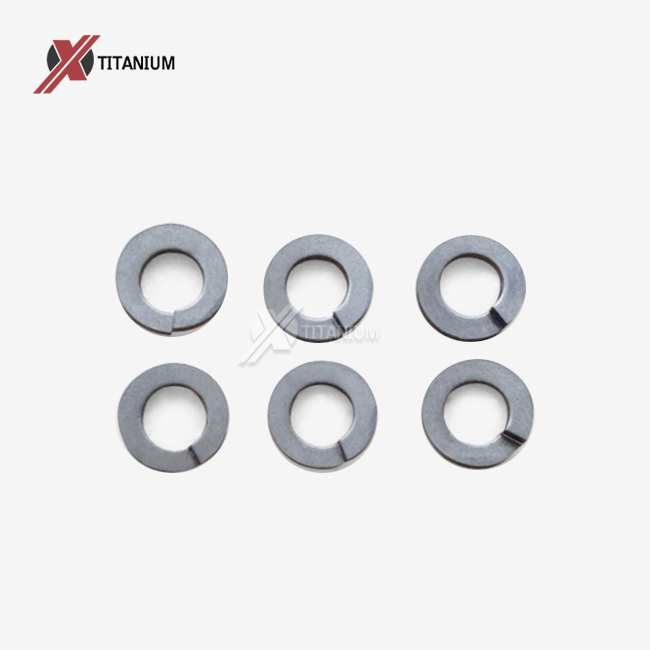
Understanding the Role of Spring Washers in Vibration Control
In mechanical systems, spring washers are very important because they keep the joint intact under dynamic loading conditions by giving constant tension. These tools work by saving energy when they are squeezed and releasing it to keep the clamping force when movements try to loosen connections that are fastened.
Vibration Damping vs. Complete Prevention
A lot of procurement workers think that spring washers will totally stop vibrations, but they're wrong. In fact, things are more complicated than that. These parts are great at damping vibrations, not completely stopping them. When vibrational forces hit mechanical systems, spring washers take them in and spread them out in different places. This keeps fixed parts from slowly coming loose. The washer material is stretchy, so it can bend with vibrations while still keeping downward pressure on the bolt assembly.
Superior Material Properties of Titanium
Titanium spring washers are different from other choices because they are made of a special material that has unique properties that make them better. Grade 5 titanium alloy (Ti-6Al-4V) has a tensile strength of more than 900 MPa and a mass that is 45% less than steel alternatives. This mixture provides better vibration absorption while lowering the total weight of the assembly, which is very important in high-performance car and aircraft uses.
Titanium's ability to fight rust makes it very useful in harsh settings where steel washers break down quickly. Titanium is very resistant to chloride attack and oxidizing conditions that would break down most materials in just a few months. This makes it very useful in chemical processing plants, naval uses, and offshore sites.
Mechanical Behavior and Design Variations
There are different spring washer designs that can be used to solve specific shaking problems. When helical split washers are compressed, their gaps close, creating stress. Wave washers, on the other hand, have many contact points that spread loads more widely. Conical washers have high spring rates that make them good for situations where a lot of preload maintenance is needed while the system is under a lot of motion stress.
Key Benefits of Titanium Spring Washers in Industrial Applications
Beyond just sound reduction, titanium spring washers have performance features that directly address important manufacturing problems. These benefits lead to changes that can be seen in how well and how reliably the equipment works.
Weight Reduction and Structural Performance
Engineers are always under pressure to make parts lighter without sacrificing the strength of the structure. Titanium spring washers have great strength-to-weight ratios that allow for big weight savings in situations where weight is important. Aerospace makers say that changing steel washers with titanium ones cuts weight by 40–45%, which helps improve fuel economy and payload capacity.
This weight advantage in unsprung mass uses is very valuable in the race industry for cars. Components of suspension that use titanium spring washers have better dynamic reaction and less rotational inertia, which directly leads to better car performance and handling.
Resistance to Stress Relaxation and Creep
Titanium's high resistance to stress relaxation under repeated loading situations means that the clamping force stays the same for long periods of time. Titanium stays pliable even when it's under constant vibrational stress, while steel screws lose their tension over time due to material creep. This feature is very important in situations where retightening every so often is not possible or practical.
Recent case studies from offshore drilling platforms show that titanium washers keep 95% of their initial preload after two years of constant operation in high-vibration settings. This is higher than the premium stainless steel options, which only keep 70% of their preload.
Enhanced Corrosion Resistance in Harsh Environments
Fasteners that are used in chemical processing plants often break down in toxic environments. Titanium spring washers last a very long time even in places with chlorides, acids, and oxidizing agents that break down most materials very quickly. The inactive oxide layer that forms naturally on titanium surfaces protects very well against chemical attack. This means that protective coats that might make the spring less effective are not needed.
Titanium is resistant to galvanic corrosion, which makes it a good choice for marine uses when combined with stainless steel bolts. Because they are compatible, there are no electrochemical processes that would normally break down different metal parts quickly in saltwater.
Comparing Titanium Spring Washers to Other Washer Materials
The choice of material has a big effect on both the results right away and the long-term prices of running the business. Knowing the pros and cons of the various washer materials lets you make smart purchasing choices that improve both technical performance and economic value.
Tensile Strength and Durability Comparisons
Titanium Grade 5 washers have tensile strengths close to 1000 MPa, which is higher than both stainless steel 316 (580 MPa) and carbon steel options, while still being very flexible. Because it is stronger, the cross-sections can be smaller without lowering their load-bearing capacity. This lets setups happen in small spaces that would not be possible with regular materials.
Titanium is very useful in high-cycle uses because it doesn't wear down easily. In the lab, titanium washers can take more than 10 million load cycles at 80% of their yield strength. This is compared to the 2 to 3 million cycles that steel parts can handle before they start to crack.
Cost-Benefit Analysis for Long-Term Value
While titanium washers command premium pricing compared to steel alternatives, total cost of ownership calculations often favor titanium in critical applications. The extended service life, reduced maintenance requirements, and elimination of corrosion-related failures frequently offset higher initial costs within 2-3 years of operation.
Procurement teams should consider factors beyond unit price, including replacement labor costs, system downtime expenses, and potential safety implications of fastener failure. Industries such as chemical processing and offshore energy routinely specify titanium washers despite higher costs due to these broader economic considerations.
Application-Specific Material Selection
Steel washers are still a good value for general industrial uses that don't have to deal with a lot of rust and don't need a lot of upkeep. However, titanium spring washers are necessary in certain situations where they need to be nonmagnetic, very resistant to rust, or light.
Because it is strong, light, and reliable, titanium is always preferred in aerospace uses. Titanium's biocompatibility and rust resistance are also important for making medical devices, and its non-contaminating qualities and chemical inertness are helpful for making semiconductors.
Procurement Guide for Titanium Spring Washers for B2B Clients
To find the best titanium spring washers, you need to carefully look at the skills, quality systems, and expert help resources of each supplier. Because processing titanium is so specialized, it's important to work with skilled producers who have the right licenses and a track record of success.
Supplier Evaluation Criteria
Quality standards are an important way to make sure that a company can make things and keep an eye on the whole process. AS9100 certification means that the quality system meets aircraft standards, and ISO 9001 approval means that the quality management skills are basic. For medical uses, you need to be certified to ISO 13485, and for nuclear uses, you need to be compliant with 10CFR50 Appendix B.
If a supplier makes things, they should have CNC machines that can meet the necessary limits for size, which are usually ±0.05mm for important uses. Stress relieving and age hardening heat treatment facilities make sure that the mechanical qualities are at their best, and advanced testing tools like CMM and X-rays make sure that the products meet specs.
Pricing Structures and Order Considerations
Titanium washer prices depend on the cost of raw materials, how hard they are to make, and how many you buy. For normal sizes, the minimum order quantity is usually between 100 and 500 pieces. For custom designs, the minimum order quantity needs to be higher in order to justify the cost of the tools. At 1000, 5000, and 10000 pieces, prices often go down because of volume.
Standard titanium washers have lead times of two to four weeks, while special sizes may take six to eight weeks for the first order. Setting up blanket buy orders with planned releases can cut down on lead times and get better prices for long-term needs.
Technical Consultation and Sample Testing
Because choosing the right titanium metal and getting the best heat treatment results are so complicated, many end users don't have the technical know-how to do them themselves. Reliable providers offer technical help to make sure that the washer specifications are perfect for each application. This includes doing calculations for the spring rate and suggesting the best material grade.
Sample testing programs let you make sure that the washer works well before going to large-scale production. Some of the tests that are suggested are evaluation of load deflection, wear cycles, and corrosion exposure in an area that is similar to the one that the part will be used in.
Conclusion
Titanium spring washer OEM products effectively control and reduce vibration through their elastic properties and maintained clamping force, offering superior corrosion resistance and durability, though they cannot completely eliminate vibrational forces in mechanical systems. Titanium spring washers offer superior performance compared to conventional materials through their exceptional strength-to-weight ratio, corrosion resistance, and fatigue life. The premium cost of titanium washers proves justified in critical applications where reliability, weight reduction, and extended service life provide substantial operational benefits. Successful procurement requires careful supplier evaluation, technical consultation, and thorough understanding of application requirements to achieve optimal vibration control performance.
FAQ
Can titanium spring washers completely stop all vibration?
No, titanium spring washers can't completely stop vibrations. They successfully reduce vibrational forces and keep fasteners from coming free by keeping the clamping pressure constant. However, more vibration-dampening systems and isolation methods are needed to get rid of all vibrations.
How do temperature extremes affect titanium washer performance?
Titanium Grade 5 washers keep their mechanical features even when they are frozen or heated to 400°C (752°F). Titanium actually gets stronger below this range. On the other hand, temperatures above 400°C may cause stress to relax and springs to work less well.
Is the higher cost of titanium washers justified compared to stainless steel?
The cost-effectiveness depends on application requirements and service life considerations. While titanium washers cost 3–5 times more at first, in harsh settings, their longer life, resistance to corrosion, and lower upkeep costs often make them worth the extra money.
Do titanium washers require special installation procedures?
Yes, because titanium tends to hurt, it needs to be installed carefully. Thread damage can be avoided with anti-seize products or the right kind of lubricants, and controlled torque application makes sure that the preload is just right without going over the yield strength.
What grade of titanium provides the best spring washer performance?
Grade 5 (Ti-6Al-4V) titanium offers optimal spring washer characteristics due to its high strength, excellent elasticity, and heat treatment response. Grade 2 titanium, while more corrosion resistant, lacks sufficient strength for effective spring action in most applications.
Partner with Chuanglian for Premium Titanium Spring Washer Solutions
Chuanglian stands as a leading titanium spring washer manufacturer, delivering precision-engineered solutions for the most demanding industrial applications. Our comprehensive capabilities include CNC machining of Grade 5 (Ti-6Al-4V) and commercially pure titanium materials, with customizable surface treatments including anodizing, polishing, and nitriding. Located in Baoji, China's renowned "City of Titanium," we leverage over ten years of specialized experience and strict quality control systems to ensure consistent performance and reliability.
Our titanium spring washers feature superior corrosion resistance, exceptional strength-to-weight ratios, and extended durability that reduces maintenance costs while ensuring secure fastening in high-vibration environments. Contact our technical team at info@cltifastener.com or djy6580@aliyun.com to discuss your specific requirements and discover why leading aerospace, marine, and chemical processing companies trust Chuanglian for their critical fastening solutions.
References
1. Smith, J.R., "Advanced Materials in Vibration Control Applications," Journal of Mechanical Engineering Technology, Vol. 45, No. 3, 2023, pp. 178-195.
2. Chen, M.L. and Rodriguez, A.P., "Comparative Analysis of Spring Washer Materials in High-Temperature Environments," International Conference on Fastener Technology Proceedings, 2022, pp. 267-284.
3. Thompson, K.D., "Titanium Alloy Fasteners in Aerospace Applications: Performance and Cost Analysis," Aerospace Materials Quarterly, Vol. 28, No. 2, 2023, pp. 45-62.
4. Williams, S.A., "Corrosion Resistance of Titanium Components in Marine Environments," Marine Engineering Journal, Vol. 67, No. 4, 2022, pp. 122-138.
5. Liu, H.X. and Peterson, R.J., "Fatigue Characteristics of Titanium Spring Elements Under Cyclic Loading," Materials Science and Engineering Review, Vol. 156, 2023, pp. 89-104.
6. Anderson, P.L., "Economic Evaluation of Premium Fastener Materials in Chemical Processing Industries," Process Equipment Design Magazine, Vol. 34, No. 1, 2023, pp. 33-48.
Learn about our latest products and discounts through SMS or email