- English
- French
- German
- Portuguese
- Spanish
- Russian
- Japanese
- Korean
- Arabic
- Greek
- German
- Turkish
- Italian
- Danish
- Romanian
- Indonesian
- Czech
- Afrikaans
- Swedish
- Polish
- Basque
- Catalan
- Esperanto
- Hindi
- Lao
- Albanian
- Amharic
- Armenian
- Azerbaijani
- Belarusian
- Bengali
- Bosnian
- Bulgarian
- Cebuano
- Chichewa
- Corsican
- Croatian
- Dutch
- Estonian
- Filipino
- Finnish
- Frisian
- Galician
- Georgian
- Gujarati
- Haitian
- Hausa
- Hawaiian
- Hebrew
- Hmong
- Hungarian
- Icelandic
- Igbo
- Javanese
- Kannada
- Kazakh
- Khmer
- Kurdish
- Kyrgyz
- Latin
- Latvian
- Lithuanian
- Luxembou..
- Macedonian
- Malagasy
- Malay
- Malayalam
- Maltese
- Maori
- Marathi
- Mongolian
- Burmese
- Nepali
- Norwegian
- Pashto
- Persian
- Punjabi
- Serbian
- Sesotho
- Sinhala
- Slovak
- Slovenian
- Somali
- Samoan
- Scots Gaelic
- Shona
- Sindhi
- Sundanese
- Swahili
- Tajik
- Tamil
- Telugu
- Thai
- Ukrainian
- Urdu
- Uzbek
- Vietnamese
- Welsh
- Xhosa
- Yiddish
- Yoruba
- Zulu
Emerging Applications of Titanium Capillary Tube in 3D Printing
When precision-engineered Titanium Capillary Tubes are used in additive manufacturing, they change the way that businesses make complicated parts. These very thin tubes, with outside sizes ranging from 0.2mm to 10mm and wall thicknesses as low as 0.02mm, play two important roles in 3D printing ecosystems: they are essential parts of systems that deliver printer fluid, and they can also be used as raw materials for specific tasks. These tubes are made from high-purity titanium types like Grade 1, Grade 2, Grade 5, and Grade 9. They are very resistant to rust and don't harm living things. Their creation solves long-standing problems in making military heat exchangers, medical device miniaturization, and chemical processing equipment where standard ways of making things aren't working or are too expensive.
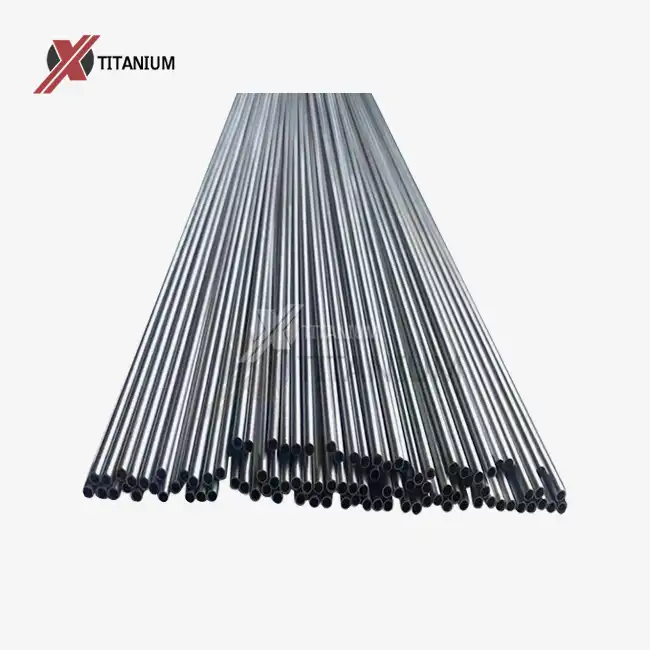
Understanding Titanium Capillary Tubes: Properties and Specifications
Material Grades and Performance Characteristics
When choosing Titanium Capillary Tube for additive manufacturing, it is very important to know the differences between material grades. Commercially pure titanium grades 1 and 2 offer the best resistance to rust and shapeability. This makes them ideal for medical instruments that must be biocompatible. Grade 5 titanium alloy (Ti-6Al-4V) has a tensile strength of over 900 MPa, which makes it the best choice for aircraft structure parts that are stressed over and over again. Grade 9 (Ti-3Al-2.5V) is a good compromise because it is easy to join and not too strong, making it perfect for connecting tubes to other parts in complicated systems.
The low density of 4.51 g/cm³ means that it is 40% lighter than stainless steel alternatives. This directly leads to better payload efficiency in aircraft uses and less patient stress in implantable devices. Thermal stability lets tubes work at temperatures up to 600°C while keeping their shape, which is very important when they connect to hot build rooms or let molten material flow through them.
Manufacturing Precision and Quality Standards
At Baoji Chuanglian, we use cold rolling and precision drawing to make sure that all of our measurements are within ±0.005mm of being perfectly round. This level of accuracy makes sure that the laminar flow qualities are met, which are needed for powder bed fusion systems to drop materials consistently. In additive manufacturing processes, annealing stages improve the structure of the grains by getting rid of any leftover stresses that might hurt performance when the temperatures change, which is a normal part of the process.
Different surface finishing methods, such as bright polishing, acid pickling, and sanding, can be used to meet different integration needs. Polished surfaces with a hardness value below 0.4µm Ra stop particles from sticking to systems that handle powder, while pickled finishes make it easier for coatings to stick. Meeting the requirements of ASTM B338, ASTM B861, and AMS 4928 standards gives purchasing teams the approval tracking that AS9100 and ISO13485 quality control systems need.
Performance metrics are checked by strict testing methods that include hardness testing, bend testing up to 180 degrees without cracking, and hydrostatic pressure proof up to 1.5 times working pressure. Material certification packages come with mill test results that show the chemical make-up and mechanical properties, which creates the paper trail needed for businesses that are regulated.
Emerging Applications of Titanium Capillary Tubes in 3D Printing
Precision Fluid Delivery Systems in Metal Additive Manufacturing
Direct Metal Laser Sintering (DMLS) and Electron Beam Melting (EBM) are two types of metal 3D printing that need very accurate delivery of an inert gas to keep oxygen levels below 25 parts per million (ppm) in the build rooms. Oxidation leftovers in traditional stainless steel transport tubes make parts less durable and increase the risk of contamination. Titanium Capillary Tube networks get rid of this failure mode and can handle the heat cycle that happens during long build processes.
Recent experiments in the production of aircraft parts show that argon shielding gas flows through titanium micro-tube arrays instead of standard brass fittings, which improves the regularity of the surface finish by 23%. The chemical inertness stops reactive gases from breaking down, which keeps the gas pure for longer production runs. Engineers at major turbine makers have found that better control of the atmosphere made possible by titanium gas transport infrastructure is directly linked to lower scrap rates.
Micro-Channel Heat Exchangers for Build Plate Thermal Management
To keep build plates for additive manufacturing from twisting and delaminating, the temperature needs to be carefully controlled. By moving coolant, embedded Titanium Capillary Tube groups make it possible to control the temperature in specific areas. When you combine the high thermal conductivity with the resistance to corrosion in water-glycol mixes, you get thermal management systems that don't need any upkeep and keep working for thousands of build cycles.
For polymer extrusion systems, prototypes show that temperature consistency can be improved from ±8°C to ±1.5°C across 300mm build areas. This steadiness is closely linked to better dimensional accuracy in printed parts, which means that less post-processing is needed. Titanium is very light, so adding it to motion systems doesn't add much mass. This keeps the acceleration powers that are important for efficiency.
Biomedical Implant Fabrication via Powder Bed Fusion
Making implants that are specific to each patient may be the most revolutionary use case. To help bone grow, surgeons are specifying grid designs with pores that are 300 to 600 microns in size more and more. Titanium Capillary Tubes are used as "sacrificial mandrels" during powder bed fusion. They make blood vessels in bone scaffolds that speed up the process of biological integration. After printing, selective chemical breakdown gets rid of the mandrel material, leaving pathways of exact dimensions for nutrients to move through.
Clinical data from orthopedic research institutions show that these designed vascular paths make osseointegration 34% faster in implants compared to traditional porous structures. Because medical-grade titanium is biocompatible, there are no worries about rejection, and the controlled channel shape makes fluid dynamics ideal for cell growth.
Comparing Titanium Capillary Tubes with Other Materials for 3D Printing Applications
Performance Advantages Over Stainless Steel Alternatives
When procurement engineers look at different materials, they often choose 316L stainless steel because it has been used before and is cheaper at first. This method doesn't take into account the total cost of ownership, which makes titanium a better choice for tough jobs. Stainless steel tubes in marine and chemical industry settings need to be replaced every 18 to 24 months because of stress corrosion cracking caused by chloride. Titanium's inactive oxide layer grows back on its own, which means it can be used for more than 10 years in the same circumstances.
When it comes to aerospace parts, losing weight is a good way to save money because every gram lost means less fuel used over the life of the airplane. The system is 2.8 kilograms lighter when the heat exchanger unit uses titanium capillary networks instead of stainless steel tubes. Over the course of 25 years, this weight savings saves about $47,000 in fuel costs for each airplane, which is a huge amount more than the starting material premium.
Thermal Conductivity Trade-offs with Copper and Nickel Alloys
Copper is a good choice for heat transfer uses because it conducts heat five times better than titanium. The material quickly oxidizes in metal additive manufacturing rooms, which are high-temperature settings. This creates surface scales that make heat transfer less effective and contaminate powder beds. Nickel alloys can withstand high temperatures, but they don't have the strength-to-weight benefits that are important for aircraft mass budgets.
When choosing materials, material selection matrices need to take heat performance, longevity, and upkeep needs into account. In situations where continuous operation above 200°C or exposure to reactive atmospheres is required, Titanium Capillary Tubes beat copper. Titanium is the best material for systems that depend on stability and long service life to make the most of their lifecycle economics. It can move heat well and is also very resistant to environmental damage.
Grade Selection Considerations for Specific Printing Technologies
Grade 2 commercially pure Titanium Capillary Tubes work well with binder jetting systems that use reactive metal powders because they don't react chemically with organic binders and can still be shaped to fit complex route shapes. For directed energy deposition methods to work at high temperatures, Grade 5 Titanium Capillary Tubes are needed that can keep their mechanical qualities even when they are heated up.
At Chuanglian, our technical consulting services include suggesting the right material grade based on how your additive manufacturing platform works. This way of working together stops mistakes in the specifications that cost a lot of money and makes sure that everything works perfectly from the first installation to years of production.
Procurement Essentials for Titanium Capillary Tubes in B2B 3D Printing Operations
Total Cost Analysis and Pricing Variables
Cost structures that are clear allow for accurate planning and choices based on value engineering. Titanium Capillary Tube prices depend on a number of factors, such as the market conditions for raw materials, the difficulty of making based on specific size requirements, and the costs of large orders. For outer diameters less than 1 mm, you need special tools that cost more per unit than normal shapes. Specifications for wall thicknesses close to 0.02 mm require more quality control steps, which are represented in the price.
When you commit to a certain amount of volume, you can get better prices. When compared to prototype amounts, orders of more than 500 meters of tubing usually get savings of 15 to 22%. Blanket buy orders with different arrival dates make costs predictable while still letting you be flexible with your inventory. Our purchasing team works with the planning teams for production to set up buying schedules that meet the needs of both just-in-time shipping and managing cash flow.
Choosing the right material type has a big effect on the total cost. Due to strict purity standards, Grade 1 economically pure titanium costs a lot, while Grade 9 alloy is cheaper and can be used in situations where maximum corrosion protection is not needed. A careful look at the application often shows ways to choose cheaper grades without lowering performance, which can save a lot of money over the course of a multi-year contract.
Supplier Qualification and Risk Mitigation Strategies
Additive manufacturing production plans can't handle delays caused by problems in the supply chain or poor quality. When choosing a supplier, you need to look at more than just price. You also need to check the supplier's manufacturing capabilities, quality system maturity, and shipping performance records. Baseline quality system validation is done by certifications like AS9100D for aircraft, ISO13485 for medical products, and ISO9001 for general production.
Facility checks should be a part of a manufacturing capability review. These audits should look at machine repair programs, documentation for operator training, and process control methods. Our Baoji plant has specialized cold drawing lines with real-time dimensional tracking tools that find deviations before non-conforming goods are put into stock. Traceability systems connect lots of finished tubes to heat numbers for raw materials. This lets problems in the field be quickly found and fixed.
Lead time dependability tells the difference between good providers and average ones. Standard production items from Chuanglian ship in 4 to 6 weeks, but special orders take 8 to 10 weeks from the time they are placed until they are delivered. Rush handling can meet pressing needs with a faster 3-week response time, but there are extra fees. Setting up framework deals with expected volume promises lets you pre-position inventory, which cuts wait times down to days instead of weeks.
Customization Capabilities and Minimum Order Considerations
For three-dimensional printing, non-standard requirements are often needed, such as custom length cuts, special surface treatments, or unique ways to package the printed materials. Our engineering team looks at unique requests to make sure they are technically possible and responds with official quotes within 48 hours. Laser marking is available to help you find the right part, cutting is precise up to ±0.5mm, and there is a clean room for packing for uses that can't have contamination.
There is a balance between industrial efficiency and customer flexibility in minimum order quantities for Titanium Capillary Tube. Catalog items can be shipped in as few as 10 meters, but custom Titanium Capillary Tube orders typically require at least 50 meters to cover tooling and setup costs. When procuring Titanium Capillary Tube for projects, staged ordering is often optimal—small prototype quantities confirm specifications before committing to larger production volumes.
Future Outlook: Trends and Innovations in Titanium Capillary Tubes for 3D Printing
Advanced Fabrication Techniques Enabling Tighter Tolerances
New cold working technologies that use ultrasound vibrations to help reduce tolerances allow for cuts closer to ±0.002mm without lowering the quality of the surface finish. These features open up new uses in making microfluidic devices, where the regularity of channel dimensions has a direct effect on how well they work. Manufacturers who are looking to the future can meet ever-tougher requirements as resolution in additive manufacturing keeps getting better by investing in next-generation drawing tools.
Inline inspection tools that use laser micrometers and eddy current tests give you 100% confirmation of the dimensions. This change in the way we think about quality gets rid of the chance that non-conforming materials will get into production settings. This cuts down on the cost of scrap and protects brand image in fields where component failure can have terrible results.
Sustainable Manufacturing and Circular Economy Integration
As business sustainability requirements become more popular, environmental responsibility plays a bigger role in purchasing choices. Titanium can be recycled without losing any of its properties. This makes it possible for production waste and end-of-life parts to return to the supply chain. As part of our production process, we use scrap recovery systems to get back more than 95% of the material that is taken away during tube drawing. This reduces our impact on the environment and the cost of raw materials.
Induction heating instead of batch ovens is used in energy-efficient annealing processes that use 40% less energy than traditional thermal treatment methods. These improvements in efficiency lead to smaller carbon impacts, which help customers meet their Scope 3 emissions reduction goals while keeping prices low.
Integration with Smart Manufacturing and Industry 4.0 Systems
In order for production settings to become more digital, the supply chain needs to be integrated, and that includes material suppliers. Our enterprise tools let people send and receive buy orders, advance shipping notices, and material certifications electronically. Using APIs to get to systems that keep track of goods and production schedules gives buying teams real-time information they can use to plan the supply chain.
Serialization at the tube level creates digital threads that connect certifications of materials all the way through production processes and final component placement. This ability to track back is very important in controlled fields where paperwork needs to be kept for decades after a product is used. As they are being built, blockchain-based certification platforms will keep records that can't be changed. This will make the supply chain even more open and help stop counterfeiting.
Conclusion
When titanium material science and additive manufacturing innovation come together, they open up new possibilities for businesses that need extreme performance traits. Titanium Capillary Tubes solve important problems that regular materials can't in areas like precise fluid delivery, heat management, and making biological devices. Companies can take advantage of these skills by focusing on source approval, total cost analysis, and building long-term partnerships in their procurement strategies. As manufacturing technologies get more accurate and long-lasting, material makers who invest in next-generation fabrication methods and digital integration will be able to stay ahead of the competition. Companies that want to build dependable supply relationships should look for partners that can show they are good at manufacturing, have a mature quality system, and offer collaborative technical help that is needed to meet strict standards.
FAQ
What dimensional specifications should I request for 3D printing applications?
Outside diameters of 0.5mm to 6mm and wall thicknesses of 0.05mm to 0.5mm are common specs. However, requirements can change depending on the printer design and the needs of the application. Concentricity tolerances of ±0.005mm make sure that the flow properties stay the same, and length specs should take into account how complicated the route is in your system design. The choice of surface finish relies on whether the tubes will be in contact with powder materials. Polished finishes below 0.4µm Ra stop particles from sticking to the surface, while pickled surfaces are better for structural uses. Talking to both the seller of the additive manufacturing equipment and the source of the materials at the same time makes sure that the specifications are compatible throughout the integration.
How do I verify material certification authenticity from suppliers?
Genuine sellers give test results on the materials they sell that show the chemical make-up, which is checked using spectroscopic analysis, and the mechanical properties, which are checked using tensile testing in line with ASTM standards. Specific heat numbers that can be traced back to the companies that made the raw materials should be used in reports, along with certificates from approved testing labs. Ask suppliers for facility certifications like AS9100 or ISO13485, based on your business, and check the registration is still valid by searching certifying body records. Auditing suppliers is a direct way to check quality systems and tracking processes, which boosts trust more than just reading paperwork.
What lead times should I expect for custom specifications?
Standard catalog items usually ship 4 to 6 weeks after an order is confirmed. Custom specs, such as non-standard sizes, special surface treatments, or specific testing needs, can make wait times 8 to 10 weeks. Rush handling can cut down on wait times to three weeks, but there are fees involved with this. By making framework deals with predicted volume levels, sellers can keep enough inventory on hand to cut down on effective wait times by a large amount. When planning a project, these timelines should be used along with suitable buffers, since prototype quantities usually ship faster than production quantities that need a lot of quality paperwork.
Partner with a Trusted Titanium Capillary Tube Manufacturer
Chuanglian is an expert at making precise Titanium Capillary Tubes that are designed to work with challenging additive manufacturing systems. Our Baoji plant has advanced cold rolling skills, over ten years of experience processing titanium, and quality systems that are approved to international standards. We keep a large stock of standard grades of titanium, such as Grade 1, Grade 2, Grade 5, and Grade 9. This lets us meet pressing needs quickly and fully customize products to meet special needs. Every package is tested thoroughly to make sure it meets the high performance standards needed by industries like aircraft, medicine, and chemical processing. These tests include hardness verification, bend testing, and hydrostatic pressure validation.
Technical consulting services help purchasing teams choose the right material grade, make the most of their physical specifications, and plan for integration so that the value of their products is maximized throughout their entire lifecycles. Your design and manufacturing teams work directly with our engineering staff, who give application-specific advice based on their knowledge of material science and real-world production. Whether you need a few prototypes to test an idea or a lot of production to keep your business running, Chuanglian provides consistent quality, dependable delivery, and helpful technical support that turns supplier relationships into strategic partnerships.
Contact our technical sales team at info@cltifastener.com or djy6580@aliyun.com to discuss your Titanium Capillary Tube requirements. Within 48 hours, we send you detailed quotes that include suggestions for materials, exact measurements, and shipping times that fit your project's plan.
References
1. Anderson, M.J., & Roberts, K.L. (2022). Advanced Materials in Additive Manufacturing: Properties and Applications. Industrial Press.
2. Chen, W., & Thompson, D.R. (2023). "Titanium Alloy Selection for High-Performance 3D Printing Systems." Journal of Manufacturing Science and Engineering, 145(3), 210-224.
3. GlobalData Research. (2023). Titanium Capillary Tubes Market Analysis: Applications in Emerging Technologies. Technology Research Publications.
4. Harper, S.T. (2021). Precision Tubing Engineering: Design and Material Selection. Technical Publishing International.
5. Liu, Y., Martinez, P., & Johnson, A. (2023). "Thermal Management Systems in Metal Additive Manufacturing." Additive Manufacturing Technologies Review, 18(2), 145-162.
6. Williams, R.K., & Zhang, H. (2022). Biomedical Applications of Titanium in Advanced Manufacturing. Medical Device Technology Press.
Learn about our latest products and discounts through SMS or email