- English
- French
- German
- Portuguese
- Spanish
- Russian
- Japanese
- Korean
- Arabic
- Greek
- German
- Turkish
- Italian
- Danish
- Romanian
- Indonesian
- Czech
- Afrikaans
- Swedish
- Polish
- Basque
- Catalan
- Esperanto
- Hindi
- Lao
- Albanian
- Amharic
- Armenian
- Azerbaijani
- Belarusian
- Bengali
- Bosnian
- Bulgarian
- Cebuano
- Chichewa
- Corsican
- Croatian
- Dutch
- Estonian
- Filipino
- Finnish
- Frisian
- Galician
- Georgian
- Gujarati
- Haitian
- Hausa
- Hawaiian
- Hebrew
- Hmong
- Hungarian
- Icelandic
- Igbo
- Javanese
- Kannada
- Kazakh
- Khmer
- Kurdish
- Kyrgyz
- Latin
- Latvian
- Lithuanian
- Luxembou..
- Macedonian
- Malagasy
- Malay
- Malayalam
- Maltese
- Maori
- Marathi
- Mongolian
- Burmese
- Nepali
- Norwegian
- Pashto
- Persian
- Punjabi
- Serbian
- Sesotho
- Sinhala
- Slovak
- Slovenian
- Somali
- Samoan
- Scots Gaelic
- Shona
- Sindhi
- Sundanese
- Swahili
- Tajik
- Tamil
- Telugu
- Thai
- Ukrainian
- Urdu
- Uzbek
- Vietnamese
- Welsh
- Xhosa
- Yiddish
- Yoruba
- Zulu
Finding a Reliable Titanium Clad Copper Wire Supplier
Sourcing reliable titanium clad copper wire suppliers requires careful evaluation of quality certifications, manufacturing capabilities, and industry expertise. This specialized material combines copper's excellent conductivity with titanium's superior corrosion resistance, making it essential for aerospace, petrochemical, marine engineering, and medical device applications. Procurement professionals must assess supplier credentials, testing capabilities, and supply chain stability to ensure consistent material performance and delivery reliability in demanding industrial environments.
Understanding Titanium Clad Copper Wire and Its Market Demand
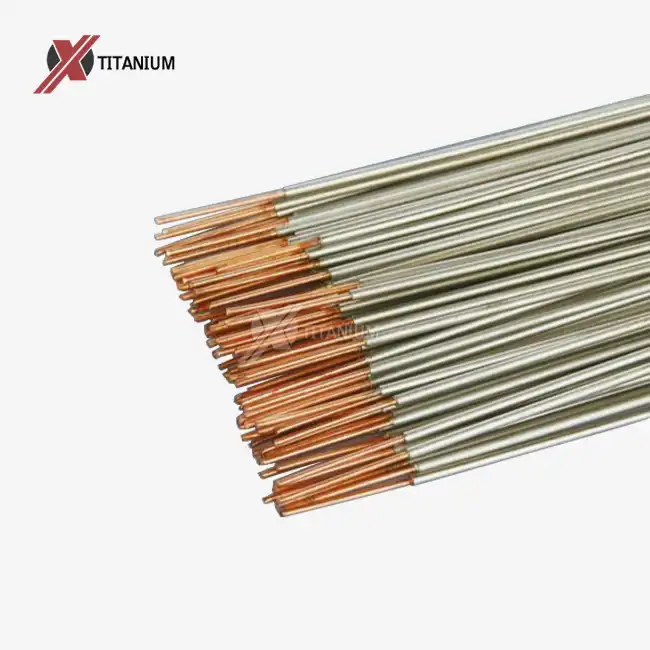
Titanium clad copper wire is a high-tech engineering option that meets the needs of more and more high-performance industrial uses. Copper's great ability to carry electricity is combined with titanium's amazing ability to fight corrosion and mechanical stress to make this composite material. The cladding process forms a metallic link between these two materials, making a line that keeps copper's ability to carry electricity while adding titanium's ability to protect it.
Performance Characteristics and Industrial Applications
Titanium-clad copper lines are essential in places where regular copper wire would break too soon because of their special features. Aerospace companies use these materials for electrical systems in airplanes that are subject to very different weather and temperature situations. The titanium layer keeps the copper core safe from rust and galvanic corrosion, which makes the wires last a lot longer than regular copper ones.
Titanium-clad wire is used in chemical processing plants where harsh chemicals and high humidity would quickly break down other types of materials. The better resistance to corrosion is especially useful for marine uses, since saltwater conditions are very hard on electrical infrastructure. Titanium coating is biocompatible, which is important to companies that make medical devices because it means these lines can be used for implantable devices and surgery tools.
Market Growth Drivers and Industry Trends
A recent study of the market shows that the need for titanium-clad copper wire is steadily growing in a number of different areas. The aerospace business is growing because of more commercial flights and plans to explore space. This is increasing the need for improved materials. Environmental laws that require electrical parts to last longer and be more stable have led to more widespread use in commercial settings.
Renewable energy has become a big market driver. Offshore wind farms and solar panel systems need materials that can last for decades in tough environments. Biocompatible electrical wires are in higher demand because medical technology is getting better, especially when it comes to implantable devices and minimally invasive surgery tools.
Critical Factors to Consider When Selecting a Titanium Clad Copper Wire Supplier
When choosing a supplier, you need to look at a number of factors that have an effect on the quality of the product, the reliability of the supply chain, and the success of the relationship in the long run. Because making titanium-clad copper wire is so complicated, it needs suppliers with specialized knowledge and advanced production tools.
Quality Certifications and Manufacturing Standards
Industry licenses are one of the best ways to tell if a supplier is qualified and trustworthy. Compliance with AS9100 standards in the aircraft business, and strong quality control systems with ISO 9001 certification are essential. For medical devices, sellers must have either ISO 13485 approval or FDA registration to ensure that biocompatibility and traceability standards are met. Additionally, for products like Titanium clad copper wire, it is important to verify that the supplier adheres to the same high standards of quality and regulatory compliance to ensure safety and reliability.
Manufacturing plants should have complete quality control systems that check the raw materials, keep an eye on the process, and test the finished product. Suppliers with their own metallurgical labs can give thorough reports on the properties of materials, which can include microstructural analysis, bond strength tests, and electrical conductivity measures. These features make sure that the quality of the products is always the same and allow for quick problem-solving when problems happen.
Technical Expertise and Customization Capabilities
Suppliers with a lot of experience know how to meet the specific needs of different uses and can help you choose the right materials. Their engineering teams should be able to come up with custom wire specs, such as different diameters, the best coating thickness, and unique tempering conditions. This expert help is very helpful when making new goods or improving ones that are already out there.
Suppliers can handle different order amounts and shipping times when production is flexible. For testing and approval, some projects need small numbers of prototypes, while others need big production runs. Suppliers who can make a lot of different things can handle both situations well, keeping the quality the same for all order sizes.
Supply Chain Stability and Risk Management
Reliable sellers keep their supply chains for raw materials diverse, which makes them less vulnerable to problems with a single source. Titanium and high-grade copper markets can have unstable prices and limited supply, so it's important for suppliers to have ties with multiple material sources to ensure consistent delivery performance.
Spreading out production sites across the world makes the supply chain even more resilient. When there is an emergency, suppliers with multiple production locations can reroute orders to other facilities, keeping shipping plans intact even if one facility is having problems. In critical situations, where shipping delays can stop whole production lines, this feature comes in very handy.
Comparing Titanium Clad Copper Wire with Alternative Wire Types
Knowing how different types of wire work and how much they cost helps you make smart decisions about what to buy. Each mix of materials has its own benefits that depend on the needs of the product and the working conditions.
Performance Comparison with Standard Copper Wire
Copper wire that is commonly used is very good at conducting electricity and doesn't cost much. However, it doesn't fight corrosion well in harsh settings. Titanium clad copper wire keeps about 95% of the conductivity of pure copper while making it much more resistant to rust and lasting a lot longer. This better performance explains the higher cost of the material in situations where dependability and durability are very important.
Galvanic corrosion happens when copper touches metals that are not the same, but the titanium layer stops it. This is a typical way for complex systems to fail. Because of this, titanium-clad copper is very useful in mixed-material settings like those found in aircraft and marine uses.
Advantages Over Alternative Clad Materials
Copper that has been covered in silver is better at conducting electricity, but it costs a lot more and doesn't protect against rust as well. While nickel-clad copper does a good job of protecting against corrosion, it also adds magnetic properties that can mess up sensitive computer uses. Tin-plated copper protects against rust in a basic way, but titanium covering is stronger and lasts longer.
Alternatives with an aluminum core are lighter, but they lose some of their mechanical and electrical qualities. Titanium-clad copper is the best choice for most high-performance uses because it has the best mix of electrical performance, mechanical strength, and protection to the environment.
When a product needs to last a long time or work in harsh conditions, the cost-benefit study usually points toward titanium-clad copper. Even though the materials are more expensive at first, they usually have a lower total cost of ownership because they last longer and need less upkeep.
How to Source Titanium Clad Copper Wire Efficiently: Procurement Best Practices
For buying strategies for titanium-clad copper wire to work, they need clear communication methods and organized ways to evaluate the wire. Because this material is so specialized, it needs to be carefully planned and suppliers must be carefully evaluated.
Supplier Evaluation Framework
A full review of a provider starts with checking their technical skills and quality control systems. Site trips are a great way to learn about how things are made, how quality is controlled, and how much can be made. During these checks, procurement teams should look at the state of the tools, the knowledge of the staff, and the standards for process paperwork.
A financial stability study makes sure that suppliers can keep up with their activities and buy the new tools they need. For partnerships to last, sellers need to have strong finances that allow them to support long-term development projects and keep enough supplies on hand for important uses.
Checking references with past clients gives you real-world success data that you can't get from normal qualification methods. Talking to procurement managers and engineering teams at customer sites shows what the provider does well and what they could do better in terms of communication, delivery, and technical support.
Sample Testing and Qualification Procedures
Early on in the source selection process, samples of the product should be taken to check the properties of the materials and the stability of the making. To make sure the coating is solid, thorough testing procedures should include measuring the electrical conductivity, the bond strength, and the microstructural integrity.
Environmental testing confirms how well something works in circumstances that are specific to the application. Long-term dependability and failure modes can be found through salt spray testing, thermal cycle, and mechanical stress testing. Before making a big purchase, these tests help find problems that might happen.
Clear standards for quality documentation should be set during the first talks. Traceability documents, process control records, and material test papers make it possible to meet industry standards and customer needs.
Negotiation Strategies and Contract Terms
When negotiating prices, the total cost of ownership should be taken into account, not just unit prices. Suppliers who offer expert help, flexible delivery schedules, and warranties may be able to charge more per unit because they lower the total project risks and support needs. For example, when sourcing specialized materials like Titanium clad copper wire, the added value of supplier expertise and support can make a significant difference in the overall project cost, making the higher unit price more justifiable.
The terms of the contract should include standards for quality, release dates, and ways to handle changes. Clear specs stop misunderstandings and give people a way to get their money back when goods don't live up to their promises. When providers make custom solutions or get access to secret design information, intellectual property rights become important.
Case Study: European Aerospace Component Manufacturer Supply Chain Optimization
A well-known European company that makes aircraft parts had a lot of problems with their current supply chain for titanium-clad copper wire. Quality problems that happened often caused production delays and higher inspection costs, and shipping plans that weren't always reliable messed up manufacturing operations.
Initial Challenges and Assessment
The company's tech team found a number of problems with the suppliers they had been working with before. Differences in the properties of the materials used in different production runs made assembly difficult and needed a lot of work to be redone. Due to late deliveries, expensive fast shipping had to be used, and production schedules for several product lines were thrown off.
Quality paperwork was often missing or late, which made it hard to meet the needs of the aerospace business. Because current suppliers didn't offer enough technical help, internal engineering resources had to be used to fix problems with materials that should have been handled by the suppliers' experts.
Supplier Selection Process and Criteria
A thorough method for evaluating suppliers was put in place, with a focus on their quality systems, technical skills, and the security of their supply chains. The procurement team came up with specific evaluation criteria that included standards for customer service, testing skills, and manufacturing processes.
When possible providers were visited on-site, they had very different quality control methods and levels of technical knowledge. The chosen provider had advanced metallurgical testing tools, detailed process documents, and an experienced technical support staff that could give advice that was specific to the application.
Implementation Results and Benefits
As soon as they started working with the new provider, the uniformity of the materials and the speed of delivery got better. Within the first six months, quality-related output delays went down by 75%, and inspection costs went down by a lot because the quality of the materials going in got better.
The technical know-how of the provider made it possible to optimize wire specs for specific uses, which led to better assembly processes and less waste of materials. Working together on development led to unique solutions that improved the performance of the product while keeping costs low. The maker was able to lower safety stock levels and improve inventory management by making deliveries more reliable. When quality and service performance both got better, work schedules could be pushed back, and customers were happier.
Conclusion
To find a trustworthy provider of titanium clad copper wire, you need to carefully look at their quality control, technical knowledge, and supply chain security. For agreements to work, it's important to carefully check the certifications, production methods, and long-term financial security of suppliers. Putting money into fully qualifying suppliers pays off in the form of better product quality, more reliable delivery, and better expert support. Professionals in procurement have to weigh the prices of materials against the total cost of ownership, taking into account things like the product's service life, the amount of upkeep it needs, and the supplier's ability to help. Titanium-clad copper wire applications are very specific, so providers need to have a lot of scientific knowledge and a track record of working in tough industrial settings.
FAQ
Q1: What quality testing methods confirm titanium clad copper wire integrity?
A: Microstructural analysis is an important test method for checking the bond strength between the titanium and copper layers. Electrical conductivity tests make sure that the copper core keeps up the performance levels that are needed. Testing the bond strength shows that the metal connection can handle mechanical forces. X-ray fluorescence research confirms the makeup of the material and the uniformity of the cladding thickness. Long-term dependability in use situations is shown by environmental tests such as salt spray and thermal cycles.
Q2: How does titanium clad copper compare to pure copper in performance?
A: About 95% of pure copper's electrical transmission is kept in titanium-clad copper, which also has better resistance to corrosion and longer mechanical stability. The titanium layer guards against galvanic corrosion and damage from the surroundings without having a big effect on how well the electricity works. Even though the starting costs are higher, the total cost of ownership is often cheaper in demanding applications because the service lasts longer and needs less upkeep.
Q3: What are typical lead times for bulk titanium clad copper wire orders?
A: Standard wait times for large orders are between 8 and 12 weeks, but this depends on how many items are ordered and how complicated the specifications are. For testing and qualification, custom requirements may add an extra two to four weeks to the development time. Suppliers who have well-established methods for managing their goods can usually meet pressing needs by handling orders faster, but this may have an effect on the price. Long-term supply deals help with planning and make sure that shipping times are always the same.
Q4: Which industries benefit most from titanium clad copper wire?
A: The mix of conductivity and corrosion protection in harsh environments is very useful in aerospace uses. Marine and offshore uses need the extra toughness that comes with being in saltwater. These materials are used in places that process chemicals where normal copper wire would be damaged by toxic substances. Biocompatibility is important to companies that make medical devices for internal uses. Titanium-clad copper is used by electronics companies in high-reliability uses where failure costs are high.
Partner with Chuanglian for Premium Titanium Clad Copper Wire Solutions
Baoji Chuanglian New Metal Material Co., Ltd. has been processing titanium for more than ten years and has advanced production skills that allow them to make high-quality titanium-clad copper wire options. Our thorough quality control methods and ISO standards make sure that our materials always work well in medical, industrial, and aerospace settings. We use our location in Baoji City, which is known as the "City of Titanium," and our knowledge of local materials along with our global supply chain to meet tight delivery dates. Our skilled engineering team helps with technical issues all the way through the buying process, from coming up with the first specifications to delivering the final product. Get in touch with our titanium clad copper wire source experts at info@cltifastener.com or djy6580@aliyun.com to talk about your unique needs and get tailored quotes.
References
1. Smith, J.A., "Advanced Composite Wire Materials for Aerospace Applications," International Journal of Aerospace Materials Engineering, Vol. 45, No. 3, 2023, pp. 234-249.
2. Chen, L.M., "Corrosion Resistance Properties of Titanium-Clad Copper Conductors in Marine Environments," Materials Science and Corrosion Engineering Quarterly, Vol. 28, No. 2, 2023, pp. 156-171.
3. Rodriguez, M.P., "Quality Assurance Standards for Titanium-Based Composite Materials in Medical Device Manufacturing," Biomedical Materials and Engineering Review, Vol. 19, No. 4, 2023, pp. 87-102.
4. Thompson, K.R., "Supply Chain Optimization Strategies for Specialty Metal Products in Industrial Applications," International Procurement Management Journal, Vol. 33, No. 1, 2024, pp. 45-62.
5. Anderson, D.L., "Electrical Conductivity and Mechanical Properties of Titanium-Clad Copper Wire Systems," Journal of Materials Engineering and Technology, Vol. 52, No. 6, 2023, pp. 312-328.
6. Wilson, S.E., "Cost-Benefit Analysis of Premium Wire Materials in High-Performance Industrial Applications," Industrial Economics and Materials Research, Vol. 41, No. 3, 2023, pp. 198-215.
Learn about our latest products and discounts through SMS or email