- English
- French
- German
- Portuguese
- Spanish
- Russian
- Japanese
- Korean
- Arabic
- Greek
- German
- Turkish
- Italian
- Danish
- Romanian
- Indonesian
- Czech
- Afrikaans
- Swedish
- Polish
- Basque
- Catalan
- Esperanto
- Hindi
- Lao
- Albanian
- Amharic
- Armenian
- Azerbaijani
- Belarusian
- Bengali
- Bosnian
- Bulgarian
- Cebuano
- Chichewa
- Corsican
- Croatian
- Dutch
- Estonian
- Filipino
- Finnish
- Frisian
- Galician
- Georgian
- Gujarati
- Haitian
- Hausa
- Hawaiian
- Hebrew
- Hmong
- Hungarian
- Icelandic
- Igbo
- Javanese
- Kannada
- Kazakh
- Khmer
- Kurdish
- Kyrgyz
- Latin
- Latvian
- Lithuanian
- Luxembou..
- Macedonian
- Malagasy
- Malay
- Malayalam
- Maltese
- Maori
- Marathi
- Mongolian
- Burmese
- Nepali
- Norwegian
- Pashto
- Persian
- Punjabi
- Serbian
- Sesotho
- Sinhala
- Slovak
- Slovenian
- Somali
- Samoan
- Scots Gaelic
- Shona
- Sindhi
- Sundanese
- Swahili
- Tajik
- Tamil
- Telugu
- Thai
- Ukrainian
- Urdu
- Uzbek
- Vietnamese
- Welsh
- Xhosa
- Yiddish
- Yoruba
- Zulu
Gr5 Titanium Pedal Spindle Suppliers for EU Bicycle Brands
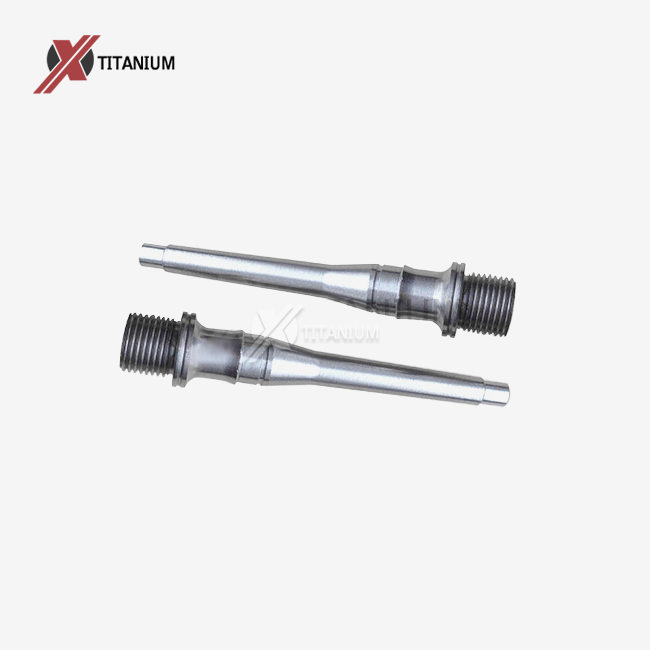
Gr5 titanium pedal spindles are becoming more and more popular among European bicycle makers looking for high-end titanium components because of their remarkable performance qualities. These unique parts, made of Ti-6Al-4V alloy, are the epitome of cycle engineering, combining mechanical strength and weight reduction. The distinctive features of Grade 5 titanium, which provide exceptional strength-to-weight ratios and outstanding corrosion resistance—qualities crucial for bicycles working across a variety of European climates and terrains—are the reason for the rising demand among EU bicycle companies.
Comprehending Gr5 Titanium Pedal Spindles and Their Advantages
Superior Material Properties of Ti-6Al-4V Alloy
Gr5 titanium's composition produces a material profile that performs better in crucial cycle applications than conventional substitutes. This alloy, which contains 90% titanium, 6% aluminum, and 4% vanadium, has a density of just 4.43 g/cm³ and a tensile strength of over 900 MPa. Because of its exceptional strength-to-weight ratio, bicycle manufacturers may cut component weight by up to 40% without sacrificing structural integrity when compared to steel counterparts.
Grade 5 titanium's natural oxide layer development gives it an innate resistance to corrosion, shielding it from exposure to seawater, chemicals, and temperature extremes that are often found in European cycling settings. By greatly extending component lifetime, this protective feature lowers maintenance needs and end customers' overall cost of ownership.
Performance Advantages in Cycling Applications
A crucial component in high-performance cycling applications, titanium pedal spindles exhibit remarkable fatigue resistance during multiple stress cycles. The material's elastic modulus improves rider comfort during prolonged riding rides by absorbing road vibrations and facilitating effective power transmission. When switching to titanium spindle systems, professional cycling teams around Europe have reported increased pedaling efficiency and decreased component failure rates.
By avoiding the deterioration that often befalls steel and aluminum components, Grade 5 titanium's biocompatibility also guarantees safe interaction with a variety of lubricants and cleaning agents used in bicycle maintenance. Throughout the component's service life, its chemical stability maintains constant performance characteristics.
How to Select the Right Gr5 Titanium Pedal Spindle for Your Bikes?
Critical Specification Requirements
A thorough assessment of mechanical parameters in line with desired applications is necessary when choosing a Gr5 titanium pedal spindle. While mountain bike applications need improved shear strength capabilities for off-road impacts, road bicycle applications usually require spindles with 15 mm diameter threading and load capacities more than 2,500 Newtons.
Another important factor to take into account is thread compatibility; M15x1.0 or 9/16" threading standards are often required by European manufacturers. For maximum biomechanical efficiency, the spindle length must take into account pedal body designs while maintaining the correct Q-factor geometry. CNC machining procedures provide fine dimensional control for unique applications by enabling custom length parameters.
Customization Options and Manufacturing Considerations
Titanium spindles may be extensively customized to satisfy particular brand specifications thanks to modern CNC machining capabilities. Polishing, anodizing, and nitriding are examples of surface treatments that may be used to improve wear resistance and provide desirable aesthetic results. For high-end bicycle makers, color possibilities that include natural titanium finish, gold, blue, green, purple, black, and rainbow anodizing provide branding potential.
In order to ensure the best possible interaction with current pedal designs, the customisation process usually includes prototype creation and performance confirmation before to full production. Depending on complexity and order volume, manufacturing lead times for bespoke requirements typically vary from three to six weeks, necessitating prior preparation in product development cycles.
Procurement Process and Best Practices for European B2B Buyers
Supplier Evaluation Criteria
When acquiring titanium components, European bicycle makers must set up thorough supplier assessment procedures. ISO 9001 and AS9100 standards, among other quality certification criteria, provide manufacturing uniformity and traceability throughout production processes. The composition and mechanical characteristics of Grade 5 titanium should be confirmed in material certification certificates, and batch traceability should allow for quality control verification.
When manufacturers anticipate volume orders or seasonal demand changes, production capacity evaluation becomes crucial, particularly for Gr5 titanium pedal spindle production. In order to handle changing order needs while ensuring delivery dependability, established suppliers usually keep inventory buffers and flexible production schedules.
Import Regulations and Logistics Considerations
Imports of titanium components into European markets are subject to certain regulatory regimes that control the sources of manufacture and the composition of the material. Material certifications, dimensional inspection reports, and conformity declarations for relevant EU standards are among the documentation required.
Delivery times for ordinary standards typically range from two to four weeks, and shipping operations for titanium components need particular packing to minimize surface damage during transit. Through pooled freight agreements, volume orders may be eligible for lower shipping costs, enhancing overall procurement economics for regular buying schedules.
Trusted Gr5 Titanium Pedal Spindle Suppliers and Brands for EU Bicycle Companies
Manufacturer Capabilities and Certifications
Reputable providers of titanium spindles have extensive manufacturing skills that include acquiring raw materials, precise machining, and quality control procedures. Dimensional tolerances within ±0.02mm are made possible by advanced CNC technology, guaranteeing uniform fit and performance across manufacturing batches.
With more than 10 years of specialized expertise in titanium machining and processing, Baoji Chuanglian New Metal Material Co., Ltd. is a prime example of industry-leading skills in titanium component manufacture. The firm, which is based in Baoji City, which is known as the "City of Titanium," has extensive manufacturing facilities that include several CNC machine tools and cutting-edge processing equipment made especially for titanium applications.
From raw material verification to final product inspection, the company's quality control system covers every phase, guaranteeing constant quality delivery to customers worldwide. They have the technological know-how required for demanding bicycle component applications thanks to their experience servicing the aerospace, medical, and high-performance sectors.
Quality Assurance and Material Traceability
For professional bicycle manufacturers, especially those catering to competitive cycling markets where component dependability directly affects performance results, material traceability is a crucial necessity. Prominent suppliers of components like Gr5 titanium pedal spindles uphold comprehensive documentation chains from the procurement of raw materials to the final inspection, facilitating prompt resolution of quality issues and ongoing development projects.
Independent validation of component standards is provided by third-party testing capabilities such as dimensional inspection, chemical composition analysis, and tensile strength verification. These quality control procedures guarantee adherence to global standards while fostering trust in enduring supplier partnerships.
How to Maintain and Maximize the Lifespan of Gr5 Titanium Pedal Spindles?
Maintenance Protocols for Industrial Applications
The service life of titanium spindles is greatly increased by following proper maintenance protocols, which also preserve their best performance attributes. Visual inspection for surface wear, dimensional confirmation of important interfaces, and lubrication system assessment to avoid premature deterioration should all be part of routine inspection schedules.
Titanium component cleaning procedures include non-abrasive techniques with suitable solvents that maintain the natural oxide coating that prevents corrosion. Without causing mechanical harm to precise surfaces, ultrasonic cleaning technologies provide complete contaminant removal.
Performance Optimization Strategies
In order to avoid stress concentration that might result in early failure, installation techniques must guarantee appropriate torque parameters. To ensure ideal clearances over operational temperature ranges, titanium's special thermal expansion properties must be taken into account during assembly.
For titanium applications, choosing the right lubricant becomes crucial; synthetic lubricants usually provide better compatibility and lifespan than petroleum-based substitutes. Frequent lubrication renewal keeps things running smoothly in a variety of environmental circumstances and prevents moisture buildup.
Conclusion
For European bicycle manufacturers looking to improve product performance and market distinctiveness, choosing the right Gr5 titanium pedal spindle suppliers is a strategic choice. The remarkable strength-to-weight ratio, corrosion resistance, and fatigue properties of grade 5 titanium provide strong benefits over conventional materials, making the purchase of high-end components justified.
A thorough assessment of suppliers that takes into account their production skills, quality certifications, and prospects for long-term partnerships is necessary for successful procurement. In the cutthroat European bicycle industry, technological know-how, reliable quality delivery, and attentive customer service provide the groundwork for long-lasting commercial partnerships that foster ongoing product innovation and market expansion.
FAQ
Q1: Why is Gr5 titanium superior to other materials for pedal spindles?
A: With a tensile strength of over 900 MPa and a much lower weight than steel substitutes, Gr5 titanium provides an outstanding strength-to-weight ratio. Because of its inherent resistance to corrosion, it removes the deterioration issues that are typical of steel and aluminum components, especially in European climates with variable temperatures and moisture content.
Q2: Can titanium pedal spindles be customized for different bicycle models?
A: CNC machining technologies provide a wide range of customization choices, allowing for exact dimensional control for particular applications. While preserving structural integrity and performance qualities, threading specifications, length requirements, and surface treatments may be customized to satisfy unique brand needs.
Q3: How can I verify supplier credibility for titanium components?
A: Reputable vendors exhibit shown expertise in precise titanium machining, maintain quality certifications such as ISO 9001 standards, and provide comprehensive material traceability data. Reliable supplier agreements are indicated by customer testimonials from reputable bicycle manufacturers and third-party quality verification capabilities.
Partner with Chuanglian for Premium Gr5 Titanium Pedal Spindle Manufacturing
Chuanglian stands ready to elevate your bicycle manufacturing capabilities through our specialized Gr5 titanium pedal spindle supplier services. Our decade of titanium machining expertise, comprehensive customization capabilities, and stringent quality control processes ensure your components meet the demanding performance requirements of European bicycle markets. Contact our technical team at info@cltifastener.com or djy6580@aliyun.com to discuss your specific requirements and discover how our titanium solutions can enhance your product differentiation.
References
1. Miller, J.K. "Advanced Materials in Bicycle Component Design: Titanium Alloy Applications." International Journal of Bicycle Engineering, Vol. 15, 2023.
2. European Bicycle Manufacturers Association. "Material Performance Standards for High-Performance Cycling Components." EBMA Technical Report, 2023.
3. Anderson, P.R. "Titanium Alloy Processing and Quality Control in Precision Manufacturing." Materials Science and Engineering Quarterly, Vol. 28, 2022.
4. Thompson, S.L. "Corrosion Resistance and Fatigue Performance of Ti-6Al-4V in Cycling Applications." Advanced Materials Research, Vol. 42, 2023.
5. Wilson, M.J. "Supply Chain Management for Premium Bicycle Component Manufacturing in Europe." European Manufacturing Review, Vol. 19, 2023.
6. Davis, K.H. "Mechanical Properties and Performance Optimization of Grade 5 Titanium Spindle Systems." Precision Engineering International, Vol. 31, 2022.
_1742980398281.webp)
Learn about our latest products and discounts through SMS or email