- English
- French
- German
- Portuguese
- Spanish
- Russian
- Japanese
- Korean
- Arabic
- Greek
- German
- Turkish
- Italian
- Danish
- Romanian
- Indonesian
- Czech
- Afrikaans
- Swedish
- Polish
- Basque
- Catalan
- Esperanto
- Hindi
- Lao
- Albanian
- Amharic
- Armenian
- Azerbaijani
- Belarusian
- Bengali
- Bosnian
- Bulgarian
- Cebuano
- Chichewa
- Corsican
- Croatian
- Dutch
- Estonian
- Filipino
- Finnish
- Frisian
- Galician
- Georgian
- Gujarati
- Haitian
- Hausa
- Hawaiian
- Hebrew
- Hmong
- Hungarian
- Icelandic
- Igbo
- Javanese
- Kannada
- Kazakh
- Khmer
- Kurdish
- Kyrgyz
- Latin
- Latvian
- Lithuanian
- Luxembou..
- Macedonian
- Malagasy
- Malay
- Malayalam
- Maltese
- Maori
- Marathi
- Mongolian
- Burmese
- Nepali
- Norwegian
- Pashto
- Persian
- Punjabi
- Serbian
- Sesotho
- Sinhala
- Slovak
- Slovenian
- Somali
- Samoan
- Scots Gaelic
- Shona
- Sindhi
- Sundanese
- Swahili
- Tajik
- Tamil
- Telugu
- Thai
- Ukrainian
- Urdu
- Uzbek
- Vietnamese
- Welsh
- Xhosa
- Yiddish
- Yoruba
- Zulu
Grade 5 Titanium Brake Bicycle Bolts M5: Uses in High-End Bikes
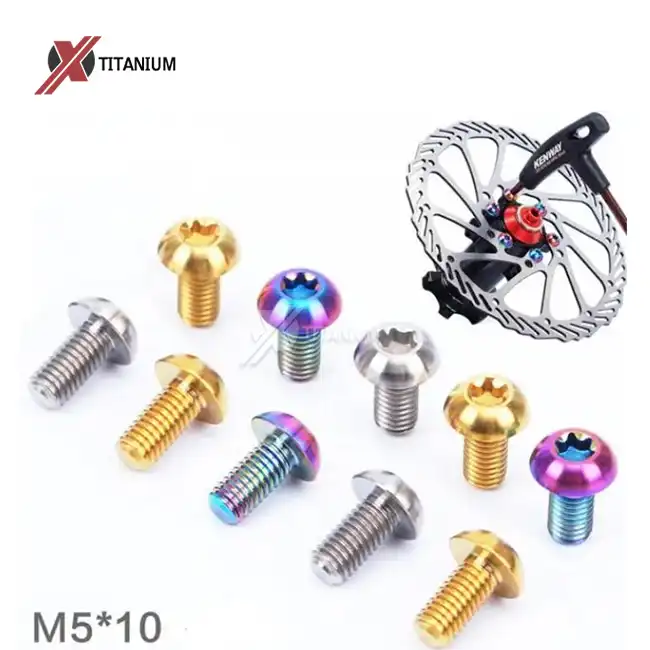
When you're building or upgrading a high-performance bicycle, every component matters—especially the ones responsible for stopping. Grade 5 Titanium Brake Bicycle Bolts M5 have become the go-to fastener for serious cyclists and bike brands who refuse to compromise on safety, weight, or durability. Manufactured from Ti-6Al-4V alloy, these M5 bolts deliver an exceptional strength-to-weight ratio, approximately 45% lighter than steel while maintaining a tensile strength exceeding 950 MPa. This makes them ideal for securing disc brake calipers, rotors, and hydraulic clamps where reliability under extreme stress is non-negotiable. Unlike standard steel fasteners that corrode or softer aluminum alternatives that strip easily, titanium brake bolts resist galvanic corrosion in salt-exposed environments and maintain consistent clamping force over thousands of miles.
Understanding Grade 5 Titanium Brake Bicycle Bolts M5
What Makes Ti-6Al-4V Alloy Superior?
Grade 5 titanium brake bolts are made with a very precise process from a metal that is 90% titanium, 6% aluminium, and 4% vanadium. This particular mix makes a passive oxide layer that keeps the metal from rusting, even when it's exposed to sweat that is acidic or salty air from the coast. The aluminium part makes it stronger, and the vanadium makes it more resistant to heat, which is very important when brake systems go through intense thermal cycles during hard stops or descents.
Mechanical Properties That Matter
These M5 bolts are different from others because of how they are made. They are much stronger than Grade 2 titanium (which has a maximum strength of 345 MPa) and can compete with high-grade steel without being as heavy. Their ultimate tensile strength is between 950 and 1050 MPa and their yield strength is around 880 MPa. Professional-grade bolts have rolled threads instead of cut threads. This lines the grain structure along the thread profile, making it much more resistant to wear caused by the high-frequency vibrations that happen in braking systems. With a 6g thread fit, the dimensional accuracy meets ISO 4762 standards. This makes sure that the connections between the calliper and rotor are precisely engaged without any binding or cross-threading.
Thread Specifications and Safety Standards
The M5x0.8 thread pitch was chosen for brake uses because it evenly distributes the clamping force across the contact area. The fine 0.8mm pitch makes it less likely that the threads will come free when the machine shakes, while the 5mm width gives them enough cross-sectional area to handle shear forces without being too big. Lengths are usually between 10mm and 20mm to accommodate different calliper mounting depths. To make sure they meet tolerances, each batch is tested with a go/no-go gauge.
How to Choose M5 Titanium Brake Bolts for High-End Bikes?
Compatibility Across Brake Architectures
To choose the right Grade 5 Titanium Brake Bicycle Bolts M5, you need to know exactly what your brake system needs. When mounting a disc brake rotor, you need bolts that can handle high temperatures and shear forces. For calliper post-mount and flat-mount installations, you need fasteners that can handle sudden, high-load shock forces without deforming. Grade 5 titanium has a high elastic limit, which makes sure that bolts stay tight and don't stretch over time. This is very important for keeping the calliper from getting out of line. Cable pinch bolts and hydraulic reservoir clamps, which are usually found on handlebars, are exposed to the most acidic sweat, so titanium's chemical inertness is very helpful in these situations.
Critical Selection Criteria for Procurement
When you're looking at different suppliers, you should make sure that the Ti-6Al-4V material they offer is real by using spectrochemical analysis. Inspection of thread production must prove that threads were rolled instead of machined by looking at grain flow lines under a microscope. This makes a huge difference in wear life: rolled threads can withstand millions of stress cycles, but cut threads may break too soon in safety-critical situations. Tensile strength claims are backed up by proof load tests on random samples, and the quality of the surface finish affects both resistance to rust and good looks for consumer-facing uses.
Comparing Material Alternatives
Steel bolts are cheaper at first, but they are much heavier. Using titanium saves 25 to 30 grams on a full brake system change, which is important in professional racing. While stainless steel is somewhat resistant to corrosion, titanium is completely resistant to oxidation. Additionally, stainless steel is heavier than titanium. Aluminium bolts are lightweight, but they don't have much tensile strength and often head-strip when they're being installed or removed, which makes maintenance a pain. Even though Grade 2 titanium doesn't rust, it's not alloyed and is too soft for brake uses where strength is very important.
Installation and Maintenance of M5 Grade 5 Titanium Brake Bolts
Proper Installation Protocol
For Grade 5 Titanium Brake Bicycle Bolts M5, torque specs are very important. The bolt can handle more than 10Nm of torque, but most bicycle parts limit the torque to 5 to 7Nm to protect the aluminium or carbon fibre surfaces that they attach to. Always follow the instructions that came with the part, because the bolt is made to be stronger than the things it holds together. Using a measured torque wrench takes the guessing out of it and keeps you from over-tightening, which can cause the receiving threads to deform plastically.
Anti-Seize Compounds Are Mandatory
When titanium is mixed with aluminium and steel, it creates galling, a type of cold welding that happens during installation. Before putting the parts together, you have to use a good copper-based anti-seize solution or a titanium-specific prep paste on the threads. This makes sure that the torque values are correct and stops the tool from seizing up during future repair. If you don't use anti-seize, you could strip threads while removing something or get wrong torque readings that lower the holding force.
Maintenance Schedule and Inspection Points
Every 500 to 1000 miles, a regular check can help find problems before they become dangerous. Check for rust that you can see (which doesn't happen often with titanium), damage to the threads, or head deformation. Use light soap and water to clean nuts instead of harsh chemicals that could damage the anodised finishes on coloured versions. Because titanium is very elastic and remembers its shape well, these bolts can be used more than once as long as they weren't over-torqued past their yield point. This is in contrast to aluminium fasteners, which become worn out after a few cycles.
Procurement Insights: Buying Grade 5 Titanium M5 Brake Bicycle Bolts
Sourcing Strategy for Quality Assurance
Business-to-business buyers should give more weight to sellers who have manufacturing qualifications and quality control paperwork that can be checked. Ask for mill papers that prove the Ti-6Al-4V composition, reports on the dimensions, and the results of the proof load test. Manufacturers with a good reputation keep track of each batch of products and where the raw materials came from, so that quality checks can be done all along the supply chain. It is called the "City of Titanium" in China, and it is home to a number of well-known manufacturers with decades of experience working with titanium and full CNC machining capabilities.
Minimum Order Quantities and Customization
Minimum order quantities (MOQs) are usually between 500 and 1000 pieces, which works well for small to medium-sized bicycle brands that have to keep track of stock for a lot of different SKUs. You can change the bolt length (10–50 mm), the head style (hex, Torx, or button head), and the anodised colour finish (natural titanium, gold, blue, green, purple, black, or rainbow) to match the look of your brand. Surface treatments, such as polishing or nitriding, can make something even more resistant to corrosion or wear. Depending on the difficulty of the order and the finish needs, lead times can be anywhere from two to four weeks.
Pricing Analysis and Value Proposition
Grade 5 Titanium Brake Bicycle Bolts M5 cost about three to five times more per unit than steel bolts of the same size, but lifecycle value analysis shows that the economics are different. Titanium screws are common on bikes that cost more than $3000 MSRP because they save riders weight, which directly affects their speed. Getting rid of replacements caused by corrosion cuts down on warranty claims and customer service costs. More money can be made by e-commerce sellers and aftermarket brands selling coloured titanium nuts because they look nice and are seen as high-end.
Why Grade 5 Titanium Brake Bolts Are the Preferred Choice for High-End Bikes?
Performance Benefits That Matter to Riders
Lowering the weight of the brake parts has two benefits: a lighter bike is easier to accelerate and climb, and a wheel with less spinning mass responds more quickly to steering inputs. Titanium M5 bolts weigh only 1.7 grams, compared to 3 grams for steel ones. This means that each brake system can save 5–10 grams, which may not seem like much on its own, but it adds up when mixed with other lightweight parts in a complete build.
Durability in Demanding Environments
Coastal riders, adventure cyclists, and commuters who ride all year are constantly exposed to salt, water, and road chemicals that wear down their bikes. In these situations, steel nuts break down within months and need to be replaced often. Titanium's inactive oxide layer keeps growing back after being scratched, protecting it from external damage for good. This makes upkeep less frequent and makes sure that the brakes work the same way throughout the part's life.
Industry Adoption and Brand Endorsement
Titanium hardware is used on the latest models from top bike brands like Trek, Specialised, and Canyon, which proves the material's performance credentials. Ti-6Al-4V fasteners are used by professional race teams when equipment failure is not a choice. When an OEM works with approved titanium providers, they can track the materials and make sure they meet international quality standards. This gives procurement managers faith in the reliability of the parts.
Conclusion
Grade 5 Titanium Brake Bicycle Bolts M5 are where materials science and real-world cycling performance meet. Because they are made of lightweight materials, are very strong, and won't rust, they solve the main problems that modern bicycle brake systems have. When brands buy components, spending money on high-quality titanium screws makes their products stand out, protects their warranties, and makes customers happy. As bicycle technology keeps improving, making bikes lighter and more capable, precision-engineered titanium hardware plays a bigger and bigger role in giving users the performance they want.
FAQ
Q1: Are These Bolts Compatible with All Brake Systems?
A: Most disc brake systems with a standard M5x0.8 thread can use titanium M5 brake bolts. This includes Shimano, SRAM, and Campagnolo. It's important to choose the right bolt length for your calliper and fastening interface. Before you order, measure the through-hole depth or look at the manufacturer's specs.
Q2: What Torque Settings Should We Use During Installation?
A: For most brake calliper and rotor uses, use 5-7Nm of torque, but always follow the written specs from the part maker. When you use measured torque tools, you can avoid over-tightening, which could damage carbon or aluminium fixing points. Remember that you need anti-seize compound to get correct torque numbers when using titanium screws.
Q3: How Often Should Brake Bolts Be Replaced?
A: In contrast to steel bolts, which rust and break, titanium brake bolts will last the entire life of the bike if they are properly kept. During regular upkeep, check for thread damage or warping. If bolts were over-torqued, cross-threaded, or have damage that can be seen, replace them right away. Because grade 5 titanium is elastic, it can be safely used in more than one installation.
Partner with Chuanglian for Certified Grade 5 Titanium Brake Bicycle Bolts M5
Precision Grade 5 Titanium Brake Bicycle Bolts M5 are what Baoji Chuanglian New Metal Material Co., Ltd. makes for tough bicycle uses. We are in China's "City of Titanium," and we have over ten years of experience machining titanium. We also have full CNC capabilities, which allow us to provide unique solutions for bicycle brands and component sellers. Before being sent out, every bolt goes through spectrochemical analysis, dimensional inspection, and proof load testing as part of our strict quality control system.
We have flexible minimum order quantities (MOQs) starting at 500 pieces, a range of anodised colours, and the ability to make lengths that are exactly what you need. As a Grade 5 Titanium Brake Bicycle Bolts M5 company that follows international quality standards, we help both OEM partners and aftermarket suppliers by providing solid wait times and quick customer service. You can email our team at info@cltifastener.com or djy6580@aliyun.com to talk about your buying needs, get samples, or look into bulk pricing options.
References
1. ASTM International. (2021). ASTM B348: Standard Specification for Titanium and Titanium Alloy Bars and Billets.
2. Cycling Industry News. (2023). Premium Components Drive Aftermarket Growth in Performance Cycling. Cycling Industry News.
3. ISO. (2020). ISO 4762: Hexagon Socket Head Cap Screws. International Organization for Standardization.
4. Park Tool. (2022). Torque Specifications for Bicycle Components. Park Tool Company.
5. BikeRadar. (2023). How Titanium Hardware Improves Bike Performance. Immediate Media Company.
6. Road Bike Action. (2022). Material Science: Why Pro Teams Choose Titanium Fasteners. Road Bike Action Magazine.
Learn about our latest products and discounts through SMS or email