- English
- French
- German
- Portuguese
- Spanish
- Russian
- Japanese
- Korean
- Arabic
- Greek
- German
- Turkish
- Italian
- Danish
- Romanian
- Indonesian
- Czech
- Afrikaans
- Swedish
- Polish
- Basque
- Catalan
- Esperanto
- Hindi
- Lao
- Albanian
- Amharic
- Armenian
- Azerbaijani
- Belarusian
- Bengali
- Bosnian
- Bulgarian
- Cebuano
- Chichewa
- Corsican
- Croatian
- Dutch
- Estonian
- Filipino
- Finnish
- Frisian
- Galician
- Georgian
- Gujarati
- Haitian
- Hausa
- Hawaiian
- Hebrew
- Hmong
- Hungarian
- Icelandic
- Igbo
- Javanese
- Kannada
- Kazakh
- Khmer
- Kurdish
- Kyrgyz
- Latin
- Latvian
- Lithuanian
- Luxembou..
- Macedonian
- Malagasy
- Malay
- Malayalam
- Maltese
- Maori
- Marathi
- Mongolian
- Burmese
- Nepali
- Norwegian
- Pashto
- Persian
- Punjabi
- Serbian
- Sesotho
- Sinhala
- Slovak
- Slovenian
- Somali
- Samoan
- Scots Gaelic
- Shona
- Sindhi
- Sundanese
- Swahili
- Tajik
- Tamil
- Telugu
- Thai
- Ukrainian
- Urdu
- Uzbek
- Vietnamese
- Welsh
- Xhosa
- Yiddish
- Yoruba
- Zulu
How are Ruthenium Iridium Coated Titanium Anodes Manufactured?
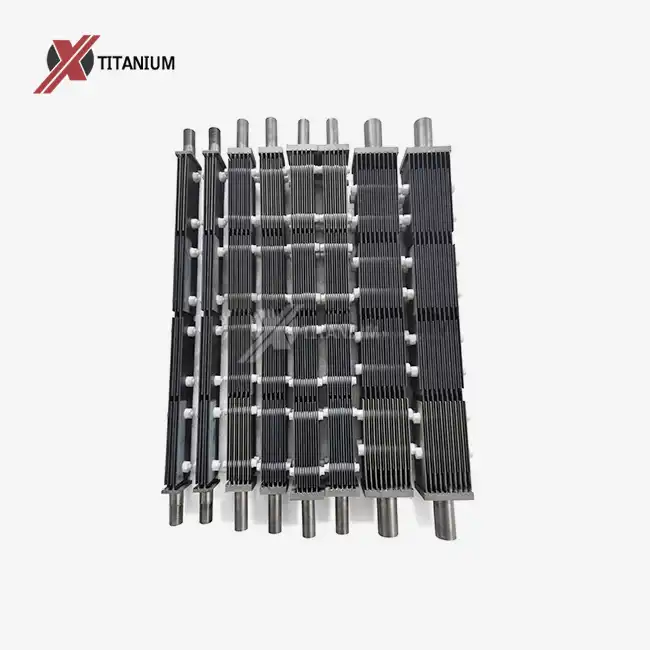
An in-depth guide for professionals who buy and sell goods and services to businesses. ruthenium iridium titanium anodes are made using a very controlled method that includes cleaning the titanium base, applying a precise coating, and keeping the temperature stable. To start the production process, high-purity titanium plates (usually Grade 1 or Grade 2) are chosen and their surfaces are activated by sandblasting, acid cleaning, and etching. Then, a mix with iridium and ruthenium precursors is used by applying methods like heat breakdown or electrochemical deposition. To make solid mixed metal oxide films, several covering layers are added and heated to temperatures between 400°C and 550°C. During production, each anode is put through a lot of quality tests to make sure it fits performance standards for conductivity, coating thickness, and consistency of dimensions.
Understanding Ruthenium Iridium Titanium Anodes: Composition and Properties
Careful materials engineering can be seen in the way these improved ruthenium iridium titanium anodes are built. At its center is a titanium base that was chosen because it is very resistant to rust and has a high mechanical strength-to-weight ratio. Titanium is a great material for foundations because it is naturally low in density, very stable at high temperatures, and resistant to harsh chemical conditions. The base is usually made of commercially pure titanium that meets ASTM B265 standards. For electrochemical uses, Grade 1 or Grade 2 standards are most popular.
The Role of Precious Metal Coatings
Their usefulness comes from the valuable metal oxide layer that covers them. Ruthenium oxide (RuO₂) is a very powerful catalyst, especially for chlorine evolution processes that happen a lot in industrial electrolysis. Iridium oxide (IrO₂) makes coatings more stable and extends their useful life, especially in acidic conditions where other coatings would break down quickly. These two oxides work together to make a layer that is better at what it does than coatings made of just one metal. Between 30 and 70% of the covering is usually made up of ruthenium.
The rest is usually made up of iridium and sometimes tantalum oxide. This amount has been carefully adjusted based on the setting in which it will be used. For best catalytic performance, chlorine production systems should have more ruthenium. On the other hand, more iridium may be needed for stability in highly acidic situations. The thickness of the coating is usually between 2 and 10 microns, which is a good mix between catalytic activity and the cost-effectiveness of the material.
Physical and Electrochemical Properties
Compared to a normal calomel electrode (SCE), these anodes have a very low overpotential when chlorine is released. Usually, it's between 1.45V and 1.55V. In practice, this feature directly means less energy use while it's running. In ideal conditions, current density can reach up to 2000 A/m². However, for longer service life, industry uses usually run at 500 to 1000 A/m². The coating's physical stability makes sure that the distance between the electrodes stays the same during operation. This keeps the current flowing evenly and stops localized degradation.
Another important feature is temperature resistance. The titanium base keeps its shape over a wide range of temperatures, and the oxide covering stays stable when the temperatures change. This temperature stability is very important in situations where the working conditions change or where the system needs to be shut down periodically. The mix of materials makes an electrode system that can withstand both temperature shock and mechanical stress, which are things that often break down other anode technologies.
Manufacturing Process of Ruthenium Iridium Coated Titanium Anodes
Every step of the process of making these ruthenium iridium titanium anodes needs to be done with great care. Quality at every step has a direct effect on how well the end product works and how long it lasts. Changes in the processing factors can have a big effect on how well the coating sticks, how well it works as a catalyst, and how long it lasts.
Substrate Preparation and Surface Activation
The first step in manufacturing is choosing and preparing the material. Precision cutting methods are used to make titanium sheets, plates, or custom forms to the right size. Preparing the surface may be the most important step in ensuring that the treatment will stick and last for a long time. The titanium surface needs to be cleaned well to get rid of any oils, leftovers, or other impurities that could make it harder for the coating to stick.
After the first cleaning, sandblasting is used to make the surface rougher, which increases the contact area and mechanical interlocking between the base and covering. The blast pressure and abrasive media are carefully managed to get the best surface roughness without hurting the titanium structure below. Acid etching is done on objects after sandblasting using oxalic acid liquids or a mix of hydrochloric and sulfuric acids. This chemical process gets rid of the passive oxide layer that forms naturally on titanium.
This leaves a reactive metal surface that is better for coating bonding. The surface that has been etched has a typical matte gray look that means it is ready for covering. There are strict rules for how to rinse and dry things. To keep covering chemistry from getting messed up, all residual acids must be removed. Rinses with deionized water will keep happening until the pH level is normal. After that, the substrates are dried in controlled-atmosphere ovens to keep them from getting dirty again before the coating is put on.
Coating Application Techniques
The valuable metal oxide layer is built up through several treatments in the coating process. Thermal breakdown is the most common way. Precursor solutions with iridium and ruthenium salts are put on a substrate that has already been made. Most of the time, these solutions use chloride salts that are dissolved in acidic carriers. The final covering makeup is controlled by exact concentration controls. Depending on the shape of the base and the size of the production, the coating can be applied by brushing, spraying, or dipping.
Brushing gives you more control over complicated shapes, while spraying works better for bigger, flat areas and more output. Because each covering layer is pretty thin, it takes more than one treatment to get the desired thickness. The material that has been covered goes through a thermal process in a furnace that is heated to 400–550°C after each use. The heat process breaks down the metal salts, which gets rid of the volatile parts and leaves behind safe metal oxide crystals on the titanium surface.
The number of coating rounds depends on how thick of a finish you want and what you need to do with the coating. In industrial production, coating and fire processes usually last between 8 and 15 times. About 0.5 to 1 micron of oxide layer is added during each turn. The slow buildup makes sure that all areas are covered evenly and that the layers stick together well. It is very important to keep an eye on the temperature during firing. Not enough heat can lead to incomplete breakdown and bad catalytic activity, while too much heat can damage the coating or cause unwanted phase changes.
Thermal Stabilization and Finishing
Anodes go through a long heat stabilization process after the final finish is applied. This process, which is done at high temperatures for several hours, helps crystals grow, gets rid of leftover stresses, and makes the layer stick better. The stability step makes the covering last longer and be less likely to break down due to electrochemical reactions while it is being used.
Some of the things that can be done after covering are finishing the edges, getting the connection points ready, and protecting the parts that shouldn't be covered. Masking materials are used by manufacturers during covering to protect areas that are meant for fixing structures or making electrical connections. These areas that aren't coated are carefully looked over, and they may get protective treatments to keep them from rusting in work settings.
Quality Control and Testing Protocols
Each output batch is thoroughly tested before it is sent out. Visual inspection finds flaws on the surface, checks for equal covering, and confirms that measurements are correct. Using X-ray fluorescence or microscope to measure the thickness of the coating makes sure that the requirements are met. Hardness testing, like the scratch test or acoustic testing, makes sure that the coating sticks well and that the base is solid. Electrochemical function testing is the only way to be sure. Sample anodes are put through rapid life tests that mimic real-life working conditions.
These tests check things like overpotential, current economy, and the stability of the layer under long-term current loads. Manufacturers with a good reputation keep written test records that show stability between runs of production. Quality systems that are in line with ISO 9001, AS9100, or certifications specific to the business give customers peace of mind that the controls used in manufacturing meet high standards. In Chuanglian's production, mechanical qualities and electrical performance are checked by bending tests and hydrostatic tests. Bright polishing, pickling, and sandblasting are some surface finishing choices that can be changed to fit the needs of a particular application. This ensures that the product works well in a wide range of industrial settings.
Performance Advantages Compared to Other Anodes
When you compare ruthenium iridium titanium anodes to other electrode technologies, it's clear that they are better. By understanding these benefits, procurement teams can use lifetime cost analysis and operational benefits to support the original investment.
Advantages Over Uncoated Titanium
Titanium doesn't rust easily, but when electrochemical processes happen on bare titanium anodes, they quickly form an inactive oxide layer. This natural oxide works as an insulator, which makes the power and energy use of cells go up by a huge amount. Because of this effect, bare titanium is not good for most electrolysis uses, even though it is chemically stable.
Ruthenium iridium films stop this passivation problem by making the surface conductive and electrocatalytically active. The mixed metal oxide layer keeps its low resistance even when the current load stays the same, which makes sure that the device works efficiently and saves energy. When compared to passivated titanium, coatings lower working voltages by 0.5 to 1.5V. This means that large amounts of energy are saved in continuous manufacturing processes.
Comparison with Single-Metal Oxide Coatings
Single-metal oxide films, especially pure ruthenium oxide, have a lot of catalytic activity but don't last long because they break down slowly when electrical stress is applied. Iridium oxide by itself is very stable, but it costs a lot more and isn't as good at using hydrogen as a catalyst for chlorine evolution. When ruthenium and iridium are mixed, they work together to make rewards.
Ruthenium is the main element that speeds up electrochemical processes, and iridium creates a solid matrix that stops the coating from wearing away. The end result is an electrode that is both effective and long-lasting. Independent studies show that these coatings can last up to 10 years in industrial settings, which is a lot longer than the usual 2 to 3 years that pure ruthenium oxide coatings last.
Real-World Application Benefits
The performance claims of these improved anodes have been proven by real-world use. When a big chlor-alkali plant switched from graphite anodes to MMO-coated titanium anodes, they reported a 15% drop in energy use and no longer having carbon in their product lines. The constant inter-electrode spacing of coated titanium anodes kept the dimensions stable. This stopped the slow voltage increases that happened as graphite anodes broke down during service.
Facilities that clean wastewater using these anodes for electrochemical oxidation processes have reported longer periods between upkeep and better treatment efficiency. The ability to prevent corrosion is especially useful in situations where the electrolyte makeup changes, since regular anodes would need to be replaced all the time. The anodes' ability to fight chloride-induced corrosion makes them useful in marine engineering uses like cathodic protection systems and ballast water treatment.
They keep working well in harsh saltwater settings. Aerospace and medical device makers like these anodes because they keep materials pure and keep the machines running without any contamination. MMO titanium anodes keep metals from getting into applications that need very pure products because they are stable in size and can't be consumed. Titanium surfaces are biocompatible, which means that these anodes can be used in medical electrochemical processes where safety of the materials is very important.
Maintenance and Lifespan Optimization of Ruthenium Iridium Titanium Anodes
To get the best return on investment, you need to follow the right upkeep and operation procedures for ruthenium iridium titanium anodes over their lifetime. Their service life is directly related to how they are used and how well they are maintained, even though these anodes are very durable.
Routine Maintenance Procedures
Surface fouling can hurt efficiency, but regular cleaning can stop it. Electrolyte impurities, the buildup of solid salts, and organic growth can all happen on the anode surfaces, which raises the resistance and lowers the efficiency. These layers can be removed without harming the coating by cleaning it regularly with the right chemical treatments. Mineral scale can be removed easily with mild acid cleaning, and organic contamination can be removed with alkaline cleaners.
When doing mechanical cleaning, you should be careful. Using abrasives could damage the valuable metal covering, which could lead to weak spots that speed up the breakdown. It is safer to use soft brushes and low-pressure water jets instead of rough scrubbing when mechanical help is needed. A lot of buildings have automatic cleaning-in-place systems that move cleaning solutions through electrochemical cells on a regular basis without having to shut down the system.
Operational Best Practices
Operating conditions have a big effect on how long an anode lasts. The current density should stay within the limits set by the maker. Too much current loads speed up the electrolytic erosion that wears away coatings. Controlling the temperature is also very important, since high temperatures speed up the processes that break down coatings. Keeping the makeup of the electrolyte within certain limits stops rust or passivation from speeding up.
Pay special attention to the steps for starting up and ending up. Rapid changes in current cause heat and mechanical stress that can weaken the layer. Thermal shock is kept to a minimum by gradually increasing the current during starting and managed shutdown. A lot of modern factories use automatic control systems that make these changes as smooth as possible, matching the need for production with the safety of the equipment.
Troubleshooting Common Issues
During operation, voltage increases often mean that the layer is wearing off or the surface is getting dirty. Systematic debugging can tell the difference between these reasons. Voltage jumps that only last a short time after a stop are usually caused by surface oxidation that clears up during operation. Ongoing, slow voltage rises could mean that the layer is wearing off or that passivation is permanent, which means that the anode needs to be inspected and maybe replaced.
Visual inspections done during repair breaks can tell you a lot about what's wrong. Discoloration, cracking, or delamination of the coating are all signs of problems that need to be fixed. Early identification lets repairs or replacements be planned and carried out before a major failure stops activities. Writing down what was found during a check makes historical records that help with planning preventative maintenance and figuring out when to replace things.
Procurement Insights: How to Choose and Buy the Right Ruthenium Iridium Titanium Anode?
To find the right provider for a ruthenium iridium titanium anode, you need to look at technical skills, quality control methods, and pricing. Because these goods are so complicated, they need to be evaluated in a way that goes beyond just comparing prices.
Evaluating Supplier Qualifications
An evaluation of a company's manufacturing capabilities should look at its technical know-how, output tools, and quality control systems. Suppliers who have special finishing facilities, controlled-atmosphere ovens, and full testing labs show that they care about quality. Certifications like ISO 9001 show that quality management is being done in a systematic way, while certifications specific to an industry, like AS9100 for aerospace applications, show that the company has special skills.
Ask for written information about the coating's ingredients, how to apply it, and how to test it. Reliable manufacturers keep thorough records of their processes and can give you test results from earlier batches of their products. Material tracking systems that keep track of where raw materials come from and how they were processed give customers more confidence in the regularity of the products they buy.
Technical Specification Considerations
Customization options are necessary for the best application fit. Standard anode shapes might not work with all cell types or operating needs. More options are available when suppliers offer custom manufacturing, which includes different base thicknesses, unique forms, and connection setups. Talk about practical factors like current density, electrolyte makeup, and temperature ranges to make sure that the specs given are right for your application.
The makeup of the coating should match the electrochemical method you are using. Coatings that are high in ruthenium are good for chlorine evolution, but coatings that are high in iridium may be needed for oxygen evolution in acidic conditions. Suppliers who know a lot about application engineering can suggest the best coating formulas based on what they've seen work in similar setups.
Commercial Terms and Logistics
Minimum order quantities change from seller to supplier. Smaller specialty manufacturers can usually handle lower volumes than large-scale producers. You should weigh the minimum order quantity (MOQ) standards against the costs of keeping inventory and the advantages of building relationships with several qualified providers. Custom-made anodes usually take between 6 and 12 weeks to make, but this depends on how complicated they are and how much time the seller has available.
Planning when to buy things around project plans and maintenance windows keeps output from being held up, which costs a lot of money. Prices are based on how much the materials cost, how hard they are to make, and how thick the layer is. Base cost is based on the amount of valuable metals used, while worth is based on how well the product was made and how long it is expected to last. When comparing suppliers and technologies, the total cost of ownership should take into account things like better energy efficiency, less upkeep, and longer operating life.
Conclusion
In conclusion, to make ruthenium iridium titanium anodes, you need to be very precise at many steps of the process, from getting the base ready to applying the coating and keeping it stable at high temperatures. The electrodes that were made have clear operational benefits that standard anode technologies can't match, such as longer service life, lower energy use, and stable dimensions. When purchasing managers understand these basic manufacturing concepts, they can better evaluate suppliers, come up with specifications, and find the best ways to save money over the course of a product's life. Buying good MMO-coated titanium anodes pays off by making operations more efficient, lowering the need for upkeep, and ensuring consistent process across a wide range of industrial electrochemical uses.
FAQ
Q1: Why is titanium used as the substrate material for these anodes?
A: Titanium is used as the base material for ruthenium iridium titanium anodes because it has the best mix of qualities that are needed for electrochemical work. It doesn't rust and can stand up to harsh fluids like strong acids, alkaline solutions, and chloride-containing conditions that would quickly break down steel or other base metals. The material stays structurally sound over a wide range of temperatures and doesn't become weak or expand too much. Titanium has a relatively low mass, which makes the electrodes lighter and easier to handle and place.
Q2: What service life can be expected under typical industrial conditions?
A: Service life relies on many things, such as the temperature, the makeup of the electrolyte, the current rate, and how the system is used. Anodes that were made correctly usually last between 5 and 10 years when used in the best circumstances, with current levels between 500 and 1000 A/m². Even longer working times may be possible in situations with lower current levels, controlled temperatures, and clean electrolytes. On the other hand, extreme situations like high temperatures, very high current densities, or dirty electrolytes speed up coating wear and shorten service life.
Q3: What factors influence the cost and availability of these anodes?
A: Precious metal content is the main factor that affects prices. Ruthenium and iridium prices change based on supply and demand in the business world, as well as global trade markets. The cost of the material is directly related to the thickness of the covering. Thicker coatings need more valuable metal, but they might last longer. The end price is also affected by how hard it is to make, how many changes need to be made, and how strict the quality control is.
Partnering with Chuanglian for Superior Anode Solutions
Chuanglian has worked in the world electrochemical business for more than ten years, making ruthenium iridium titanium anodes and rare metal products. Our facility is in Baoji City, which is known around the world as the "City of Titanium." It blends local knowledge of materials with advanced manufacturing skills built for tough industrial uses. Our process for making anodes includes several quality control steps, such as hardness tests, bending tests, and hydraulic evaluations, to make sure that the anodes are mechanically sound and work well with electricity.
During the production process, cold rolling, hot rolling, annealing, and precise pickling are used to make plates with the best surface properties for coating bonding. Bright polishing, acid cleaning, and sandblasting are all surface finishing choices that can be matched to your exact operating needs. Technical consulting services help buying teams figure out how to choose the right anode, which can be hard. Based on the chemistry of the electrolyte, the required current density, and working limitations, our experts make suggestions that are tailored to each application.
Customization goes beyond size and includes things like improving the coating's makeup, designing connections, and coming up with safe ways to ship and install it. Quality assurance follows strict rules that are in line with global norms. Each batch of products goes through a lot of tests, and customers are given written results of the tests. Material traceability systems keep track of where the raw materials come from all the way through to the delivery of the finished product. This helps with quality control and meeting legal requirements.
As a well-known company that makes anodes, we keep smart ties with material suppliers that make sure we always have enough, even when the market changes. To talk about your unique anode needs, please email our technical team at info@cltifastener.com or djy6580@aliyun.com. Chuanglian provides the technical support and high-quality manufacturing that your operations need, whether you need small batches of prototypes to test new processes or large amounts of production for building growth.
References
1. Trasatti, S. (2000). Electrocatalysis: Understanding the Success of DSA®. Electrochimica Acta, Volume 45, Issue 15-16, pp. 2377-2385.
2. Chen, G. (2004). Electrochemical Technologies in Wastewater Treatment. Separation and Purification Technology, Volume 38, Issue 1, pp. 11-41.
3. Comninellis, C., & Vercesi, G. P. (1991). Characterization of DSA®-Type Oxygen Evolving Electrodes: Choice of Base Metal. Journal of Applied Electrochemistry, Volume 21, Issue 4, pp. 335-345.
4. Ardizzone, S., Fregonara, G., & Trasatti, S. (1990). Inner and Outer Active Surface of RuO₂ Electrodes. Electrochimica Acta, Volume 35, Issue 1, pp. 263-267.
5. Bergmann, M. E. H., Rollin, J., & Iourtchouk, T. (2009). The Occurrence of Perchlorate During Drinking Water Electrolysis Using BDD Anodes. Electrochimica Acta, Volume 54, Issue 7, pp. 2102-2107.
6. Schmittinger, P., Florkiewicz, T., Curlin, L. C., Lüke, B., Scannell, R., Navin, T., Zelfel, E., & Bartsch, R. (2012). Chlorine Principles and Industrial Practice. Weinheim: Wiley-VCH Verlag GmbH & Co. KGaA.
Learn about our latest products and discounts through SMS or email