- English
- French
- German
- Portuguese
- Spanish
- Russian
- Japanese
- Korean
- Arabic
- Greek
- German
- Turkish
- Italian
- Danish
- Romanian
- Indonesian
- Czech
- Afrikaans
- Swedish
- Polish
- Basque
- Catalan
- Esperanto
- Hindi
- Lao
- Albanian
- Amharic
- Armenian
- Azerbaijani
- Belarusian
- Bengali
- Bosnian
- Bulgarian
- Cebuano
- Chichewa
- Corsican
- Croatian
- Dutch
- Estonian
- Filipino
- Finnish
- Frisian
- Galician
- Georgian
- Gujarati
- Haitian
- Hausa
- Hawaiian
- Hebrew
- Hmong
- Hungarian
- Icelandic
- Igbo
- Javanese
- Kannada
- Kazakh
- Khmer
- Kurdish
- Kyrgyz
- Latin
- Latvian
- Lithuanian
- Luxembou..
- Macedonian
- Malagasy
- Malay
- Malayalam
- Maltese
- Maori
- Marathi
- Mongolian
- Burmese
- Nepali
- Norwegian
- Pashto
- Persian
- Punjabi
- Serbian
- Sesotho
- Sinhala
- Slovak
- Slovenian
- Somali
- Samoan
- Scots Gaelic
- Shona
- Sindhi
- Sundanese
- Swahili
- Tajik
- Tamil
- Telugu
- Thai
- Ukrainian
- Urdu
- Uzbek
- Vietnamese
- Welsh
- Xhosa
- Yiddish
- Yoruba
- Zulu
What Is ISO 7043 Standard for Nuts?
The ISO 7043 standard establishes comprehensive technical specifications for hexagon nuts with nylon inserts, commonly known as nylock nuts. This international standard ensures consistent quality, dimensional accuracy, and performance characteristics across global manufacturing operations. ISO 7043 Titanium Nylock Nuts are the best fastener technology ever made. They combine the best qualities of titanium with the tried-and-true closing system of polymer inserts. The standard sets important parameters, such as thread specs, limits for size and shape, material requirements, and testing procedures, that make sure the products work reliably in tough industrial settings.
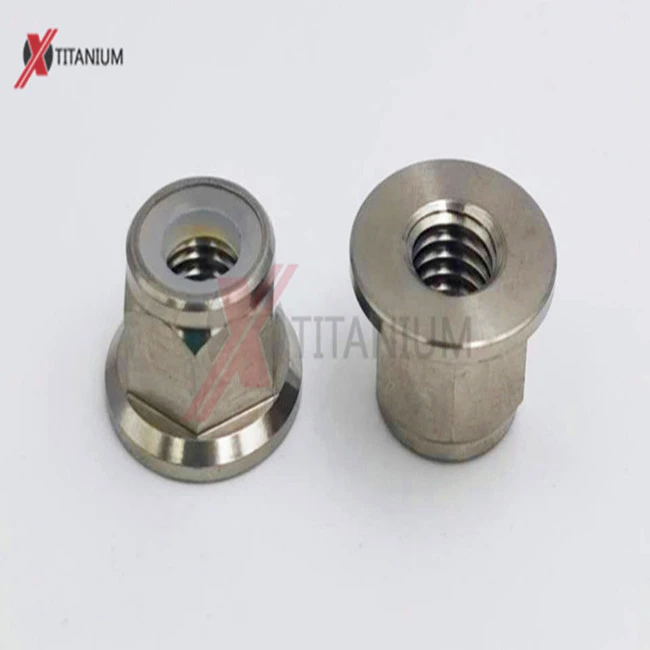
Understanding the ISO 7043 Standard for Nuts
Technical Specifications and Requirements
The ISO 7043 standard spells out exact limits for dimensions and mechanical qualities that are needed for fasteners to work the same way in all kinds of situations. This standard includes requirements for thread pitch accuracy, hexagonal sizes, height limits, and the placement of nylon inserts that allow products from different makers around the world to be used interchangeably.
According to ISO 7043, the makeup of a material must have certain strength and corrosion protection traits. When it comes to titanium alloys, the standard takes into account the unique qualities of Grade 2 and Grade 5 metals, which have strength-to-weight ratios that are about 40% higher than those of steel alternatives.
As stated in ISO 7043, the testing procedures include checking the torque-tension, checking the resistance to shaking, and checking the resistance to temperature changing. The strict quality control measures show that the locking system for the nylon insert works well and that the structure stays strong under practical stress.
Comparison with Related Standards
ISO 7043 is different from ISO 7040 because it focuses on metric thread setups and requires higher levels of accuracy in measurements. ISO 7040 talks about common torque nuts, while ISO 7043 talks about tighter tolerances that are good for aircraft and precision machines. The link between ISO 7043 and DIN 985 shows how international attempts are being made to standardize things. Both standards have the same basic size requirements, but ISO 7043 adds new testing methods and more material compatibility rules.
Properties and Performance of ISO 7043 Titanium Nylock Nuts
Material Characteristics and Advantages
Titanium's natural qualities, like its high resistance to rust and light weight, change how well regular fasteners work. In ISO 7043 Titanium Nylock Nuts, Grade 5 titanium (Ti-6Al-4V) is used because it has a tensile strength of 895 to 1000 MPa and a mass of only 4.43 g/cm³, which saves a lot of weight in important situations.
Titanium's ability to form an inactive oxide layer makes it very resistant to chloride environments, saltwater contact, and acidic conditions that are common in chemical processing and marine settings. This natural defense system gets rid of the need for extra surface treatments and makes sure that the product will last for a long time.
Temperature stability is another important benefit. Titanium can keep its shape at temperatures ranging from -253°C to 600°C. Because they are resistant to heat, titanium nylock nuts can be used in aircraft situations where temperatures change a lot during operation cycles.
Locking Mechanism Performance
ISO 7043-compliant nuts use nylon insert technology to control interference between male and female threads. This provides a steady dominant torque that keeps the nuts from coming loose when they are vibrated. The core is made of polyamide 6.6, a material that stays flexible at temperatures ranging from -50°C to +120°C.
Vibration resistance testing shows that titanium nylock nuts work better than regular nuts. They can keep the joint together under steady oscillating loads that go over 50,000 cycles. The outstanding performance comes from the mix of the wear resistance of titanium and the dampening properties of the nylon core. Titanium nylock nuts can be used more than once, but it depends on how hard the application is. In most cases, they can be removed and put back on three to five times without losing their closing force. This reusability makes upkeep a lot easier in situations where entry is needed only sometimes.
Applications and Benefits of ISO 7043 Titanium Nylock Nuts in Industry
Aerospace and Defense Applications
ISO 7043 Titanium Nylock Nuts are used by aerospace makers for important structural assemblies where reducing weight has a direct effect on fuel economy and payload capacity. Vibration resistance is very important in places on commercial airplanes like wing attachment points, engine mount systems, and control surface connections.
Titanium's high resistance to corrosion in maritime settings and harsh operating conditions makes it ideal for use in military aircraft uses. Titanium's non-magnetic qualities make it useful in electronic warfare systems and sensitive instrumentation units.
Titanium is good for making engine parts because it stays strong at high temperatures and doesn't change shape. Titanium nylock nuts are used in turbine housing parts, exhaust system links, and accessory drive mechanisms so that they can handle thermal cycles without losing their performance.
Marine and Offshore Engineering
When building an offshore platform, the problems are unique because the fasteners have to work well in saltwater and under a lot of stress. Titanium nylock nuts make strong links for safety-important systems like structural parts, blowout preventers, and pipeline connections.
Titanium is used in submarines for hull penetrations, ballast system parts, and navigation equipment mounts because it is strong for its weight and doesn't rust. Titanium fasteners have a longer service life, which means they need less upkeep during long operation times. It is helpful for desalination plants that titanium doesn't crack when exposed to chloride. This means that it can work reliably in high-salinity settings where other adhesives break down more quickly.
Medical Device Manufacturing
In biomedical uses, titanium's high biocompatibility and strong mechanical links are needed. Titanium nylock nuts are used for fixed and semi-permanent connections in surgical tool systems, implantable device housings, and diagnostic equipment.
Titanium is used to make MRI devices because it is non-magnetic and doesn't interfere with the creation of magnetic fields. It also provides safe mechanical connections for important parts. Titanium is chemically inert, which means it can be sterilized using autoclaving, gamma radiation, and chemical cleaning without losing its properties or functionality.
How to Choose the Right Titanium Nylock Nut According to ISO 7043?
Material Grade Selection
There are different grades of titanium that can be used depending on the purpose and the surroundings. For moderate-stress uses, Grade 2 titanium is very good at resisting corrosion and being shaped. Grade 5 (Ti-6Al-4V), on the other hand, is stronger for high-load structural links.
Because it is stronger and lighter than other titanium grades, Grade 5 is often used in aerospace uses. The alpha-beta composition of Ti-6Al-4V makes it very resistant to cracks spreading, which is important for safety-critical airplane parts. Depending on the load, marine applications can use either Grade 2 or Grade 5. Grade 2 is cheaper for lower-stress uses while still having great protection to corrosion in seawater.
Dimensional and Performance Specifications
The choice of thread size affects both the strength and the resistance to shaking. Fine thread pitches make thread contact better and increase wear resistance, while coarse threads make installation and removal easy in the field. The color code on the nylon inner shows the temperature ranges and chemicals that are compatible. Standard white cotton plugs work well up to 120°C, but there are special high-temperature versions that can work up to 150°C for tough jobs.
When setting torque limits, it's important to keep titanium's unique properties in mind, like the fact that it has a lower elastic stiffness than steel and can get thread galling during installation. Usually, the right torque values are between 60 and 80% of the standards for a similar steel bolt.
Quality Certification and Traceability
Specifications for buying things should require full material tracking, which includes proof of where the titanium ingot came from, its chemical makeup, and proof of its mechanical properties. This makes sure that all production lots are the same and lets failure analysis happen if needed.
The ISO 9001 certification sets the base standards for a quality system, while the AS9100 certification lists the quality controls that are unique to aerospace and must be used in aviation uses. For biocompatibility assurance, medical device uses may need ISO 13485 approval. Verification by a third party during testing adds to the quality assurance, especially in important situations where a failed fastener could have disastrous results. Independent labs can check that ISO 7043 standards and material property claims are being followed.
Procuring ISO 7043 Titanium Nylock Nuts: Guidance for B2B Buyers
Supplier Evaluation and Selection
To find good providers, you need to look at their manufacturing skills, quality control methods, and titanium processing-specific technical know-how. Manufacturers who have been in business for a long time and have flight certifications usually have the precision cutting and quality control tools needed to make ISO 7043 Titanium Nylock Nuts.
Location affects wait times and shipping costs, especially for urgent orders that need to be shipped quickly to meet tight production plans. When making prototypes or small amounts, regional suppliers may be better, while foreign makers may be better for saving money when buying in bulk.
Superior suppliers stand out from others by offering technical help that includes application advice, material suggestions, and custom modification services. Suppliers who are knowledgeable about metallurgy can help with choosing the right materials and making sure that the specifications are perfect for each purpose.
Cost Analysis and Value Considerations
Titanium fasteners usually cost 300–500% more than steel alternatives when they are first bought, but a lifetime cost study often shows that they are a better deal because they last longer and need less upkeep. In aerospace uses, reducing weight leads to measurable fuel cost saves over the life of the system.
large pricing structures change a lot from one seller to the next. For committed large sales, known makers usually offer better prices. Annual supply deals can keep prices stable and make sure that important production needs are met. Some hidden costs, like fast shipping, special packing, and certification paperwork, can have a big effect on the total cost of purchase. These things should be part of a full cost study so that you can compare suppliers accurately and plan your budget.
Supply Chain Management
Titanium fasteners have a restricted supply base and unique handling needs, so managing lead times becomes very important. Standard wait times are between 4 and 12 weeks, but they can be shorter or longer based on the amount and complexity of the specifications. Strategies for managing inventory should weigh the costs of keeping things on hand against the need to have them available, especially for high-value, low-volume uses. To avoid expensive delays, just-in-time delivery plans need suppliers and production schedules to work together very carefully.
Quality incoming inspection procedures make sure that materials received meet the requirements of the specifications and keep track of the paperwork for tracking. Statistical sample plans based on MIL-STD-105E make sure that the right number of inspections are done while keeping inspection costs as low as possible.
Conclusion
The ISO 7043 standard is a very important guideline for making sure that titanium nylock nuts always work well and are of high quality in tough industries. Procurement pros can make choices that improve performance and cost-effectiveness by knowing the technical specs, material qualities, and application requirements. Uniquely combining titanium's excellent material qualities with tried-and-true nylock technology creates fastener solutions that can work in the toughest conditions and remain reliable and valuable over time.
FAQ
What is the difference between ISO 7043 and other nut standards?
ISO 7043 talks about hexagon nuts with nylon inserts in a very specific way, focused on metric thread designs that provide better accuracy in measurements. In contrast to ISO 7040, which covers common torque nuts, ISO 7043 has stricter tolerances that are better for precise purposes and uses more up-to-date testing methods to meet the needs of current production.
How many times can titanium nylock nuts be reused?
Titanium nylock nuts can usually be removed and put back on three to five times without losing their locking torque. This depends on the seriousness of the application and the fitting conditions. Each cycle causes the nylon insert to wear down more and more, which lowers the efficiency of the dominant torque. Critical applications should either limit refilling or set up ways to check the force.
What temperature ranges are suitable for titanium nylock nuts?
In normal situations, nylon plugs work well from -50°C to +120°C, but the titanium base material stays strong from -253°C to 600°C. For high-temperature uses that go beyond the limits of nylon inserts, all-metal dominant torque options or special high-temperature polymer inserts may be needed.
How do you verify supplier certification and authenticity?
Genuine suppliers give full material traceability records, which include where the titanium ingot came from, a study of its chemical makeup, and the results of tests on its mechanical properties. Quality standards like ISO 13485 for medical uses or AS9100 for aircraft use show that the quality system controls are working properly. Verification by an independent third party adds extra security to important apps.
Are titanium nylock nuts worth the additional cost compared to steel?
Most of the time, lifecycle cost analysis shows that titanium screws are more valuable because they last longer, need less upkeep, and are lighter. In aerospace applications, the cost of fuel is lowered in a measurable way. In naval applications, replacement times are shortened and breakdowns caused by corrosion are decreased.
Secure Your Supply of Certified ISO 7043 Titanium Nylock Nuts with Chuanglian
Partnering with Chuanglian ensures access to premium-grade ISO 7043 Titanium Nylock Nuts that are made to strict military and industrial standards. Our thorough quality control system, which includes strict material traceability and dimensional verification, makes sure that all of our production batches work the same way. With over ten years of titanium processing expertise and state-of-the-art CNC machining tools, Chuanglian delivers reliable supply chain solutions for your most difficult projects. Contact our technical team at info@cltifastener.com or djy6580@aliyun.com to discuss your specific requirements and receive personalized procurement guidance.
References
1. International Organization for Standardization. "ISO 7043:2017 - Hexagon nuts with nylon insert - Property classes 6 and 8." Geneva: ISO Publications, 2017.
2. American Society for Testing and Materials. "ASTM B348-19 Standard Specification for Titanium and Titanium Alloy Bars and Billets." West Conshohocken: ASTM International, 2019.
3. Aerospace Industries Association. "NAS 1291 - Nut, Self-Locking, Hexagon, Titanium Alloy." Washington: AIA Publications, 2018.
4. European Committee for Standardization. "EN 3045 - Aerospace Series - Nuts, Self-Locking with Nylon Insert, Titanium Alloy." Brussels: CEN Publications, 2020.
5. Society of Automotive Engineers. "SAE AMS 4928N - Titanium Alloy Bars, Forgings, and Rings 6Al-4V Annealed." Warrendale: SAE International, 2019.
6. Defense Logistics Agency. "MIL-DTL-6099G - Detail Specification: Nut, Self-Locking, Hexagon." Columbus: DLA Land and Maritime, 2021.
Learn about our latest products and discounts through SMS or email