- English
- French
- German
- Portuguese
- Spanish
- Russian
- Japanese
- Korean
- Arabic
- Greek
- German
- Turkish
- Italian
- Danish
- Romanian
- Indonesian
- Czech
- Afrikaans
- Swedish
- Polish
- Basque
- Catalan
- Esperanto
- Hindi
- Lao
- Albanian
- Amharic
- Armenian
- Azerbaijani
- Belarusian
- Bengali
- Bosnian
- Bulgarian
- Cebuano
- Chichewa
- Corsican
- Croatian
- Dutch
- Estonian
- Filipino
- Finnish
- Frisian
- Galician
- Georgian
- Gujarati
- Haitian
- Hausa
- Hawaiian
- Hebrew
- Hmong
- Hungarian
- Icelandic
- Igbo
- Javanese
- Kannada
- Kazakh
- Khmer
- Kurdish
- Kyrgyz
- Latin
- Latvian
- Lithuanian
- Luxembou..
- Macedonian
- Malagasy
- Malay
- Malayalam
- Maltese
- Maori
- Marathi
- Mongolian
- Burmese
- Nepali
- Norwegian
- Pashto
- Persian
- Punjabi
- Serbian
- Sesotho
- Sinhala
- Slovak
- Slovenian
- Somali
- Samoan
- Scots Gaelic
- Shona
- Sindhi
- Sundanese
- Swahili
- Tajik
- Tamil
- Telugu
- Thai
- Ukrainian
- Urdu
- Uzbek
- Vietnamese
- Welsh
- Xhosa
- Yiddish
- Yoruba
- Zulu
How does he shape of titanium anode baskets influence the electrolysis effect?
The form of titanium anode baskets has a big effect on how well electrolysis works because it determines the current density, the flow dynamics of the electrolyte, and the touch surface area with the anode material inside. Well-thought-out basket shapes, like cylinders, rectangles, or custom shapes, make sure that electrochemical reactions happen evenly, keep voltage drops to a minimum, and improve the movement of ions throughout the electrolyte bath. Because of this precise accuracy, less energy is used, the quality of the finishing is better, and the machine lasts longer. Choosing the right basket form isn't just a technical matter for procurement managers who are in charge of electroplating or metal finishing operations; it's also a strategy choice that affects production consistency, upkeep schedules, and the total return on investment.
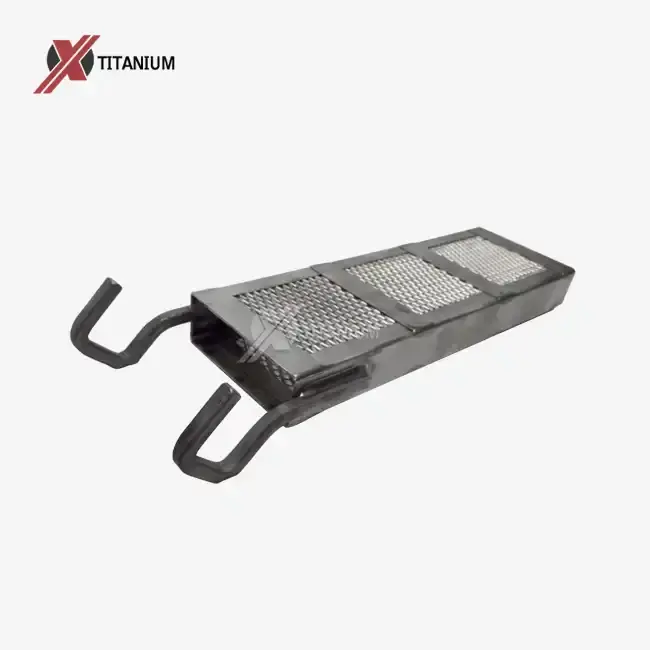
Understanding Titanium Anode Baskets and Their Electrolysis Function
Titanium anode baskets are special electrochemical fittings made from widely pure titanium that is very pure, usually ASTM B265 Grade 1 or Grade 2 material. During the electroplating and metal finishing processes, these boxes hold nickel, copper, tin, or zinc balls that dissolve in water. A passive layer of titanium dioxide appears on the top of the titanium structure during anodic conditions. This keeps the structure from moving during electrolysis. This oxide film keeps the basket from melting while still letting electricity flow to the anode material inside through contact points.
The Role of Titanium in Electrochemical Systems
Titanium is perfect for this use because of the way it reacts with electricity. Titanium baskets don't rust like steel or aluminum ones do in acidic coating baths; they stay strong in environments ranging from very acidic to slightly alkaline. The substance is very strong against chloride attacks, which makes it ideal for chlor-alkali processes and saltwater electrolysis systems. Compared to stainless steel, it is less dense, which makes it easier to handle during upkeep processes. Its mechanical strength also lets it handle the stress of being submerged in water all the time and cycling currents.
How Basket Geometry Impacts Current Distribution?
How current flows across the cathode surface is largely controlled by the shape of the anode basket. Placing a cylindrical basket in the middle of a plating tank provides radial current paths that make sure all the workpieces hung around its edge get the same amount of current. When flat cathode screens are lined up next to rectangular baskets, they create linear current fields that are perfect for plating strips and lines from reel to reel. Custom-shaped baskets, like L-shaped or multi-compartment designs, can fit into tanks with complicated shapes or different anode chemicals in the same bath. The electrical field structure changes with each arrangement, which has a direct effect on the speed and uniformity of the deposition.
Surface Area and Electrolyte Flow Optimization
The size of the basket mesh and the shape of the surface as a whole determine how the electrolyte flows around the anode materials. Larger openings in open mesh designs encourage strong electrolyte flow, which stops concentration differences and makes sure that reacting areas are always getting new ions. On the other hand, thinner mesh designs have smaller anode particles but may slow flow, which could lead to areas where nothing is moving. Whether natural convection currents or forced circulation systems can successfully refill the electrolyte next to the dissolving anode material depends on the three-dimensional shape. It could be a simple cylinder or a complex cage structure.
How Titanium Anode Basket Shape Affects Electrolysis Performance?
Geometric optimization of titanium anode baskets immediately leads to improvements in electroplating processes that can be measured. Three factors—uniform current density, efficient mass movement, and minimizing electrical resistance—are at the heart of the link between basket shape and electrolysis efficiency.
Current Density Uniformity and Deposition Quality
In precision electroplating, the main goal is still to get the current to flow evenly across the cathode surface. Because they naturally make circular current fields, cylindrical basket forms are perfect for barrel plating jobs where small parts keep falling. Because the shape is symmetrical, every part of the spinning barrel gets the same amount of current exposure, which makes the coating layer constant. When you put together rectangular baskets and flat cathode panels, you get parallel current lines that are needed for plating with chromium for decoration or nickel for function on flat surfaces. When the current density changes across the cathode, areas with a high density get too much metal growth while areas with a low density don't get enough coating. This is directly controlled by the shape of the flaw basket.
Case studies from the making of printed circuit boards (PCBs) clearly show this concept. When round baskets were used instead of flat anode bars in vertical plating lines, the difference in copper thickness between circuit boards went from ±15% to ±5%. The cylinder form kept the same anode-to-cathode spacing even as the anode material broke down, but the flat bars changed shape as the material broke down, which gradually changed how the current flowed. Because of this regularity, there was no need to make any changes to the anode in the middle of a shift. This cut down on labor costs and production breaks.
Mass Transport and Electrolyte Circulation
The way electrolytes move in plating tanks is controlled by the form and interior mesh structure of titanium baskets. Streamlined cylinder shapes create little turbulence, which lets laminar flow conditions happen that are good for thin films that need smooth surfaces. Shapes that are angular and rectangular with sharp corners create turbulence zones that help mix things but may also trap gas bubbles that are made during electrolysis. Custom perforated designs take these things into account by including flow lines that move the electrolyte along certain paths. This makes sure that the percentage of ions is the same throughout the bath space.
Optimized basket forms are especially helpful for electroplating processes that use cathodes with a lot of surface area, like expanding metal mesh or porous structures. A study in the aerospace fastener business found that conical basket designs with graduated mesh density were 23% more powerful at throwing than normal cylindrical baskets. The conical shape made an upward flow of electrolyte that was pushed by heat convection, and the graduated mesh stopped current from building up more at the basket ends than elsewhere. This new form made it possible to plate complex internal threads and blind holes, which used to need more than one plating run.
Energy Efficiency Through Shape Optimization
The electrical resistance between the anode and the cathode has a direct effect on how much energy is used. This resistance is changed by the form of the basket, which changes the useful current path length and cross-sectional area. Long tubular baskets in deep tanks make the distance between the anode and cathode bigger, which raises the ohmic resistance and power use. Placing flat, rectangular boxes close to the panel cathodes cuts down on the distance between them, which lowers the voltage needed. Combining vertical and horizontal elements in multi-tiered basket designs makes the best use of space in small plating cells while still keeping a good current economy.
These energy effects can be seen in numbers from zinc etching processes. Changing from solid zinc anode bars to circular titanium baskets filled with zinc balls cut power use by 18%, even though the titanium mesh added more resistance. The improvement came from keeping the anode surface area the same as the zinc dissolved. As the zinc dissolved, the solid bars got thinner, which raised the resistance and needed higher voltages to keep the goal current density. The form of the basket kept the anode material's electrical properties stable over its service life.
Comparison of Titanium Anode Basket Shapes with Other Anode Materials
The effectiveness of an anode basket is affected by both the material choice and the shape design. Titanium anode baskets have special qualities that make it possible to shape them in ways that would not be possible or useful with other materials.
Titanium Versus Stainless Steel Baskets
Nickel and copper coating use acidic fluids that contain chloride, which quickly eat away at stainless steel baskets. This rust adds iron to coating baths, which makes deposits weak and makes it impossible for them to stick together. Shape complexity makes this weakness worse—the complex turns, welds, and mesh crossings in stainless steel baskets create galvanic cells that speed up attacks in one area. Titanium's inactive oxide layer stays fixed no matter what shape the basket is, so designers can make them in complicated forms without raising the risk of corrosion. Custom titanium baskets with multiple compartments separate anode materials that don't work well together inside a single tank. This can't be done with materials that are easily corroded.
A cost study shows that titanium's higher starting cost is cheaper in the long run because it lasts longer. Every six months, a rectangular stainless steel basket in a hard chrome plating bath needs to be changed because it has holes in it from rust. Under the same conditions, the structure of a similar titanium box that has been acid-pickled on the outside stays strong for more than five years. During this time, the shape stays the same in terms of dimensions, keeping the original current distribution traits and getting rid of the performance loss that stainless steel baskets experience as rust gets worse.
Titanium Compared to Graphite and Lead Alloy Anodes
In the past, insoluble anodes made of graphite or lead alloys were used to carry direct current instead of holding anode material. These materials aren't stable in their dimensions. For example, graphite wears away through electrolytic oxidation, and lead alloys form protective oxide layers that need to be mechanically cleaned every so often. Titanium baskets don't have these problems because they are inactive and don't change shape. To improve performance, the basket shape can include internal gaps or varying mesh density, which can't be done with structures made of brittle graphite or soft lead.
Being able to change shapes is especially useful in specific situations. To make chlorine gas, chlor-alkali cells need anodes that can resist chemical attacks from both saturated brine and wet chlorine. Titanium mesh baskets that have been covered with mixed metal oxide catalysts will always keep their mesh shape. Anodes made of dimensionally stable metals like tantalum or niobium, on the other hand, can't be mechanically worked into complex forms like titanium can. The basket shape lets gas escape through the mesh, which stops bubble blindness that lowers the active surface area.
Maintenance and Longevity: How Shape Contributes to Titanium Anode Basket Lifespan
By changing the areas that are vulnerable to mechanical wear, chemical attack, and fouling buildup, titanium anode baskets shape has a direct effect on how often it needs to be maintained and how long it will last.
Design Features That Simplify Maintenance
With their wide holes at the top, cylindrical baskets make it easy to quickly add more anode material without taking the basket out of the plating tank. During production, operators just add new metal balls to keep the machine running continuously. When switching coating chemicals, rectangular baskets with lid panels that can be taken off allow for full anode replacements. These shape-dependent usability features cut down on downtime and keep repair workers from coming into contact with dangerous plating solutions.
The mesh pattern inside the basket form changes how often it needs to be cleaned. A coarse mesh with big holes lets chemical cleaning solutions flow easily, breaking down the brightener breakdown products and removing any organic contaminants that have built up. Because these leftovers get stuck in fine mesh structures, they need to be mechanically brushed or cleaned with ultrasonic waves. Smooth, gradually curved changes between mesh panels and structural frames in basket shapes get rid of cracks where sludge can gather, which lowers the number of times they need to be cleaned. Welded parts that have been treated with pickling and passivation don't have any places where rust could start easily, which would weaken the structure.
Shape Influence on Corrosion Resistance
Titanium is very resistant to corrosion in general, but some physical traits can make it vulnerable in certain places. When there is a lot of current flowing through a passive oxide film, sharp corners and edges can focus electrical fields, which could be higher than the breakdown voltage of the film. Rounded corners and filleted transitions keep the protective silence while easily distributing current. Crossroads in the mesh show possible weak spots where crevice rust could start if electrolyte pools up. Basket forms that allow electrolytes to run continuously across all surfaces stop the loss of oxygen and changes in pH that cause crevice attack.
Surface treatments that are based on the shape of the basket make it last even longer. Sandblasting makes a smooth, matte finish that gives more surface area for passive film formation. Acid pickling gets rid of contamination and heat-tint from welding, making sure that the passivation process covers the whole surface of the basket evenly. Electropolishing makes mesh surfaces smooth, which lowers the drag coefficient and makes the flow of electrolytes better. Shape plays a role in how well these treatments work; complex shapes with shadowed areas don't get full covering, leaving exposed areas.
Predictive Maintenance Based on Shape Characteristics
Monitoring tools that are made to fit the shape of the basket allow for early action before a catastrophic failure. The bottom of cylindrical baskets wears down faster than the rest of the material on the anode, which makes the mesh thinner through a process of mechanical wear and electrochemical attack. Inspections that are based on the number of amp-hours used allow replacing before damage happens. Edge rusting happens in rectangular baskets where current density is high, so the border welds and mesh terminations need to be looked at every so often. Ultrasonic thickness readings at expected high-stress areas help custom-shaped baskets with complicated shapes find thinning before they break mechanically.
Procurement Considerations: Selecting the Right Titanium Anode Basket Shape for Your Needs
To do titanium anode baskets selection right, you need to find a balance between technical performance needs, cost limits, and the supplier's skills. To find the best options for each application, procurement managers have to look at a lot of different factors.
Matching Basket Geometry to Process Requirements
The general shape needs are set by the configuration of the electroplating bath. Long pieces of work need vertical plating tanks with long cylinder or rectangular baskets that keep the anode and cathode aligned throughout the tank depth. For horizontal barrel plating systems to work, they need small, circular baskets to be placed in the middle of the spinning barrel. Modular rectangular baskets that are the same across all stations make it easier to keep track of supplies and do repairs on automatic plating lines with more than one station.
Anode material characteristics influence mesh size selection. Smaller tiny holes are needed for fine nickel or copper balls so they can't get into the plating bath. Zinc or tin slugs that are bigger can handle rougher mesh that helps electrolytes move more easily. We make sure the structure is strong enough by calculating the weight capacity based on the anode material density and the basket volume. Titanium has a high strength-to-weight ratio, which lets thin-walled designs hold heavy anode loads without deforming.
Customization Options and Manufacturing Capabilities
Standard round and square baskets can be used for many things, but unique shapes can be made to fit specific needs. L-shaped baskets can be placed in corners of tanks that don't have a lot of room. Multi-compartment baskets let you use different anode materials or different rates of breakdown at the same time in the same plating cell. Designs for baskets that include handles, hooks, or mounting pieces make them easier to put together and take apart for upkeep. Checking a supplier's manufacturing skills makes sure they can give the unique features you need within a reasonable amount of time.
How the baskets are made affects their quality and how well they work. Titanium sheet that has been cold-rolled has better mechanical qualities than titanium sheet that has been hot-rolled. This means that stress cracks are less likely to form at welded joints. With precise laser cutting, the sides of the mesh are clean and don't change shape when heated, so the measurements stay the same. Using titanium filler wire in TIG welding makes joints that are strong, won't rust, and don't have any holes or other problems. Acid pickling and passivation are two surface processes that make sure that all of the sides of the basket are equally resistant to corrosion. To make sure quality is always the same, these process standards should be written down in the procurement specs.
Supplier Selection Criteria for Long-Term Partnership
Buying titanium baskets is an investment that will last for a long time and needs to be done with suppliers that can be trusted. Manufacturers who have worked with electrochemical uses for a long time know how the shape of the basket, the chemistry of the electrolyte, and the soldering performance all affect each other in subtle ways. In addition to the real product, technical support services like application engineering, electrochemical models, and fixing help add a lot of value. Quality certifications, like ISO9001, show that the process can be controlled, and material certifications that list the grade and chemical make-up of titanium make sure that the specifications are met.
Stable lead times are important for keeping production plans. When suppliers keep enough raw materials on hand and enough manufacturing capacity, they can keep lead times steady. This keeps production from being interrupted by late basket orders. With prototyping, you can try unique basket designs before committing to large-scale production, which lowers the technical risk. After-sales help, such as warranty terms and the ability to get new parts, guards against failures that were not expected.
Conclusion
The curve of the basket is an important but often overlooked factor in how well an electroplating system works. The shape of the titanium anode baskets controls the even flow of current, the patterns of liquid, and the amount of energy used. These are important factors that affect the quality of the plating and the cost of running the machine. Titanium's high resistance to rust and high mechanical strength make it possible to make complicated shapes that would not be possible with other materials.
Its passive behavior also ensures that the dimensions stay the same over a long period of time. Manufacturers can stay ahead of the competition as long as they make purchasing decisions that balance technical needs with cost concerns and the abilities of the suppliers. As electroplating technologies get better at making things more efficiently and to tighter quality standards, improved titanium basket forms will become even more important from a strategic point of view.
FAQ
Q1: What basket shape works best for vertical electroplating tanks?
A: When cylindrical baskets are put in the middle of vertical tanks, they form radial current distribution patterns that are perfect for workpieces that are hung around the basket's edge. The balanced shape keeps the distance between the anode and cathode the same throughout the tank's depth, which makes sure that the plating thickness is the same from top to bottom. Long cylinders work well in deep tanks for plating long parts like tubes or bars, while shorter, wider cylinders work better in shallow tanks for plating small parts quickly.
Q2: How does mesh size affect electrolysis efficiency?
A: The size of the mesh aperture combines the need to keep anode material contained with the need for electrolyte movement. Larger mesh holes encourage strong flow, which lowers concentration differences and boosts the efficiency of mass movement. Smaller holes hold tiny anode particles, but they might stop flow, which could lead to areas where ions stop moving. The best mesh size varies on the particle size of the anode material and how the electrolyte is mixed. Systems that use forced circulation can handle smaller mesh than systems that use natural convection.
Q3: Can titanium basket shape reduce energy consumption?
A: By reducing the distance between the anode and cathode and increasing the useful cross-sectional area that can carry current, optimized basket shape lowers electrical resistance. Shapes that keep the anode's surface area the same as the material is used down stop resistance from rising over time, which would require voltage changes. Putting baskets in the right place in relation to the cathode surfaces makes current paths that work well, which cuts down on ohmic losses and power use by up to 20% compared to systems that aren't well thought out.
Partner With Chuanglian for Superior Anode Basket Solutions
Baoji Chuanglian New Metal Material Co., Ltd. brings over a decade of specialized experience manufacturing precision titanium anode baskets tailored to demanding electroplating and electrochemical applications. Located in Baoji City—renowned as China's "City of Titanium"—our facility combines advanced CNC machining capabilities with deep metallurgical expertise to deliver baskets meeting the strictest performance specifications.
Our engineering team works collaboratively with clients to design custom basket geometries optimizing current distribution for specific tank configurations and plating chemistries. Every basket undergoes rigorous quality control including dimensional verification, weld integrity inspection, and surface treatment validation before shipment. Reach out to our technical team at info@cltifastener.com or djy6580@aliyun.com to discuss your titanium anode basket requirements with a trusted manufacturer committed to delivering measurable performance improvements.
References
1. Schlesinger, M., & Paunovic, M. (2010). Modern Electroplating (5th ed.). John Wiley & Sons, Hoboken, New Jersey.
2. Dini, J.W. (1993). Electrodeposition: The Materials Science of Coatings and Substrates. Noyes Publications, Park Ridge, New Jersey.
3. Bard, A.J., & Faulkner, L.R. (2001). Electrochemical Methods: Fundamentals and Applications (2nd ed.). John Wiley & Sons, New York.
4. Gamburg, Y.D., & Zangari, G. (2011). Theory and Practice of Metal Electrodeposition. Springer Science+Business Media, New York.
5. Pletcher, D., & Walsh, F.C. (1990). Industrial Electrochemistry (2nd ed.). Chapman and Hall, London.
6. Newman, J., & Thomas-Alyea, K.E. (2004). Electrochemical Systems (3rd ed.). John Wiley & Sons, Hoboken, New Jersey.

Learn about our latest products and discounts through SMS or email