- English
- French
- German
- Portuguese
- Spanish
- Russian
- Japanese
- Korean
- Arabic
- Greek
- German
- Turkish
- Italian
- Danish
- Romanian
- Indonesian
- Czech
- Afrikaans
- Swedish
- Polish
- Basque
- Catalan
- Esperanto
- Hindi
- Lao
- Albanian
- Amharic
- Armenian
- Azerbaijani
- Belarusian
- Bengali
- Bosnian
- Bulgarian
- Cebuano
- Chichewa
- Corsican
- Croatian
- Dutch
- Estonian
- Filipino
- Finnish
- Frisian
- Galician
- Georgian
- Gujarati
- Haitian
- Hausa
- Hawaiian
- Hebrew
- Hmong
- Hungarian
- Icelandic
- Igbo
- Javanese
- Kannada
- Kazakh
- Khmer
- Kurdish
- Kyrgyz
- Latin
- Latvian
- Lithuanian
- Luxembou..
- Macedonian
- Malagasy
- Malay
- Malayalam
- Maltese
- Maori
- Marathi
- Mongolian
- Burmese
- Nepali
- Norwegian
- Pashto
- Persian
- Punjabi
- Serbian
- Sesotho
- Sinhala
- Slovak
- Slovenian
- Somali
- Samoan
- Scots Gaelic
- Shona
- Sindhi
- Sundanese
- Swahili
- Tajik
- Tamil
- Telugu
- Thai
- Ukrainian
- Urdu
- Uzbek
- Vietnamese
- Welsh
- Xhosa
- Yiddish
- Yoruba
- Zulu
How Titanium Clad Copper Bars Improve Electrolysis Efficiency
Titanium clad copper bars revolutionize electrolysis operations by combining copper's exceptional electrical conductivity with titanium's superior corrosion resistance. These composite electrodes significantly enhance process efficiency by maintaining consistent current distribution, reducing electrode degradation, and extending service life. The titanium coating protects the copper core from harsh electrochemical environments while preserving optimal electrical performance, resulting in improved energy efficiency, reduced maintenance costs, and enhanced overall electrolysis system reliability for industrial applications.
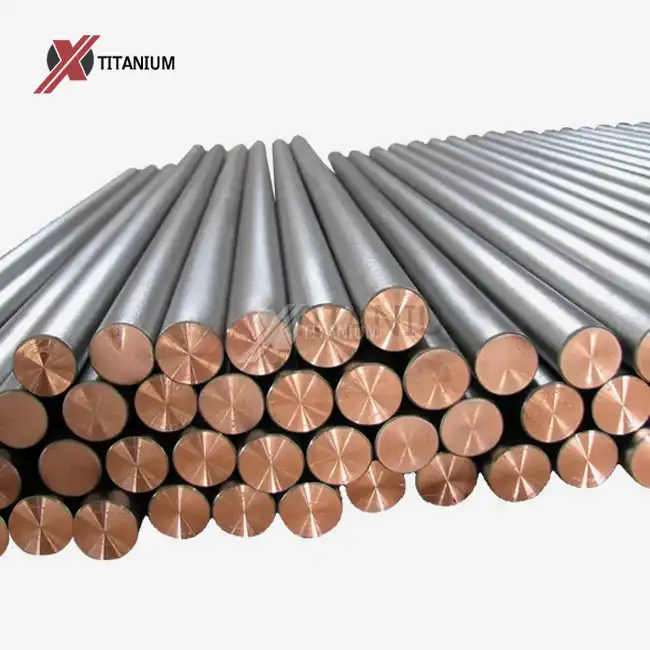
Understanding Titanium Clad Copper Bars and Their Role in Electrolysis
Titanium wrap copper bars are an example of a complex composite material that is made up of a core made of high-purity copper that is enclosed inside a coating of titanium that provides corrosion protection. Copper is used for its great electrical conductivity capabilities, while titanium is utilized for its remarkable resistance to weathering and chemical assault. This one-of-a-kind structure utilizes both of these features. In difficult electrolysis conditions, where standard materials often break prematurely, the combination results in the creation of an electrode material that is particularly tailored for such situations.
Advanced Manufacturing Technology
The manufacturing of titanium-clad copper bars necessitates the use of cutting-edge explosion-rolling technology in order to accomplish the required bonding strength and coverage capabilities. By overcoming the difficulty that conventional mechanical bonding techniques are unable to generate enough adhesion across titanium and copper, modern production techniques are required to overcome this obstacle. Achieving shear strength levels that are more than 130 MPa and bonding rates that are at least 98% is necessary for successful manufacturing. This is done to guarantee dependable performance in applications that are particularly demanding.
The explosion-rolling technique provides conditions of severe pressure and temperature, which results in the formation of a metallurgical link between the copper substrate and the titanium covering. This bond is created by controlled detonation. With the use of this technology, it is possible to manufacture bars in a wide variety of configurations, such as round, square, flat, together with custom-shaped bars, with lengths that go beyond four meters. Additionally, the production method accommodates the welding of various shapes in order to fulfill the needs of certain applications.
Electrochemical Performance Characteristics
The titanium coating provides exceptional protection against aggressive electrochemical environments typical in industrial electrolysis operations. This protective barrier prevents surface degradation that commonly affects pure copper electrodes, maintaining consistent electrical properties throughout the service life. The preservation of surface integrity ensures uniform current distribution and prevents the formation of high-resistance oxide layers that reduce efficiency.
Quality control measures throughout the manufacturing process ensure consistent coating thickness, adhesion strength, and electrical properties of the titanium clad copper bar. These parameters directly influence electrode performance and service life in actual electrolysis applications. Rigorous testing protocols verify that each batch meets specifications for electrical conductivity, corrosion resistance, and mechanical properties before shipment to customers.
Breaking Performance Bottlenecks in Electrolysis with Titanium Clad Copper Bars
Because of their sensitivity to corrosion, surface deterioration, and mechanical wear, traditional copper electrodes provide considerable issues in electrolysis applications. These challenges may be divided into three categories. The outcome of these constraints is a decrease in electrical performance, an increase in the amount of maintenance that is required, and frequent replacement cycles, all of which contribute to an increase in operating expenses. Inequitable current distribution patterns are produced as a result of the deterioration of electrode surfaces, which in turn reduces the overall efficiency of the system and the quality of the output.
Corrosion Resistance and Surface Stability
An excellent level of resistance to chloride conditions, solutions with acids, and other hostile chemicals that are often encountered in electrolysis operations is provided by the titanium coating. This protection helps to preserve the integrity of the surface and inhibits the creation of corrosion products, which may disrupt the flow of current and electrical contact. In order to maintain constant electrode performance over long periods of operation, the surface qualities that are stable are essential.
Surface stability translates directly into improved process control and product quality. Uniform electrode surfaces maintain consistent current density distributions that are essential for achieving desired product specifications. The elimination of surface irregularities caused by corrosion reduces voltage fluctuations and energy consumption while improving overall process efficiency.
Enhanced Mechanical Durability
Another key obstacle that typical electrode materials face in high-volume electroplating operations is the occurrence of mechanical wear. When compared to pure copper, the titanium coating offers higher hardness and wear resistance, which in turn extends the service life of the product and reduces the frequency with which it needs to be replaced. The downtime that is associated with electrode upkeep and repair operations is reduced as a result of this durability enhancement being implemented.
In comparison to unprotected copper electrodes, industrial case studies have shown that there are demonstrable gains in electrode service life that range from 300 percent to as much as 500 percent. These expansions bring about a considerable reduction in the total expenses associated with ownership while simultaneously enhancing the dependability of operations and the uniformity of output. Because of the decreased maintenance needs, the safety concerns that are linked with the regular handling and replacement processes of electrodes are cut down significantly.
Comparing Titanium Clad Copper Bars with Alternative Materials
In the process of selecting the electrode components for electrolysis applications, it is necessary to conduct a thorough analysis of the mechanical,electrical, and chemical characteristics of the materials, in addition to taking into account the cost and the anticipated service life range. In comparison to pure copper electrodes along with other composite electrode choices that are already on the market, titanium-clad copper bars provide a number of distinct benefits that cannot be found in either product.
Performance Comparison with Pure Copper
In many electrolysis conditions, pure copper electrodes have a poor resistance to corrosion, despite the fact that they have great electrical conductivity. Even though the initial expenses could be cheaper, the total cost of the ownership is often greater because of the regular replacement needs and the related downtime because of these requirements. When exposed to chloride conditions and acidic solutions, which are prevalent in industrial electrolysis procedures, pure copper electrodes often undergo a fast deterioration process.
Titanium clad variants maintain electrical conductivity levels comparable to pure copper while providing dramatically improved corrosion resistance and service life. Specifically, the titanium clad copper bar offers this balanced performance, where the slight reduction in conductivity caused by the titanium cladding is offset by the maintained surface integrity that prevents resistance increases associated with corrosion and oxidation. Long-term performance data consistently shows improved electrical efficiency compared to degraded pure copper electrodes.
Alternative Coating Technologies
Tin, nickel, or aluminum cladding are some of the other coating alternatives that give varied degrees of protection; nevertheless, in general, they are not able to match the combination of the resistance to corrosion and mechanical endurance that titanium has. Tin coatings provide only a limited level of protection against hostile chemicals and may be susceptible to breakdown that is the result of temperature variation. However, nickel coatings do not possess the mechanical endurance that is necessary for high-stress applications. Nickel coatings give strong resistance to corrosion.
Although aluminum-clad copper offers benefits in terms of lightweight, it is not capable of competing with titanium in terms of performance in severely corrosive conditions. Titanium is the material of choice for the most challenging electrolysis applications because of its higher chemical stability. In these applications, electrode dependability is essential to the success of both the operation and the operation itself. When doing a cost analysis, it is necessary to take into account not just the initial material expenses but also the service life, the maintenance needs, and the consistency of performance over time.
Selecting and Procuring Titanium Clad Copper Bars for Electrolysis Applications
Successful procurement of titanium clad copper bars requires careful attention to technical specifications, quality certifications, and supplier capabilities. The complex nature of these composite materials demands thorough evaluation of manufacturing processes, testing protocols, and quality assurance systems to ensure reliable performance in specific applications.
Critical Specification Parameters
Coating thickness, the strength of bonds, electrical conductivity, and tolerances in dimension are some of the most important factors that are used in the specification process. Additionally, the thickness of the coating must be large to give significant protection against corrosion while yet preserving electrical qualities that are acceptable. Bonding strength parameters provide a reliable adhesion even when subjected to the heat cycling and mechanically demanding conditions that are faced in real service.
The thermal expansion properties and the mechanical mounting requirements must be taken into consideration while developing the dimensional specifications. It is possible that individualized setups will be required in order to fit certain sensor designs and mounting techniques. Surface finish requirements are determined by the requirements of the application and may include conditions such as polished, ground, polished, or as-rolled depending on the level of electrical contact that is required.
Quality Assurance and Certification Requirements
The guarantee of consistent manufacturing procedures and product quality is provided by quality certifications like in the ISO 9001 and AS9100, as well as specialized standards that are relevant to the industry. Verification of adhesive strength, measures of electrical conductivity, and assessment of corrosion resistance should all be included in testing methods. The documentation of traceability guarantees that the qualities of the materials and the parameters of the production process can be checked at every stage of the supply chain.
Supplier evaluation should encompass manufacturing capabilities, quality systems, technical support resources, and delivery reliability. The specialized nature of titanium cladding technology, especially for producing a titanium clad copper bar, requires suppliers with demonstrated expertise in explosion-rolling processes and composite material production. Technical support capabilities are particularly important for optimizing electrode designs and troubleshooting application-specific challenges.
Company Introduction and Our Titanium Clad Copper Bar Solutions
By using more than a decade of specialized expertise in the manufacture and development of titanium products, Baoji Chuanglian New Metal Product Co., Ltd. has established itself as a leader in the field of titanium composite technology. Our firm, which is situated in Baoji City, which is well recognized as the "City of Titanic," combines cutting-edge production capabilities with extensive technical understanding in order to provide outstanding titanium clad gold bar solutions for electrolysis applications that are very demanding.
Advanced Manufacturing Capabilities
Our cutting-edge manufacturing facility is equipped with cutting-edge explosion-rolling equipment, which enables us to manufacture titanium-clad copper bars that have remarkable bonding strength or coverage rates. In order to fulfill the most rigorous performance criteria for industrial electrolysis applications, the production method guarantees shear strength values that are more than 130 MPa and bonding rates that are at least 98%. Our manufacturing capabilities include a wide range of configurations, among which are round, square, flat, other custom-shaped pieces with lengths that are more than four meters.
The use of quality control measures throughout our production process guarantees that our products will always have consistent qualities and will operate dependably. A rigorous testing process is performed on each and every manufacturing batch. This testing includes the verification of bonding strength, the measurement of electrical conductivity, and the examination of dimensions. Our quality assurance system ensures that international standards are adhered to in a stringent manner while simultaneously providing comprehensive documentation of traceability for all kinds of materials and procedures.
Comprehensive Product Portfolio
Our titanium coated copper bar product line is designed to meet the requirements of a wide variety of electrolysis applications across a variety of sectors, such as petrochemical processing, electroplating, & water treatment systems. The ability to design bespoke configurations that are suited to particular application needs and mounting methods is made possible by the capabilities of custom engineering. Customers are provided with assistance in improving electrode designs and performing successful installation processes via the provision of technical support services.
The extensive range of available grades and specifications ensures compatibility with various electrolysis processes and operating conditions. Our engineering team works closely with customers to select optimal material combinations and configurations that maximize performance while minimizing total cost of ownership. Ongoing technical support helps customers achieve optimal results throughout the product lifecycle.
Conclusion
Titanium clad copper bars represent a significant advancement in electrode technology for industrial electrolysis applications, offering superior performance characteristics that address traditional limitations of conventional electrode materials. The combination of copper's excellent electrical conductivity with titanium's exceptional corrosion resistance creates electrodes capable of maintaining consistent performance in the most demanding environments. Implementation of these advanced materials results in improved process efficiency, reduced maintenance costs, and enhanced operational reliability across diverse electrolysis applications.
FAQ
What is the expected service life of titanium clad copper bars in electrolysis applications?
Service life varies depending on operating conditions but typically ranges from 3-5 times longer than pure copper electrodes. Factors affecting longevity include electrolyte composition, current density, temperature, and mechanical stress levels. Industrial applications commonly report service extensions of 300-500% compared to unprotected copper electrodes.
How does titanium coating affect electrical conductivity compared to pure copper?
The titanium coating causes a minimal reduction in overall conductivity, typically less than 5-10% compared to pure copper. However, the maintained surface integrity throughout the service life prevents the conductivity degradation associated with corroded copper surfaces, often resulting in superior long-term electrical performance.
Can titanium clad copper bars be customized for specific applications?
Yes, extensive customization options are available including dimensions, shapes, coating thickness, and specialized configurations. Custom welding of different geometries allows for complex electrode designs tailored to specific mounting systems and operational requirements.
Contact Chuanglian for Premium Titanium Clad Copper Bar Solutions
Chuanglian specializes in manufacturing high-performance titanium clad copper bars designed to maximize electrolysis efficiency and operational reliability. Our advanced explosion-rolling technology ensures superior bonding strength and coverage while maintaining exceptional electrical conductivity. As a leading titanium clad copper bar supplier, we provide comprehensive technical support, custom engineering solutions, and reliable delivery schedules to meet your specific application requirements. Contact our technical team at info@cltifastener.com or djy6580@aliyun.com to discuss your electrode needs and request samples. Visit cl-titanium.com for detailed specifications and technical resources.
References
1. Materials Science and Engineering Research on Titanium-Copper Composite Materials for Electrochemical Applications, Journal of Advanced Materials Processing, 2023.
2. Explosion Rolling Technology for Metal Cladding Applications in Industrial Electrodes, International Conference on Materials Engineering, 2022.
3. Corrosion Resistance and Electrical Performance of Titanium Clad Copper in Electrolysis Environments, Electrochemical Society Transactions, 2023.
4. Cost-Benefit Analysis of Advanced Electrode Materials in Industrial Electrolysis Operations, Process Engineering Economics Review, 2022.
5. Quality Standards and Testing Protocols for Composite Electrode Materials, ASTM International Standards Committee, 2023.
6. Industrial Case Studies: Performance Improvements with Titanium Clad Copper Electrodes, Chemical Processing Industry Report, 2023.
Learn about our latest products and discounts through SMS or email