- English
- French
- German
- Portuguese
- Spanish
- Russian
- Japanese
- Korean
- Arabic
- Greek
- German
- Turkish
- Italian
- Danish
- Romanian
- Indonesian
- Czech
- Afrikaans
- Swedish
- Polish
- Basque
- Catalan
- Esperanto
- Hindi
- Lao
- Albanian
- Amharic
- Armenian
- Azerbaijani
- Belarusian
- Bengali
- Bosnian
- Bulgarian
- Cebuano
- Chichewa
- Corsican
- Croatian
- Dutch
- Estonian
- Filipino
- Finnish
- Frisian
- Galician
- Georgian
- Gujarati
- Haitian
- Hausa
- Hawaiian
- Hebrew
- Hmong
- Hungarian
- Icelandic
- Igbo
- Javanese
- Kannada
- Kazakh
- Khmer
- Kurdish
- Kyrgyz
- Latin
- Latvian
- Lithuanian
- Luxembou..
- Macedonian
- Malagasy
- Malay
- Malayalam
- Maltese
- Maori
- Marathi
- Mongolian
- Burmese
- Nepali
- Norwegian
- Pashto
- Persian
- Punjabi
- Serbian
- Sesotho
- Sinhala
- Slovak
- Slovenian
- Somali
- Samoan
- Scots Gaelic
- Shona
- Sindhi
- Sundanese
- Swahili
- Tajik
- Tamil
- Telugu
- Thai
- Ukrainian
- Urdu
- Uzbek
- Vietnamese
- Welsh
- Xhosa
- Yiddish
- Yoruba
- Zulu
Why Surgeons Prefer Titanium Bone Screws for Implants
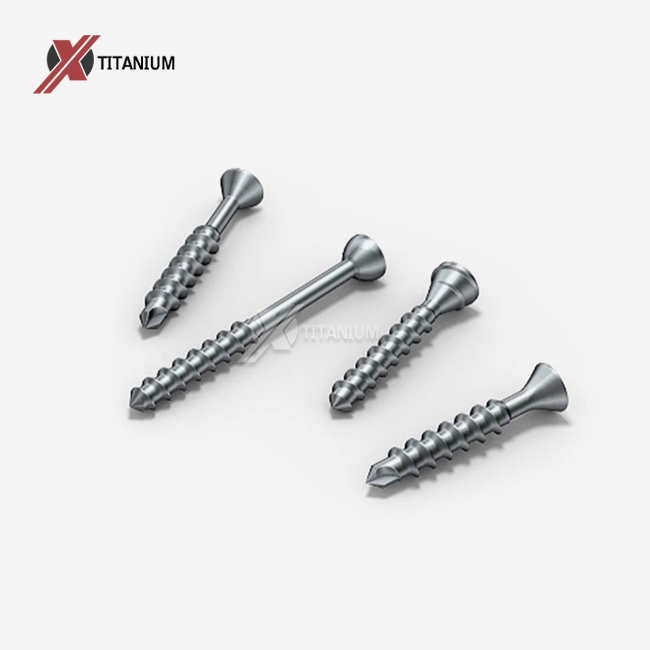
As a result of their excellent biocompatibility, better corrosion resistance, and ideal mechanical qualities, titanium medical screws are always the first choice for bone implant treatments. Unlike standard stainless steel implants, titanium implants fuse smoothly with human bone tissue through a process called osseointegration. This lowers the risk of rejection and improves the long-term results of surgery. Because the material isn't magnetic, it's easy to see what happened after surgery, and its strength-to-weight ratio makes it stable without being too heavy. Because of these important benefits, titanium is the best material for orthopedic, spine, and reconstructive operations.
Comprehending Titanium Medical Screws: Properties and Benefits
There has been a big change in the medical device business toward implants made of titanium, especially bone screws. These carefully designed internal fixing devices are a step forward in technology that helps doctors with a number of problems they face every day.
Exceptional Biocompatibility and Osseointegration
The biocompatibility of titanium medical screws is very high, which makes them stand out from other transplant materials. When these screws are exposed to air, they form a solid titanium dioxide (TiO2) oxide layer on their surface. This makes the contact with the surrounding tissue inert. This natural shield stops bad reactions in the tissue and helps healthy bone grow around the implant.
When titanium bone pins are used, the osseointegration process is one of their best features. Titanium doesn't get wrapped up in fibrous tissue like some other materials can. Instead, bone cells can grow right into the screw's surface. This molecular bonding makes a strong, long-lasting relationship that gets stronger over time instead of weakening.
Superior Mechanical Properties
The tensile strength of Grade 23 titanium alloy (Ti-6Al-4V ELI) is between 860 and 960 MPa, which means it lasts a very long time under physiological loads. The measure of stiffness of the material is about 110 GPa, which is very close to that of human bone. This means that it doesn't have the stress shielding effects that can cause bone to break down around traditional steel implants.
Titanium has a mass of 4.43 g/cm³, which makes it lighter while still keeping its structure strong. In situations where more than one pin is needed, this feature becomes very important because it lowers the total load on the patient's skeletal system.
Titanium vs. Alternative Materials: Making Informed Procurement Decisions
When choosing bone screw solutions, people who buy medical devices have to look at a number of different material choices. Understanding the relative benefits helps make sure that patients get the best care while keeping costs in check.
Stainless Steel Comparison
Traditional 316L stainless steel has been used in the medical field for many years, but titanium is much better in many technical areas. The higher elastic stiffness (200 GPa) of stainless steel makes mechanical mismatches with bone tissue, which could cause the implant to come loose over time. MRI artifacts are also caused by steel's ferromagnetic features, which makes tracking and evaluation after surgery more difficult.
Another important difference is corrosion resistance. Aluminum and stainless steel both work well in most physiological settings, but titanium's oxide layer protects better against body fluids and chemicals. This increased protection is especially important for people whose immune systems are weak or who need to have the device implanted for a long time.
Cost-Benefit Analysis for Procurement Teams
Titanium bone screws are more expensive than steel ones—usually 40 to 60 percent more per unit. But titanium usually has a lower total cost of ownership when you look at things like fewer repair surgeries, better patient results, and better imaging compatibility. When choosing materials, procurement managers should look at the materials' lifetime costs instead of their beginning buy prices.
Custom production is another thing that sets titanium sellers apart in the market. Because the material is easy to machine, it can be given particular thread designs, surface treatments, and changes in size that may be needed for certain surgical uses. This gives medical device companies the freedom to make answers that are specific to each patient's needs.
Procurement Insights: Sourcing and Buying Titanium Medical Screws
To set up solid supply chains for titanium medical screws, you need to carefully look at the tools you have for manufacturing, quality control, and technical support. Because laws for medical devices are so complicated, companies need to work with suppliers who understand both the science behind the materials and the rules.
Supplier Evaluation Criteria
A thorough evaluation of the seller is the first step to successful buying. Some important things that are looked at are ISO 13485 approval for medical device quality management, ASTM F136 compliance for surgical titanium metals, and FDA registration to get into the US market. Suppliers should show that the traits of materials are the same from one lot to the next by using statistical process control and thorough testing methods.
Another important thing for buying teams to think about is the manufacturing ability. Specialized tools and trained workers are needed to machine titanium because of its unique properties. When compared to general machine shops that try to do medical work, suppliers with specific medical device production lines usually offer better quality stability and shorter wait times.
Batch Testing and Traceability Requirements
To make sure they follow the rules, medical grade titanium screws need to be tested and accompanied by a lot of paperwork. For each production lot, there should be a study of the chemical makeup, tests of the mechanical properties, and confirmation of the surface finish. Suppliers must keep full records of all steps, from the heat numbers of the raw materials to the final packing and cleaning.
Certificates of compliance, dimensional inspection records, and biocompatibility test results should all be in the paperwork box. Modern sellers offer electronic data management systems that let you access quality records and shipping paperwork at any time. This makes the buying process and getting ready for audits easier.
Ensuring Quality and Compliance in Titanium Bone Screw Procurement
Medical gadget procurement plans that work are built on quality assurance processes. Because internal devices are so important, they need strict quality control methods all along the supply chain.
Regulatory Compliance Standards
Manufacturing and distributing titanium medical screws are controlled by a number of different regulatory systems. ASTM F136 sets the requirements for the chemical make-up and mechanical properties of Grade 23 titanium metal, and ISO 5832-3 sets the standards for materials used in medical implants around the world. Part 820 of FDA 21 CFR sets the standards for quality systems for companies in the United States that make medical devices.
The Medical Device Regulation (MDR) says that products sold in Europe must have a CE mark. This includes biocompatibility testing that follows ISO 10993 guidelines. These rules make sure that titanium bone screws meet safety and effectiveness standards in all places around the world.
Inspection and Testing Protocols
Incoming materials should be inspected, work in progress should be tracked, and the finished product should be checked. Dimensional precision (usually ±0.05mm for threaded features), surface finish standards (Ra 0.8µm or better), and checking the mechanical qualities through tensile and fatigue tests are some of the most important factors.
For titanium implants, surface contamination research is very important because even very small amounts of waste can affect biocompatibility. Advanced sellers use X-ray photoelectron spectroscopy (XPS) and scanning electron microscopy (SEM) to check the oxide layer stability and surface cleaning.
Future Trends and Innovations in Titanium Medical Screws
Titanium bone screws are still getting better in the medical device business thanks to new discoveries in material science and better ways of making them. These changes open up new ways for procurement workers to improve patient results while also lowering costs.
Advanced Surface Treatments
New methods for changing the surface of titanium implants make the body respond better to them. Plasma spray coats add hydroxyapatite or other bioactive materials to help bones grow, and anodization methods make controlled oxide layers that speed up the process of osseointegration. These methods can shorten the time it takes to heal and make implants more stable in the long run.
Additive manufacturing technologies make it possible to make titanium surfaces that are porous and help bone grow. These structures, which are made by selective laser sintering or electron beam melting, can connect chemically and mechanically. When compared to traditional smooth surfaces, these implants integrate faster and stay in place better.
Market Growth and Procurement Implications
The world market for titanium medical screws keeps growing because people are living longer and more surgeries are being done. Because of this growth, buying teams can get better prices by promising to buy more, and they can also get access to better product technologies.
As medical device businesses try to cut down on geographic risks and shipping costs, supply chain regionalization trends change how they buy things. Global procurement processes can be more flexible and secure when they work with suppliers who can make things in more than one area.
Conclusion
Titanium medical screws are the current standard for bone implants because they are biocompatible, have good mechanical qualities, and work well in clinical settings. Surgeons like these devices because they blend in with bone tissue naturally, don't rust, and let doctors see clearly after surgery. Even though they cost more at first, titanium screws are worth it in the long run because they lower the number of revisions needed and improve patient results. Because the material is so flexible, it can be used to make unique products that meet the needs of specific surgeries while still following all the rules in all global markets.
FAQ
What makes Grade 23 titanium superior to Grade 5 for medical applications?
Compared to normal Grade 5 metal, Grade 23 titanium (Ti-6Al-4V ELI) has less oxygen, nitrogen, and iron impurities. This extra-low interstitial makeup makes the material more flexible and resistant to breaking, which is important for internal devices. The higher purity lowers the chance of bad reactions in the tissue while keeping the great mechanical qualities needed for surgery uses.
Do titanium bone screws interfere with MRI imaging?
Due to its non-ferromagnetic features, titanium can be used in MRI treatments. While stainless steel implants cause a lot of image distortion when scanned, titanium screws cause almost no image distortion. Because of this similarity, doctors can use high-quality imaging to check on the patient's healing and find any problems that might arise.
How do manufacturers prevent galling during screw insertion?
Because titanium tends to cold weld (gall), it needs special surface processes to lower its friction coefficients. Type II anodization makes a hard oxide layer that keeps metals from touching each other while they are being inserted. Advanced providers may also use special coatings or controlled surface patterns that make fitting easier and keep the biocompatibility of the product.
What sterilization methods are compatible with titanium medical screws?
All common ways of sterilizing medical screws made of titanium don't damage the material. Sterilization by steam sterilizer at 121–134°C works well for instant use situations. Using gamma irradiation (25–40 kGy) to clean boxes ahead of time makes it possible for sterile supply chains. Sterilization with ethylene oxide (EtO) works well for temperature-sensitive wrapping while keeping the purity of the material.
Partner with Chuanglian for Premium Titanium Medical Screws
At Chuanglian, we make the best titanium medical screws in the world in our state-of-the-art factory in Baoji, which is known as the 'City of Titanium.' As a leading titanium medical screws supplier, our Grade 23 titanium metals and ISO-certified production methods make sure that our products always work well with living things and are biocompatible for important medical uses. We have been making medical titanium products for more than ten years, and we offer full technical support, full tracking paperwork, and reliable delivery schedules that medical device procurement teams need. Get in touch with our technical experts at info@cltifastener.com or djy6580@aliyun.com to talk about your needs for a titanium medical screws source and find out how our advanced production can help you meet your quality goals.
References
1. Niinomi, M. "Mechanical Properties of Biomedical Titanium Alloys." Materials Science and Engineering, 2018.
2. American Society for Testing and Materials. "Standard Specification for Wrought Titanium-6Aluminum-4Vanadium ELI Alloy for Surgical Implant Applications (UNS R56401)." ASTM F136-13, 2019.
3. Geetha, M., Singh, A.K., Asokamani, R., and Gogia, A.K. "Ti Based Biomaterials: The Ultimate Choice for Orthopaedic Implants." Progress in Materials Science, 2020.
4. International Organization for Standardization. "Implants for Surgery - Metallic Materials - Part 3: Wrought Titanium 6-Aluminum 4-Vanadium Alloy." ISO 5832-3:2016, 2021.
5. Chen, Q. and Thouas, G.A. "Metallic Implant Biomaterials." Materials Science and Engineering Reports, 2019.
6. Williams, D.F. "Titanium for Medical Applications: Principles and Applications in Medical and Dental Implant Materials." Woodhead Publishing Series in Biomaterials, 2020.
Learn about our latest products and discounts through SMS or email