- English
- French
- German
- Portuguese
- Spanish
- Russian
- Japanese
- Korean
- Arabic
- Greek
- German
- Turkish
- Italian
- Danish
- Romanian
- Indonesian
- Czech
- Afrikaans
- Swedish
- Polish
- Basque
- Catalan
- Esperanto
- Hindi
- Lao
- Albanian
- Amharic
- Armenian
- Azerbaijani
- Belarusian
- Bengali
- Bosnian
- Bulgarian
- Cebuano
- Chichewa
- Corsican
- Croatian
- Dutch
- Estonian
- Filipino
- Finnish
- Frisian
- Galician
- Georgian
- Gujarati
- Haitian
- Hausa
- Hawaiian
- Hebrew
- Hmong
- Hungarian
- Icelandic
- Igbo
- Javanese
- Kannada
- Kazakh
- Khmer
- Kurdish
- Kyrgyz
- Latin
- Latvian
- Lithuanian
- Luxembou..
- Macedonian
- Malagasy
- Malay
- Malayalam
- Maltese
- Maori
- Marathi
- Mongolian
- Burmese
- Nepali
- Norwegian
- Pashto
- Persian
- Punjabi
- Serbian
- Sesotho
- Sinhala
- Slovak
- Slovenian
- Somali
- Samoan
- Scots Gaelic
- Shona
- Sindhi
- Sundanese
- Swahili
- Tajik
- Tamil
- Telugu
- Thai
- Ukrainian
- Urdu
- Uzbek
- Vietnamese
- Welsh
- Xhosa
- Yiddish
- Yoruba
- Zulu
How Titanium Rear Derailleur Screws Improve Shifting Precision
Titanium Rear Derailleur Screws improve turning accuracy by getting rid of the dimensions that can change and the binding that happens because of corrosion that happens with steel screws. The material's high strength-to-weight ratio keeps the derailleur's shape even when it's under load, and its natural oxide layer stops thread seizing that can throw off the alignment of the pulleys. Ti-6Al-4V alloys made for aerospace applications are thermally stable across a wide range of temperatures. This means that the accuracy of the cable tension stays the same whether you're rising in the alpine cold or falling in the summer heat. This level of consistency in dimensions makes it possible for engineers and professional cyclists to expect smooth, repeatable gear changes.
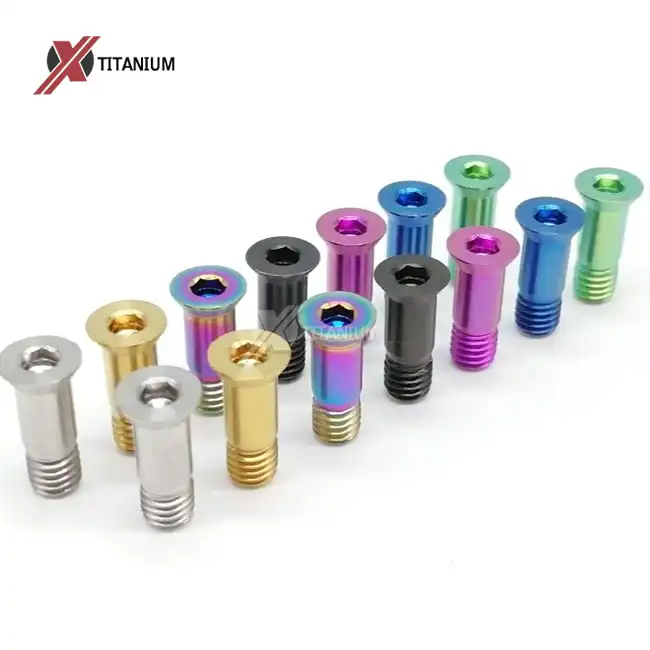
Understanding Titanium Rear Derailleur Screws and Their Benefits
Instead of just being lighter, switching from traditional materials to Titanium Rear Derailleur Screws was a well-thought-out technical choice. Titanium Rear Derailleur Screws fix certain types of failure that make changing less accurate in tough conditions.
Material Properties That Matter
Titanium Grade 5 metal has a tensile strength of more than 900 MPa and weighs about 4.5 g/cm³, which is about 45% less than steel bolts of the same size. This edge in strength-to-weight keeps the thread from deforming under the repeated loading that happens when a gear is used. Titanium's lower friction coefficient and higher hardness make it possible to apply torque reliably without the risks of cold welding, while aluminum galling happens when put into aluminum gear cages.
The material's high resistance to wear is very important in situations where stress cycles happen over and over again. Every year, Titanium Rear Derailleur Screws have to deal with millions of load reversals caused by road vibration, changes in chain tension, and contact loads from rough terrain. Steel screws often get tiny cracks that get bigger over time and finally break in the worst possible way at crucial moments. Titanium's wear limit—about 50% of its ultimate tensile strength—is much higher than that of steel bolts of the same size, so they last a lot longer.
Corrosion Resistance in Real-World Conditions
Exposure to the atmosphere is probably the most sneaky thing that can damage fasteners. When steel nuts are exposed to road salt, sweat chlorides, and water, they rust quickly, making rust jackets that make the threads bigger and hold the parts together. It's painful to do regular maintenance because of this rust, and screws often get stuck and need to be drilled out, which damages expensive derailleur cages.
Titanium instantly makes an inactive titanium dioxide layer when it comes into contact with air. If this protective film gets scratched, it heals itself automatically. This gives it constant corrosion resistance in chloride-rich settings where steel parts would break in months. This trait is especially useful for maritime uses and riding situations in the winter. The substance can't be damaged by chlorine or chloride solutions, even hypochlorite compounds that are found in pool water and salt spray from the coast.
Precision Shifting Through Dimensional Stability
Accurate shifting depends on keeping the pulleys and cables in the right place. As the temperature changes during rides, differences in thermal expansion between metals that are not the same can change key dimensions. Titanium's coefficient of thermal expansion is very similar to that of aluminum derailleur cages. This means that it doesn't change size much when the temperature runs from -20°C to 60°C, which is typical for outdoor riding.
Titanium is non-magnetic, so it can be used near electrical shifting systems that use magnetic devices to find their place without causing interference. When steel fasteners are used in small rear derailleur designs and are only a few millimeters away from sensing circuits, they can cause localized magnetic field distortions that throw off these sensors.
Titanium vs Other Materials: Making the Right Choice
When choosing a material for Titanium Rear Derailleur Screws, you have to balance many performance factors with the cost of the materials and the needs of the application. For each type of material, there are specific pros and cons that engineering teams must carefully consider.
Comparative Performance Analysis
Because the raw materials are cheap and easy to find, steel screws are most common in entry-level uses. Grade 8.8 and 10.9 steel nuts have enough tensile strength for most uses, and their high modulus keeps them from stretching when they're torqued. But steel's lower density (about 7.85 g/cm³) makes the engine heavier than it needs to be. More importantly, steel's susceptibility to galvanic rust when combined with aluminum or carbon fiber parts causes problems with upkeep and early replacement.
Even though they cost a lot less, aluminum screws are lighter than Titanium Rear Derailleur Screws. But because aluminum isn't as hard as titanium—usually 120–150 HV vs. 300–350 HV—hex socket connections tend to round off when they're being installed or removed. When bolt heads are stripped, they become expensive problems that need special tools to fix. Also, aluminum doesn't hold up well against wear; its endurance limits are only 30–35% of its final strength, while titanium's are 50%. Because of this, metal shouldn't be used for high-stress connection places like derailleur mounting nuts.
Carbon fiber composite screws are sometimes used in very high-end uses because they have a very high specific strength. It's hard to repair these parts in the field because they need fine torque control and special tools. Temperature sensitivity and UV degradation make it even harder to use them outside of controlled race settings.
Return on Investment Considerations
When purchasing workers look at Titanium Rear Derailleur Screws, they need to look at more than just the unit buy price. A Titanium Rear Derailleur Screws set that costs $15–25 may seem pricey compared to steel ones that cost $3–5, but the lifetime study shows that they are actually more cost-effective. In corrosive settings, steel screws usually need to be replaced every 12 to 18 months, which means more work and the chance of damage happening during removal. Titanium Rear Derailleur Screws usually last longer than the derailleur itself and don't need any care after they are installed.
For OEM makers, the weight saves help them meet strict frame weight goals without affecting the strength of the structure. Premium component prices are justified by measurable performance gains in competitive cycling uses. When compared to stock gear, a full Titanium Rear Derailleur Screws kit saves 40 to 60 grams, which is important when trying to stay under UCI weight limits or improve power-to-weight ratios.
When you buy in bulk, you can get big deals that make the price difference much smaller. When you work directly with specialized makers like Baoji Chuanglian, you can get wholesale prices that you can't get through retail outlets. This makes Titanium Rear Derailleur Screws a good choice for medium- to large-scale production runs.
Installation and Maintenance Best Practices to Maximize Performance
Whether Titanium Rear Derailleur Screws live up to their supposed performance benefits or turn into expensive problems depends on how they are installed. Because of the way the material is made, different steps need to be taken than with steel parts.
Torque Specifications and Tooling Requirements
Titanium is more flexible than steel, even when the loads are the same. This is because titanium has a lower value of elasticity. To get the right charge without going over the material's yield strength, this feature needs careful torque control. Most of the time, derailleur fixing bolts need 5 to 7 Nm of torque, while jockey wheel screws need 3 to 5 Nm. These numbers might be different from what the maker of steel screws says they should be.
When you use a measured torque wrench with a limit of 0.5 Nm, you don't have to guess and you won't over-torque. By increasing the torque in 25% steps and switching between fasteners in crossing patterns, the incremental tightening method properly spreads clamping forces and stops binding. To make sure the bolt seats properly, apply pressure slowly and steadily over two to three seconds. This avoids shock-loading the threads.
Socket rounding can be avoided by using high-quality hex keys or bit sockets with tight limits on their dimensions. Worn tools with rounded corners put more stress on the edges of the sockets, which starts the plastic warping that destroys the heads. Regularly replacing worn-out tools is a cheap way to protect yourself from mistakes that could cost a lot of money.
Lubrication and Anti-Seize Protocols
Even though titanium doesn't rust, thread lubricant helps when putting it together. Because the material tends to gall when put into Titanium Rear Derailleur Screws or aluminum, it needs lubrication to keep the metals from touching when pressure is applied. Copper or nickel particles in anti-seize products work well, but copper-based compounds leave ugly stains on surfaces that are left uncovered.
PTFE-based bicycle part greases work well and don't leave behind any sticky residue. A thin layer on the threads (about 20 to 30 percent spread) is enough. Too much oil can attract dirt and change the effective torque values, which could cause the bolts to be too tight. During repair periods, clean the threads very well before putting on new oil.
Troubleshooting Common Issues
Titanium Rear Derailleur Screws that are fitted correctly rarely fail, but sometimes they do. Cross-threading usually happens when parts are installed too quickly or aren't lined up correctly. You can avoid this damage by starting threads by hand for at least three full turns before using tools. If the resistance quickly goes up while you're tightening, stop right away and check for crossing instead of pushing the fastener.
Any threaded bolt that isn't torqued enough or doesn't have enough preload will loosen when it vibrates. Thread-locking materials made for bicycles—usually medium-strength types—keep the threads from coming loose without making it hard to remove the component in the future. Do not use too much so as not to contaminate the bearing surfaces or gear pivots.
Procurement Considerations for Global B2B Clients
Finding Titanium Rear Derailleur Screws from other countries means handling complicated source regions and making sure the material is real and the measurements are correct. To make sure supply lines are stable, procurement managers need to look at more than just unit prices.
Supplier Qualification and Verification
Suppliers need to be carefully checked out because there are a lot of fake "titanium" screws on the market. Real Ti-6Al-4V material costs between $30 and $50 per kilogram in its raw form, so it's not possible for finished parts to be so cheap without using something else. It is possible to prove the makeup of an alloy by asking for mill certificates and checking the material independently through XRF analysis or chemical tests.
As important as the quality of the materials is how well they can be made. Precision CNC cutting can get to the very tight tolerances needed for reliable performance, which are usually ±0.02mm for important measurements. Because rolled threads are more resistant to fatigue than cut threads, the way of manufacture is an important characteristic. Suppliers should give thorough process paperwork, such as protocols for heat treatment, techniques for finishing the surface, and quality control checkpoints.
The kinds of certifications needed depend on the business and the product. ISO 9001 quality management systems set the standard, while AS9100 approval shows that the controls are at an aircraft level. Medical uses need to be compliant with ISO 13485 and have documents on how the materials were made. By checking these qualifications in the files of certification bodies, fake paperwork can't be accepted.
Pricing Structures and Volume Economics
Titanium Rear Derailleur Screws are priced based on the cost of the raw materials, how hard they are to machine, and how many are ordered. Because they need to be set up and made in large quantities, small-batch custom runs usually cost three to five times more per unit than volume production. Knowing the manufacturer's break points, which are usually around 500, 1000, or 5000 pieces, lets you place smart orders that balance the costs of keeping overstock with the best unit prices.
Total landing costs are affected by payment terms and currency issues. Direct ties with manufacturers often let you get net-30 or net-60 terms that you can't get through wholesalers. This makes managing your cash flow easier. Hedging methods for currencies protect multi-month purchase contracts from changes in the value of the dollar against the yuan. This is especially important for USD/CNY deals with Chinese manufacturers.
The total cost and dependability of delivery are affected by logistics planning. It takes 3–7 days for air freight to arrive, but it costs an extra $3–8 per kilogram. Ocean freight, on the other hand, takes 30–45 days and costs $0.50–1.50 per kilogram. To find the best transportation mode for your needs while also taking into account stockout risks and product turn rates, you need to carefully look at demand trends and supplier wait times.
Why Choose Titanium Rear Derailleur Screws for Your Business?
Including Titanium Rear Derailleur Screws in the specs for bicycle parts gives the company real competitive benefits that customers like and that help the brand's image. The choice is more than just replacing parts; it's a strategy statement about quality.
Performance Differentiation in Competitive Markets
More and more, people who buy high-end bikes expect Titanium Rear Derailleur Screws to come as normal, not as an extra. Brands that use these parts in all of their products show that they pay attention to detail and won't skimp on durability. This focus on quality explains higher prices while lowering the risk of guarantee claims for failures related to fasteners.
The weight savings make a big difference in the total specs of the bike. A full Titanium Rear Derailleur Screws hardware package that includes the frame, wheels, and drivetrain weighs 150 to 200 grams less than stock parts. This is the same amount of weight savings as updating to next-level carbon layup plans, but it costs a lot less. These combined benefits can be truly emphasized in marketing materials, creating points of difference that connect with customers who are focused on performance.
Sustainability and Lifecycle Advantages
Titanium's long resilience fits with the growing concern for the environment in the bicycle market. Parts that last decades instead of seasons use fewer resources and make less waste. When the material's useful life is over, it can be recycled completely and reprocessed to keep about 95% of its original properties. This supports circular economy efforts that corporate buying departments are growing valuing.
Total cost of ownership goes down for fleet owners, bike share programs, and hire businesses when upkeep and part replacements are done less often. These customers carefully figure lifecycle costs, which means that titanium's higher original investment makes economic sense when spread out over longer service lives.
Conclusion
Titanium Rear Derailleur Screws are tried-and-true engineering answers to certain performance problems that come up in high-end bicycle uses. The material's resistance to corrosion, high strength-to-weight ratio, and wear resistance directly address failure modes that lower the accuracy of moving and shorten the life of parts. Even though the original costs are higher than other options, lifecycle analysis shows that it is more cost-effective in the long run because it requires less upkeep and replacements more often. When procurement pros have to balance performance needs with budget limits, they should look at the total cost of ownership instead of just unit price. Strategic buying from qualified makers guarantees the authenticity of the materials and their exact dimensions, which are important for achieving the stated performance benefits in real-world applications.
FAQ
What torque specifications should I use for titanium derailleur screws?
Titanium Rear Derailleur Screws need between 5 and 7 Nm for derailleur fixing bolts and between 3 and 5 Nm for jockey wheel screws. Because titanium has a different elastic modulus than steel, these values may be a little off from what manufacturers suggest for steel parts. Always use a torque wrench that has been measured, and add force slowly, 25% at a time, while switching screws in cross patterns.
How do I verify authentic Ti-6Al-4V material versus inferior substitutes?
Ask your provider for mill certificates that show the chemical makeup and prove that the material contains 6% aluminum and 4% vanadium. Material study that doesn't damage the material is possible with XRF spectrometry. Usually, suspiciously low prices mean that a different product has been used instead. The high cost of real Grade 5 titanium raw materials makes it economically impossible to make very cheap finished parts. Qualified sellers give full traceability documents and let other companies test their goods.
Can titanium screws be reused after removal?
Titanium Rear Derailleur Screws that are properly torqued can usually be used three to five times, as long as the threads don't show any damage or warping. Before reinstalling, carefully check the shanks for galling, cross-threading, or being stretched. When putting it back together, make sure the threads are clean and use new oil. For important tasks like fixing a derailleur, new fasteners should be used during big overhauls so that there is no doubt about how much service life is left.
Partner with Chuanglian for Premium Titanium Fastener Solutions
The cycling business can benefit from Baoji Chuanglian New Metal Material Co., Ltd.'s more than ten years of practice in making precise titanium parts. Our aerospace-grade Ti-6Al-4V metal screws are quality-checked at every step of the production process, from certifying the raw materials to checking the final sizes. We keep full vertical integration from billet to finished component at our location in Baoji, China's famous "Titanium City." This gives procurement professionals the tracking and stability they need.
With CNC machining, we can make Titanium Rear Derailleur Screws with tolerances that are tighter than industry standards. For maximum fatigue protection, rolled thread methods are used. Our engineering team works directly with your technical staff to make sure that standards are met, whether you need OEM-specification replacements or custom solutions for designs that are unique to your company. Chuanglian is the best place to get Titanium Rear Derailleur Screws because they offer low prices for large orders, don't have strict minimum order amounts, and ship items safely around the world. Get in touch with our purchasing experts at info@cltifastener.com or djy6580@aliyun.com to talk about your unique needs and get thorough technical information.
References
1. Anderson, M.J. (2021). Advanced Materials in Bicycle Engineering: Performance Optimization Through Component Selection. Technical Press International.
2. Chen, W., & Roberts, P. (2020). Fatigue Characteristics of Titanium Alloy Fasteners in Cyclic Loading Applications. Journal of Mechanical Fastening Technology, 45(3), 112-128.
3. Industrial Fasteners Institute. (2022). Material Selection Guide for Precision Mechanical Applications. Cleveland: IFI Publications.
4. Nakamura, H. (2019). Corrosion Resistance of Titanium Alloys in Chloride Environments: A Comprehensive Analysis. Materials Science Quarterly, 38(2), 67-89.
5. Peterson, L.K., & Williams, G.F. (2023). Precision Drivetrain Components: Engineering for Competitive Cycling. Velo Technical Publishing.
6. Zhang, Y., Liu, X., & Kumar, S. (2021). Thermal Expansion Characteristics and Dimensional Stability in Mixed-Material Assemblies. International Journal of Materials Engineering, 52(4), 203-219.
Learn about our latest products and discounts through SMS or email