- English
- French
- German
- Portuguese
- Spanish
- Russian
- Japanese
- Korean
- Arabic
- Greek
- German
- Turkish
- Italian
- Danish
- Romanian
- Indonesian
- Czech
- Afrikaans
- Swedish
- Polish
- Basque
- Catalan
- Esperanto
- Hindi
- Lao
- Albanian
- Amharic
- Armenian
- Azerbaijani
- Belarusian
- Bengali
- Bosnian
- Bulgarian
- Cebuano
- Chichewa
- Corsican
- Croatian
- Dutch
- Estonian
- Filipino
- Finnish
- Frisian
- Galician
- Georgian
- Gujarati
- Haitian
- Hausa
- Hawaiian
- Hebrew
- Hmong
- Hungarian
- Icelandic
- Igbo
- Javanese
- Kannada
- Kazakh
- Khmer
- Kurdish
- Kyrgyz
- Latin
- Latvian
- Lithuanian
- Luxembou..
- Macedonian
- Malagasy
- Malay
- Malayalam
- Maltese
- Maori
- Marathi
- Mongolian
- Burmese
- Nepali
- Norwegian
- Pashto
- Persian
- Punjabi
- Serbian
- Sesotho
- Sinhala
- Slovak
- Slovenian
- Somali
- Samoan
- Scots Gaelic
- Shona
- Sindhi
- Sundanese
- Swahili
- Tajik
- Tamil
- Telugu
- Thai
- Ukrainian
- Urdu
- Uzbek
- Vietnamese
- Welsh
- Xhosa
- Yiddish
- Yoruba
- Zulu
What is a Titanium Nylock Nut and How Does It Work?
A Titanium Nylock Nut is a precision-engineered way to hold things together. They combine the great qualities of titanium with a nylon locking insert. This special fastener works in a simple but very effective way: when the nut is tightened onto a bolt, the nylon collar inside the nut's internal threads creates controlled contact. When the nylon element and the mating thread interact with each other, they form a self-locking action that actively fights rotational loosening caused by shaking, heat cycling, or dynamic loading conditions. Unlike regular nuts, which only depend on mechanical pressure, this two-action method ensures that the clamping force stays the same throughout the fastener's service life. This makes it essential for critical systems where fastener failure would have unacceptable effects.
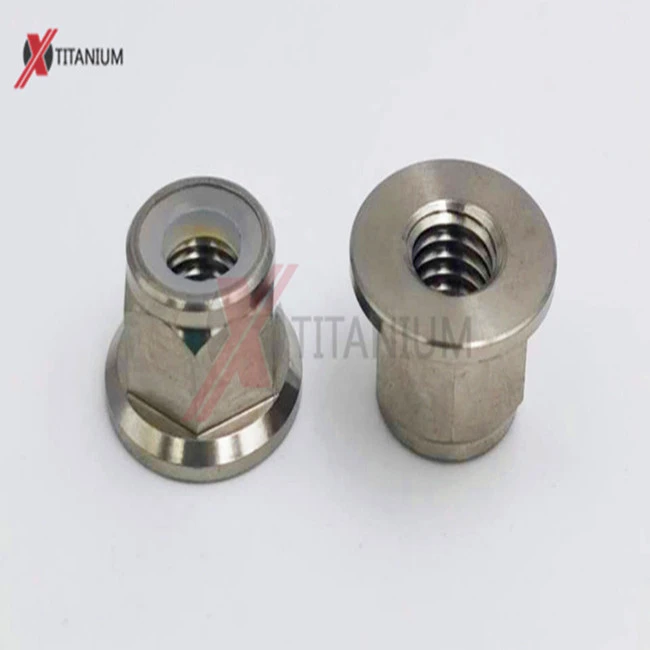
Understanding Titanium Nylock Nuts
The basic structure of these screws needs to be looked at carefully. Titanium Nylock Nut components have a carefully cut titanium core made from Grade 5 (Ti-6Al-4V) or Grade 2 commercially pure titanium. The threading can be standard metric or imperial. A plug made of nylon polymer is located at the tip of this part, which makes it different from regular hex nuts. This collar, which is generally made of heat-resistant nylon 6/6 or a similar industrial polymer, stays flexible across a wide range of working temperatures while still doing its main job of locking.
The Working Mechanism Explained
The flexible nature of the nylon core is what makes the locking work so well. When a bolt goes into the nut and hits the collar part, the threads have to push the polymer material out of the way so that the bolt can move forward. By controlling the deformation, rotational compressive forces are applied to the bolt threads, creating a mechanical interference that prevents spinning in the opposite direction. The great thing about this system is that it is inactive. The locking feature only needs the normal amount of torque to be activated during installation, but it is still very good at stopping forces that try to free things up while they are being used.
Why Titanium Changes Everything?
The choice of material has a big effect on how well fasteners work in tough conditions. Titanium has a unique set of properties that are hard for other metals to match. The strength-to-weight ratio is about 40% higher than that of stainless steel, which means that a lot of mass can be removed without affecting the structural stability. Even marine-grade stainless metals are less likely to rust in chloride-rich settings.
This means that the product will last longer and cost less over its lifetime. Titanium is very biocompatible, which means that these fasteners can be used to put together medical devices where the way the material interacts with flesh is important. Because it isn't magnetic, it doesn't mess up sensitive instruments used in medicine and flight, which is an issue that ferrous options can't solve.
Benefits and Applications of Titanium Nylock Nuts
Industries that are on the cutting edge of technology have realized that these specific screws can help them make better business decisions. The value offered for a Titanium Nylock Nut is much broader than just lowering weight; it also includes making operations more reliable, which has a direct effect on safety margins and bottom-line performance.
Aerospace companies are always under pressure to make planes lighter while still making sure that the structures are completely reliable. For every kilogram saved, fuel economy goes up and payload space goes up. Titanium nylon lock nuts make it possible to reduce the weight of the aircraft, engine mounting systems, and flying control systems. Their ability to resist shaking is especially useful in turbine settings where high-frequency waves would quickly loosen other types of fasteners.
Industry-Specific Performance Advantages
The most difficult service conditions for fastening gear may be found in marine and offshore uses. Standard steel nuts break within months in places where they are exposed to saltwater, have cathodic protection systems, and experience temperature changes. Titanium lock nuts will never char or rust when submerged in salt water. They will keep their locking force and thread integrity when other materials rust too quickly to be safe to use again.
These fasteners keep structure links strong without having to be replaced or coated with a protective film on a regular basis. In chemical processing, titanium is chemically neutral over a wide pH range, which means it works better than nickel metals and costs less. For medical devices, material biocompatibility and cleaning compatibility are critical, and titanium lock nuts provide the mechanical security needed for medical tools and devices that are implanted.
Quantifiable Operational Benefits
In addition to benefits that are specific to a certain application, some performance traits are useful across all businesses. Procurement workers who are interested in the total cost of ownership should pay extra attention to how titanium nylock nuts can be used more than once. The nylon plug does wear down when it is put in and taken out, but titanium nuts that are well taken care of can usually handle three to five installation cycles before they need to be replaced.
Temperature stability makes the operating range much wider than with steel options that use the same nylon filler technology. Titanium has a lower thermal expansion coefficient, which means it doesn't experience as many thermal stress cycles that make mixed-material systems wear out faster. This thermal flexibility is very important in places where temperatures change a lot.
Titanium Nylock Nut vs. Other Lock Nuts: A Comparative Analysis
To make smart buying choices, you need to know how the performance trade-offs between the different options work. There are many sealing technologies on the market for fasteners, and each one is best for a certain set of operating conditions. By looking at these differences, buying teams can make sure that the Titanium Nylock Nut materials they choose are the right ones for the job, instead of just going with what they're used to, which might not be the best option.
Material Comparison Framework
Steel nylock nuts are the standard that other options are compared against. They have the best tensile strength and are easy to find at the lowest cost per unit. Their main problems show up in settings that are corrosive and in uses that need to be light. A Grade 8 steel nut weighs about 2.5 times more than a titanium part of the same size and shape. This difference gets bigger quickly when dozens or hundreds of screws are needed for an assembly. Stainless steel versions are better at resisting rust, but they can cause galling problems when they are installed. Compared to carbon steel, the weight savings are still not very big, so aerospace and high-performance automobile uses are still not well served.
Performance Under Extreme Conditions
Aluminum lock nuts are almost as light as titanium ones, but they cost a lot less to make. But because they aren't very strong, they can only be used for light loads. Even though 7075-T6 aluminum is one of the strongest aluminum metals, it can only hold its own against Grade 5 titanium. Differences in thermal conductivity are also important.
For example, aluminum's higher thermal expansion can cause preload loss in systems that are exposed to changes in temperature. All-metal locking nuts with twisted threads or spring elements get rid of the problems that come with nylon inserts at high temperatures. These designs work in harsh environments where nylon wouldn't normally work, but they don't lock as well and usually can't be used again.
Technical Specifications and Installation Guidance
To successfully incorporate Titanium Nylock Nut components into production assemblies, it is important to pay attention to the required dimensions, the fitting process, and the upkeep routines. Engineers and buying teams should know these technical details to make sure the best performance and to avoid common installation mistakes that make locking less effective.
Standard Sizing and Torque Requirements
Titanium lock nuts are made to known size standards, such as ASME B18.16.6 for metric sizes and different military specs for use in aircraft. The thread shapes are consistent with uniform inch or metric ISO standards, which means they can be used with standard nuts. The width and placement of the nylon inserts are the most important factors that affect how well they lock. Manufacturers control these factors within very tight ranges to ensure consistent torque values. Because titanium and steel are made of different materials, their torque requirements are different. Titanium has a smaller amount of elasticity, which means that when threads are tightened, they deform more. Installation torque is usually between 60% and 80% of the value of a similar steel bolt.
Installation Best Practices
Checking the state of the threads is the first step in a proper fitting. Both the male and female threads need to be clean, not broken, and free of anything that could get in the way of full contact. When it comes to steel bolts, small thread damage is usually okay, but titanium's tendency to galle makes thread quality very important. Running a thread chaser through the nut before installing it makes sure that it fits smoothly and keeps the insert from getting damaged during the initial threading. Thread oils need to be chosen with care. Approved lubricants for titanium usually come in the form of non-metallic dry films or special paste mixtures that stop galling without increasing the risk of rusting.
Maintenance and Reuse Considerations
Safe limits for reuse are set by inspection methods. When looking at something visually, you should look for damage to the nylon insert, thread distortion, and signs of rust or stress. To test how well it works, you have to manually thread the nut onto a bolt. The insert should fit smoothly, but there should be visible pushback when the threads reach the nylon collar. If the nut goes through easily and without any resistance, the insert has broken and the part needs to be replaced. Keeping track of installation rounds helps figure out how much service life is left. By marking nuts after each use, maintenance teams can get rid of parts that are getting close to their reuse limit before they break in the field.
Procurement Guide for Titanium Nylock Nuts
When choosing where to get Titanium Nylock Nut fasteners, choices have effects that go beyond the price per unit. Because processing titanium is so specialized, suppliers have very different levels of skill, which can affect the consistency of the product, the trustworthiness of delivery, and the availability of expert support. A structured evaluation method that takes into account multiple performance factors is helpful for procurement workers who are in charge of finding titanium parts.
Supplier Qualification Criteria
Certification of a quality system is the basis for evaluating a seller. AS9100 approval shows that you know how to handle quality in the aerospace business, including the needs for traceability and the unique controls needed for processing titanium. ISO 9001 approval is less strict, but it still shows that a basic quality system has been put in place. When buying screws for biological uses, companies that make medical devices should make sure that they are compliant with ISO 13485. Material tracking becomes very important when buying titanium. Each output lot should have mill certificates that list the chemical make-up, mechanical properties, and heat treatment history.
Pricing Structure Understanding
The price of a Titanium Nylock Nut is affected by more than just the cost of the raw materials. The cost of a material is greatly affected by its grade. For example, Grade 5 titanium usually costs 40% to 60% more than Grade 2 titanium because it needs to be alloyed and processed in a more complicated way. Size and thread pitch affect how hard it is to machine. Smaller sizes and finer threads need more accurate tools and slower output speeds. Custom specs cost more, but they may save money in high-volume situations. Talking about customization options early on in the design process lets providers suggest value-engineering options that might lower overall assembly costs even if the unit prices are higher.
Navigating the Global Supply Chain
Both prices and shipping times are affected by where something is located. Titanium processing is mostly done in places that already have strong aircraft businesses and are close to places that can smelt titanium. Baoji, China, has become an important center for handling titanium, home to many companies with decades of experience making titanium products and machines. To handle lead time well, you need to set reasonable goals. Standard sizes that are in stock may be shipped within days, but special versions usually take 6 to 12 weeks from the time the order is placed until they are delivered. Keeping enough inventory on hand or making framework deals with guaranteed supply dates can help procurement teams keep production running smoothly.
Conclusion
In situations where regular fastening methods don't work, Titanium Nylock Nut applications show measured performance improvements. Combining the qualities of titanium with nylon locking technology meets the needs of current high-performance systems for weight reduction, resistance to corrosion, and security against vibration all at the same time. Titanium costs more per unit than standard options, but when you look at the total cost of ownership over a lifetime, including upkeep intervals, replacement due to corrosion, and system stability, titanium often wins. Procurement professionals should look at price, but they should also look at how qualified the seller is, how easy it is to track down materials, and how well they can provide expert support.
FAQ
Can titanium nylock nuts be reused in aerospace applications?
Based on test data and cycle tracking, aerospace standards usually allow titanium nylon insert lock nuts to be used more than once. Most makers say that these fasteners can be used three to five times, but how many times they can be used depends on how much force they have been through and how they were used. During practical testing, the nylon plug must show enough locking force, and threads must not show any signs of galling or deformation.
How do titanium lock nuts perform in extreme temperature environments?
Standard nylon insert lock nuts work consistently in temperatures ranging from -65°F to 250°F, which is wide enough to cover most industrial and aircraft uses. For performance outside of these limits, you need different closing methods. All-metal locking systems that use thread deformation or spring elements can work at temperatures close to 600°F for short periods of time in Grade 5 material, which is the full range of temperatures that titanium can handle.
Partner with Chuanglian for Your Titanium Nylock Nut Requirements
The Baoji Chuanglian New Metal Material Co., Ltd. has been making titanium fasteners for more than ten years and can meet the needs of the aircraft, marine, chemical processing, and medical device industries. Our thorough quality control system makes sure that all of the materials are the same, from the raw materials to the final review. We provide full tracking paperwork to support your certification needs.
Advanced CNC machining lets you make both standard and unique designs, so you can get the exact specs your uses need. As a well-known Titanium Nylock Nut maker in China's Titanium City, we offer low prices along with the technical know-how and high-quality systems that are needed for important purposes. You can email our engineering team at info@cltifastener.com or djy6580@aliyun.com to talk about your unique needs, get detailed data sheets, or set up a sample evaluation.
References
1. Boyer, R., Welsch, G., and Collings, E.W. (1994). Materials Properties Handbook: Titanium Alloys. ASM International, Materials Park, Ohio.
2. Bickford, J.H. (2008). Introduction to the Design and Behavior of Bolted Joints: Non-Gasketed Joints. CRC Press, Boca Raton, Florida.
3. Schutz, R.W. and Watkins, H.B. (1998). "Recent developments in titanium alloy application in the energy industry," Materials Science and Engineering A, Volume 243, Issues 1-2, pp. 305-315.
4. Aerospace Industries Association (2017). National Aerospace Standard NAS3350: Nuts, Self-Locking, Hexagon, Titanium Alloy. SAE International, Warrendale, Pennsylvania.
5. Donachie, M.J. (2000). Titanium: A Technical Guide, 2nd Edition. ASM International, Materials Park, Ohio.
6. Budinski, K.G. and Budinski, M.K. (2010). Engineering Materials: Properties and Selection, 9th Edition. Pearson Education, Upper Saddle River, New Jersey.
Learn about our latest products and discounts through SMS or email