- English
- French
- German
- Portuguese
- Spanish
- Russian
- Japanese
- Korean
- Arabic
- Greek
- German
- Turkish
- Italian
- Danish
- Romanian
- Indonesian
- Czech
- Afrikaans
- Swedish
- Polish
- Basque
- Catalan
- Esperanto
- Hindi
- Lao
- Albanian
- Amharic
- Armenian
- Azerbaijani
- Belarusian
- Bengali
- Bosnian
- Bulgarian
- Cebuano
- Chichewa
- Corsican
- Croatian
- Dutch
- Estonian
- Filipino
- Finnish
- Frisian
- Galician
- Georgian
- Gujarati
- Haitian
- Hausa
- Hawaiian
- Hebrew
- Hmong
- Hungarian
- Icelandic
- Igbo
- Javanese
- Kannada
- Kazakh
- Khmer
- Kurdish
- Kyrgyz
- Latin
- Latvian
- Lithuanian
- Luxembou..
- Macedonian
- Malagasy
- Malay
- Malayalam
- Maltese
- Maori
- Marathi
- Mongolian
- Burmese
- Nepali
- Norwegian
- Pashto
- Persian
- Punjabi
- Serbian
- Sesotho
- Sinhala
- Slovak
- Slovenian
- Somali
- Samoan
- Scots Gaelic
- Shona
- Sindhi
- Sundanese
- Swahili
- Tajik
- Tamil
- Telugu
- Thai
- Ukrainian
- Urdu
- Uzbek
- Vietnamese
- Welsh
- Xhosa
- Yiddish
- Yoruba
- Zulu
How to fit titanium bicycle frame parts professionally
Fitting titanium bicycle frame parts professionally demands precision, specialized knowledge, and meticulous attention to titanium's unique metallurgical behavior. Unlike aluminum or steel, titanium alloys such as Grade 9 (Ti-3Al-2.5V) require controlled handling during assembly to preserve their exceptional strength, corrosion resistance, and fatigue life. Professional fitting involves thorough pre-assembly inspection, dimensional verification, appropriate tooling selection, proper anti-seize application to prevent galling, and controlled welding environments with full argon shielding. Understanding these protocols ensures structural integrity, optimal performance, and long-term durability for high-value bicycle frames.
Understanding Titanium Bicycle Frame Parts
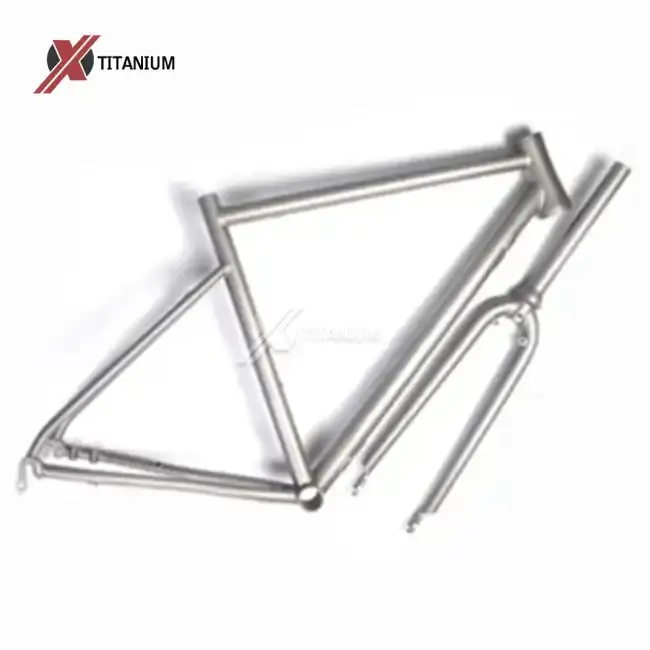
Learning about titanium bicycle frame parts is a big step forward in cycling engineering because they combine the science of making aerospace-grade materials with the art of making precise parts. These parts include dropouts, chainstays, seat stays, braze-ons, bottom bracket shells, and head tubes. They are usually made from two different alloys that are picked for their unique functions.
Material Composition and Selection
Because it has a great mix of ductility and tensile strength (at least 900 MPa), Grade 9 titanium (Ti-3Al-2.5V) is the main material used for tubes. Given its low density of 4.43 g/cm³, this alloy is about 40% lighter than steel while still maintaining the same level of structural integrity. The modulus of elasticity of the material (about 100–110 GPa) lets it deflect in a controlled way when it's loaded. This stops high-frequency vibrations without affecting power transfer, which is what makes titanium ride quality unique.
Grade 5 titanium (Ti-6Al-4V) is only used for made parts that need to be very hard and resistant to wear, like dropouts and threaded interfaces. Its high hardness grade of 300–350 HB keeps threads from stripping and deforming even when high torque loads are applied. This is especially important for current mid-drive e-bike motors and heavy pannier mounting systems.
Manufacturing Standards and Quality Control
CNC cutting makes sure that the specs for size meet ISO 2768-m standards. This is especially important for interference fits in things like headset cups and bearing seats. Surface treatments like polishing, anodising, and nitriding improve both how it looks and how well it works. You can choose from natural titanium, gold, blue, green, purple, black, and rainbow finishes.
Searching for the "alpha case"—a fragile oxygen-filled layer that can weaken the weld—is the most important quality control step. Professional makers do detailed tests on thick-walled parts to find internal holes or inclusions that could cause cracks to spread. These tests include hardness testing using the Vickers or Rockwell C scales, chemical makeup analysis, and ultrasound testing.
Step-by-Step Guide to Fitting Titanium Bicycle Frame Parts Professionally
Professionally putting together titanium bicycle frame parts requires careful planning and execution. The process is very different from fitting steel or aluminium because titanium is easily contaminated, reacts differently to heat, and needs a certain amount of torque.
Pre-Fitting Inspection and Preparation
Before you start putting anything together, you should carefully look over all of the parts to make sure they are not discoloured or have surface problems. Silver or light straw colouring on welding areas means that the argon shielding is working right; blue, purple, or white powdery dust means that the metal is oxidising and could become weak, which needs to be rejected. Check the measurements using accurate measuring tools, paying special attention to the regularity of wall thickness and tube diameters (16–22mm for seat stays, 25–32mm for top tubes and 19–25mm for chainstays).
To get rid of industrial grease, dust, or residues, clean all surfaces that touch with acetone or isopropyl alcohol. If there is contamination during fitting, it can affect later welding processes or cause stress to build up. Wear lint-free gloves when handling parts to keep skin oils from messing up the surface preparation.
Critical Anti-Seize Application
One of the most common problems with assemblies is that titanium tends to cold weld or gall, which is when oxide layers fuse under torque. Copper- or nickel-based anti-seize compound should be used on all threaded connections, bearing surfaces, and metal-to-metal contact points. This small step stops catastrophic thread fusion that can destroy expensive parts during regular repair.
Jig Setup and Alignment Verification
Place frame parts in a professional alignment jig that is made to keep the geometry correct while the fitting process is going on. Check the bike's alignment in several directions using dial markers or laser measurement systems. Make sure the head tube angle, bottom bracket drop, chainstay length and rear dropout spacing all meet the design requirements within 0.5 mm of the allowed range.
Titanium has a lower value of elasticity than steel, which means frames are more flexible. Because of this, alignment must be checked under realistic load conditions. Before going to full penetration welding, temporary tack welds should be checked to make sure they fit right.
Welding Environment and Technique
To TIG weld titanium bicycle frame parts, you need an oxygen-free environment, which can be achieved by shielding the torch with argon gas and purging the tube from the inside. Set the flow rate of argon to between 15 and 20 cubic feet per hour and use trailing shields or purge dams to keep the pressure inside the tubes positive. Welds that are exposed to air during the melting phase, even for a short time, become brittle and easily crack.
Weld titanium with lower amperage settings than steel, using a pulsed technique that lets heat escape between pulses. This keeps the size of the heat-affected zone small and stops grain growth that makes the metal less flexible. Professional fabricators usually use back-purging systems that let argon enter through the tubes' interiors. This makes an atmosphere that protects both sides of the weld joint.
Post-Weld Inspection and Testing
After welding, look for discolouration within 25 mm of the weld beads. Welds that are good should only have a silver or faint gold colour. Use dye penetrant tests on important structural parts to find cracks on the surface that you can't see with the naked eye. Non-destructive testing (NDT) methods, like ultrasound examination, check that high-stress parts like bottom bracket shells and head tubes have sound internal welds.
Titanium vs Other Materials in Bicycle Frame Parts: Procurement and Technical Comparisons
The choice of material has a big effect on not only how well it works, but also how hard it is to fit, what tools are needed, and how specialised the suppliers are. All of these things have a direct effect on the buying strategy and the total cost of ownership for titanium bicycle frame parts.
Performance and Durability Trade-offs
Under normal load conditions, titanium frames have almost infinite wear life, which means they don't break from repeated stress cycles that finally do happen to aluminium frames. High-end carbon fibre parts usually have a lower absolute weight, but they can still fail catastrophically because of hidden impact damage. Titanium's consistent flexibility and isotropic strength make it fail-safe in ways that mixed materials don't have.
Another big benefit is that titanium doesn't rust. When exposed to oxygen, it makes a passive TiO2 oxide layer that protects parts from corrosion caused by road salts, humidity, and the atmosphere itself, even without any coats. Steel frames need to be watched out for rust all the time, while aluminium frames oxidise less dramatically but still break down over time in harsh environments.
Fitting Complexity and Tooling Requirements
Putting together titanium parts requires special skills and tools that you can't find in most bike shops. For TIG welding to work, you need systems that use inert gases, fabricators who are skilled and licensed in joining titanium, and quality control rules that are stricter than those for steel or aluminium. Because of this specialisation, production is concentrated among a smaller group of qualified suppliers. This may make wait times longer but ensures uniform quality.
When you put together carbon fibre, you use a glue and carefully control the temperature and pressure. When you weld aluminium, the process can be changed more. These differences in complexity should be taken into account by procurement teams when choosing vendors and setting project deadlines.
Cost-Performance Balance for B2B Procurement
Titanium frames usually cost two to three times as much as similar aluminium frames because the material is more expensive and the processing is more difficult. Lifecycle study, on the other hand, shows that titanium frames are very valuable: they don't need much upkeep, they don't need to be refinished, and they stay structurally sound for decades longer than other options. When you look at the projected service life, cost-per-year often works out better for titanium in high-end product lines and situations where dependability is very important.
Buying plans should divide uses into groups: aluminium is good for low-cost mass production, carbon fibre is good for racing where weight is important, and titanium is good for high-end custom builds, expedition touring, e-bike structural reinforcement, and uses where corrosion resistance is worth the initial investment.
Best Practices for Sourcing and Procuring Titanium Bicycle Frame Parts
Effective buying of titanium bicycle frame parts includes more than just negotiating prices. It also includes carefully evaluating suppliers, making sure that technical specifications are met, and managing relationships strategically.
Supplier Qualification and Certification Verification
Give priority to suppliers who have the right quality management certifications that show they can control and trace processes in a systematic way. For each shipment, factories should give material test reports (MTRs) that confirm the chemical makeup, mechanical properties, and lot tracking. Ask for proof of the fabricators' technical knowledge in the form of welding procedure specs (WPS), procedure qualification records (PQR), and proof of their welder skills.
When you can, go to factories and pay attention to the work areas, how the machines are maintained, and the rules for quality checks. Suppliers who are willing to let anyone into their facility usually have faith in their processes and are dedicated to quality.
Custom Specification Negotiation
Titanium is very flexible, so it can be easily changed in terms of shape, tube width, wall thickness, and surface finish. Give detailed engineering drawings that show the important sizes, tolerances, material grades, and finish needs. Talk to suppliers about expected load scenarios, planned uses, and performance standards so that they can make the best design suggestions.
Set clear acceptance criteria, such as acceptable size differences, surface finish standards, maximum colour changes in welded areas, and the testing records that must be provided. Specifications that aren't clear lead to quality problems; clear requirements protect everyone's interests.
Lead Time Management and Inventory Strategy
Titanium parts usually take 8 to 16 weeks to make from the time an order is placed until it is delivered. This is because the manufacturing process is very complicated and quality control is very strict. Plan your purchasing plans to take these longer lead times into account, especially when working with other parts of the supply chain.
You might want to make framework agreements with your preferred suppliers and keep small stockpiles of standard parts while ordering custom parts on schedules that are specific to the project. This mixed method finds a good balance between the costs of keeping supplies and the freedom to change the production plan.
Building Strategic Supplier Partnerships
Titanium purchase works best when people work together instead of just buying things one at a time. Get suppliers involved early on in the product development process. Use their knowledge of materials and experience with manufacturing to make designs that are easier to make and cost less. Suppliers who care about your success give you the best technology help, can handle urgent orders, and put quality consistency first because they know the long-term value of the relationship.
Maintenance and Longevity of Titanium Bicycle Frame Parts
Titanium's longevity doesn't mean it doesn't need to be maintained, but compared to other materials, it is much easier to preserve titanium bicycle frame parts. Following the right care instructions will increase the service's life while keeping its performance levels.
Routine Inspection Protocols
Every six months, do eye checks. Look for cracks starting to form in the welds, look for galling signs at the threaded interfaces, and make sure the bearing surfaces are still smooth and undamaged. Unlike aluminium, which shows fatigue cracks before it breaks, titanium stays the same until critical stress levels are passed. This means that regular checking is necessary, even though the material is naturally strong.
Cleaning and Surface Care
Use mild soap and water to clean titanium frames. Do not use wire brushes or rough cleaners that could scratch the protective oxide layers. For brushed or bead-blasted finishes, Scotch-Brite pads make it easy to smooth out small scratches, bringing the finish back to its original look without having to be refinished. Because strong chemicals can damage the oxide layer, anodised colour finishes need to be handled with more care.
Titanium does not need paint or protection coatings to keep it from rusting, which cuts down on the cost of labour and materials for long-term upkeep by a large amount. This feature is especially helpful for fleet owners who have to take care of many units, since refinishing costs add up quickly with steel or aluminium frames.
Addressing Wear and Damage
Titanium doesn't break down over time, but hits can cause localised distortion. Titanium deforms clearly before it breaks, unlike carbon fibre, which breaks in a catastrophic way. This gives warning signs that allow replacement before it breaks. Talk to the original makers about how to fix things. Skilled fabricators can often fix broken titanium frames by cutting them up and rewelding them together again using the right methods.
Establish clear ways for customers to file warranty claims with their providers, and keep track of any production flaws that are found during regular maintenance. Professional manufacturers stand behind their work and will replace or fix parts that have problems with the materials or the way they were made during the warranty period.
Conclusion
Professional installation of titanium bicycle frame parts needs specific skills, exact methods, and high quality standards that set this high-end material apart from other materials. Understanding titanium's unique metallurgical qualities, following the right anti-seize procedures, keeping oxygen-free welding conditions, and doing thorough checks after assembly are all things that can be done to make sure that the structure stays strong and the performance lasts a long time.
Strategic purchasing methods that focus on qualified suppliers, clear custom specifications, and working together to achieve goals increase value while handling the complexity of the materials. When designed, made, and put together correctly, titanium parts offer unbeatable durability, resistance to corrosion, and ride quality, which is why they are so expensive for high-performance cycling uses.
FAQ
Why does titanium cost more than aluminum or steel components?
The price of titanium parts is higher than those made of aluminium or steel because the raw material costs about five times as much as steel, and it has to be made in a certain way that doesn't use oxygen, with certified fabricators and strict quality control rules. Higher unit costs are caused by things like harder processing, smaller output volumes, and longer wait times. However, lifecycle value analysis shows that titanium has a lower cost-per-year when you consider its virtually infinite fatigue life, zero corrosion maintenance, and decades-long service life compared to aluminium, which has limited fatigue resistance, and steel, which is easily corroded.
What timeline should we expect for professional fitting and delivery?
Custom titanium bicycle frame parts are usually made and fitted by a professional in 8 to 16 weeks, but this depends on how complicated the design is, how busy the factory is, and how much testing paperwork is needed. These steps are included in the schedule: getting the materials, CNC cutting, welding, surface finishing, quality control, and checking the final assembly. People who already work with a provider may be able to get rush production, but tight deadlines can make costs go up and quality control might not be as thorough.
Can damaged titanium parts be repaired?
Qualified fabricators can often fix titanium parts that have flaws in the way they were made, the way they were welded, or damage from service by sectioning and rewelding them properly. Repairability relies on where the damage is, how bad it is, and how the part is made. Titanium's metallic structure allows for localised repair while keeping structural integrity when done properly, unlike carbon fiber's laminate failures that can't be fixed. Before trying to fix something, you should always get an expert opinion from the original maker or a certified titanium repair professional. If you do it wrong, the damage could get worse.
Partner with Chuanglian: Your Trusted Titanium Bicycle Frame Parts Manufacturer
Baoji Chuanglian New Metal Material Co., Ltd. has been a specialist in precision titanium machining for more than ten years. They supply Grade 9 titanium bicycle frame parts that meet the strictest requirements to high-performance bicycle makers all over the world. Our CNC manufacturing lets us make custom seat stays, top tubes, chainstays, and other parts with dimensional tolerances that meet ISO 2768-m standards.
We also offer a wide range of surface treatment options, such as polishing, anodising, and nitriding, which improve functionality and create a unique look. Located in Baoji City, which is known around the world as the "City of Titanium," we have strict quality control throughout the entire production process. We make sure that every part has the right weld colouration, a confirmed chemical makeup, and all the paperwork needed to track the materials back to their original sources. Our engineering team offers technical advice to help you choose the best materials, make the best use of space, and come up with design suggestions that are specific to your product's needs.
Chuanglian gives you consistent quality, reliable lead times, and competitive prices that help your market position, whether you need a few prototypes for custom builds or a lot of production parts for OEM manufacturing. Get in touch with our purchasing agents at info@cltifastener.com or djy6580@aliyun.com to talk about your needs for a titanium bicycle frame parts source and find out how our manufacturing skills match up with your quality standards and delivery expectations. You can look through our full catalogue of parts and licensing paperwork at cl-titanium.com.
References
1. American Society for Testing and Materials. (2021). ASTM B338: Standard Specification for Seamless and Welded Titanium and Titanium Alloy Tubes for Condensers and Heat Exchangers. West Conshohocken, PA: ASTM International.
2. Donachie, M. J. (2000). Titanium: A Technical Guide (2nd ed.). Materials Park, OH: ASM International.
3. Lutjering, G., & Williams, J. C. (2007). Titanium: Engineering Materials and Processes (2nd ed.). Berlin: Springer-Verlag.
4. Schutz, R. W., & Watkins, H. B. (1998). Recent developments in titanium alloy application in the energy industry. Materials Science and Engineering: A, 243(1-2), 305-315.
5. Titanium Information Group. (2019). Fabrication of Titanium and Titanium Alloys: Welding Guidelines and Best Practices. London: Titanium Information Group.
6. Veiga, C., Davim, J. P., & Loureiro, A. J. R. (2012). Properties and applications of titanium alloys: A brief review. Reviews on Advanced Materials Science, 32(2), 133-148.
Learn about our latest products and discounts through SMS or email