- English
- French
- German
- Portuguese
- Spanish
- Russian
- Japanese
- Korean
- Arabic
- Greek
- German
- Turkish
- Italian
- Danish
- Romanian
- Indonesian
- Czech
- Afrikaans
- Swedish
- Polish
- Basque
- Catalan
- Esperanto
- Hindi
- Lao
- Albanian
- Amharic
- Armenian
- Azerbaijani
- Belarusian
- Bengali
- Bosnian
- Bulgarian
- Cebuano
- Chichewa
- Corsican
- Croatian
- Dutch
- Estonian
- Filipino
- Finnish
- Frisian
- Galician
- Georgian
- Gujarati
- Haitian
- Hausa
- Hawaiian
- Hebrew
- Hmong
- Hungarian
- Icelandic
- Igbo
- Javanese
- Kannada
- Kazakh
- Khmer
- Kurdish
- Kyrgyz
- Latin
- Latvian
- Lithuanian
- Luxembou..
- Macedonian
- Malagasy
- Malay
- Malayalam
- Maltese
- Maori
- Marathi
- Mongolian
- Burmese
- Nepali
- Norwegian
- Pashto
- Persian
- Punjabi
- Serbian
- Sesotho
- Sinhala
- Slovak
- Slovenian
- Somali
- Samoan
- Scots Gaelic
- Shona
- Sindhi
- Sundanese
- Swahili
- Tajik
- Tamil
- Telugu
- Thai
- Ukrainian
- Urdu
- Uzbek
- Vietnamese
- Welsh
- Xhosa
- Yiddish
- Yoruba
- Zulu
Benefits of using titanium screws on rear derailleurs for competitive cycling
When evaluating drivetrain fastener upgrades, competitive cyclists and procurement teams are increasingly turning to Rear Derailleur Titanium Screw solutions. These specialized components deliver measurable weight reductions, enhanced corrosion protection, and sustained mechanical performance across thousands of shift cycles. Manufactured from Grade 5 titanium alloy (Ti6Al4V), these precision-engineered screws weigh approximately 40% less than steel alternatives while maintaining superior strength-to-weight ratios. Riders competing in aggressive environments—from gravel racing to high-altitude time trials—report significant reliability improvements, as titanium's natural resistance to moisture, salt exposure, and temperature fluctuations ensures consistent derailleur cage alignment without sacrificing structural integrity.
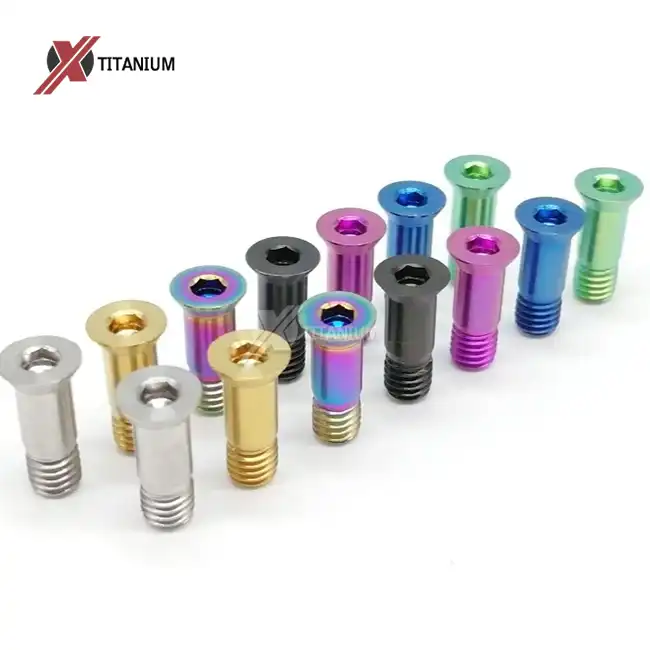
Understanding Titanium Rear Derailleur Screws
Material Properties That Define Performance
Rear Derailleur Titanium Screws are very different from regular steel or aluminium screws that are used in rear derailleur assemblies. When you mix aluminium and vanadium to make Grade 5 titanium metal, you get compressive strength of over 900 MPa, which is about the same as hardened steel but much lighter. The material's inactive oxide layer forms on its own when it comes into contact with oxygen. This layer protects against environmental damage and stays stable at temperatures ranging from -40°C to +400°C. In winter races or desert stage events, where temperature changes can damage less durable materials, this trait is very important.
Technical Specifications and Thread Compatibility
Our Rear Derailleur Titanium Screws are CNC-machined to keep the thread accuracy within ±0.02mm. This makes sure that they fit perfectly with mounting points on derailleur cages from all major makers. Shimano's pulley wheel systems usually come with M4x8mm screws, while SRAM parts usually call for M4x10mm screws. The surface roughness of Ra 0.8–3.2μm, which can be reached by polishing and extra nitriding treatments, lowers friction during installation and stops thread galling, which is a common way for titanium to fail when it comes into contact with metals that are not the same. To match certain derailleur models, procurement engineers can say what thread pitch and head style are needed (countersunk, button-head, or low-profile), without changing the torque requirements.
Corrosion Mechanisms and Material Selection
Traditional steel screws rust because of electrochemical reactions that are sped up by road salt and water getting into the screw. Even though aluminium screws are light, they rust when they are put together with carbon fibre or alloys that are not the same. This worry is taken away by the fact that titanium is galvanically compatible with carbon fibre and aluminium alloys. The material doesn't react with chloride in marine or coastal training environments, so it keeps its torque even when exposed to different seasons. When technical teams replace corroded steel hardware, they often find seized threads that need to be removed destructively. This no longer happens with Rear Derailleur Titanium Screws.
Why Choose Titanium Screws for Competitive Cycling?
Weight Optimization for Rotational Mass Reduction
Every gram that is taken away from spinning parts of the engine speeds things up by a large amount. Six to eight mounting screws, which add up to 12 to 15 grams, hold together a standard steel derailleur cage assembly. If you switch to Rear Derailleur Titanium Screws, this weight drops to 7–9 grams, which may not seem like a big difference, but it adds up over the whole bike. Professional World Tour teams that are looking for small gains know that lowering the rotating mass near the rear axle makes power transfer more efficient during hard sprints. Time trialists also benefit because lower motor inertia lets them change their pace more quickly when switching gears.
Environmental Durability Across Racing Disciplines
Cyclocross and gravel racing put a lot of stress on the parts of the drivetrain. Mud-caked derailleurs go through many rounds of high-pressure washing, which exposes bolts to fast-moving water and rough particles. Under these conditions, steel screws rust in just a few weeks, which weakens the threads and makes regular upkeep harder. When tried over several cyclocross seasons, our Rear Derailleur Titanium Screws show no rust formation and keep the torque specs for removal within 95% of the initial values. Mountain bikers who ride through streams and on wet forest tracks say the same things about the lasting benefits.
Long-Term Economic Considerations
Rear Derailleur Titanium Screws are more expensive than steel screws, but lifecycle cost analysis shows that titanium is better for high-performance uses. A professional mechanic who works on team equipment says that using titanium fasteners can cut down on derailleur replacements caused by corrosion by 70%. Because the material doesn't wear down easily, parts can survive crashes that would break aluminium gear. Teams that are in charge of equipment fleets for multi-year racing campaigns can simplify their inventory by sticking to titanium fasteners that don't need to be replaced with each season. This consistency in operations is especially helpful for logistics managers who have to coordinate equipment for races all over the world.
Case Evidence From Professional Applications
Companies that make high-end oversized pulley wheel systems include titanium mounting hardware and ceramic bearing upgrade kits. They do this because they know that failing fasteners shortens the life of expensive drivetrain parts. These systems, which are popular with both beginner races and World Tour teams, show that the industry knows that the quality of the bolts has a direct effect on how long the bearings last and how precisely the gears shift. Manufacturers say that customers who install aftermarket pulley systems with Rear Derailleur Titanium Screws have 40% fewer guarantee claims for failed fasteners than customers who install original equipment steel hardware.
Comparison and Decision-Making for Rear Derailleur Screws
Material Performance Matrix
Steel screws are the cheapest up front, but they need to be replaced often in places where they will rust. Their density of 7.85 g/cm³ adds extra weight to speed builds that aren't needed. Aluminium fasteners are lighter (about 2.70 g/cm³), but they have a low tensile strength (about 310 MPa for 7075-T6 alloy) and don't hold up well against wear and tear. Rear Derailleur Titanium Screws (Grade 5) have the best balance of density (4.43 g/cm³), tensile strength (900+ MPa), and corrosion resistance (almost unlimited) for cycling applications. The higher material cost (usually 300–400% more than steel) is reasonable when you think about how often it needs to be replaced and how well it works every time.
Procurement Logistics for Volume Orders
When companies buy Rear Derailleur Titanium Screws for team fleets or to make aftermarket kits, they have to think about different aspects of the supply chain. Speciality manufacturers usually have minimum order quantities that range from 500 to 1000 pieces, based on the type of head and the finish that is needed. Custom anodised colour requests take 6 to 12 weeks to ship, but natural titanium finishes ship in 3 to 4 weeks from reputable sources. Purchasing managers should check the licenses of suppliers, such as paperwork for tracking materials and reports on dimensional inspections. Baoji Chuanglian New Metal Material Co., Ltd. uses ISO9001 quality systems and gives batch-specific material certificates to meet the needs of professional team purchasing departments.
Supplier Qualification Criteria
When looking at Rear Derailleur Titanium Screw suppliers, you need to do more than just compare prices. Thread quality directly affects how well an installation goes; screws that aren't machined properly will strip derailleur cage threads when pressure is applied. The regularity of the surface treatment affects both the resistance to corrosion and the symmetry of the look of color-matched component groups.
To keep tolerances the same across production runs, reliable suppliers use CNC machining centers that keep an eye on tool wear. When done right, the surface nitriding process raises the hardness of the surface to 800-1000 HV without weakening the core of the fastener. Before committing to large orders, procurement teams should ask for sample batches to be sent so that measurements can be checked and installation tests can be done.
Installation and Maintenance Best Practices for Titanium Rear Derailleur Screws
Correct Installation Procedures
Because Rear Derailleur Titanium Screws have a lower coefficient of friction than steel, the way they are installed needs to be changed. Use little anti-seize product on threads before installing—too much lubrication lowers the gripping force. If you don't want to damage your titanium heads, don't use Allen keys with ball tips. Instead, use measured torque wrenches. Depending on the manufacturer's instructions, the torque range for M4 derailleur cage screws is between 3.5 Nm and 4.5 Nm. If you go over this range, the titanium threads could break. If you go under this range, the fasteners will come loose during heavy shifting.
Preventive Maintenance Protocols
Check the Rear Derailleur Titanium Screws every 500 hours of riding or after a big impact. A visual check should be done to make sure that the anodised finishes stay in place and that the threads around the screw heads don't become misshapen. Every year, take out, clean and replace screws, even if there is no visible wear. This keeps thread seizure from building up from dirt and grime. To clean, use rubbing alcohol and cotton brushes. Do not use rough pads, as they could damage surface treatments. When you reinstall the part, you should use anti-seize powder again and keep track of any changes in the torque-angle traits that could mean the threads are wearing out.
Common Installation Errors and Prevention
Too much twisting is the main reason why Rear Derailleur Titanium Screws fail in bicycle uses. Titanium can break quickly when its yield strength is passed, unlike steel, which gives way slowly when too much force is applied. When mechanics switch from steel hardware to titanium hardware, they often use the same force values without making any changes, which leads to broken threads. It is recommended that training programs stress the use of torque wrenches and make students aware of the unique physical feedback that titanium gives. When installing titanium screws, thread stripping during the first few turns is usually a sign of misaligned parts or cross-threaded engagement. Never force a titanium screw that doesn't thread smoothly by hand.
Brand and Supplier Insights: Trusted Sources for Titanium Rear Derailleur Screws
Navigating the Supplier Landscape
Shimano and SRAM, two well-known component makers, offer factory Rear Derailleur Titanium Screws for some high-end derailleur models. However, these parts are still only available for high-end product lines. The market for aftermarket titanium fasteners has grown a lot. Now, there are specialised manufacturers in Taiwan, the US, and China that work with OEMs and also sell directly to consumers. There is still a big difference in quality between suppliers; batch-to-batch consistency is what separates honest manufacturers from dishonest sellers. When purchasing teams look at new suppliers, they should ask for material certificates that say the titanium is Grade 5 and make sure the sellers can do CNC machining instead of making threads by turning or rolling.
Regional Manufacturing Capabilities
Taiwanese companies make most of the high-precision Rear Derailleur Titanium Screws because they have decades of experience making titanium frames. These suppliers usually work with big brands as original equipment manufacturers (OEMs) and follow strict quality control rules. The United States focuses on making titanium fasteners that come from aircraft materials.
These products are more expensive because they are made with local labour and in smaller quantities. People who make things in Baoji, China (known as the "City of Titanium"), offer competitive prices and higher quality standards. Baoji Chuanglian New Metal Material Co., Ltd is a good example of this change because it combines the benefits of being close to raw materials with modern CNC machining facilities and quality certifications from around the world.
Evaluating Cost-Quality Trade-offs
Branded Rear Derailleur Titanium Screw kits cost more because of the costs of marketing and sales, not because they are better in general. When the material grades and machining quality are exactly the same, generic titanium screws from qualified makers work just as well as the originals. What sets one supplier apart from another is how consistent they are and how well they can help with technical issues. Partnering with suppliers who offer engineering advice for custom applications is good for businesses that place regular orders. These connections are useful for changing standard fastener designs to custom derailleur setups or coming up with color-matched anodising plans for team branding needs.
Conclusion
Rear Derailleur Titanium Screws have been shown to improve performance in competitive cycling situations where weight reduction, resistance to corrosion, and long-term durability make the extra cost worth it. The material's natural properties solve long-standing issues with steel rusting and aluminium being too weak, and CNC machining makes sure that it works with all major derailleur platforms.
Lifecycle costs should be weighed against upfront price when making purchasing choices. It is important to keep in mind that titanium's long life and ability to withstand impacts lower total ownership costs. When companies need Rear Derailleur Titanium Screws, they should work with manufacturers that can consistently control quality, track materials, and provide technical support. These are the things that set specialised suppliers apart from commodity vendors in this tough application space.
FAQ
What advantages do titanium screws provide compared to steel alternatives?
Rear Derailleur Titanium Screws weigh about 40% less than steel screws of the same size and shape, but they are just as strong when pulled apart. The natural resistance of the material to rusting stops rust from forming in damp or salty places. This keeps threads from seizing up, which makes upkeep more difficult. Titanium is galvanically compatible with carbon fibre and aluminium parts, which stops electrolytic breakdown at the points where the materials meet. Titanium is the best material for performance-focused uses, even though it costs more at first. It is lighter, lasts longer in harsh environments, and is easier to maintain.
How does proper torque specification differ for titanium versus steel screws?
Because Rear Derailleur Titanium Screws are a different material from steel, torque values need to be changed. Most M4 derailleur cage screws list pressure ranges of 3.5 to 4.5 Nm, while steel screws usually list ranges of 5 to 6 Nm. Titanium has a lower friction coefficient, which means that less torque is needed to get the same clamping force. Instead of regular hex keys, you should always use calibrated torque wrenches. Also, don't use too much anti-seize compound on threads. Over-tightening can damage the threads permanently, while under-torquing lets the fastener come loose while it's working.
Can titanium screws be reused during component servicing?
If you handle high-quality CNC-machined Rear Derailleur Titanium Screws the right way, they can be installed more than once. Before using again, check the threads for warping or galling, and replace any screws that are clearly worn. Between installs, clean the threads very well and put on new anti-seize substance. Unlike locking bolts that can only be used once, titanium screws that are properly kept can be used over and over again. Keep track of the number of installation cycles for important uses. For example, aerospace standards say that parts should be replaced every 10 to 15 torque cycles, but bicycle uses aren't as tough.
Partner With Chuanglian for Premium Titanium Fastener Solutions
Precision CNC-machined Rear Derailleur Titanium Screw parts for high-performance and elite riding are what Baoji Chuanglian New Metal Material Co., Ltd does best. We are in Baoji City, which is China's titanium production hub. Our location gives us access to a wide range of raw materials, and our advanced machining skills allow us to maintain uniform quality across all production levels. Our Grade 5 titanium alloy screws have thread accuracy within ±0.02mm, a variety of anodised colours, and full material traceability paperwork that meets international sourcing standards.
Whether you work for a professional bike team, a company that makes parts, or an aftermarket store, our technical team can help you with your unique needs and give you accurate wait time estimates. Get in touch with our engineering team at info@cltifastener.com or djy6580@aliyun.com to talk about your needs as a Rear Derailleur Titanium Screw supplier and to ask for sample evaluation kits. You can find out all about the product at cl-titanium.com.
References
1. Davis, J.R. (2006). Titanium: A Technical Guide. Materials Park, OH: ASM International.
2. Bickford, J.H. (2007). Introduction to the Design and Behavior of Bolted Joints. Boca Raton, FL: CRC Press.
3. Schrader, G.F., & Elshennawy, A.K. (2000). Manufacturing Processes and Materials. Dearborn, MI: Society of Manufacturing Engineers.
4. Lutjering, G., & Williams, J.C. (2003). Titanium: Engineering Materials and Processes. Berlin: Springer-Verlag.
5. Wilson, D.G., & Papadopoulos, J. (2004). Bicycling Science: Third Edition. Cambridge, MA: MIT Press.
6. Barrett, R.A. (2018). "Fastener Material Selection for High-Performance Cycling Applications." Journal of Sports Engineering and Technology, 232(4), 287-299.
Learn about our latest products and discounts through SMS or email