- English
- French
- German
- Portuguese
- Spanish
- Russian
- Japanese
- Korean
- Arabic
- Greek
- German
- Turkish
- Italian
- Danish
- Romanian
- Indonesian
- Czech
- Afrikaans
- Swedish
- Polish
- Basque
- Catalan
- Esperanto
- Hindi
- Lao
- Albanian
- Amharic
- Armenian
- Azerbaijani
- Belarusian
- Bengali
- Bosnian
- Bulgarian
- Cebuano
- Chichewa
- Corsican
- Croatian
- Dutch
- Estonian
- Filipino
- Finnish
- Frisian
- Galician
- Georgian
- Gujarati
- Haitian
- Hausa
- Hawaiian
- Hebrew
- Hmong
- Hungarian
- Icelandic
- Igbo
- Javanese
- Kannada
- Kazakh
- Khmer
- Kurdish
- Kyrgyz
- Latin
- Latvian
- Lithuanian
- Luxembou..
- Macedonian
- Malagasy
- Malay
- Malayalam
- Maltese
- Maori
- Marathi
- Mongolian
- Burmese
- Nepali
- Norwegian
- Pashto
- Persian
- Punjabi
- Serbian
- Sesotho
- Sinhala
- Slovak
- Slovenian
- Somali
- Samoan
- Scots Gaelic
- Shona
- Sindhi
- Sundanese
- Swahili
- Tajik
- Tamil
- Telugu
- Thai
- Ukrainian
- Urdu
- Uzbek
- Vietnamese
- Welsh
- Xhosa
- Yiddish
- Yoruba
- Zulu
How to identify authentic gr5 titanium bicycle bolts
To find a real Gr5 titanium bicycle bolt, you have to do a lot of tests, including checking the bolt's chemical makeup, making sure the threads are intact, and looking over the supplier's certification. Real Ti-6Al-4V bolts have aluminium (5.5–6.75%) and vanadium (3.5–4.5%) contents that can be checked, rolled threads that keep the grain structure, and meet ASTM B348 Grade 5 standards. Many fake nuts are made from recycled scrap titanium or low-quality Grade 2 metal, which doesn't have the tensile strength and fatigue resistance needed for high-stress bicycle uses. Verification using spectrometry, hardness testing, and mill test certificate analysis keeps the safety and honesty of purchase.
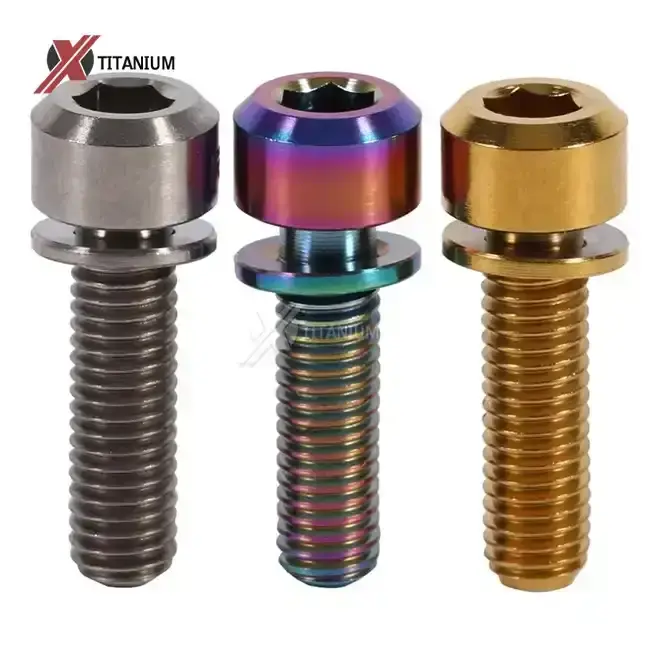
Understanding GR5 Titanium Bicycle Bolts and Their Value
To make smart purchases, you need to know what makes Gr5 titanium bicycle bolts stand out in the world of high-performance bike manufacturing. The bolts are made with precision from a metal called Ti-6Al-4V, which is mostly titanium (90%), aluminium (6%), and vanadium (4%). This particular mix makes an alpha-beta phase structure that has mechanical qualities that can't be matched by other materials used in riding.
Material Composition and Core Performance
Chromoly steel has a density of 7.85 g/cm³, while Ti-6Al-4V metal has a density of 4.43 g/cm³, which is about 45% less weight. This weight advantage doesn't hurt the strength of the structure. Genuine Gr5 titanium bicycle bolts have a tensile strength of 950 to 1050 MPa and a yield strength of around 880 MPa, which is about the same as Grade 10.9 steel screws but better at resisting rust. The metal naturally creates a layer of titanium dioxide on the surface that protects it from damage caused by sweat, road salts, and wet coastal areas where steel would rust quickly.
Applications in Premium Cycling Components
These bolts are used by high-end bicycle makers in important safety parts like stem systems, brake callipers, rotor mountings, and handlebar interfaces. The lower modulus of elasticity of the material (about 113 GPa compared to 210 GPa for steel) allows controlled elastic extension under pressure, which helps keep the thread engaged even when the material is vibrating all the time.
This quality is very important for aircraft parts that are subjected to high-frequency road vibrations because loosening them could be dangerous. Because they can withstand temperatures up to 400°C, these screws are perfect for brake systems that have to work in downhill racing or enduro. Using fake or lower-quality Gr5 titanium bicycle bolts instead of real ones increases the chance of catastrophic failure. Bad fasteners void product contracts, hurt the brand's image among serious cyclists, and put companies at risk of being sued when parts fail under stress. Understanding this value offer makes it clear why identification is important for reasons other than cost.
Common Challenges in Identifying Authentic GR5 Titanium Bicycle Bolts
The titanium fastener market has a lot of problems with identification that make buying Gr5 titanium bicycle bolts harder for even experienced buyers. Fraudsters have gotten smarter and can now make fakes that look real and fool people who only look at them briefly.
Visual Similarity of Counterfeit Products
Without special tests, real Gr5 titanium bicycle bolts and fake ones often look the same. Both may have similar surface finishes, measurement precision, and quality of machining. Colour and appearance are not always effective ways to tell if something is real or not because counterfeiters often use PVD coatings or anodised finishes that look like real goods. Because of this visual merging, buying teams can't rely on the old ways of inspecting goods that worked for telling the difference between steel grades or aluminium alloys.
Material Substitution Tactics
Unreliable sellers often use commercially pure Grade 2 titanium instead of titanium, which has the same corrosion protection but lacks the aluminium and vanadium that make titanium stronger. Grade 2 material is much cheaper, but its tensile strength is only 340 to 480 MPa, which is not enough for high-stress cycle uses. More of a problem are bolts made from recovered titanium trash, whose alloy compositions are hard to predict. This means that different production runs have different mechanical qualities. Some counterfeiters even sell stainless steel nuts that have been treated to look like titanium.
Manufacturing Process Deception
The way a thread is made has a big impact on its wear resistance, but this effect can't be seen at first glance. Real high-performance nuts have rolled threads that match the metal grain structure along the thread outlines. This makes the fatigue life about 30% longer than with cut threads. When you cut threads, tiny stress builds up at the thread's roots, which causes cracks to spread when the thread is loaded and unloaded again and again. To tell the difference between rolled and cut threads, you need to look at them under a microscope, which is not possible during normal getting processes. These problems make buying weak, which can have very bad results. One batch of fake nuts can cause problems in the field, guarantee claims, shutdowns of production lines, and close attention from regulators. In addition to the cost of replacement parts, the damage to the company's image among quality-conscious OEM customers and cycling fans who expect parts to be completely reliable has a financial effect.
Effective Methods to Verify Authenticity of GR5 Titanium Bicycle Bolts
To prove that a bolt is real, you need to use a set of systematic procedures that include reviewing the paperwork, trying the bolt physically, and checking the supplier's qualifications. Multiple levels of authentication must be used by procurement teams to stop fake goods from getting into supply lines.
Chemical Composition Analysis
The best way to be sure of something's authenticity is to use spectrometric testing, which confirms that the amount of aluminium is between 5.5 and 6.75% and the amount of vanadium is between 3.5 and 4.5%, as required by ASTM B348 Grade 5 standards. Portable X-ray fluorescence analysers allow testing that doesn't damage the object being tested. They can give you a composition analysis in minutes without breaking any fixings. This technology is very helpful for inspecting arriving shipments because it lets checks be made in real time before receiving shipments. By giving accepted providers baseline composition profiles, you can use them as a guide to compare different production lots.
Mechanical Property Verification
Hardness testing is a quick way to check if something is real. For example, real Gr5 titanium bicycle bolts measures 30-35 HRC on the Rockwell scale. Values that are much lower than this range mean that Grade 2 replacement or bad heat treatment happened. Tensile testing on sample bolts shows that the final tensile strength meets the requirements of 900–1050 MPa, but this destructive method is better for validating batches every so often rather than checking every single one. Random samples are put through 880 MPa of tensile stress in proof load testing to make sure that no lasting damage happens below the yield strength. This is important proof that the material has been properly heated and has the right microstructure.
Thread Integrity and Dimensional Inspection
If you look at the thread shape under a microscope, you can tell if the threads were rolled or cut. At 50x inspection, rolled threads have smooth crests and roots with continuous grain flow, while cut threads have sharp edges and broken grain structure. Using go/no-go scales to check the thread tolerance makes sure it meets ISO 6g standards, which makes sure the threads connect properly and the load is spread out evenly. By measuring the concentricity between the head and the shank, uneven loads on the sides of the component is avoided. This is especially important for carbon fibre parts that are prone to damage from localised stress.
Documentation and Certification Review
Demanding mill test results that can be linked to specific heat lots gives proof of composition and mechanical qualities. Real producers have strict systems that link certificates to production batches so that they can be tracked. Supplier certifications like ISO 9001, AS9100 for aircraft uses, or medical device standards show that they have quality control systems that can make sure production is uniform. Third-party certification from independent testing labs adds another level of proof, especially when looking for new suppliers or making sure that other sources are reliable.
Surface Finish and Manufacturing Quality
Surface roughness measurement (Ra value) shows how well the product was made and finished. High-quality nuts have controlled ends and don't have burrs that could damage carbon fibre parts while they are being put together. An review of the PVD covering makes sure that the thickness and adhesion are all the same. This is what sets professional treatments apart from simple decorative applications.
Checking the head shape makes sure that the tool contact surfaces are correct, which stops cam-out and fastener damage during installation. Using these methods of proof requires spending money on testing tools and training for staff, but the cost is small compared to the risks that fake parts pose. A lot of buying organisations work with outside testing labs to do regular checking. This way, they can be thorough while also making good use of their resources.
Comparing GR5 Titanium Bicycle Bolts Against Alternatives to Validate Authenticity
Knowing how real Gr5 titanium bicycle bolts stack up against other materials helps with identification and makes application-specific selection criteria clearer. These similarities show differences that can be measured and show that the goods being sold are fake.
GR5 Versus GR2 Titanium
Grade 2 commercially pure titanium is very resistant to rust but has very different mechanical qualities. The tensile strength of Grade 2 is only 340–480 MPa, while Gr5 titanium bicycle bolts tensile strength is 900–1050 MPa. This means that Grade 2 is not ideal for high-stress fastener uses. Because aluminium and vanadium aren't added to Grade 2, it can't get the strength that cycle uses need through heat treatment. The differences in weight are still very small because the mass doesn't change much from grade to grade. If procurement teams find titanium bolts that aren't as strong as expected, they should assume Grade 2 substitution, which can be proven by a composition study that shows the lack of alloying elements.
Titanium Versus Stainless Steel
316 or 18-8 stainless steel bolts, which are popular in riding, weigh about 77% more than Gr5 titanium bicycle bolts, but they are just as resistant to corrosion in most situations. But stainless steel is better at galvanic compatibility with aluminium frames than titanium. When titanium touches aluminium, it needs anti-seize chemicals to keep it from galling. Steel has a higher elastic stiffness, which means it doesn't stretch as much when it's loaded. This can be helpful in some situations, but it could make things more likely to come free when they're vibrated. Different materials have different magnetic qualities. For example, titanium is not magnetic, while stainless steel is. This makes for an easy field test.
Titanium Versus Aluminum Fasteners
Aluminium bolts aren't much lighter than titanium bolts, but they can't hold as much force. Aluminum's tendency for threads to come off when torqued raises safety issues in important situations like stem assemblies. Titanium has higher tension and shear strengths (about 550 MPa shear strength), which stops failure modes that happen a lot with aluminium bolts. Also, aluminium is more limited in its uses than titanium because it is more resistant to galvanic rusting when it comes into touch with metals that are not the same. By setting performance standards that real Gr5 titanium bicycle bolts must meet, these comparison insights help with identification. Fasteners with average properties—stronger than Grade 2 titanium but not as strong as Gr5 titanium bicycle bolts standards—probably have metal formulas that aren't as strong because they were made from recovered scrap, which supports the idea that they are fake.
How to Source Authentic GR5 Titanium Bicycle Bolts for Your Business?
To get real Gr5 titanium bicycle bolts, you need to choose your suppliers carefully, paying attention to their manufacturing skills, quality systems, and open documentation practices. The shopping method is very different from buying goods because it focuses on building relationships rather than maximising selling prices.
Manufacturer Qualification and Certification
Authentication is easier when you work with makers who have strong quality control systems. Suppliers who are approved to AS9100 aerospace standards show that their processes meet the strict testing and material traceability needs of the aircraft business. ISO 9001 certification sets the standards for a quality system, but companies with more industry certifications are better for cycling-specific uses. By asking for facility checks or third-party audit reports, you can find out what kind of production equipment is available, how qualified the staff is, and how much they are paid. When manufacturers buy spectrometers, tensile testing tools, and coordinate measuring machines, it shows that they are committed to quality control that meets your needs.
Documentation Transparency and Traceability
Real manufacturers give a lot of paperwork that connects certifications for raw materials to final goods. In mill test results, there should be unique heat lot numbers that can be used to find suppliers of billets through production records. Manufacturing accuracy is shown by dimensional inspection records that say the product meets DIN 912, DIN 7991, or ISO 7380 standards. Chemical composition documents from recognised labs prove that the alloy is real. If a supplier refuses to provide paperwork when asked to or gives general certificates that don't include specific traceability information, this is a red flag that needs more attention or the development of an alternative source.
Production Capability and Help with Custom Orders
Check to see if the providers have the CNC cutting and thread rolling tools needed to make high-quality fasteners. Manufacturers who offer custom head styles, thread lengths, or PVD coating choices show that they are flexible enough to meet the unique needs of high-end bicycle making. With the ability to place bulk orders and consistent wait times, you can plan your production, and the minimum order numbers should match the amount of goods you buy. Having access to technical support makes it easier to make decisions about which materials to use when creating new models or improving old ones.
Reputation Assessment and Reference Verification
Reputation in the industry is a useful way to prove who you are. Aerospace, medical device, and marine engineering suppliers have to go through strict customer approval steps that make sure they can do what they say they can do. By asking for and checking references from customers, you can see how well a company has done in the past in terms of quality consistency, delivery reliability, and responding to quality problems. Taking part in trade shows and professional organisations for your industry shows that you are interested in the market and want to see industry standards rise. Purchasing is more stable when you build ties with qualified sellers than when you buy things on the spot. Once authentication methods confirm a supplier's skills, ongoing relationships make buying easier while keeping quality high through re-qualification audits and sample testing programs that happen on a regular basis.
Conclusion
To make sure that Gr5 titanium bicycle bolts are real, they need to be checked using a method that includes chemical analysis, mechanical testing, measuring, and checking the supplier's qualifications. Because fake goods are so common, eye inspection isn't enough. Procurement teams need to use strict identification to make sure that cheap fasteners don't damage the purity of the product or the brand's image.
Knowing the properties of a material, how it compares to other options, and signs of poor production quality can help you make smart buying choices. Reliable sourcing is based on strategic partnerships between suppliers and makers who use clear paperwork, strong quality systems, and have a history of success in the industry. Putting money into authentication methods and building relationships with qualified suppliers pays off in the form of fewer field failures, fewer guarantee claims, and more trust from customers in the quality of your products.
As bicycle technology improves and performance standards rise, makers participating in premium market segments must make sure that their fasteners are real. This is because the integrity of the parts directly affects how the brand is positioned and how much of a competitive edge they have.
FAQ
Do GR5 Titanium Bicycle Bolts Rust?
Gr5 titanium bicycle bolts that are real don't rust in the way that steel screws do. The inactive layer of titanium dioxide that forms on uncovered surfaces on its own protects them from corrosion caused by water, road salts, and chemicals. But titanium can gall when it's threaded into aluminium parts without the right anti-seize material being used. This can cause thread seizure that looks like rust but is actually caused by adhesive friction wear.
How Can I Visually Differentiate Titanium from Steel Bolts?
It's hard to tell them apart visually because both materials can have similar finishes applied to them. Titanium has a slightly darker grey colour than stainless steel, which looks lighter, but coats can hide this difference. A magnet is used as the final field test. Titanium has no magnetic pull, while most stainless steels have weak magnetic properties. Another sign is a measure of weight: Gr5 titanium bicycle bolts feel noticeably lighter than steel bolts of the same size.
What Documentation Should Accompany Authentic Bolts?
Genuine Gr5 titanium bicycle bolts should have mill test reports that say the chemical composition meets ASTM B348 Grade 5 standards, mechanical property test results that say the tensile and yield strengths are correct, dimensional inspection reports that say the tolerances are correct, and heat lot traceability information that shows where the raw materials came from. Suppliers who can't provide this paperwork don't have the quality systems that are needed to make sure that the products they sell are always real.
Partner with Chuanglian for Certified Gr5 Titanium Bicycle Bolt Manufacturing Excellence
If you buy from Baoji Chuanglian New Metal Material Co., Ltd., a company that makes Gr5 titanium bicycle bolts and has been working with titanium for over ten years, you won't have to worry about authenticity issues. As the "City of Titanium" (Baoji City) is known around the world, our plant has full CNC machining skills and strict quality control systems that make sure every fastener meets ASTM B348 Grade 5 standards. We offer full mill test approval, composition analysis paperwork, and mechanical property proof for all production batches. This takes away the worries that buying teams have about fakes.
Our track record of working with aircraft, medical device, and high-performance bike companies shows that we can meet your most stringent technical needs. Whether you need standard fastener sets or unique specs for your own designs, our engineering team works together throughout the development process to make sure that the best materials are chosen and the best way to make the product is used. Get in touch with our buying agents at info@cltifastener.com or djy6580@aliyun.com to talk about your Gr5 titanium bicycle bolt supplier needs and find out how our open processes, certified quality systems, and technical know-how can protect your brand's reputation while improving the reliability of your supply chain.
References
1. ASTM International. "ASTM B348-13: Standard Specification for Titanium and Titanium Alloy Bars and Billets." Annual Book of ASTM Standards, Vol. 02.04, 2019.
2. Boyer, R., Welsch, G., and Collings, E.W. "Materials Properties Handbook: Titanium Alloys." ASM International, Materials Park, Ohio, 1994.
3. Lutjering, G. and Williams, J.C. "Titanium: Engineering Materials and Processes." Springer-Verlag, Berlin, Second Edition, 2007.
4. Donachie, Matthew J. "Titanium: A Technical Guide." ASM International, Materials Park, Ohio, Second Edition, 2000.
5. International Organization for Standardization. "ISO 7380-1:2011 Hexagon Socket Button Head Screws." Geneva, Switzerland, 2011.
6. Veiga, C., Davim, J.P., and Loureiro, A.J.R. "Properties and Applications of Titanium Alloys: A Brief Review." Reviews on Advanced Materials Science, Vol. 32, pp. 133-148, 2012.
Learn about our latest products and discounts through SMS or email