- English
- French
- German
- Portuguese
- Spanish
- Russian
- Japanese
- Korean
- Arabic
- Greek
- German
- Turkish
- Italian
- Danish
- Romanian
- Indonesian
- Czech
- Afrikaans
- Swedish
- Polish
- Basque
- Catalan
- Esperanto
- Hindi
- Lao
- Albanian
- Amharic
- Armenian
- Azerbaijani
- Belarusian
- Bengali
- Bosnian
- Bulgarian
- Cebuano
- Chichewa
- Corsican
- Croatian
- Dutch
- Estonian
- Filipino
- Finnish
- Frisian
- Galician
- Georgian
- Gujarati
- Haitian
- Hausa
- Hawaiian
- Hebrew
- Hmong
- Hungarian
- Icelandic
- Igbo
- Javanese
- Kannada
- Kazakh
- Khmer
- Kurdish
- Kyrgyz
- Latin
- Latvian
- Lithuanian
- Luxembou..
- Macedonian
- Malagasy
- Malay
- Malayalam
- Maltese
- Maori
- Marathi
- Mongolian
- Burmese
- Nepali
- Norwegian
- Pashto
- Persian
- Punjabi
- Serbian
- Sesotho
- Sinhala
- Slovak
- Slovenian
- Somali
- Samoan
- Scots Gaelic
- Shona
- Sindhi
- Sundanese
- Swahili
- Tajik
- Tamil
- Telugu
- Thai
- Ukrainian
- Urdu
- Uzbek
- Vietnamese
- Welsh
- Xhosa
- Yiddish
- Yoruba
- Zulu
How to identify high-quality motocross titanium bolts
Checking the material grade is the first step in finding high-quality motocross titanium bolts. Grade 5 titanium metal (Ti-6Al-4V) is still the standard because it has a tensile strength of about 930 MPa and better fatigue resistance. The people in charge of buying things should look at steel certificates, surface processes like polishing or anodising, and thread gauges to make sure the dimensions are correct. Genuine motocross titanium bolts have stable grain flow patterns, threads that are rolled instead of cut, and won't gall when they're properly oiled. For business-to-business buyers looking for fasteners that reduce weight while maintaining structural integrity in tough off-road racing situations, they must check the qualifications of the seller, ask for material tracking reports, and test samples.
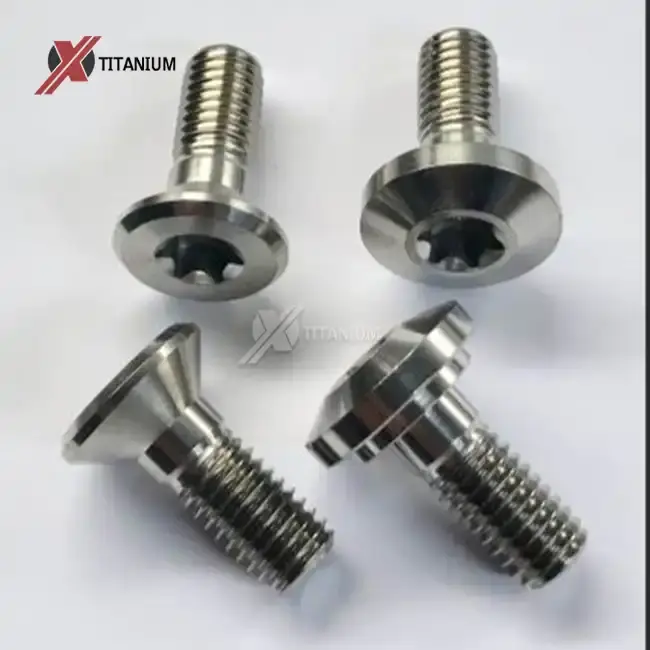
Understanding the Core Characteristics of Motocross Titanium Bolts
Material Composition and Grade Selection
The motocross titanium bolts market is dominated by Grade 5 titanium alloy, which is officially named Ti-6Al-4V. This is because it has 6% aluminium and 4% vanadium, which make it stronger and more stable at high temperatures. This mix has a mass of only 4.43 g/cm³, which is about half that of steel. However, it still has mechanical qualities that are as good as or better than many hardened steels. When weight is very important, like in engine mounts, suspension links, and frame parts, racing teams and OEM makers choose this grade. Commercially pure titanium grade 2 is more resistant to rust, but it doesn't have the tensile strength needed for high-stress clamping tasks, so it shouldn't be used in structural jobs.
The accuracy of manufacturing has a direct effect on how well the product works. CNC-machined bolts from reputable companies like Baoji Chuanglian New Metal Material Co., Ltd. go through thread-rolling and multi-axis turning methods that keep the grain structure of the material. Cut threads, on the other hand, break grain lines and shorten wear life by up to 30%. Thread sizes from M6 to M10 can fit a variety of frame and engine mounting points, and special sizes can be made for unique designs. These fasteners can withstand temperatures up to 600°C, which makes them ideal for use in exhaust manifolds where aluminium bolts would soften and steel bolts would add extra weight.
Corrosion Resistance and Environmental Durability
Off-road racing subjects bolts to mud, saltwater, fuel vapors, and vibration-induced stress cycling. Titanium's inactive oxide layer forms on its own when it is exposed to air. It protects the metal from rust and chemical attack. Motocross titanium bolts are stable even when bathed in salty water during beach races, while stainless steel can crack under chloride stress corrosion in marine settings. Because of this built-in security, there is no need for zinc plating or cadmium coats, which are heavy and can come off when the metal is loaded and unloaded many times.
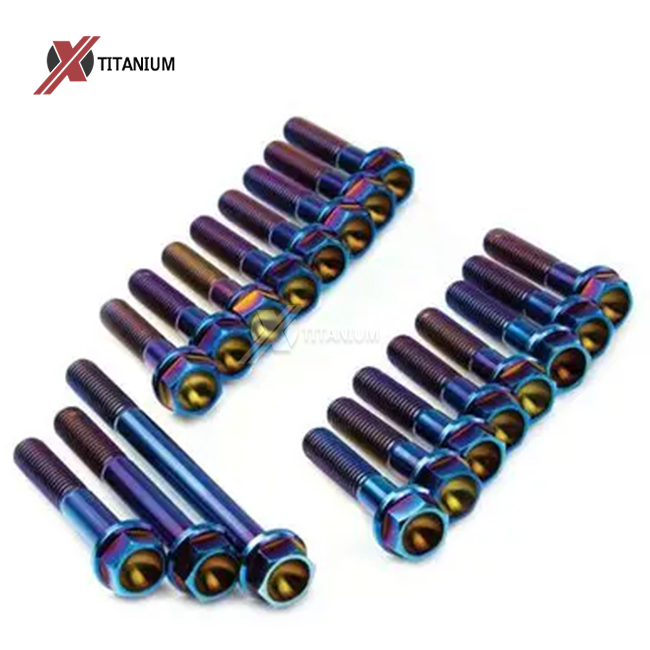
Surface treatments make things last even longer. Anodising uses controlled electricity to make the oxide layer thicker. This makes the surface harder and gives the metal colours like silver, gold, blue, purple, and various shades. Nitriding spreads nitrogen into the surface, which makes nuts that are often put together and taken apart less likely to wear out. Polished finishes lower the amount of stress that builds up at surface flaws, which extends the fatigue life of systems that are prone to shaking.
How to Evaluate Titanium Bolt Quality: Essential Criteria for B2B Buyers
Material Certification and Traceability
Demanding full material traceability paperwork is the first step in strict buying. Reliable sellers give mill certificates that list the chemicals that were tested using Positive Material Identification (PMI) and show that the amount of aluminium and vanadium meets ASTM B348 standards for motocross titanium bolts. Specific heat lot numbers should be used in these reports so that quality assurance teams can track bolts back to the titanium sponge source where they came from. Facilities that are certified by AS9100 or ISO 9001 show that they follow aerospace-grade quality management systems, which use statistical process controls and batch tests as normal.
According to ISO 898-1 guidelines, tension and proof load tests are needed to check the mechanical properties. For Grade 5 material, proof should show that the maximum tensile strength is close to 950–1050 MPa and the yield strength is higher than 880 MPa. On the Rockwell C scale, the hardness range is usually between HRC 30 and 36. This range finds the right balance between strength and flexibility to keep the material from breaking when it's hit with shock loads. Metallographic cross-sections show the internal grain structure and prove that there are no holes or other flaws that could cause cracks to spread.
Dimensional Accuracy and Thread Precision
The quality of the thread affects both how well it fits and how well it holds over time. Go/No-Go gauging makes sure that the thread pitch meets the standards for tolerance class 6g. This keeps the threads from sticking during installation or coming loose when the machine shakes. When compared to cut threads, which leave tensile residue stresses at root radii, rolled threads have compressive surface stresses that make motocross titanium bolts more resistant to wear. Measuring thread engagement length ensures proper clamping force distribution—insufficient engagement focuses stress on initial threads, while excessive length adds needless weight.
Head shape needs the same amount of attention. To keep the hexagonal hole sizes accurate, socket head cap screws must be used to stop tools from cam-outing and head stripping that follows. When you use a flange head design, the compressive loads are spread out over a larger bearing area. This makes the composite or aluminium fastening tabs less stressed. Tolerances in shank length affect how threads contact tapped holes versus pass-through gaps, which has a direct effect on the uniformity of joint preload.
Comparing Motocross Titanium Bolts with Other Bolt Types: Making an Informed Choice
Titanium Versus Steel Fasteners
Because they are cheaper, steel nuts rule the bulk market. Grade 8.8 metric fasteners have tensile strengths of around 800 MPa. With a capacity of 1200 MPa, Grade 12.9 high-strength alloy steel is stronger than titanium in its raw state. But this benefit goes away when strength-to-weight rates are used to choose the best material. Because motocross titanium bolts are 45% lighter than steel bolts of the same size, engineers can lower the amount of unsprung mass in suspension systems. This makes it easier for riders to control their bikes when they're turning sharply.
Another point of difference is corrosion protection. Protective coatings are needed for steel screws. Zinc plating adds 5–8 microns of thickness but breaks down in acidic conditions, and black oxide doesn't offer much protection. These coatings change the sizes of things, which makes accurate structures harder to make. Motocross titanium bolts don't need to be coated to prevent rust; their dimensions stay the same over time, and they don't experience galvanic corrosion when combined with aluminium or carbon fibre parts.
Aluminum Bolts and Niche Applications
Fairings and fenders that aren't solid use aluminium screws in specific ways. In these cases, vibration damping and electrical insulation are more important than final strength. Aluminium 7075-T6 metals have tensile strengths of 500 MPa and densities that are lower than motocross titanium bolts. This means that they can be used for number plate mounts and decorative panels. But aluminium has a lower modulus of elasticity, which means it stretches more when it's under load. This makes it more likely to come loose in places with a lot of shaking unless thread-locking chemicals are added.
A look at the costs for 2024 shows that these fasteners are very expensive—usually 300–500% more than similar steel screws and 200–300% more than aluminium. This initial investment is spread out over the life of the bolt, since titanium doesn't rust or wear out easily, so it doesn't need to be replaced as often as steel screws do. When racing teams figure out the total cost of ownership, they know that a single mechanical failure during the season due to worn-out fasteners can be more expensive than the money they saved by buying cheaper materials at the start.
Practical Steps to Identify and Source High-Quality Motocross Titanium Bolts
Supplier Pre-Qualification and Certification Verification
Teams in charge of buying things for businesses should make scorecards for suppliers that rate their production capacity, the age of their quality system, and their expert support skills. Companies that use CNC machining centers with five-axis capabilities are dedicated to making accurate motocross titanium bolts, while companies that use hand lathes introduce too much variation. Site audits check to see if providers keep environments with controlled temperatures that stop hydrogen from absorbing during heat treatment. This is an issue that causes titanium metals to crack later than they should.
By asking for examples from aerospace or medical device users, you can find out how well a seller can meet strict requirements. Companies like Baoji Chuanglian New Metal Material Co., Ltd. have been making titanium fasteners for more than ten years and have improved their CNC cutting methods by getting feedback from high-stakes uses over and over again. Because they are in Baoji City, which is known as the "City of Titanium," they can easily get high-quality materials and the specialised metalworking knowledge that is concentrated in this industrial cluster.
Sample Testing Protocols and Inspection Methods
Before committing to large amounts of production, procurement managers should order test runs for both harmful and non-destructive testing. Tensile testers make sure that bolts break within the expected load ranges. Fatigue testers use cyclic loading to make motocross titanium bolts work like they have for years in a short amount of time. Ultrasonic checking finds holes in the ground that can't be seen with the naked eye, and dye penetrant testing finds cracks on the surface that could get worse when stressed.
Coordinate measuring tools (CMM) are used to check that the thread pitch, head height, and shank thickness are all within the allowed ranges. Using eddy current scales to compare the thickness of the anodising layer makes sure that the surface treatment is the same from one production lot to the next. By installing test bolts on real motorcycle frames using a dynamometer, you can confirm how well they work in the real world and find out about any installation or compatibility problems before placing large orders.
Customization Options and Engineering Collaboration
Catalogues of off-the-shelf fasteners don't usually cover the unique mounting shapes that are found in prototype race frames or limited-edition motorbike models. Through joint engineering, suppliers that offer customisation services close this gap. Different amounts of material can be accommodated by custom thread lengths in carbon fibre subframes, and different head styles can be used with unique fairings. With anodising colour matching, sponsors' brand colours can be used on obvious motocross titanium bolts, turning useful parts into decorative ones.
Engineers can find the best bolt count and weight spread when thread sizes other than M6, M8, and M10 are available. Baoji Chuanglian can make custom sizes because they have a lot of different machining methods and can be flexible with their production schedule. This means they can take on small orders that bigger companies would normally turn down because they aren't profitable. Technical advice is needed when choosing materials to make sure that Grade 5 standards match the estimated joint loads. This stops over-engineering, which raises costs without improving performance.
Maintaining and Ensuring Long-Term Performance of Titanium Bolts in Motocross Applications
Installation Best Practices and Torque Management
Proper installation prevents 90% of motocross titanium bolts problems caused by material flaws. Because titanium tends to galling (cold welding between threads that fit together), anti-seize products made for titanium metals must be used. Copper paste or ceramic-based lubricants make a buffer layer that lowers friction coefficients during tightening. This lets you use the right amount of force without damaging the thread. Manufacturers usually recommend a torque of 5 to 6 Nm for M6 bolts, and the amount needed increases proportionally for bigger sizes.
When you use measured torque tools, you don't have to guess, which can lead to joints that aren't torqued enough and loosening or nuts that are over-torqued and stretched past their yield points. Beam-style or click-type torque wrenches that are adjusted once a year make sure that the preload is the same on all of the bolts in a joint pattern. Alternating tightening sequences across bolt patterns keep mounting surfaces from bending and keep the load evenly distributed, which stops fretting rust at the points where two parts meet.
Inspection Schedules and Failure Prevention
After a race, racing teams should check for obvious deformation at the bolt heads, thread damage or discolouration that could mean the engine got too hot. By comparing the length of a fitted bolt to its original dimensions, you can find plastic deformation caused by overloading, and torque-audit processes make sure that fasteners keep their proper preload after being exposed to vibration. During competition, catastrophic fails can be avoided by replacing motocross titanium bolts that show any signs of stress.
When cleaning, strong chemicals that could damage the powder layer on titanium should not be used. Mild cleaners and soft brushes get rid of mud and other dirt without leaving scratches that are stressful. Keeping extra fasteners in places that control moisture keeps them from getting contaminated, and organising goods by lot number makes it easier to find problems if they happen. These maintenance steps make service times longer, which means that these fasteners give you a return on your investment over many seasons of steady use.
Conclusion
To find high-quality motocross titanium bolts for use, you need to do a full evaluation that includes checking the material's certifications, making sure the technical tests are correct, and evaluating the supplier's abilities. Grade 5 titanium metal has the best strength-to-weight ratio when it comes from producers who use precise CNC machining and strict quality controls. When business-to-business buyers work with experienced suppliers who offer traceable materials, flexible customisation options, and expert help throughout the procurement cycle, they gain a competitive edge.
When these premium fasteners are installed and maintained correctly, they last a long time and don't break. This makes their higher cost worth it because they remove failure risks and improve car performance. Even though motocross bikes are getting lighter and more powerful, the quality of the titanium bolts is still a very important factor in deciding who wins and who has to quit because of a mechanical problem.
FAQ
What advantages do titanium bolts offer compared to steel alternatives in racing applications?
Motocross titanium bolts reduce unsprung mass by approximately 45% compared to steel counterparts while maintaining comparable or superior tensile strength around 930 MPa. This weight reduction improves suspension response, handling precision, and acceleration. Titanium doesn't rust, so protective coatings that change dimensions aren't needed. Its nonmagnetic properties also keep electrical sensors that are becoming more popular in modern race bikes from interfering with the metal.
How can procurement teams verify authentic Grade 5 titanium material?
Asking for mill certificates with PMI test data proves that the amount of aluminium and vanadium meets the requirements of ASTM B348. Independent spectrometric study of sample motocross titanium bolts gives proof, and metallographic cross-sections show grain structure that is consistent with the right heat treatment. Suppliers you can trust will give you full tracking, connecting finished bolts to the original titanium sponge heat lots.
Are custom dimensions and finishes available for specialized mounting applications?
Well-known companies like Baoji Chuanglian often make threads in special sizes, lengths, and head styles that fit their own frame designs. Anodising methods can be customised to match the colour scheme of a team, and special surface treatments can be used to protect against specific weather conditions for motocross titanium bolts. Minimum order numbers depend on how complicated the product is, and expert advice is needed to make sure that the specs match the performance needs.
Partner with a Trusted Motocross Titanium Bolts Manufacturer
Baoji Chuanglian New Metal Material Co., Ltd. has been making motocross titanium bolts for over ten years and works with companies all over the world in the aerospace, racing, and high-performance equipment industries. Our advanced CNC cutting and strict quality control systems make sure that every bolt meets the exacting Grade 5 (Ti-6Al-4V) standards. The tensile strength is also checked using ISO-standard testing methods. We keep track of all of the materials, from the raw titanium sponge to the finished fasteners. This way, we can give B2B buying teams the proof they need for compliance and source approval.
Our engineering team works together to make sure that the engine mounts, suspension parts, and frame pieces we make for motocross bikes are the right size, colour, and surface treatment. We give racing teams and OEM makers the dependability they need by having quality inspection staff check each production batch and manufacturing schedules that are flexible enough to handle both small trial orders and large volume orders. You can email our expert sales team at info@cltifastener.com or djy6580@aliyun.com to talk about your motocross titanium bolts needs, ask for material approvals, or set up testing of samples.
References
1. Boyer, R., Welsch, G., & Collings, E.W. (1994). Materials Properties Handbook: Titanium Alloys. ASM International, Materials Park, Ohio.
2. Donachie, M.J. (2000). Titanium: A Technical Guide, 2nd Edition. ASM International.
3. International Organization for Standardization (2017). ISO 898-1:2013 Mechanical Properties of Fasteners Made of Carbon Steel and Alloy Steel.
4. ASTM International (2021). ASTM B348-13 Standard Specification for Titanium and Titanium Alloy Bars and Billets.
5. Lutjering, G., & Williams, J.C. (2007). Titanium, 2nd Edition. Springer-Verlag Berlin Heidelberg.
6. SAE International (2019). AMS 4928 Titanium Alloy Bars, Wire, Forgings, Rings, and Drawn Shapes 6Al-4V Annealed.
Learn about our latest products and discounts through SMS or email