- English
- French
- German
- Portuguese
- Spanish
- Russian
- Japanese
- Korean
- Arabic
- Greek
- German
- Turkish
- Italian
- Danish
- Romanian
- Indonesian
- Czech
- Afrikaans
- Swedish
- Polish
- Basque
- Catalan
- Esperanto
- Hindi
- Lao
- Albanian
- Amharic
- Armenian
- Azerbaijani
- Belarusian
- Bengali
- Bosnian
- Bulgarian
- Cebuano
- Chichewa
- Corsican
- Croatian
- Dutch
- Estonian
- Filipino
- Finnish
- Frisian
- Galician
- Georgian
- Gujarati
- Haitian
- Hausa
- Hawaiian
- Hebrew
- Hmong
- Hungarian
- Icelandic
- Igbo
- Javanese
- Kannada
- Kazakh
- Khmer
- Kurdish
- Kyrgyz
- Latin
- Latvian
- Lithuanian
- Luxembou..
- Macedonian
- Malagasy
- Malay
- Malayalam
- Maltese
- Maori
- Marathi
- Mongolian
- Burmese
- Nepali
- Norwegian
- Pashto
- Persian
- Punjabi
- Serbian
- Sesotho
- Sinhala
- Slovak
- Slovenian
- Somali
- Samoan
- Scots Gaelic
- Shona
- Sindhi
- Sundanese
- Swahili
- Tajik
- Tamil
- Telugu
- Thai
- Ukrainian
- Urdu
- Uzbek
- Vietnamese
- Welsh
- Xhosa
- Yiddish
- Yoruba
- Zulu
How to identify genuine titanium disc brake plug bolts from counterfeit ones
Identifying genuine titanium disc brake plug bolts requires examining material composition, surface finish, manufacturer markings, and certification documentation. Authentic Titanium Disc Brake Plug Bolt products manufactured from Grade 5 Ti-6Al-4V alloy exhibit specific characteristics: a distinctive gray-silver appearance, 40% lighter weight than steel equivalents, non-magnetic properties, and precision CNC machining marks.
Genuine bolts display clear manufacturer identification, batch traceability codes, and comply with ISO 965 dimensional standards, whereas counterfeit components often present inconsistent threading, suspicious weight variations, and lack verifiable material certifications that guarantee performance in critical braking applications.
Introduction
The global market for high-performance fasteners has an ongoing problem that affects safety, operating stability, and the efficiency of procurement: a lot of fake titanium parts are being sold. This is a problem that purchasing managers, quality engineers, and technical procurement specialists in the aerospace, motorsport, and high-performance cycling industries deal with every day. When fake fasteners get into supply lines, especially in safety-critical brake systems, the problems don't just end with money loss; they also include legal risks, damage to the brand's image, and possibly catastrophic component failures.
Working with procurement teams has shown us a concerning pattern: sophisticated counterfeit operations are becoming more and more like Titanium Disc Brake Plug Bolts, so visual identification is not enough. Surface processes are used to make steel bolts look like titanium, and lower grades of titanium are mistakenly sold as aerospace-grade Ti-6Al-4V alloy. These dishonest practices take advantage of people's desire to save money in competitive buying settings, where a real Grade 5 titanium fastener usually costs three to five times as much as a stainless steel option.
This complete guide gives people who work in buying structured verification methods that were created after years of testing materials and reviewing the supply chain. We talk about practical ways to authenticate that strike a balance between thoroughness and operational efficiency. This way, your team can confidently tell the difference between real titanium disc brake parts and complex fakes without having to go to a metallurgical lab for every shipment.
Understanding Titanium Disc Brake Plug Bolts and Their Critical Role
Defining the Component and Its Function
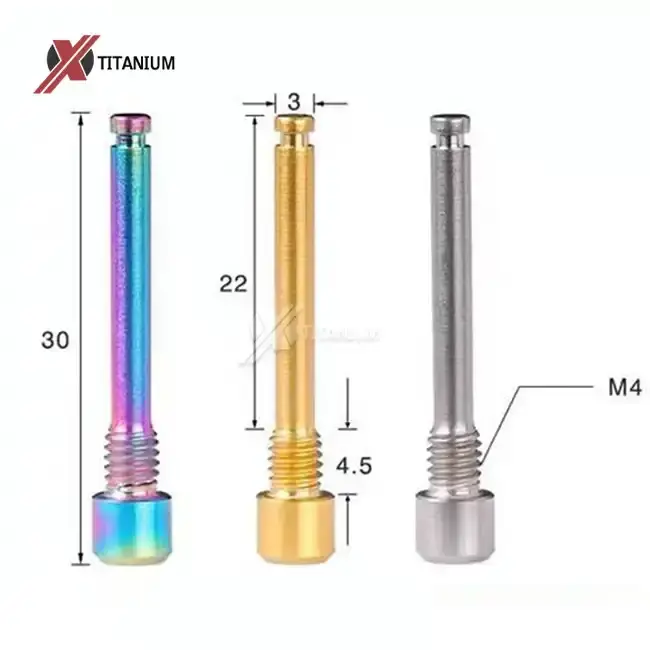
Titanium Disc Brake Plug Bolts are specialized bolts made to seal fluid galley ports or keep holding mechanisms in hydraulic brake calipers in place. These precisely machined parts do two things: they keep the brake fluid clean and they can handle the high temperatures and mechanical stress that come with high-performance brake systems. The fasteners usually have fine-pitch threading (M4, M5, or custom specifications) that is made to fit into aluminum or magnesium caliper housings without causing galvanic corrosion, which is when two different metals break down when they come into contact with water.
Material Properties That Define Performance
Genuine Grade 5 titanium alloy (Ti-6Al-4V) performs better than other bolt materials in ways that aren't possible with regular metals. The metal is made up of 90% titanium, 6% aluminum, and 4% vanadium. It has a tensile strength of more than 950 MPa and a hardness of 30 to 36 HRC. In this mix, the structural integrity is about the same as high-grade steel, but the density is only 4.43 g/cm³. This is what makes the weight reduction that is often mentioned 40–45%. In performance applications, the lower unsprung mass directly leads to better suspension response and handling dynamics.
In addition to being lighter, titanium's naturally occurring oxide layer makes it very resistant to rusting from DOT brake fluids, saltwater, and acidic outdoor contaminants. This passive film heals itself when it gets scratched, providing long-lasting protection that steel fasteners that are painted or plated can't match.
The material keeps its mechanical qualities at temperatures close to 400°C, which keeps the dimensions stable near areas of friction where temperatures rise during hard braking. Because of these qualities, real titanium fasteners are very useful in marine, racing, and aerospace applications where part reliability is directly linked to operational safety.
Why Authenticity Matters Beyond Cost Considerations
Choosing real titanium fasteners solves a number of important buying problems. When fake parts are made from poor materials or the wrong types of alloys, they can fail in a lot of different ways. We have proof of fake bolts (actually Grade 2 industrial titanium or titanium-coated steel) breaking during pressure tests, failing to seal fluids because they weren't resistant enough to corrosion, and catastrophic shear failures during thermal stress testing. Each failure mode creates a liability risk and a possible safety incident that are much worse than any initial cost savings from buying parts that are too cheap.
Material accuracy from batch to batch is needed for high-performance uses that need to be consistent. Real manufacturers keep tight controls on their processes and keep track of their materials to make sure that every fastener meets the published standards. Fake businesses don't have this kind of infrastructure, so the parts they make aren't always made of the right materials or have the right mechanical properties. Because of this, fake fasteners can't really work with the quality control standards that B2B buyers in controlled businesses have to follow.
Common Characteristics and Indicators of Genuine Titanium Disc Brake Plug Bolts
Physical and Material Verification Markers
Titanium Disc Brake Plug Bolts that are real have unique physical qualities that can be used to confirm their authenticity without having to do lab tests. Grade 5 titanium is usually a gray-silver color, but the color can change slightly depending on how it is heated and finished on the outside. The substance doesn't behave at all like a magnet—a simple magnet test can instantly spot steel-core fakes, no matter how the surface is treated. Another quick way to be sure is to compare the weight to manufacturer standards or samples of known-good products. The difference in density between titanium and steel is still big enough to see with simple measurements.
The texture of the surface gives us more information. Titanium parts that were CNC-machined have uniform tool marks and finishing designs that show how precisely they were made. According to ISO 965 standards, real fasteners have thread profiles that are all the same and have sharp, well-defined crests and roots. Fake parts often have threading that isn't straight, rough surfaces that show they weren't machined well, or looks that are too perfect to be real, which suggests they weren't machined precisely.
Markings, Certifications, and Documentation Standards
Reliable makers mark their titanium fasteners forever with information that can be used to track them. Real goods usually have manufacturer logos that are laser-etched or stamped on them, as well as material grade designations like "Ti64" or "Gr5" and batch or lot codes that make it possible to track back through the supply chain to the raw material sources. The quality of the markings is a good way to tell the difference. Real companies use high-precision marking tools to make identifications that are clear and last a long time, while fake companies often use marks that aren't uniform or are easy to wear off.
Material certifications, test reports, and compliance declarations are some of the paperwork that comes with real titanium fasteners. Material Test Reports (MTRs) from approved labs include chemical makeup analysis that proves the Ti-6Al-4V meets specifications, mechanical property testing results, and data for verifying dimensions. Real suppliers give out certificates of conformance that list relevant standards like ASTM B348, AMS 4928, or requirements related to the business. There is traceability in the documentation that connects the specific batch to the source material heat numbers. This lets the whole supply chain be checked.
Packaging and Presentation Quality Indicators
Professional packing shows that high quality standards were used throughout the whole production process. Real titanium fasteners come in protective packaging that keeps the surface from getting damaged during shipping. The packaging has clear printing on it that lists the product information, checks the quantity, and gives instructions on how to handle it. Packaging materials that have high-quality printing, tamper-evident seals, and uniform marking across product lines are signs that the company is serious about protecting its brand.
A lot of the time, fake goods come in plain packages with labels that have quality problems like writing mistakes, blurry pictures, or missing technical information. Although packaging can't prove for sure that something is real, the quality of the packaging is strongly linked to overall manufacturing standards, which helps procurement teams flag suspicious shipments for more thorough checks.
Techniques and Best Practices for Verifying Authenticity During Procurement
Practical In-House Testing Methods
A number of simple verification tests can be done by procurement teams without the need for a lot of lab equipment. Using portable Rockwell or Vickers hardness tools to check the material's properties shows that they meet the requirements for Grade 5 titanium (30–36 HRC). The test is easy to use, doesn't require much training, and gives you numbers right away, so it can be used for new inspection processes.
Using Go/No-Go gauges to check the thread gauge makes sure that the dimensions are correct and the fitting is precise. Real precision-machined fasteners smoothly pass Go gauges and correctly reject No-Go gauges, showing that they meet the tolerances that were set. Dimensional differences are common in fake parts made without good quality control, and this mechanical check finds them.
Supplier Evaluation and Qualification Protocols
Comprehensive source evaluation is the basis for stopping fake goods. Procurement teams should check possible suppliers against certain criteria, such as having a manufacturing plant that is certified by ISO 9001, AS9100, or an industry-specific organization; having a quality management system that is recorded; and being willing to let third parties verify the quality of their products. Authorized distributors of well-known brands offer traceability paperwork that connects products to their original makers. This lowers the risk of fakes compared to gray-market sources.
The name of a supplier in industry networks gives you useful information. Professional groups, online discussion boards, and suggestions from other professionals can help you find trustworthy sources and warn you about sketchy ones. We tell procurement teams that when they are setting up new relationships with suppliers or making large orders, they should ask for facility checks or audit reports from a third party.
Third-Party Laboratory Verification for Critical Applications
When a lot is at stake, it makes sense to have independent lab tests done by accredited materials testing facilities. Using X-ray fluorescence (XRF) spectroscopy or optical emission spectroscopy to analyze the alloy's chemical make-up is the only way to be sure of its grade. This method can find inferior materials or wrong alloy compositions that a visual inspection cannot. Testing the material's mechanical properties, such as measuring its tensile strength, yield strength, and elongation, makes sure that its performance characteristics match its certifications.
For large production runs or to make sure that new suppliers are qualified, these thorough testing protocols work well for sample-based verification, and this is especially critical when evaluating specific components like the Titanium Disc Brake Plug Bolt. Although testing can cost anywhere from a few hundred to over a thousand dollars per sample, this investment protects against much bigger losses when fake parts fail or when someone gets sued.
Comparing Genuine Titanium Bolts to Common Counterfeits and Alternatives
Material and Performance Differentiation
Buying teams can make better decisions when they know how real titanium fasteners stack up against both real and fake alternatives. Stainless steel brake fasteners are less expensive and don't rust as much as other materials, but they are heavier and have lower strength-to-weight ratios. Alternatives to aluminum are light, but they don't have the tensile strength and fatigue resistance needed for safety-critical uses. Carbon fiber composite bolts are still being tested, and they are too expensive for most uses. There are also worries about how long they will last when loaded and unloaded many times.
Genuine Grade 5 titanium is in a special performance category because it is strong, light, and resistant to rust all at the same time. This mix makes it okay to charge more in situations where better performance means better safety gaps or more competitive advantages. Aerospace-grade Ti-6Al-4V bar stock costs about $20 to $40 per kilogram, while stainless steel costs about $3 to $8 per kilogram. This is why finished components are more expensive than raw materials.
Recognizing Counterfeit Indicators and Red Flags
Usually, fake Titanium Disc Brake Plug Bolts can be put into a few different groups. Type 1 uses cheaper materials, usually stainless steel, and changes the surface to look like titanium by anodizing or PVD finish. Basic tests for authenticity show that these fakes are not real: magnetic pull shows that they are made of steel, and density readings show that they are too heavy. Two types of fakes use real titanium but lie about the grade, using Grade 2 titanium instead of Grade 5 alloy because it costs 30 to 40 percent less than Grade 5. These fakes pass basic tests to show that they are titanium, but they fail tests to see how strong and hard they are.
Prices that are much lower than the going rate are a red flag that needs more investigation. For example, real Grade 5 titanium brake fasteners from reputable makers rarely come with discounts of more than 15-20% off of standard prices because of the cost of the materials. More worries are raised when suppliers refuse to give material certifications, don't want third-party testing to happen, or offer suspiciously short lead times for what they say are custom-machined parts. When these signs show up, procurement teams should know that they need to authenticate goods before they can be accepted.
Real-World Impact of Counterfeit Components
When fake fasteners get into systems, they cause problems that go beyond the cost of the parts themselves. We have proof of instances where fake brake hardware failed and caused full product recalls, which cost manufacturers millions of dollars in replacement costs, damage to their brand's reputation, and legal settlements. During competition, racing teams had technical problems because of fake fasteners that weren't strong enough, which put them at a disadvantage and put safety at risk. When audits found fake parts in supply chains, medical device makers had to deal with stricter rules and slower product approvals.
These examples from real life show why identification methods are important for managing risk and not just adding extra paperwork. When you look at the possible losses from fake parts breaking, the cost of thorough verification procedures is still very small. This means that investments in authentication are easily justified from a risk-adjusted return point of view.
Best Procurement Strategies to Ensure Genuine Titanium Disc Brake Plug Bolt Acquisition
Selecting Qualified Suppliers and Authorized Channels
Strategic source selection lowers the risk of counterfeiting during all stages of buying. The best way to be sure of an item's authenticity is to deal directly with the manufacturer or an authorized distributor. This is because these channels keep full records of quality and traceability. Established titanium manufacturing facilities in recognized centers of knowledge, such as Baoji, China (known around the world as the "City of Titanium"), offer direct sourcing with full quality assurance systems and material certifications.
When buying teams look at possible sellers, they should give more weight to those who have the right quality certifications that show they manage quality in a systematic way. AS9100 certification shows quality standards for the aircraft industry, ISO 9001 certification shows that a general quality management system is being used, and industry-specific certifications show that the company is an expert in a certain field. Suppliers who keep these certifications go through regular audits by a third party, which is an independent check of their quality practices.
Building long-term ties with suppliers has benefits beyond preventing Titanium Disc Brake Plug Bolts counterfeiting. Preferred supplier programs give you access to consistent quality, priority scheduling for production, and technical support. Custom production and strict quality standards are often justified by large orders, and long-term relationships help both parties understand the needs of the application and the expected level of performance. These partnerships create more value than methods that try to minimize process costs.
Evaluating Pricing Structures and Value Propositions
Realistic prices for real titanium fasteners help buying teams spot offers that seem too cheap, which could mean they are fakes. Grade 5 titanium brake bolts that are real usually cost between $3 and $15 each, but this depends on the size, complexity, surface processes, and number of bolts ordered. The fact that precision-machined, approved screws cost less than $2 a piece should immediately raise red flags, given the high costs of raw materials, machining, and quality control needed for real production.
Instead of trying to get the lowest unit price, procurement plans should focus on the total cost of ownership. Genuine titanium screws last longer, don't need to be maintained because of corrosion, and work consistently, which lowers the number of quality incidents. When you add up all the costs, including what could go wrong, the cost of repairs, and how reliable the supplier is, it's usually better to buy slightly more expensive genuine parts from well-known brands than the cheapest ones that come with higher risks.
Implementing Incoming Inspection and Quality Verification
Strong processes for incoming checking catch fake parts before they get into production or reach customers. Some practical inspection methods are comparing the item's appearance to known-good samples, using precision measuring tools to check its dimensions, comparing its weight to its specifications, and checking random samples with hardness testers or other verification tools. Following these steps only takes a short amount of time but offers strong defense against fakes getting in.
Another important part of an inspection is going over the paperwork. Teams in charge of buying things should make sure that approvals for materials refer to the exact batch that was received, that test reports show data that is within the acceptable ranges, and that tracking codes on parts match the paperwork. Discrepancies should lead to hold procedures and more checks before deliveries are accepted. Setting clear acceptance criteria and refusal processes makes sure that quality standards are applied consistently across all receiving operations.
Conclusion
Material testing, source approval, paperwork review, and arriving inspection processes must all be combined to authenticate Titanium Disc Brake Plug Bolts in a methodical manner. The higher price of genuine Grade 5 Ti-6Al-4V parts is justified by their performance benefits, such as higher strength, resistance to rust, and lighter weight. Procurement workers keep their companies safe by using multiple levels of authentication, working with certified sources, and sticking to strict quality control standards. The cost of authentication procedures is still small compared to the money that could be lost if a fake part fails. For this reason, thorough verification is an important part of responsible procurement management in safety-critical applications.
FAQ
How can we quickly verify titanium authenticity without laboratory equipment?
Rapid field authentication combines a number of easy-to-use methods. Using a strong magnet will show that fake steel reacts strongly to magnets but real titanium doesn't. Using a precision scale, compare the weight of the part to what the maker says it should be. Titanium's low density (4.43 g/cm³) makes it different from steel options that can be seen.
Look at the surface finish and threading quality under a microscope, and look for uniform machining lines that show precise making. Look for permanent maker markings and ask for material approvals to go with them. These methods are good for preliminary screening, but any suspicious parts need to be thoroughly tested in a lab before they can be accepted.
What price range indicates genuine titanium brake bolts?
Genuine Grade 5 Titanium Disc Brake Plug Bolts usually cost between $3 and $15 each, but this depends on the specs, surface treatments, and number of pieces ordered. The lowest prices that can be charged are based on the cost of raw Ti-6Al-4V materials, the need for precise CNC machining, and investments in quality assurance.
Parts that cost a lot less than this range, especially approved screws that cost less than $2 a piece, should be looked at with more suspicion and verified more thoroughly. If you buy in bulk from a well-known maker, you might get a small discount, but if the price is way below what the market will bear, it's probably fake goods or wrong information about the material grades.
Which certifications should we require from titanium fastener suppliers?
Ask accredited labs to send you material test reports that include a chemical composition analysis that proves the material meets the Ti-6Al-4V specification, mechanical property testing results like measurements of tensile strength and hardness, and data to confirm the dimensions. Need certificates of approval that list relevant standards like ASTM B348 or AMS 4928.
Check that providers keep quality management system certifications for aircraft uses, such as ISO 9001 or AS9100. Insist on full traceability documentation that connects delivered parts to raw material heat numbers. This will allow for verification along the entire supply chain and show that the supplier is committed to quality assurance.
Partner with Chuanglian for Certified Titanium Disc Brake Plug Bolt Supply
You can buy from Baoji Chuanglian New Metal Material Co., Ltd., which has been processing titanium for more than ten years and specializes in making precision-machined fasteners from Grade 5 Ti-6Al-4V alloy. Our factory in Baoji, which is known around the world as the "City of Titanium," has full CNC machining capabilities and makes disc brake parts that meet the strictest requirements in aerospace, motorsport, and industry.
We have strict quality control throughout the whole production process, from checking the raw materials to doing the final review. This makes sure that every part has clear performance characteristics and can be fully tracked back to its source.We offer full material certifications, mechanical property test results, and dimensional proof paperwork with every order as a Titanium Disc Brake Plug Bolt manufacturer.
Our quality management systems are in line with international standards, which helps you meet your supplier qualification needs and legal obligations. Our technical team works with your engineers to make sure that the part specifications are perfect for your specific application, whether you need standard configurations or custom-engineered solutions with certain surface treatments, such as a natural titanium finish, anodizing in different colors, or PVD coating for longer life.
Get in touch with our buyers at info@cltifastener.com or djy6580@aliyun.com to talk about your titanium fastener needs. We provide full expert support, reasonable prices for large orders, and dependable shipping schedules that help you meet your project deadlines. Visit cl-titanium.com to see our full selection of titanium goods and learn how working with a reputable Titanium Disc Brake Plug Bolt provider can help you maintain the integrity of your supply chain while giving your applications the performance benefits they need.
References
1. Boyer, R., Welsch, G., and Collings, E.W. (1994). Materials Properties Handbook: Titanium Alloys. ASM International, Materials Park, Ohio.
2. Donachie, Matthew J. (2000). Titanium: A Technical Guide, 2nd Edition. ASM International, Materials Park, Ohio.
3. Froes, F.H. (2015). Titanium: Physical Metallurgy, Processing, and Applications. ASM International, Materials Park, Ohio.
4. Lütjering, Gerd and Williams, James C. (2007). Titanium, 2nd Edition. Springer-Verlag, Berlin, Germany.
5. Peters, M., Kumpfert, J., Word, C.H., and Leyens, C. (2003). "Titanium Alloys for Aerospace Applications," Advanced Engineering Materials, Volume 5, Issue 6, pages 419-427.
6. Schutz, R.W. and Watkins, H.B. (1998). "Recent Developments in Titanium Alloy Application in the Energy Industry," Materials Science and Engineering: A, Volume 243, Issues 1-2, pages 305-315.
Learn about our latest products and discounts through SMS or email