- English
- French
- German
- Portuguese
- Spanish
- Russian
- Japanese
- Korean
- Arabic
- Greek
- German
- Turkish
- Italian
- Danish
- Romanian
- Indonesian
- Czech
- Afrikaans
- Swedish
- Polish
- Basque
- Catalan
- Esperanto
- Hindi
- Lao
- Albanian
- Amharic
- Armenian
- Azerbaijani
- Belarusian
- Bengali
- Bosnian
- Bulgarian
- Cebuano
- Chichewa
- Corsican
- Croatian
- Dutch
- Estonian
- Filipino
- Finnish
- Frisian
- Galician
- Georgian
- Gujarati
- Haitian
- Hausa
- Hawaiian
- Hebrew
- Hmong
- Hungarian
- Icelandic
- Igbo
- Javanese
- Kannada
- Kazakh
- Khmer
- Kurdish
- Kyrgyz
- Latin
- Latvian
- Lithuanian
- Luxembou..
- Macedonian
- Malagasy
- Malay
- Malayalam
- Maltese
- Maori
- Marathi
- Mongolian
- Burmese
- Nepali
- Norwegian
- Pashto
- Persian
- Punjabi
- Serbian
- Sesotho
- Sinhala
- Slovak
- Slovenian
- Somali
- Samoan
- Scots Gaelic
- Shona
- Sindhi
- Sundanese
- Swahili
- Tajik
- Tamil
- Telugu
- Thai
- Ukrainian
- Urdu
- Uzbek
- Vietnamese
- Welsh
- Xhosa
- Yiddish
- Yoruba
- Zulu
What factors should I consider when choosing m8 titanium rotor bolts for performance vehicles?
When selecting titanium fasteners for brake rotors, several critical factors demand attention. The choice of M8 titanium rotor bolts hinges on material grade certification, dimensional compatibility, supplier quality systems, and long-term performance consistency. M8 titanium rotor bolts must also be evaluated for thread fit, clamp load retention, and thermal expansion behavior under repeated braking cycles. Aerospace-grade Ti-6Al-4V (Grade 5) alloy represents the industry benchmark, offering tensile strength exceeding 950 MPa while maintaining a density of just 4.51 g/cm³—roughly 45% lighter than steel equivalents.
Thread pitch accuracy, surface treatment options, and certifications such as ISO 9001 and ASTM B348 directly influence operational safety and supply chain reliability. For procurement teams overseeing racing fleets, motorcycle manufacturers, or high-end automotive builds, verifying batch traceability and mechanical testing documentation ensures that every bolt meets performance-critical specifications without compromise.
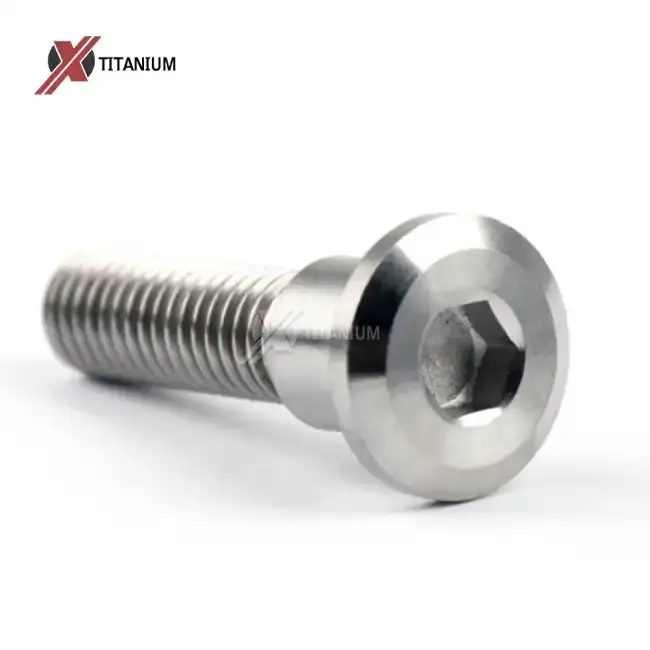
Understanding M8 Titanium Rotor Bolts: Specifications and Benefits
Core Material Properties That Define Performance
Ti-6Al-4V, a grade 5 titanium alloy, is the main material used to make high-quality brake rotor fasteners. 6% aluminum, 4% vanadium, and pure titanium are mixed in this mixture to make a metal structure that can handle high dynamic stress and temperature changes. The tensile strength is at least 950 MPa, and the hardness is about 35 HRC. These properties make it possible for these bolts to keep their clamping force in situations where other materials would fail. The melting point of 1660°C gives a large thermal margin during hard stopping events. This keeps the rotor from breaking down, which can happen in racing conditions where temperatures are higher than 400°C.
Because of the higher physical density, the unsprung weight is immediately reduced. If a performance vehicle swaps out twelve steel rotor bolts for M8 titanium rotor bolts, each wheel unit will weigh about 18 to 22 grams less. This decrease at the hub's outer radius makes the suspension more responsive, lowers gyroscopic resistance during turning, and improves acceleration. These benefits build over competitive racing seasons or demanding off-road uses.
Dimensional Precision and Compatibility Requirements
To make sure the load is spread out evenly and the hub doesn't break too soon, the thread specifications must line up perfectly with the hub mounting points. Standard M8 titanium rotor bolts have a nominal diameter of 8 mm and a thread pitch of 1.25 mm, which is in line with ISO metric standards. Length choices usually run from 15mm to 40mm, which can fit different rotor thicknesses and spacer configurations found on different motorcycle models, car platforms, and specialty race uses.
The thread engagement depth is a very important safety factor. For the rated shear strength to be reached, the hub material must have at least six full threads involved in it during proper fitting. Tolerance bands of ±0.05mm or smaller should be checked in the procurement specs to make sure that bolts sit properly and don't cross-thread or bind during assembly. Different types of heads, like Torx, Allen hex, and traditional hex heads, can be used with different types of tools. However, T25 Torx setups are more popular in professional settings because they reduce the risk of cam-out and improve torque transfer accuracy.
Corrosion Resistance That Extends Service Life
Marine environments, coastal roads, and winter weather all expose brake parts to chloride-rich air, which breaks down ferrous materials very quickly. Titanium alloy is almost completely resistant to corrosion in air and salt water, so it doesn't need any protection layers to keep its structure intact. This chemical inertness stops rust-welding, which is when rusty steel bolts tighten up in aluminum hubs. This is a terrible maintenance problem that usually means digging out broken fasteners and damaging hub threads.
There are different surface treatment options that improve performance even more. For basic corrosion resistance, the natural titanium finish is used. Polished surfaces, on the other hand, make installation easier and look better. Anodizing methods create controlled oxide layers that can be used for color coding. The blue, gold, rainbow, green, purple, and black choices make it easy to find bolts with different lengths or torque requirements in complicated systems. Nitriding processes make the surface harder, which extends wear resistance in high-vibration situations without affecting the flexibility of the material underneath.
Performance Considerations: Strength, Reliability, and Installation
Mechanical Properties Under Racing Conditions
The vanadium alloying element in Grade 5 titanium makes it very resistant to wear, which is a very important trait when the material is loaded and unloaded many times. When used in racing, brake calipers clamp down on M8 titanium rotor bolts during braking, putting them thru thousands of high-stress events every hour. Material fatigue testing shows that M8 titanium rotor bolts that are properly made keep more than 90% of their initial tensile strength after one million loading cycles at 60% of their maximum rated stress. Steel bolts have a hard time matching these performance metrics without adding a lot of weight.
How bolts react to installation torque and operational stress is based on their yield strength. Grade 5 titanium doesn't bend plastically until it is overloaded very far. Its normal yield point is around 880 MPa. This behavior creates a safety buffer that keeps things from breaking down completely when unexpected shock loads happen, like when wheels hit rough ground or when riders land hard on motocross tracks.
Installation Protocols That Prevent Common Failures
Titanium is different from stainless steel because it doesn't galvanize, but the right way to put it is still important. When there is a lot of touch pressure between the fastener and hub threads, tiny surface welding can happen. This is called thread galling. Professional installation standards say that anti-seize compounds made just for titanium must be used. These are usually nickel- or copper-free molybdenum disulfide pastes that stop metals from sticking to each other without affecting the accuracy of the torque.
For each hub material and rotor configuration, torque specs must be checked against manufacturer documentation. If you use too much torque, the threads or bolts could become permanently damaged, and if you use too little torque, the parts can move very slightly, which speeds up wear and makes noise. For m8 titanium rotor bolts, this torque sensitivity is even more critical because titanium's lower modulus of elasticity and higher galling tendency require precise lubrication and friction control to achieve proper clamp load without overstressing the threads.
For consistent fitting in industrial settings, digital torque wrenches with an accuracy of ±2% are the way to go. Tightening in steps, usually in a star or cross shape, makes sure that the load is evenly spread across all mounting points and stops the rotor from warping.
Long-Term Durability and Maintenance Economics
Professional race teams' service interval data shows that M8 titanium rotor bolts that are properly placed often last longer than the brake rotors themselves. In difficult situations, steel fasteners need to be replaced every 12 to 18 months because they corrode or wear out. M8 titanium rotor bolts, on the other hand, stay in specification for 36 months or more under the same conditions. This longer service life cuts down on repair downtime, lowers the cost of keeping supplies on hand, and gets rid of the chance that something will break down during important operations.
When corrosion resistance and fatigue resistance work together, they make it easy to take the bolt off and put it back on during its service life. Threads stay true to their original sizes without binding or stripping that happens with corroded steel gear. This makes it easy to change the rotor during regular maintenance windows. This edge in serviceability is especially useful for fleet workers who have to keep track of many cars on long deployment schedules.
Comparing M8 Titanium Rotor Bolts with Other Materials: Which Is Best?
Titanium Versus Stainless Steel: Performance Trade-offs
Stainless steel bolts are usually 30–40% cheaper than M8 titanium rotor bolts, so they are cheaper to buy at first. This cost benefit gets smaller, tho, when lifetime factors are taken into account. The middling corrosion resistance of austenitic steel grades (304, 316) is hampered by their much greater density—about 8.0 g/cm³ compared to titanium's 4.51 g/cm³. Because of this difference in density, it takes heavier stainless steel parts to get the same level of strength, which goes against the main goal of speed car design, which is to reduce weight.
Martensitic steel types are stronger, but they also have magnetic qualities and are less resistant to corrosion. In chloride-rich settings, the chromium oxide layer that keeps stainless steel from oxidizing can break down. This is especially true when the steel is under a lot of stress, which leads to crevice rust. Professional motorcycle racing series and auto track day organizers are choosing M8 titanium rotor bolts more and more because data on reliability shows that it fails much less often over multiple seasons of competition.
Aluminum Alloy Limitations in Critical Applications
Aerospace-grade aluminum alloys (7075-T6) have great strength-to-weight ratios when built correctly, but they don't have the right qualities for brake rotor bolts. Grade 5 titanium can reach 950+ MPa of tensile strength, while aluminum can only reach about 570 MPa. Because of this lack of strength, bigger fastener cross-sections or more bolts are often needed to get the same safety margins, which cancels out any weight advantage.
Aluminum's thermal growth properties make it even less useful. Aluminum has a rate of thermal expansion that is about 35% higher than titanium's. This means that when brakes heat up and cool down, aluminum bolts expand and contract more. When this doesn't match up with steel or cast-iron rotors, stress builds up and fatigue cracks start to form faster. Reliable makers never use metal for brake rotors in places where safety is very important.
Vehicle-Specific Material Selection Criteria
Upgrading to M8 titanium rotor bolts is most helpful for high-performance bikes. Extreme lean angles, tough stopping needs, and being outside in all kinds of weather make corrosion resistance and fatigue strength very important. M8 titanium rotor bolts are often required for superbike racing because failure analysis data shows that it is more reliable under championship-level stress circumstances.
Competitive mountain bikes and road race bikes are another type of bike where M8 titanium rotor bolts make a real difference. The reduced weight directly improves the efficiency of climbing and acceleration, and the resistance to water and mud makes the parts last longer during training and competition schedules. Custom anodized colors are also useful because they make it easy to see which hardware goes with which wheels during pit stops.
When off-road cars are used near the coast or in the desert, salt spray and rough dust speed up rusting. M8 titanium rotor bolts keep their mechanical qualities in these hard conditions, while steel bolts usually need to be replaced after just one season of competition. The total cost of ownership estimate supports M8 titanium rotor bolts, even though it costs more at first. This is especially true for teams that have to keep a lot of parts on hand and stick to tight repair schedules.
Procurement Guide: How to Source Quality M8 Titanium Rotor Bolts for Your Business
Supplier Certification and Manufacturing Process Verification
Quality control starts with making sure the supplier is qualified. Manufacturers with a good reputation keep certifications, such as ISO 9001 for quality management systems and ASTM B348 compliance for titanium material specifications. These certifications show that the processes for getting materials, machining, and final inspection are written down and followed. Purchasing teams should ask for approval paperwork with every order, so that everything can be tracked from the arrival of the raw titanium billet to the finished bolt.
Precision measurements are needed for safety-critical screws, and CNC cutting can provide them. Reliable providers use multi-axis CNC machines that can keep the ±0.05mm limits needed for thread engagement and head concentricity. Thread rolling, which is better than thread cutting, makes surfaces that are work-hardened and have better fatigue resistance by aligning the grain structure along the thread outlines instead of cutting the material strands.
Every shipment should come with material certification documents that list the results of tests on the material's chemical composition and mechanical properties. These papers show that the titanium alloy passes the requirements for Grade 5 and has the right amount of aluminum and vanadium. Tensile testing shows that each output lot achieves a minimum strength level of 950 MPa, and hardness testing shows that the heat treatment works.
Strategic Purchasing Approaches for B2B Procurement
Volume purchasing agreements lower the cost per unit while making sure that production environments or fleet maintenance operations always have what they need. Customized packing choices from suppliers, like kits with M8 titanium rotor bolts of the right length, washcloths, and anti-seize compound, make inventory management easier and cut down on installation mistakes. For proprietary applications, you can ask for custom head styles or specialized drive configurations. The minimum order quantity is usually between 500 and 1000 pieces, but this depends on the needs of the tools.
When looking for specialized fasteners, managing lead times becomes very important. Standard M8 titanium rotor bolts with common surface finishes usually ship within two to three weeks. However, shipping times can go up to six to eight weeks for special anodizing colors or non-standard lengths. Professionals in procurement should build relationships with suppliers that can keep extras of things that sell quickly on hand while also being able to speed up production runs for important projects.
Evaluating Supplier Reliability and Support Capabilities
Warranty terms show that the company that made the product is confident in its quality. Suppliers with a good reputation usually offer defect guarantees that cover material flaws and non-conformance with measurements. The warranties also make it clear how to return and exchange items. Professional-grade suppliers are different from commodity suppliers because they offer technical support. Being able to talk to an engineer about torque specifications, installation procedures, and compatibility checks adds a lot of value beyond the hardware itself.
When managing foreign supply lines, it's especially important to be quick to respond to customer service requests. Procurement teams can keep track of production plans and avoid costly downtime by using clear lines of communication, written systems for tracking orders, and early warnings of possible delays. Suppliers with on-time delivery rates of more than 95% and quick technical support show that they want to build long-term partnerships instead of just doing business.
Making the Informed Decision: Matching M8 Titanium Rotor Bolts to Your Vehicle's Needs
Application-Specific Selection Criteria
For racing motorcycles, the highest performance standards are needed. For this segment, bolt sets should be made of Grade 5 material, have rolled threads, a tensile strength of at least 950 MPa, and be the right length to fit the rotor and hub combinations that are needed. Anodized color choices are useful during quick wheel changes in the pits because they let workers quickly check that the hardware was installed correctly while they are under a lot of time pressure.
Similar specifications are good for both track day cars and street performance builds, but the tolerance ranges may be a little wider depending on how bad the application is. The cost-benefit analysis moves toward a normal natural titanium finish for uses where cutting weight very significantly doesn't give as much of a competitive edge as it does in professional racing.
In marine and seaside settings, corrosion protection is more important than the lightest weight possible. Material certification should be a big part of the requirements for these environments, and extra surface treatments like nitriding could be added to make things last longer in harsh environments.
Budget Optimization Without Compromising Safety
M8 titanium rotor bolts are more expensive to buy at first than steel options by 3 to 5 times, based on the specs and order amounts. This higher price is due to the higher cost of the raw materials, the need for special machining, and strict quality control rules. When maintenance frequency, replacement intervals, and failure risk are taken into account, however, lifecycle cost analysis shows a different economic picture.
Strategies for buying things that balance limited funds with performance needs might stage the use of M8 titanium rotor bolts, starting with the most important uses where failure would have the worst effects. Installing front brake rotors gets priority because they help slow down the vehicle more than installing rear ones, which might use standard hardware at first until budgets can handle it.
Maintenance Cycles and Replacement Planning
When put correctly, M8 titanium rotor bolts have service lives that are longer than the average length of time a person owns a car and uses it on the street. Racing environments speed up wear because they are exposed to more vibrations and changes in temperature, but even in these settings, quality M8 titanium rotor bolts usually last 24 to 36 months, while steel fasteners only last 12 to 18 months.
During regular brake service, inspection procedures should include a visible check for thread damage, strange wear patterns, or discoloration that could mean the brakes were exposed to too much heat. Checking the torque makes sure that vibration hasn't loosened any fasteners. However, M8 titanium rotor bolts that have been properly installed are very resistant to vibration because they have good friction properties.
Replacement schedules usually line up with rotor replacement cycles, so screw changes don't have to be done separately. When technicians replace whole rotor assemblies with new hardware at regular service intervals, this synchronization makes it easier to keep track of inventory and makes maintenance simpler.
Conclusion
To choose the right M8 titanium rotor bolts, you need to carefully look at the material requirements, the supplier's skills, and the needs of the application. When it comes to high-performance uses, Grade 5 Ti-6Al-4V metal has the best mix of strength, lightness, and resistance to rust. Safety and dependability are ensured by accurate measurements, the right surface treatments, and certifications that have been checked.
Long-term, strategies for buying things that focus on qualified suppliers, lifetime cost analysis, and application-specific requirements are more valuable than strategies that focus only on price at first. Titanium hardware has many technical benefits, such as less unsprung weight, resistance to corrosion, and high resistance to fatigue. These benefits directly improve vehicle performance, extend maintenance intervals, and make operations more reliable in a wide range of settings, from coastal roads to professional racing circuits.
FAQ
Why do titanium rotor bolts outperform steel in strength-to-weight ratio?
At about 45% of steel's mass, Grade 5 titanium metal has a tensile strength of more than 950 MPa. This better strength-to-weight ratio lowers rotational inertia at the wheel hub. This improves the handling and suspension reaction while keeping the structure strong even when heavy loads are applied during stopping.
Are M8 titanium rotor bolts compatible with all performance vehicle types?
For motorcycles, race bikes, cars, and boats, these screws work as long as the length and thread pitch are the right ones for the hub. To make sure the parts are compatible, you need to make sure they have the right M8 x 1.25mm threading, the right thread contact depth, and the right bolt length for the rotor and spacer setups.
What installation practices prevent galling with titanium fasteners?
Galling can be avoided by using an anti-seize product that works with titanium on the threads before fitting. When you use calibrated torque wrenches and follow the manufacturer's instructions for sequential tightening patterns, you can be sure that the clamping force is correct without putting too much stress on the threads or distributing the load unevenly across the mounting points.
How do certification standards impact procurement decisions?
Certifications like ISO 9001 and ASTM B348 make sure that companies follow documented quality processes and material requirements. These standards give procurement teams faith in the accuracy of measurements, the mechanical properties, and the uniformity of batches. These are important factors for safety-critical uses that need to be able to track their materials.
Partner with Chuanglian for Premium Titanium Rotor Bolt Solutions
Baoji Chuanglian New Metal Material Co., Ltd. has been skilled in titanium cutting for more than ten years and has strict quality control systems that make sure every fastener meets the highest performance standards. Our Grade 5 Ti-6Al-4V rotor bolts are CNC-machined with great accuracy and have a tensile strength of more than 950 MPa. The surface can be treated in a variety of ways, such as anodizing in different colors, and they are fully certified by ISO 9001 and meet ASTM B348 standards for materials.
As a dedicated M8 titanium rotor bolts manufacturer in China's famous "City of Titanium," we have a lot of production capacity spread across a dozen CNC machining centers. This means that we can accommodate a wide range of order quantities, from small prototypes to large production runs. Our expert team offers full application support, helping procurement workers choose the best fastener configurations for high-performance car, racing, marine, and aerospace uses.
You can email our engineering experts at info@cltifastener.com or djy6580@aliyun.com to talk about your specific needs, ask for material certifications, or get competitive prices on buying in bulk M8 titanium rotor bolts. Find out why leading manufacturers trust Chuanglian for critical fastener solutions that deliver measurable performance advantages.
References
1. Donachie, M. J. (2000). Titanium: A Technical Guide (2nd ed.). ASM International, Materials Park, Ohio.
2. Boyer, R., Welsch, G., & Collings, E. W. (1994). Materials Properties Handbook: Titanium Alloys. ASM International.
3. Society of Automotive Engineers. (2018). Aerospace Material Specification AMS 4928: Titanium Alloy Bars, Wire, Forgings, Rings, and Drawn Shapes 6Al-4V Annealed. SAE International.
4. Lutjering, G., & Williams, J. C. (2007). Titanium (2nd ed.). Springer-Verlag, Berlin Heidelberg.
5. American Society for Testing and Materials. (2021). ASTM B348-21: Standard Specification for Titanium and Titanium Alloy Bars and Billets. ASTM International, West Conshohocken, PA.
6. Veiga, C., Davim, J. P., & Loureiro, A. J. R. (2012). Properties and applications of titanium alloys: A brief review. Reviews on Advanced Materials Science, 32(2), 133-148.
Learn about our latest products and discounts through SMS or email