- English
- French
- German
- Portuguese
- Spanish
- Russian
- Japanese
- Korean
- Arabic
- Greek
- German
- Turkish
- Italian
- Danish
- Romanian
- Indonesian
- Czech
- Afrikaans
- Swedish
- Polish
- Basque
- Catalan
- Esperanto
- Hindi
- Lao
- Albanian
- Amharic
- Armenian
- Azerbaijani
- Belarusian
- Bengali
- Bosnian
- Bulgarian
- Cebuano
- Chichewa
- Corsican
- Croatian
- Dutch
- Estonian
- Filipino
- Finnish
- Frisian
- Galician
- Georgian
- Gujarati
- Haitian
- Hausa
- Hawaiian
- Hebrew
- Hmong
- Hungarian
- Icelandic
- Igbo
- Javanese
- Kannada
- Kazakh
- Khmer
- Kurdish
- Kyrgyz
- Latin
- Latvian
- Lithuanian
- Luxembou..
- Macedonian
- Malagasy
- Malay
- Malayalam
- Maltese
- Maori
- Marathi
- Mongolian
- Burmese
- Nepali
- Norwegian
- Pashto
- Persian
- Punjabi
- Serbian
- Sesotho
- Sinhala
- Slovak
- Slovenian
- Somali
- Samoan
- Scots Gaelic
- Shona
- Sindhi
- Sundanese
- Swahili
- Tajik
- Tamil
- Telugu
- Thai
- Ukrainian
- Urdu
- Uzbek
- Vietnamese
- Welsh
- Xhosa
- Yiddish
- Yoruba
- Zulu
How to Prevent Galling in Titanium Bolts
A thorough grasp of the material's characteristics and appropriate handling methods are necessary to prevent galling in titanium bolts. When surface materials move between threaded components under pressure and friction, galling occurs, resulting in irreversible damage. Because titanium has special properties, this phenomena presents serious problems for titanium mountain bike bolts. Using the right lubricants, managing assembly torque, choosing suitable surface treatments, and putting quality production procedures into place are all examples of effective preventative techniques. In aeronautical, maritime, medicinal, and recreational applications, these techniques guarantee maximum performance and durability.
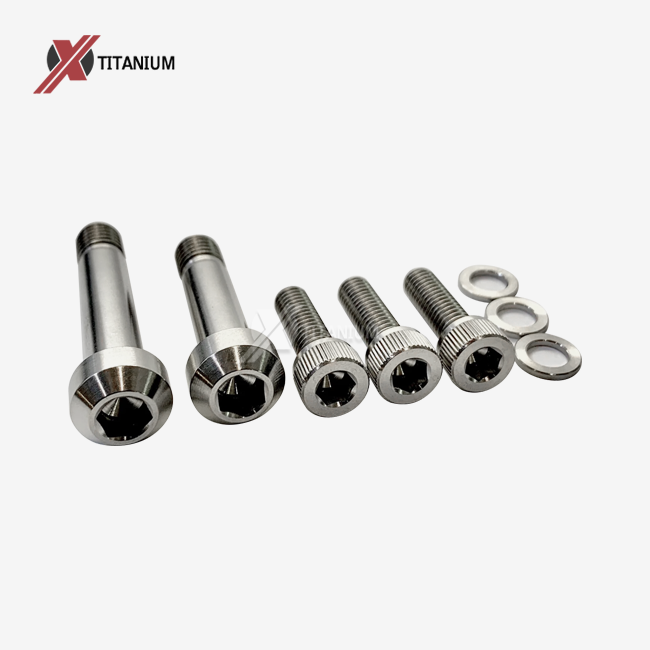
Understanding Galling in Titanium Bolts
In high-performance applications, galling is one of the most important failure mechanisms that titanium fasteners might experience. When titanium bolts encounter friction under stress, surface material transfer and permanent damage to threaded surfaces result in this severe type of adhesive wear.
The Science Behind Titanium Galling
Compared to steel or aluminum counterparts, titanium bolts are particularly prone to galling due to their high chemical affinity and natural ductility. When asperities on mating surfaces come into contact under pressure, a tiny phenomena takes place. Localized welding, material transfer, and surface ripping ensue when these contact locations undergo relative motion.
The galling propensity of titanium Grade 5 (Ti-6Al-4V) is influenced by its distinct crystalline structure. Under stress, titanium's oxide coating may dissolve, revealing new metal surfaces that easily stick to one another, in contrast to steel, which develops a protective oxide layer that offers some lubrication.
Impact on Component Integrity and Performance
Galling seriously jeopardizes bolt integrity in a number of ways. Because of the damage, effective thread engagement is reduced, which weakens the joint and increases the risk of catastrophic failure under operating loads. Furthermore, galled threads often cannot be reused, which increases the frequency of component replacement and maintenance expenses.
For procurement managers controlling lifetime costs in businesses needing extraordinary dependability, understanding these implications is crucial. Failures due to galling may lead to significant warranty claims, unplanned maintenance, and safety events that harm the image of the brand and undermine consumer trust.
Root Causes and Factors Contributing to Galling in Titanium Mountain Bike Bolts
Galling susceptibility of titanium fasteners, such as titanium mountain bike bolts, is influenced by a number of interrelated variables. By being aware of these factors, engineers and procurement professionals may choose materials and assembly processes with knowledge.
Material Grade and Alloy Composition Effects
Because of its aluminum and vanadium composition, titanium Grade 5 (Ti-6Al-4V), which is often used in high-performance mountain bike fasteners, has particular galling properties. Under certain stress circumstances, the alpha-beta microstructure facilitates material transfer while offering exceptional strength-to-weight ratios.
Galling resistance varies across titanium grades. Specialized grades made for threaded applications have components that lessen adhesive wear tendencies, whereas pure titanium grades often exhibit greater galling susceptibility than alloy compositions.
Design Parameters and Manufacturing Variables
A key factor in preventing galling is thread shape. Because coarse threads have less contact pressure per unit area than fine threads, they often have superior galling resistance. Galling initiation is greatly impacted by surface roughness, and smoother finishes usually perform better.
Galling risk is directly impacted by manufacturing tolerances. In addition to minimizing high-stress concentration spots where galling usually starts, threads made under stricter dimensional constraints guarantee appropriate load distribution. Compared to forming procedures, CNC machining methods provide better dimensional consistency.
Environmental and Operational Factors
Galling incidence is significantly influenced by assembly circumstances. Conditions that are favorable to material transfer are produced by improper torque application, insufficient lubrication, and the presence of contaminants. Moisture, grime, and chemical pollutants are examples of environmental exposures that might weaken protective surface treatments and raise the risk of galling.
Surface film integrity and material characteristics are impacted by temperature changes during assembly and operation. High temperatures weaken titanium's ability to withstand adhesive wear, and thermal cycling may damage lubricant layers and protective coatings.
Proven Methods to Prevent Galling in Titanium Mountain Bike Bolts
A methodical strategy that incorporates surface treatments, appropriate assembly methods, and material selection is necessary for effective galling avoidance. These tactics have proven effective in a variety of challenging applications in the aerospace, marine, and recreational sectors, including titanium mountain bike bolts.
Advanced Surface Treatments and Coatings
Significant protection against material transfer is offered by contemporary anti-galling surface treatments. While preserving the dimensional constraints necessary for precise applications, specialized coatings provide barrier layers that stop direct metal-to-metal contact.
By producing homogeneous oxide layers with regulated thickness and hardness characteristics, anodizing processes improve galling resistance. While Type III hard anodizing gives better protection for high-stress situations, Type II anodizing delivers exceptional wear resistance for applications with moderate loads.
By diffusing nitrogen into surface layers, nitriding procedures produce titanium nitride materials that are very robust and resistant to adhesive wear. This treatment significantly increases surface durability while preserving the corrosion resistance of the underlying titanium.
Lubrication Systems and Anti-Seize Compounds
The most economical way to avoid galling is by proper lubrication. Long-term protection without sacrificing joint integrity or causing contamination problems is offered by specialized anti-seize compounds made for titanium applications.
In situations where liquid lubricants may eventually migrate or collect impurities, dry film lubricants provide benefits. These coatings provide constant performance throughout the course of their service life and retain their protective qualities across a broad temperature range.
Environmental factors, compatibility with other system components, and application requirements all influence the choice of suitable lubricants. For certain working circumstances, molybdenum disulfide, graphite, and specialty polymer-based compounds each have unique benefits.
Precision Torque Control and Assembly Best Practices
The high stress concentrations that cause galling are avoided by regulating assembly torque within certain limits. Consistent application pressures are guaranteed by calibrated torque tools, which also remove variances that might cause premature failure.
For titanium mountain bike bolts, recommended torque levels usually fall between 60 and 80% of comparable steel fastener requirements. This decrease preserves sufficient clamp loads for joint integrity while taking into consideration titanium's lower elastic modulus and distinct yield characteristics.
Comparison of Titanium Bolts vs Alternatives in Galling Resistance and Other Key Metrics
Making educated purchasing selections based on application requirements and cost considerations is made possible by having a thorough understanding of the performance characteristics of various fastener materials. Even though they are susceptible to galling, titanium bolts provide special benefits when used appropriately.
Strength-to-Weight Performance Analysis
The outstanding strength-to-weight ratios of titanium Grade 5 bolts much surpass those of steel and aluminum substitutes. Titanium bolts provide significant weight savings without sacrificing structural integrity because of its density, which is around 60% that of steel, and tensile strengths that are close to 1000 MPa.
By lowering unsprung mass and increasing fuel economy, this weight advantage improves vehicle performance. In addition to extending service life over aluminum substitutes, titanium's greater fatigue resistance lowers operating costs and the need for ongoing maintenance.
Corrosion Resistance and Environmental Durability
In chemical industrial and maritime conditions, titanium's exceptional resistance to corrosion offers substantial benefits. When exposed to saltwater, acids, and other harsh environments, titanium bolts retain their characteristics, in contrast to steel fasteners that need cathodic protection or protective coatings.
Consistent performance from cryogenic conditions to high service temperatures is guaranteed by the material's stability over severe temperature ranges. Because of its thermal stability, materials don't need to be changed for various working conditions, which makes inventory control easier and procurement less complicated.
Cost-Benefit Analysis for Bulk Procurement
Although titanium bolts are more expensive than steel competitors, their longer lifespan and lower maintenance needs often make the initial outlay worthwhile. Lifecycle cost assessments show substantial savings with fewer replacement cycles and maintenance activity downtime.
Standardized specifications and volume purchase agreements are two ways that bulk procurement tactics may significantly reduce costs. Building enduring ties with suppliers makes it possible to get advantageous pricing structures and priority distribution during times of strong demand.
Procurement Guide for Titanium Mountain Bike Bolts
A thorough assessment of supplier capabilities, quality processes, and technical support resources is necessary for the successful acquisition of galling-resistant titanium bolts, especially titanium mountain bike bolts. Consistent product performance and dependable supply chains are guaranteed by these factors.
Supplier Evaluation and Quality Assurance
Evaluating testing facilities, quality management systems, and production capabilities are all part of qualifying titanium bolt suppliers. Depending on end-use requirements, suppliers should have certifications like ISO 13485 for medical equipment or AS9100 for aerospace applications.
One essential need for high-performance applications is material traceability. Complete material certificates that detail the alloy composition, heat treatment parameters, and mechanical qualities for every manufacturing lot must be provided by suppliers.
Galling resistance is directly impacted by surface quality and dimensional uniformity, which are ensured by manufacturing process controls. Industry requirements for precision fasteners should be met or surpassed by CNC machining capabilities, surface treatment facilities, and final inspection processes.
Customization Options and Technical Support
Prominent vendors provide a wide range of customisation options to satisfy particular application needs. Specialized coatings, distinctive head designs, and custom thread configurations allow for optimization for specific assembly needs and performance standards.
During the stages of material selection and application development, technical support services provide invaluable help. Based on loading circumstances, exposure to the environment, and assembly limitations, skilled engineering teams may suggest the best requirements.
Product quality and delivery dependability are impacted by packaging and logistical skills. While effective logistics systems guarantee on-time delivery to meet production schedules, proper packing guards against damage during transportation.
Conclusion
Titanium bolt galling may be avoided using a multifaceted strategy that includes careful material selection, sophisticated surface treatments, and accurate assembly methods. Engineers and procurement specialists may use efficient preventative techniques that optimize component performance and service life by comprehending the basic mechanics behind galling. When used and specified correctly, titanium mountain bike bolts provide remarkable strength-to-weight ratios, superb corrosion resistance, and long-term dependability. Partnering with competent suppliers that uphold strict quality standards and provide thorough technical assistance throughout the procurement process is essential to success.
FAQ
Q1: What makes titanium bolts more prone to galling than steel alternatives?
A: Surface materials easily stick together under pressure and friction due to titanium's high chemical affinity and ductility. Titanium's oxide coatings may disintegrate under stress, revealing new metal surfaces that readily fuse together, in contrast to steel, which forms protective oxide layers that provide some lubrication.
Q2: How do anti-galling coatings affect bolt performance and weight?
A: Contemporary anti-galling coatings greatly increase wear resistance while adding very little weight. While producing protective barrier layers, anodizing procedures usually increase surface dimensions by less than 0.001 inches. Without sacrificing the strength-to-weight benefits that make titanium appealing for performance applications, these coatings improve galling resistance.
Q3: What torque specifications should be used for titanium mountain bike bolts?
A: Generally speaking, titanium bolts need 60–80% of the torque values needed for comparable steel fasteners. This decrease preserves sufficient clamp loads while taking into consideration titanium's various elastic characteristics. To guarantee uniform application, always refer to the manufacturer's requirements and utilize torque tools that have been calibrated.
Q4: Can galled titanium bolts be repaired or reused?
A: A galled titanium bolt's thread damage and decreased load-carrying ability usually make it unsafe to reuse. The integrity of the joint is further compromised when more material is removed in an attempt to fix galled threads. For crucial applications, replacing the fasteners with new ones is the safest course of action.
Chuanglian: Your Trusted Partner for Premium Titanium Mountain Bike Bolts
With more than ten years of specialized expertise in titanium processing and machining, Baoji Chuanglian New Metal Material Co., Ltd. is a top producer of titanium mountain bike bolts. Our firm, which is based in Baoji City, sometimes referred to as the "City of Titanium," uses sophisticated CNC machining skills and extensive quality control systems to provide excellent anti-galling solutions for demanding applications.
With the aid of cutting-edge machinery, our titanium mountain bike bolts are precisely machined from Grade 5 (Ti-6Al-4V) alloy to stringent specifications. To guarantee constant performance and dependability, every fastener is put through stringent testing and quality inspection processes. Surface treatments that improve galling resistance while preserving the material's intrinsic benefits include polishing, anodizing, and nitriding.
To satisfy particular application needs, the wide range of products offers configurable solutions with different diameters, lengths, and thread configurations. Through sophisticated anodizing techniques, color possibilities include natural titanium, gold, blue, green, purple, black, and rainbow finishes. These titanium mountain bike bolts for sale combine outstanding corrosion protection, mechanical strength, and resistance to acids and alkali with lightweight design.
Quality assurance systems ensure every product meets international standards through comprehensive testing protocols and material certifications. Our experienced engineering team provides technical support throughout the procurement process, helping customers optimize specifications for their unique applications. Contact our specialists at info@cltifastener.com or djy6580@aliyun.com to discuss your requirements and discover how our titanium solutions can enhance your product performance and reliability.
References
1. Boyer, R., Welsch, G., and Collings, E.W. "Materials Properties Handbook: Titanium Alloys." ASM International, Materials Park, OH, 1994.
2. Lutjering, G. and Williams, J.C. "Titanium: Engineering Materials and Processes." Springer-Verlag, Berlin, 2007.
3. Metals Handbook, Volume 2: Properties and Selection of Nonferrous Alloys and Special-Purpose Materials. ASM International, Materials Park, OH, 1990.
4. Peters, M., Kumpfert, J., Ward, C.H., and Leyens, C. "Titanium Alloys for Aerospace Applications." Advanced Engineering Materials, Volume 5, Issue 6, 2003.
5. Schutz, R.W. and Thomas, D.E. "Corrosion of Titanium and Titanium Alloys." ASM Handbook Volume 13B: Corrosion Materials, ASM International, 2005.
6. Threadgill, P.L. "The Prospects for Joining Titanium Alloys." Materials Science and Technology, Volume 11, Issue 11, 1995.
Learn about our latest products and discounts through SMS or email