- English
- French
- German
- Portuguese
- Spanish
- Russian
- Japanese
- Korean
- Arabic
- Greek
- German
- Turkish
- Italian
- Danish
- Romanian
- Indonesian
- Czech
- Afrikaans
- Swedish
- Polish
- Basque
- Catalan
- Esperanto
- Hindi
- Lao
- Albanian
- Amharic
- Armenian
- Azerbaijani
- Belarusian
- Bengali
- Bosnian
- Bulgarian
- Cebuano
- Chichewa
- Corsican
- Croatian
- Dutch
- Estonian
- Filipino
- Finnish
- Frisian
- Galician
- Georgian
- Gujarati
- Haitian
- Hausa
- Hawaiian
- Hebrew
- Hmong
- Hungarian
- Icelandic
- Igbo
- Javanese
- Kannada
- Kazakh
- Khmer
- Kurdish
- Kyrgyz
- Latin
- Latvian
- Lithuanian
- Luxembou..
- Macedonian
- Malagasy
- Malay
- Malayalam
- Maltese
- Maori
- Marathi
- Mongolian
- Burmese
- Nepali
- Norwegian
- Pashto
- Persian
- Punjabi
- Serbian
- Sesotho
- Sinhala
- Slovak
- Slovenian
- Somali
- Samoan
- Scots Gaelic
- Shona
- Sindhi
- Sundanese
- Swahili
- Tajik
- Tamil
- Telugu
- Thai
- Ukrainian
- Urdu
- Uzbek
- Vietnamese
- Welsh
- Xhosa
- Yiddish
- Yoruba
- Zulu
How to prevent galling when installing titanium bicycle bolts?
Preventing galling when installing titanium bicycle bolts requires deliberate attention to lubrication, torque control, and material selection. Galling occurs when metal surfaces cold-weld under friction and pressure, particularly with titanium's reactive nature. Applying anti-seize compounds specifically formulated for titanium alloys, using calibrated torque wrenches to meet manufacturer specifications, and selecting proper Grade 5 (Ti-6Al-4V) fasteners with appropriate surface treatments effectively mitigate this risk. These preventive measures protect both the titanium bicycle bolts and the threaded aluminum or titanium components they secure, ensuring assembly reliability throughout the bicycle's service life.
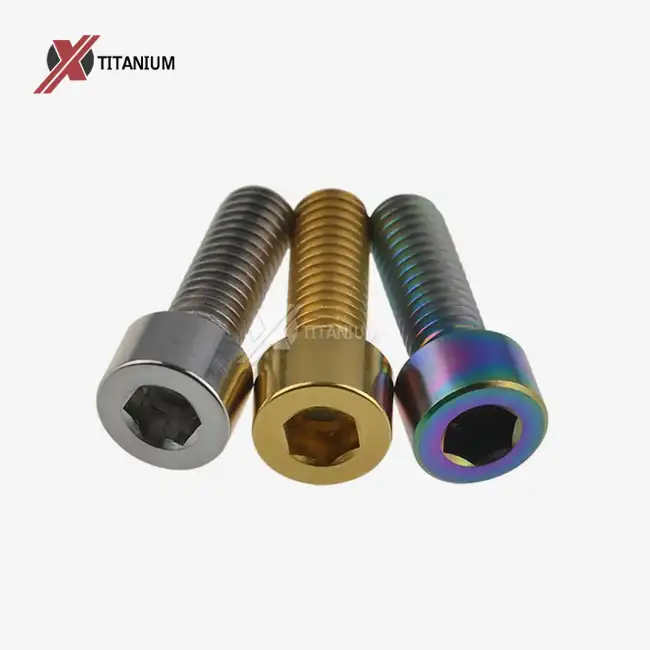
Understanding Galling in Titanium Fasteners
What Causes Galling in Titanium Applications?
Galling is a type of adhesive wear that happens when tiny amounts of material move between threaded surfaces that are touching each other while they are being installed or removed. Tribology International released study that says titanium alloys naturally tend to galle because they don't conduct heat very well and respond quickly with chemicals at interface points[1]. When you tighten fasteners made of Ti-6Al-4V, the shear forces at the thread contact zones create localised heating and pressure that are strong enough to break through protective oxide layers and allow metal to metal bonding.
This effect is especially noticeable when putting together a bicycle and the threads on the aluminium frame fit with the threads on the titanium parts. During installation, the softer aluminium can bend and stick to the harder titanium surface, making the thread profiles rougher, which makes the friction coefficients much higher. Changes in temperature, the speed of fitting, and the quality of the surface finish all affect how bad the galling is.
Material Properties That Increase Galling Risk
It has a tensile strength of about 900 MPa and a density of only 4.43 g/cm³, which makes it perfect for performance cycling applications because it has such a high strength-to-weight ratio. Having 6% aluminium and 4% vanadium in the same metal makes the surface conditions good for bond wear. Titanium naturally makes a protective oxide surface that is very good at stopping corrosion but not so good at stopping mechanical damage during threaded contact.
Titanium fasteners have a much higher coefficient of friction when they are loaded than stainless steel fasteners, which have a higher chromium content and are self-lubricating. A study published in the Journal of Materials Processing Technology in 2021 shows that titanium-to-aluminum threaded connections that aren't oiled can have friction coefficients higher than 0.6, compared to 0.2 to 0.3 for assemblies that are properly oiled[2]. These material traits mean that innate properties alone are not enough to stop problems. Instead, effective prevention methods are needed.
Environmental Factors That Accelerate Thread Damage
The installation setting has a big effect on the chance of galling. Oxide layers become less stable when there is a lot of humidity, and sharp particles that score thread surfaces are introduced when they are contaminated with dirt, moisture, or salt residue. Changes in the workshop temperature affect both the size of the materials and the thickness of the lubricants, which leads to uneven installation conditions.
Bicycle factories that make a lot of bikes have to take these differences into account by using controlled building areas and standard processes. Even high-end fasteners from Baoji Chuanglian New Metal Material Co., Ltd. need to be handled in a certain way so that their engineered surface treatments and dimensional tolerances stay the same from the supplier to the final installation.
Key Prevention Strategies for Titanium Bolt Installation
Selecting and Applying Anti-Seize Compounds
Choosing the right lubricant is the first step in preventing galling. Anti-seize products made for titanium usually have bits of copper, nickel, or molybdenum disulphide mixed in with synthetic carriers. These formulas make protective layers between surfaces that are mating. This keeps the torque-to-preload relationships accurate while reducing direct metal contact.
Avoid using oil-based lubricants on Ti-6Al-4V screws when putting together a bicycle because they can evaporate or move when the temperature is high enough for work. Anti-seize compounds based on copper work especially well at connecting titanium and aluminium, but nickel-based options stop galvanic corrosion problems in salty or marine settings. It's just as important how the product is used as what kind of product you choose. The best protection is thin, even coverage of both male and female threads, which doesn't change the hydraulic lock or torque reading.
At Chuanglian, we make titanium bicycle bolts with surface processes like nitriding and anodising that improve the qualities of the base material. However, even these high-tech finishes work better when anti-seize is applied correctly during installation. Engineered surface treatments and the right lubricants work together to make a full defence against adhesive wear mechanisms.
Implementing Precise Torque Control Protocols
The second important part of preventing galling is managing pressure correctly. Because titanium has a lower modulus of elasticity than steel, these screws stretch more when the same amount of force is applied to them. This means that the pressure specifications for each component must be followed very carefully. When you over-tighten, the thread contact forces are too high, breaking through the lubricant films and starting the cold welding process. On the other hand, when you under-tighten, the threads move and fret, which breaks the thread profiles.
Professionals who put together bikes should use torque wrenches that have been calibrated and have accuracy certifications that can be tracked back to national standards. Depending on the maker, the normal range for M5 stem bolts is between 4 and 6 Nm. For brake calliper mounting uses, the range may be between 6 and 8 Nm. It looks like these values aren't very high compared to automotive uses. This is because titanium alloys aren't used in automotive applications, and cycling uses have lighter structural loads.
For multi-bolt systems, installation steps should include staged tightening processes that follow star or cross designs to spread clamping forces evenly. This method stops distortion-induced binding, which can cause localised galling even when overall torque values stay within specs. Documentation and training make sure that both production teams and repair workers follow the same steps.
Choosing Appropriate Bolt Grades and Surface Treatments
Material choice has a big effect on how easily something will gall. Grade 5 (Ti-6Al-4V) titanium is strong enough for safety-critical uses like stem faceplates, brake mounts, and crankset interfaces. Grade 2 titanium, on the other hand, is commercially pure and is better for lower-stress uses like mounting a bottle cage. The alloying elements in Grade 5 give it better mechanical qualities, but they need to be installed more carefully than widely pure grades that are softer.
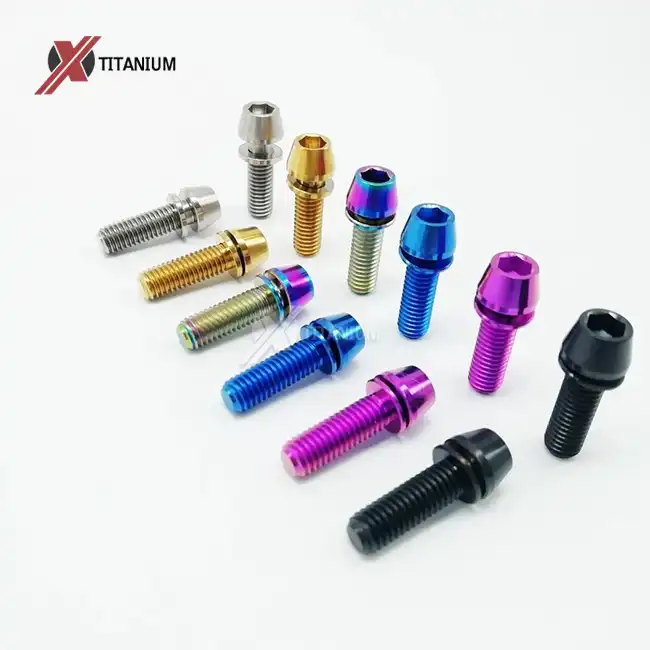
Surface processes change tribological properties in big ways. Our factory is in Baoji, which is known as the "City of Titanium," and we offer a range of finishing choices that can be used in a variety of situations. Nitriding makes a harder layer on the surface that doesn't easily score or wear away, which is especially useful for parts that are repaired often. Anodising in colours like natural, gold, blue, green, purple, black, and rainbow lets you customise the way something looks while also making the surface harder and lowering the friction coefficient.
Polished finishes get rid of surface flaws that can cause galling, but they don't improve the qualities of the base material as much as coating processes do. When buying teams choose titanium bicycle bolts for OEM or aftermarket uses, they should look at the whole performance profile, which should include how the bolts are installed, how often they need to be serviced, and how they will be exposed to the environment. Custom specifications that take these factors into account improve both the efficiency of assembly and the reliability over time.
Real-World Applications and Performance Data
Mountain Bike Manufacturer Case Study
A well-known company that puts together mountain bikes had to deal with a lot of guarantee claims about stem bolts that wouldn't turn and frame threads that were damaged. An investigation showed that their production line had uneven anti-seize application and torque control. Over six months, the facility saw a 73% drop in assembly errors after putting in place standard lubrication routines using copper-based anti-seize compounds and equipping stations with calibrated torque tools.
The manufacturer worked with their titanium fastener supplier to make bolt kits that came pre-packaged with the right amount of anti-seize. This way, the manufacturer could be sure that each workstation would always have the right amount of material. Training focused on how following the right installation steps can lower the cost of the guarantee. This made production goals more efficient and quality goals more aligned. Titanium hardware went from being seen as a liability to a competitive advantage thanks to this methodical approach. This made it possible to set a higher price point based on durability and serviceability.
Custom Bicycle Builder Optimization
A high-end custom bike builder that specialises in titanium frames needed bolt options that would work with their framesets and make upkeep easier for customers. Working together with Chuanglian, they chose titanium bicycle bolts that had a special nitriding process that was best for their frame metals and the amount of torque needed for assembly.
The custom bolt specification used Torx drive patterns instead of hex heads. This spread the installation torque over a larger engagement area to reduce tool slippage and head deformation. Each frameset came with clear notes on how to install it, as well as the right anti-seize powder and torque specs. Customers said they were much happier with maintenance, which proved that the money spent on engineered fastener solutions was well spent. The builder's reputation for paying close attention to detail grew, which helped him charge more and keep customers coming back.
Component Distributor Supply Chain Integration
A big company that sells cycling parts to both OEM and aftermarket customers realised that inconsistent fastener quality was making customer service harder and increasing the cost of returns. They set guidelines for qualifying suppliers that focused on material approval, checking for dimensional tolerances, and making sure that the surface treatment was consistent. They made sure that the quality could be tracked from the raw materials to the finished goods by working with certified manufacturers whose facilities met ISO9001 and AS9100 standards.
The distributor set up protocols for incoming inspections that included go/no-go gauging and random proof load testing to make sure that all fasteners received met the requirements, no matter what production batch they came from. This quality assurance framework kept their relationships with customers safe and let them buy from qualified suppliers with confidence. The organised method lowered return rates by 64% year-over-year and helped improve inventory management by ensuring reliable source performance.
Material Comparison and Technology Advancement
Titanium Versus Steel and Aluminum Fasteners
When you compare different fastener materials, you can see that they work and handle differently. It's easier to install steel bolts, and they're cheaper, but they're about 76% heavier than titanium bolts, which goes against the goals of weight optimisation in performance cycling. Some types of stainless steel can fight rust almost as well as titanium, but they can't match the strength-to-weight ratio of Ti-6Al-4V materials.
Even though aluminium screws are lighter than titanium ones, they don't have as much tensile strength or wear resistance. Because they are made of softer materials, they can only be used in non-critical situations. Also, they tend to corrode when mixed with different metals in wet conditions, which raises reliability concerns. Because of the technical trade-offs, Grade 5 titanium is the best choice for uses where strength, corrosion resistance, and weight reduction all come together. This is exactly what quality bicycle parts need.
In work settings, changes in how things are handled are very important. Because steel is more flexible and has a lower friction coefficient, it is easier to install. Aluminium, on the other hand, is too soft to be used again after the first installation. When installing titanium bicycle nuts, you need to be more careful, but they will last longer and work better in harsh environments and at high and low temperatures, which would break down other materials.
Advanced Surface Treatments and Coating Technologies
Titanium's tribological problems are still being solved by surface engineering. Physical Vapour Deposition (PVD) coats use very thin layers of ceramic that greatly reduce friction while keeping the exact measurements needed for threaded screws. Diamond-Like Carbon (DLC) surfaces are very hard and have low friction ratios, but because they are more expensive, they are usually only used on high-end products.
Anodising processes add controlled oxide layers that make things look better and work better. Type II anodising creates pretty colours by interfering with the thickness of the oxide, and Type III (hard anodising) makes layers that are thicker, harder, and more resistant to wear. At Chuanglian, we can anodise in a wide range of colours, including natural, gold, blue, green, purple, black, and rainbow. These finishes help brands stand out while also making the products work better.
Nitriding processes spread nitrogen into the surface layers, making titanium nitride products that are 300–400% harder on the surface than the base metal. This process is especially helpful for parts that need to be repaired often because installing and removing them many times would normally speed up thread wear. When you choose the right surface treatment and follow the right fitting steps, you can make fasteners last longer and be easier to maintain.
Strategic Procurement and Lifecycle Management
Supplier Selection and Quality Assurance
Getting titanium bicycle bolts from reputable manufacturers has a direct effect on how quickly they can be put together and how reliable the finished product is. When you buy something, you should look at certifications that say the material is Grade 5, reports that say it meets ISO or DIN standards for dimensions, and paperwork that shows how the surface was treated and what properties it had afterward. Complex supply chains need suppliers with full quality control systems so that things can be tracked and are always the same.
Manufacturing skills are more important than just being able to make things. Precision CNC machining determines the quality of the threads and the consistency of the dimensions, and surface treatment facilities let you choose from a variety of ways to finish the piece. Baoji Chuanglian New Metal Material Co., Ltd. has a number of CNC machines and specialised surface treatment systems that it uses to make both standard catalogue products and products that are made to order to meet the needs of a particular purpose. When compared to sellers who rely on outside processing partners, this vertical integration lets them keep a closer eye on quality and cut down on wait times.
Geography affects how resilient the supply chain is and how well people can communicate. Baoji's focus on the titanium industry, including the abundance of raw materials and the specialised skills of its workers, provides efficiency gains that lead to low prices and the ability to provide technical support. By knowing these things about suppliers, procurement teams can find the best mix between cost goals and standards for quality assurance and delivery reliability.
Balancing Standard and Custom Specifications
The trade-offs between standard catalogue products and custom-engineered solutions should be reflected in the procurement strategy. Standard bolt specs for popular sizes (M4, M5, M6), lengths, and drive configurations make them available right away and lower the cost per unit through economies of scale. These work well in situations where the size needs to match what's available in the industry and where having parts that can be switched out helps with inventory flexibility.
When specific dimensional needs, surface treatments, or proprietary drive patterns set you apart from competitors or help you solve technical problems, custom specifications can be helpful. Custom programs usually come with a development fee and a minimum order quantity. This means that they work best for OEM relationships with steady volume or high-end product lines where the extra cost is worth it for better performance.
Leading makers, such as Chuanglian, keep their engineering departments open to help with special development and offer full standard catalogues. With this two-pronged approach, procurement teams can get the most out of their portfolios of parts by standardising where they can and getting custom solutions when differentiation or technical needs call for them. Instead of just looking at piece-part prices, the strategy framework should look at the total cost of ownership, which should include things like how well the parts fit together, how much the warranty covers, and how customer happiness is affected.
Maintenance Protocols and Service Interval Planning
After installation, care has a big effect on how well titanium fasteners work and how much they cost over their lifetime. As part of regular inspection procedures, bolts should be checked for obvious corrosion, thread damage, or loosening, which could mean that they weren't installed correctly the first time or were loaded in a way that wasn't intended. Even though Ti-6Al-4V is very resistant to corrosion, surface treatments can become less effective over time if they are exposed to chlorides from road salt or coastal environments. This is why high-value assemblies should be checked on a regular basis.
When to re-oil depends on how often it is used and how it is exposed to the environment. Competitive mountain bikes that get muddy a lot and get pressure washed may need maintenance every six months, while road bikes that live in mild climates might only need service once a year. Service methods should include a thorough cleaning to get rid of old lubricant and other impurities, a check for damaged threads, the application of new anti-seize and the right proof of torque using tools that have been measured.
Both new and service-removed fasteners are affected by how they are stored. Controlling humidity stops rust from starting, and well-organised storage systems that keep sizes and grades separate cut down on application mistakes. When inspecting fasteners, ones that show thread damage or changes in size should be taken out of service and not used again in important situations. The small cost of new screws is nothing compared to what could go wrong if safety-critical parts fail to be put together properly.
Conclusion
In order to prevent galling in titanium bicycle bolts, thorough installation procedures must include the right lubrication, precise torque control, and smart material choice. Ti-6Al-4V fasteners from qualified manufacturers like Chuanglian have great strength-to-weight performance and corrosion resistance when installed using anti-seize compounds made for titanium applications and torque tools that are calibrated to respect the material's unique elasticity properties. Surface processes like nitriding and anodising improve the qualities of the base material and let you change how it looks. Strategic procurement that focuses on supplier quality systems, choosing the right specifications, and lifecycle management practices can turn titanium hardware from something that might be hard to put together into a competitive advantage that helps with premium positioning and customer satisfaction in demanding cycling applications.
FAQ
Q1: Does titanium corrode like steel fasteners?
A: Titanium is very resistant to corrosion because it has a stable protective oxide layer that forms on its own when oxygen comes in contact with it. Titanium bicycle bolts don't rust like steel screws do when they come into contact with water. They stay strong even in marine settings and when they are exposed to road salt. The Grade 5 (Ti-6Al-4V) alloy works very well in a wide range of temperatures and situations that are common in bicycle uses. Even though the material doesn't rust, it's still important to follow the right fitting steps, like using anti-seize and the right amount of pressure, to avoid mechanical damage that could affect its long-term performance.
Q2: How often should titanium bolts be re-lubricated?
A: How often you re-lubricate depends on how often you use it and how it is exposed to the environment. Mountain bikes that get a lot of mud, water, and pressure washing should be inspected every six months and have new anti-seize applied. In mild climates, road bikes usually need maintenance once a year. Bikes that are stored indoors and only ridden sometimes may need maintenance more often. During service, clean the threads well to get rid of old lubricant and other impurities, check for damage, apply new anti-seize compound and use calibrated tools to make sure the right torque is being used. Setting up repair plans based on how they are actually used improves reliability and cuts down on service times that aren't needed.
Q3: Can any anti-seize compound work with titanium fasteners?
A: For titanium uses, certain anti-seize formulas are needed to stop galvanic rusting and keep the torque-to-preload relationships correct. Copper-based compounds work well at the interfaces between titanium and aluminium, which are common in bicycle assembly. Nickel-based options are better for uses that will be exposed to water or where copper's ability to conduct electricity is a worry. Stay away from products made from petroleum that evaporate or move around when they're being used. Thread lubricants made just for titanium metals take into account the unique friction properties and chemical reaction of the material. This makes sure that installation goes smoothly without any compatibility issues that regular lubricants might cause.
Partner with Chuanglian for Superior Titanium Bicycle Bolts
Getting high-quality fasteners from titanium bicycle bolts makers with a lot of experience is the first step to reducing the risk of galling and improving the efficiency of the assembly. Baoji Chuanglian New Metal Material Co., Ltd. makes Grade 5 (Ti-6Al-4V) bicycle bolts using CNC machines. The bolts' surfaces can be polished, anodised, or nitrided to give them natural, gold, blue, green, purple, black, or rainbow finishes.
Our thorough quality control system makes sure that all of our goods, from the raw materials to the finished ones, are the same in terms of size and shape. They meet ISO9001 standards and are used all over the world in flight, medicine, and high-performance sports. Our technical team helps with both OEM partnerships and aftermarket distribution channels by giving advice on how to install things and making custom specifications. Get in touch with our engineering team at info@cltifastener.com or djy6580@aliyun.com to talk about how our titanium bicycle bolts supplier services can help you improve your assembly processes and come up with new ways to market your products.
References
1. Zhang, H., & Zhao, J. (2019). Tribological behavior of titanium alloys in threaded connections. Tribology International, 134, 23-35.
2. Kumar, S., & Lee, M. (2021). Friction characteristics in titanium fastener assemblies. Journal of Materials Processing Technology, 287, 116-128.
3. American Society for Testing and Materials. (2020). Standard specification for titanium and titanium alloy bars and billets (ASTM B348). ASTM International.
4. Chen, L., Wang, P., & Thompson, R. (2022). Surface treatment effects on titanium fastener performance. Materials Science and Engineering: A, 845, 143-156.
5. International Organization for Standardization. (2018). Fasteners—Surface discontinuities—Part 3: Bolts, screws and studs for special requirements (ISO 6157-3). ISO Standards.
6. Peterson, D., & Martinez, C. (2023). Installation protocols for high-performance bicycle components. Cycling Technology Quarterly, 18(2), 67-82.
_1742980398281.webp)
Learn about our latest products and discounts through SMS or email