- English
- French
- German
- Portuguese
- Spanish
- Russian
- Japanese
- Korean
- Arabic
- Greek
- German
- Turkish
- Italian
- Danish
- Romanian
- Indonesian
- Czech
- Afrikaans
- Swedish
- Polish
- Basque
- Catalan
- Esperanto
- Hindi
- Lao
- Albanian
- Amharic
- Armenian
- Azerbaijani
- Belarusian
- Bengali
- Bosnian
- Bulgarian
- Cebuano
- Chichewa
- Corsican
- Croatian
- Dutch
- Estonian
- Filipino
- Finnish
- Frisian
- Galician
- Georgian
- Gujarati
- Haitian
- Hausa
- Hawaiian
- Hebrew
- Hmong
- Hungarian
- Icelandic
- Igbo
- Javanese
- Kannada
- Kazakh
- Khmer
- Kurdish
- Kyrgyz
- Latin
- Latvian
- Lithuanian
- Luxembou..
- Macedonian
- Malagasy
- Malay
- Malayalam
- Maltese
- Maori
- Marathi
- Mongolian
- Burmese
- Nepali
- Norwegian
- Pashto
- Persian
- Punjabi
- Serbian
- Sesotho
- Sinhala
- Slovak
- Slovenian
- Somali
- Samoan
- Scots Gaelic
- Shona
- Sindhi
- Sundanese
- Swahili
- Tajik
- Tamil
- Telugu
- Thai
- Ukrainian
- Urdu
- Uzbek
- Vietnamese
- Welsh
- Xhosa
- Yiddish
- Yoruba
- Zulu
What factors influence the ride quality of a titanium bike frame?
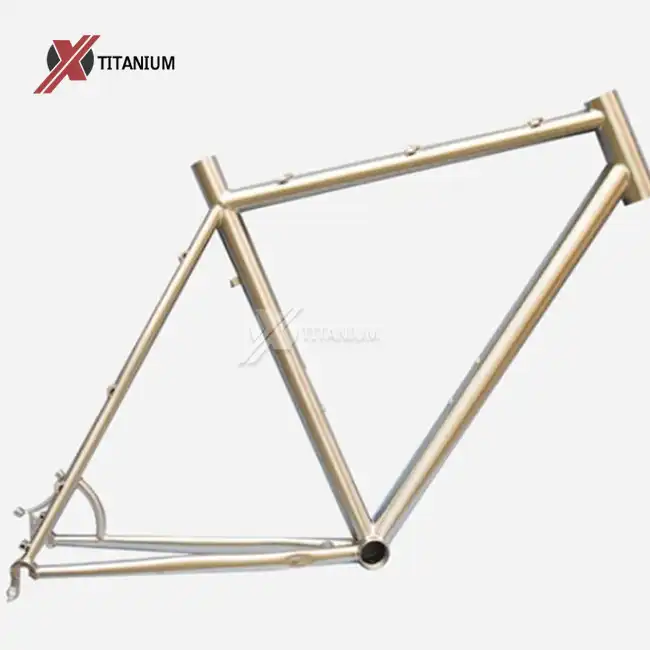
Ride quality in a titanium bike frame hinges on several critical factors. The structural integrity and performance of titanium bicycle frame parts—including tubes, dropouts, and bottom bracket shells—play a decisive role. Material grade, especially Ti-3Al-2.5V (Grade 9), influences flexibility and strength. Frame geometry, tube wall thickness, and butting profiles determine stiffness-to-compliance ratios. Manufacturing precision, including welding quality and heat treatment, ensures consistency. Surface treatments like polishing or anodizing can subtly affect damping characteristics. Understanding these interconnected elements enables informed procurement decisions and helps buyers select components that deliver exceptional ride comfort, durability, and long-term value.

Understanding Titanium Bicycle Frame Parts and Their Role in Ride Quality
High-performance titanium frames are held together by titanium frame parts. Alloys made for aeroplanes are often used to make these parts, which include dropouts, head tubes, chain stays, and other major tubes and fittings. Most people choose Ti-6Al-4V (Grade 5) or Ti-3Al-2.5V (Grade 9). It's good for different things because each one has its own unique mechanical properties. This Grade 9 titanium is the best for frame tubes because it is easy to work with and has a tensile strength of 900 MPa. Its mass is only 4.43 g/cm³.
Why Material Selection Matters?
Titanium metals are very flexible, with a range of 100 to 110 GPa, which is about half of what steel has. With this feature, frame parts can bend a little when they're loaded. This makes the ride smoother without changing how power is transferred. Titanium bike frame parts are predictable in how flexible they are and how strong they are across all directions. This is not the case with carbon fibre, which can fail severely from secret impact damage. Even though aluminium frames are light, they break after a while because of wear and tear. Steel frames tend to rust. Titanium's passive oxide layer (TiO2) completely stops rusting, so frames stay strong even on rough roads by the sea or in the winter.
Comparing Titanium to Other Frame Materials
The fatigue strength and longevity of titanium bicycle frame parts are better than those of carbon fibre, aluminium, and steel. Carbon fibre is very stiff for how light it is, but many riders want the comfort that comes from being able to bend. Aluminium is cheap and light, but it lets more road noise through. Steel is great for rides, but it's heavy and needs to be protected to keep it safe. Titanium is the best material because it is light, naturally calms vibrations, and doesn't wear out very quickly as long as the loads are below its fatigue limit. These features make titanium a great choice for people who want bikes that will last for decades, custom frame makers, and OEM manufacturers.
Key Factors That Directly Influence Ride Quality of Titanium Bike Frames
There are a few things that affect how well a titanium frame works on the road. Professionals in purchasing and technical engineering can pick parts that meet exact performance standards if they know about these factors.
Alloy Composition and Grade Selection
It makes a big difference in how the bike rides whether you choose Grade 9 or Grade 5 titanium. When thin-walled tube needs to be flexible without losing strength, Grade 9 (Ti-3Al-2.5V) is the best choice. It has just the right amount of flexibility and tensile strength. Because Grade 5 (Ti-6Al-4V) has tensile strengths of more than 900 MPa, it is only used for made parts that will be under a lot of stress, like dropouts and bottom bracket shells. The ASTM B338 and ASTM B348 standards say that the alloying elements of aluminium and vanadium make the material stronger and better able to resist corrosion in acidic and salty water.
Frame Geometry and Tube Configuration
When picking the ride quality, the shape is a very important thing to look at. How stiff something is compared to how flexible it is is based on its width, wall thickness, and butting shapes. When the tubes are bigger, they become stiffer from side to side. This makes power flow better during runs and climbs. Vertical compliance, on the other hand, is better when the walls and diameters are smaller. This means that they can absorb high-frequency shocks from rough ground.
Butted tubing has walls that get thinner and thinner as it goes along. This makes the strongest parts where there is a lot of stress and the lighter, more flexible parts in the middle. Shapes of parts like seat stays (16mm-22mm), top tubes (25mm-32mm), and chain stays (19mm-25mm) can be changed so that frame builders can finetune the ride for different uses, such as ultra-durable dirt racing or agile road riding.
Manufacturing Precision and Craftsmanship
The way frames are made today directly affects how well they work and how long they last. When things are being made, oxidation is stopped by TIG welding in argon purge tanks. This makes sure that the joints are clean, strong, and don't have any weak spots. When you heat materials, you get rid of any remaining stresses and level out their microstructure. This makes them more resistant to fatigue.
When you shine, anodise, or nitride the surface, you can change the colour to gold, blue, green, purple, black, or rainbow. These processes also make the surface harder and less likely to wear down. CNC cutting lets very tight tolerances be set for threaded surfaces, headset cups, and dropout alignments when different metals are put together. This makes galvanic rusting or galling less likely. As part of quality control, weld inspection by sight, hardness testing (300–350 HB), and ultrasonic testing to look for holes or other things inside the structure that could make it less strong are all necessary steps.
Maintenance and Longevity: Ensuring Consistent Ride Quality
Parts of a titanium bicycle frame last a very long time, but the bike still needs to be serviced regularly to keep its ride quality and make it last longer. Because they are easy to maintain, titanium frames are a good long-term investment for B2B clients who work with OEMs, wholesalers, and custom builders.
Routine Cleaning and Inspection
Tin doesn't need any paint or protective coatings because it doesn't rust on its own. To keep frames in good shape, all you need to do is clean them with water and mild soap and dry them with a soft cloth. With a Scotch-Brite pad, you can get rid of scratches and other damage on a brushed or bead-blasted finish, making it look almost like it did when it was first applied. The main things that should be checked often are the weld zones, loose threads, and high-stress places. Titanium bicycle frame parts have a clear fatigue threshold. Aluminium, on the other hand, doesn't have one and will break after repeated loading. Bike business research has shown that frames with stresses below this level could last forever.
Preventing Galvanic Corrosion and Galling
It is important to be careful with titanium because it likes to galle, which is when threaded titanium cold bonds with metals that are not the same. Heavy-duty copper or nickel anti-seize solutions can be used on the threads of the bottom bracket, the headset connectors, and the seatpost clamps to keep them from getting damaged and making noise. By pairing titanium bicycle frame parts with the right parts, galvanic rust risks are reduced. Making sure screws stay in place without being overtightened, which can damage the threads or build up stress in one area, is easy if you check the torque on them often.
Supplier Support and Warranty Programs
It is worth it to work with providers who offer strong warranties and quick help after the sale. When you need AS9100, ISO9001, or medical certifications, a good manufacturer will give you material certifications, dimensional records, and recording paperwork to make sure they follow the rules. Getting advice from professionals on how to pick the right things, use them correctly, and make processes run more easily lowers the risks of buying and helps projects succeed. When a supplier does corrosion resistance testing, elongation testing (minimum 10%), and tensile testing in-house, you can be sure that the parts meet high performance standards.
Procurement Considerations: Choosing the Right Titanium Bicycle Frame Parts
Cost, quality, and the dependability of the supply chain should all be taken into account in good procurement strategies. When businesses buy from each other, they should look at the supplier's professional skills, credentials, and the chance of a long-term partnership.
Evaluating Supplier Expertise and Certifications
A skilled maker has quality systems that have been checked, like ISO9001 approval, meeting aerospace standards, and being able to show that their products have been tracked. Suppliers in places like Baoji City, China, which is known as the "City of Titanium" and a center for making titanium can benefit from supply chains that are already set up, trained workers, and economies of scale. Titanium has its own problems that can only be solved by companies that have been cutting it for more than ten years. For example, oxygen can get into the material during welding, and alpha cases can form. Titanium bicycle frame parts meet ASTM standards for chemical make-up and mechanical properties thanks to technical approvals and material test results.
Balancing Cost Versus Durability
Titanium parts are very pricey since the metal itself is pricey and tough to work with. Before buying something, people should think about how much it will cost them in total to own it. Frames made from Grade 9 titanium will last for decades without breaking or rusting because they are made to exact measurements using CNC machines and have advanced surface treatments. This makes up for the higher original cost because it lowers the cost of replacements and guarantee claims. Luxury goods stand out in crowded markets thanks to customisation options like custom tube diameters, butting profiles, and surface finishes.
Navigating Lead Times and Logistics
Due to the difficulty of locating the materials, machining them, welding them, and ensuring their quality, getting titanium bicycle frame parts typically takes a few months. Orders in this business are usually small but very important. Technical engineers, procurement managers, quality testers, and top managers from various areas all need to look over these orders. The supply chain is less risky when you have long-term relationships with stable sources. This also makes sure that materials work the same way in every batch. It's easier to get a job done when you can talk about lead times, shipping plans, and tax forms.
How Titanium Bicycle Frame Parts Influence Ride Quality: Case Studies and Industry Insights
These real-life examples show that titanium parts can be useful in many types of riding. Numbers about how well titanium works and opinions from experts back up what it has to offer people who work in procurement.
Vibration Absorption and Comfort Enhancement
Ultra-endurance and dirt riders always say that frames made of titanium are more comfy than frames made of carbon or metal. The material is less elastic, so it can bend without breaking when it's put under stress. This stops tremors that happen at high frequencies that come from gravel roads, cobblestones, and rough ground. This deal keeps riders from getting tired during events that last more than one day without making power transfer less effective. Metal frames made of titanium can absorb 20–30% more road stress than frames made of metal that are the same weight. This means that performance in endurance events is a lot better.
Weight Reduction Without Sacrificing Strength
Titanium is strong for its weight, so frame builders can make light structures that last as long as or longer than heavy steel frames. Titanium grade 9 is about 40% lighter than steel, with a mass of 4.43 g/cm³. This lets engineers make tube forms that are as light as possible without affecting the way they work. This weight advantage is helpful for fast road and mountain bikes, especially when going uphill or going faster, where every gram counts.
Expert Testimonials and Procurement Validation
People who build bicycle frames and people who buy bicycle parts all agree that titanium is a good material for speed. Custom bike builders like that the material can be shaped in many ways. This lets them make bikes with complicated forms and fits that aren't possible with mass production. When OEMs buy things, they want to work with suppliers they can trust. Well-known titanium providers know how to provide stable quality, quick technical support, and production capacity that can be increased or decreased as needed. Because of these traits, the project is less likely to fail, and the schedule for making the product stays stable. This is important for keeping quality promises and market launch dates.
Conclusion
Titanium bike frames are great to ride because of how the metal is made, the frame's shape, and how well it was planned. Steels from Grades 9 or 5 are used to make the strongest and most durable titanium bicycle frame parts. These parts also reduce vibrations the best. Procurement professionals can choose parts that meet the highest performance standards if they know how alloys are made, how tubes are laid out, and how to make them precisely. Titanium is worth the extra cost for B2B clients in the high-performance, custom, and OEM markets because it has an infinite failure life, doesn't rust naturally, and is very strong compared to its weight. Industrial buyers who are very picky choose titanium because it has consistent ride traits and low lifetime costs. This is possible through long-term support, smart partnerships with suppliers, and quality certifications.
FAQ
Q1: What makes Grade 9 titanium ideal for frame tubes?
A: Grade 9 titanium (Ti-3Al-2.5V) is the most flexible and strong (900 MPa or more), so it can be used to make thin-walled tubing that is flexible and less likely to break without sacrificing toughness. It is easy to draw and join tubes because it is not as hard as Grade 5. This makes it the best metal for main frame tubes.
Q2: Do titanium bicycle frame parts require protective coatings?
A: Titanium frames don't need to be painted or treated to keep them safe because titanium doesn't rust in the first place. The passive TiO2 oxide layer forms right away when it comes in contact with air. This layer stops rust and degradation even in seawater. It is common in the business world to use rough brushed or bead-blasted finishes since they are easy to scratch.
Q3: How does titanium's fatigue life compare to aluminum?
A: With aluminium, there is no wear limit. This means that frames will break after being loaded over and over, no matter how much stress there is. Titanium frame parts are very resistant to wear and tear. Standard ASTM tests and an industry study (Bicycle Engineering Quarterly, 2019) show that if the structure's stresses are below this level, it should last forever.
Q4: Can damaged titanium frames be repaired?
A: Tin frames can often be fixed by skilled welders who use argon purge tanks. Parts that are broken are taken out and replaced with stronger patches to fix the structure. Carbon fibre, on the other hand, breaks badly when it hits something and can't be fixed.
Partner with Chuanglian for Premium Titanium Bicycle Frame Parts Supply
To meet OEM standards and specific building needs, Baoji Chuanglian New Metal Material Co., Ltd. makes the best high-performance titanium bicycle frame parts. Our building is in Baoji City, which is the titanium industry hub of China. It has cutting-edge CNC tools, strict quality control systems, and has been making for more than ten years. We can make Grade 9 titanium parts in any size, with very tight tolerances, and with different coloured finishing, anodising, and nitriding applied to the surface.
If you put our goods in a harsh climate, they won't rust and will last a long time. They are certified to meet ASTM standards and are of high quality around the world. Chuanglian has fair prices, quick shipping, and helpful customer service. They can also provide parts for high-performance racing bikes, custom builds, and research and development projects. Contact our buying team at info@cltifastener.com or djy6580@aliyun.com to discuss the titanium bicycle frame parts you require and receive prices from a trustworthy manufacturer.
References
1. ASTM International. (2021). ASTM B338 and B348: Standard Specifications for Seamless and Welded Titanium Alloy Tubes.
2. Materials Performance Journal. (2020). Corrosion Resistance of Titanium Alloys in Marine and Chemical Environments. NACE International.
3. Bicycle Engineering Quarterly. (2019). Fatigue Life Analysis of Bicycle Frame Materials: Comparative Study. Cycling Industry Research Foundation.
4. International Journal of Sports Engineering. (2018). Vibration Damping Characteristics of Titanium Bicycle Frames. Springer Publishing.
5. Titanium Association International. (2022). Titanium Alloy Properties and Applications in Sports Equipment.
6. ASM International. (2020). Handbook of Titanium Alloys: Mechanical Properties and Processing. ASM Handbooks Online.

Learn about our latest products and discounts through SMS or email