- English
- French
- German
- Portuguese
- Spanish
- Russian
- Japanese
- Korean
- Arabic
- Greek
- German
- Turkish
- Italian
- Danish
- Romanian
- Indonesian
- Czech
- Afrikaans
- Swedish
- Polish
- Basque
- Catalan
- Esperanto
- Hindi
- Lao
- Albanian
- Amharic
- Armenian
- Azerbaijani
- Belarusian
- Bengali
- Bosnian
- Bulgarian
- Cebuano
- Chichewa
- Corsican
- Croatian
- Dutch
- Estonian
- Filipino
- Finnish
- Frisian
- Galician
- Georgian
- Gujarati
- Haitian
- Hausa
- Hawaiian
- Hebrew
- Hmong
- Hungarian
- Icelandic
- Igbo
- Javanese
- Kannada
- Kazakh
- Khmer
- Kurdish
- Kyrgyz
- Latin
- Latvian
- Lithuanian
- Luxembou..
- Macedonian
- Malagasy
- Malay
- Malayalam
- Maltese
- Maori
- Marathi
- Mongolian
- Burmese
- Nepali
- Norwegian
- Pashto
- Persian
- Punjabi
- Serbian
- Sesotho
- Sinhala
- Slovak
- Slovenian
- Somali
- Samoan
- Scots Gaelic
- Shona
- Sindhi
- Sundanese
- Swahili
- Tajik
- Tamil
- Telugu
- Thai
- Ukrainian
- Urdu
- Uzbek
- Vietnamese
- Welsh
- Xhosa
- Yiddish
- Yoruba
- Zulu
How to Select Titanium Bike Bottle Cage Bolt for Custom Frames
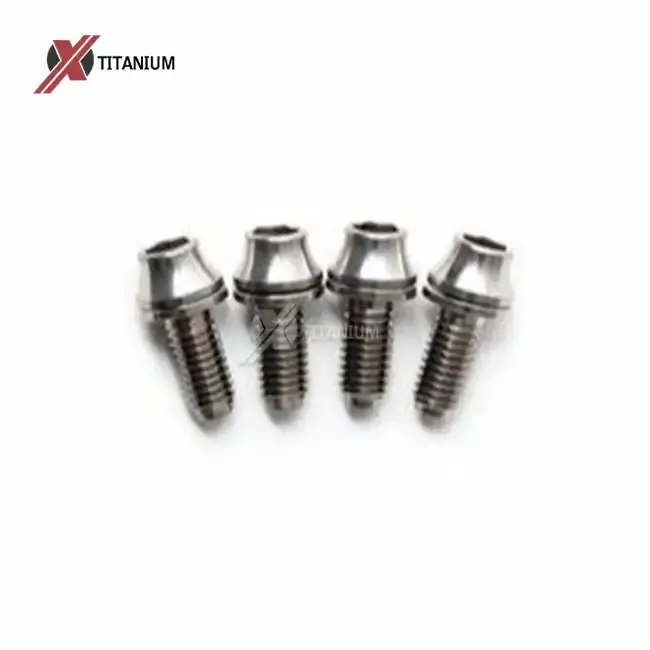
Selecting the right titanium bike bottle cage bolt for a custom frame requires more than picking the cheapest option. The bolt must match your frame's thread standard, tolerate environmental stress, and deliver reliable clamping force without adding unnecessary weight. Grade 5 Ti-6Al-4V bolts — CNC-machined to M5×0.8mm pitch — represent the industry benchmark for this application. With tensile strength reaching 950 MPa and a per-bolt weight of roughly 1.5g, they outperform both steel and aluminum alternatives in longevity, corrosion immunity, and aesthetic versatility.
Understanding Titanium Bike Bottle Cage Bolts: Features and Benefits
What Makes Titanium the Preferred Fastener Material?
Grade 5 titanium (Ti-6Al-4V) gets a passive oxide layer on its surface. This makes it chemically inactive against salt spray, sweat, sports drink residue, and road dust. This trait can be measured and is well-documented. ASTM B348 shows that Ti-6Al-4V keeps its structure in places with a lot of chloride, which makes stainless steel and aluminum fasteners break down. The normal steel cage bolt weighs about 3g, while the titanium equivalent weighs about 1.5g. This means that each bolt is 50% lighter. That difference adds up to a big performance boost for weight-conscious builds when spread out over four mounting spots on a custom frame.
Titanium has a benefit over other metals that goes beyond its raw numbers. This benefit is especially important for bicycle uses. Every bolt is put under repeated micro-loads by road shaking and trail chatter. It is because titanium has a higher fatigue limit than most aluminum metals that it won't let a crack spread. This is why more and more OEM bike brands are specifying titanium parts on high-end carbon and titanium frames. Chuanglian's titanium cage bolts come in seven anodized colors: natural titanium, gold, blue, green, purple, black, and rainbow. The surface can also be polished, anodized, or nitrided. For online sellers, this color range directly addresses the "color-matching culture" that makes people buy things on sites like Instagram and Amazon.
Key Selection Criteria for Titanium Bike Bottle Cage Bolts on Custom Frames
Matching Thread Specifications to Your Frame
For mounting a bottle cage on a bike with a titanium bike bottle cage bolt, the standard is M5x0.8mm pitch with lengths between 12mm and 16mm. If you go outside of this range, you run the real risk of losing clamping depth in the frame's rivnut with a bolt that is too short, or getting false torque readings with a bolt that is too long. When Chuanglian machines these bolts, they make sure that the length is within ±0.1mm and the head diameter is within ±0.05mm. This way, there is no variation in size between orders. Custom frames, especially those made from carbon fiber or titanium tubes, often have thin-wall rivnuts that need to be very precise (ISO metric thread class 6g). During production, a Go/No-Go gage check makes sure of this agreement before any bolt ships.
Head Drive Type and Torque Compatibility
Choosing the right head type affects both the reliability of the installation and how it looks. For mounting on a bottle cage, these are the drive configurations that matter:
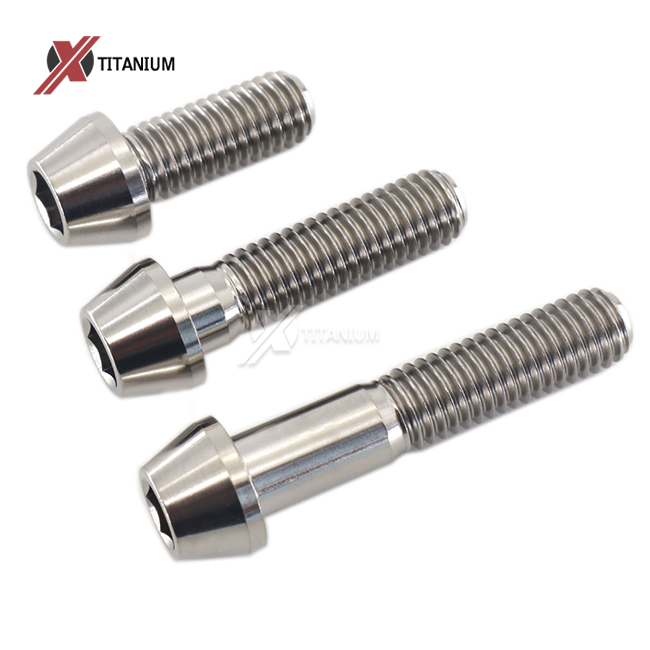
- Hex (Allen) drive — 3mm or 4mm: The most common choice for roadside adjustability. Grade 5 titanium resists rounding at the recommended 4–5 Nm installation torque, unlike softer Grade 2 variants.
- Torx drive: Distributes torque across more contact surface, reducing the risk of cam-out during installation on carbon frames where overtightening causes irreversible damage.
- Button head: A low-profile aesthetic option suited to builds where bolt-head visibility is a design consideration.
If you choose the right drive type at the beginning, you can avoid the most common installation mistake that leads to bad reviews for online sellers: stripped heads.
Comparing Titanium Cage Bolts to Alternative Materials
Why Titanium Wins the Long-Term Value Equation?
A lot of buying managers only look at the price per unit when deciding between a titanium bike bottle cage bolt, aluminum, and stainless steel. That comparison doesn't take into account the costs that come after. Aluminum bolts are cheap and light, but their hex screws round out easily after being installed many times, and when they come into touch with wet carbon fiber frames, they rust. Strong, but heavy, stainless steel bolts can get stuck in aluminum or titanium frame threads, which is called a "frozen bolt" and makes customers return bikes under warranty and leave bad reviews on online stores.
Titanium works well with both carbon fiber and aluminum metals because it doesn't let the electrochemical processes happen that speed up corrosion at contact points happen. Its density of 4.43 g/cm³ is about the same as aluminum (2.7 g/cm³) and steel (7.8 g/cm³), but its 950 MPa tensile strength at Grade 5 is much higher than that of either aluminum or steel. Titanium is the only material that really covers all three performance aspects at the same time because it is light, strong, and chemically stable. Titanium cage bolts usually have a retail margin of 70% to 85% for B2B buyers who are managing SKU profitability. Each bolt costs $0.50 to $1.00, and the retail price ranges from $3 to $8. There is no similar group of aluminum or stainless steel bolts that offers that margin structure.
Procurement Best Practices for Titanium Bike Bottle Cage Bolts
Evaluating Supplier Credibility Before Committing to Volume
One layer of quality risk is removed when you buy titanium fasteners from a confirmed maker instead of a trade business. Important things to look for in a supplier are XRF material verification (to make sure the material is actually Ti-6Al-4V and not a cheaper Grade 2 substitute), documented thread gage inspection records, and batch color consistency data. The lack of batch color consistency data is the main complaint in online reviews of anodized titanium hardware.
Chuanglian is based in Baoji, China, which is known as the global center for titanium processing. They have been CNC-machining titanium bike bottle cage bolt parts for more than ten years. The business keeps normal M5×0.8mm bolts in stock in all seven color choices, with a 7–10 day delivery window. The minimum order quantity (MOQ) is 500 pieces, and you can order a mix of colors. This is perfect for small e-commerce businesses that need to manage multiple color SKUs. When negotiating volume prices, market rates should be used as a guide, and shipping speed should also be taken into account. Putting together a mixed-color order of 1,000 to 5,000 pieces into a
Installation and Maintenance of Titanium Bike Bottle Cage Bolts
Correct Installation Prevents the Most Common Field Failures
Titanium can gall, which is a cold-welding effect that happens when oxide layers on the surface bond together under pressure. This can't happen at all if you put a little copper-based or titanium-specific anti-seize compound on the bolt holes before you place them. The recommended torque for installation is between 4 and 5 Nm. This limit is usually set by the frame's rivnut or the material of the cage, not by the bolt's own yield point. For custom frames, you should use a measured torque wrench instead of a multi-tool for fitting. In carbon frames, rivnut pull-through is usually caused by over-torquing, which hurts both the bolt and the frame.
Regular upkeep is easy: wipe the bolts clean after riding in salty or wet weather, check the hex/torx holes for debris buildup every year, and re-torque them. Titanium doesn't rust, so the surface doesn't break down much during normal riding. However, checking the thread integrity every season will increase the service life and keep hardware from breaking down in the middle of a ride.
Conclusion
Choosing a titanium bike bottle cage bolt is a very precise purchase choice. Material grade, thread accuracy, drive type, surface finish consistency, and supplier verification all play a role in how well the product works in the field and how well it does in the market. CNC-machined to tight specs, Grade 5 Ti-6Al-4V bolts come in a variety of anodized colors and are the best combination of performance, looks, and profit for both custom bike builds and e-commerce product lines. The best way to get long-lasting procurement results is to match the criteria to the application and the quality standard to the seller.
FAQ
Q1: Are titanium cage bolts truly rustproof?
A: Yes. Ti-6Al-4V forms a stable passive oxide film that resists atmospheric corrosion, salt spray, and acidic biological fluids including sweat. Unlike stainless steel, which can develop surface rust in chloride-rich environments, titanium remains visually and structurally unchanged over extended service periods.
Q2: Will these bolts fit my existing aluminum bottle cage mounts?
A: Standard M5×0.8mm titanium bolts are dimensionally interchangeable with aluminum or steel bolts on any frame using the industry-standard braze-on or rivnut mounting system. No frame modification is required.
Q3: Do I need anti-seize compound?
A: Yes. Titanium threads can gall against themselves or other metals without lubrication. Apply anti-seize paste to threads before installation. This is not a product defect — it is standard practice for all titanium fasteners.
Q4: What torque setting should I use?
A: 4–5 Nm is the established industry standard for M5 bottle cage bolts. Use a calibrated torque wrench, particularly on carbon frames where over-torquing causes permanent damage.
Q5: Why specify Grade 5 over Grade 2?
A: Grade 5 (Ti-6Al-4V) offers significantly higher hardness and tensile strength. The hex or torx drive on a Grade 2 bolt can round out under normal installation torque, rendering the bolt unremovable without drilling — a critical failure mode in precision custom frames.
Source Your Titanium Cage Bolts Through Chuanglian
In Baoji, China, Chuanglian is a specialized titanium bike bottle cage bolt maker with production capacity that can be checked. You can order Grade 5 Ti-6Al-4V bolts in seven anodized colors, and we can ship stocked sizes in 7–10 days. The minimum order quantity is 500 pieces, and you can mix colors. OEM brand partners can get heads with different shapes, lengths, and finishes on the outside. You can email our sales and technical support team at info@cltifastener.com or djy6580@aliyun.com.
References
1. ASTM B348 Standard Specification for Titanium and Titanium Alloy Bar and Billet — ASTM International, 2021.
2. Titanium: A Technical Guide — Matthew J. Donachie, ASM International, 2000.
3. Bicycle Frame Materials and Performance — Cycling Science, Swann & Burke, Human Kinetics, 2019.
4. Corrosion of Titanium and Titanium Alloys — Corrosion: Fundamentals, Testing, and Protection, ASM Handbook Vol. 13A, 2003.
5. Fastener Design Manual — Richard T. Barrett, NASA Reference Publication 1228, 1990.
6. Mechanical Fastening, Joining, and Assembly — James A. Speck, CRC Press, 2nd Edition, 2015.

Learn about our latest products and discounts through SMS or email