- English
- French
- German
- Portuguese
- Spanish
- Russian
- Japanese
- Korean
- Arabic
- Greek
- German
- Turkish
- Italian
- Danish
- Romanian
- Indonesian
- Czech
- Afrikaans
- Swedish
- Polish
- Basque
- Catalan
- Esperanto
- Hindi
- Lao
- Albanian
- Amharic
- Armenian
- Azerbaijani
- Belarusian
- Bengali
- Bosnian
- Bulgarian
- Cebuano
- Chichewa
- Corsican
- Croatian
- Dutch
- Estonian
- Filipino
- Finnish
- Frisian
- Galician
- Georgian
- Gujarati
- Haitian
- Hausa
- Hawaiian
- Hebrew
- Hmong
- Hungarian
- Icelandic
- Igbo
- Javanese
- Kannada
- Kazakh
- Khmer
- Kurdish
- Kyrgyz
- Latin
- Latvian
- Lithuanian
- Luxembou..
- Macedonian
- Malagasy
- Malay
- Malayalam
- Maltese
- Maori
- Marathi
- Mongolian
- Burmese
- Nepali
- Norwegian
- Pashto
- Persian
- Punjabi
- Serbian
- Sesotho
- Sinhala
- Slovak
- Slovenian
- Somali
- Samoan
- Scots Gaelic
- Shona
- Sindhi
- Sundanese
- Swahili
- Tajik
- Tamil
- Telugu
- Thai
- Ukrainian
- Urdu
- Uzbek
- Vietnamese
- Welsh
- Xhosa
- Yiddish
- Yoruba
- Zulu
Why Choose Titanium Alloy Caliper Pistons for Racing Brake Systems
When braking performance is non-negotiable, the piston material inside your caliper makes all the difference. Titanium alloy caliper pistons — machined from aerospace-grade Ti-6Al-4V (Gr5) — deliver a decisive edge in racing environments: roughly 45% lighter than steel, with thermal conductivity approximately 18 times lower than aluminum. That combination suppresses brake fluid boiling, eliminates vapor lock, and preserves consistent pedal feel lap after lap. For OEM brake system manufacturers sourcing components that must pass PPAP scrutiny and survive rotor temperatures exceeding 800°C, understanding why titanium outperforms conventional materials is the starting point for every serious procurement conversation.
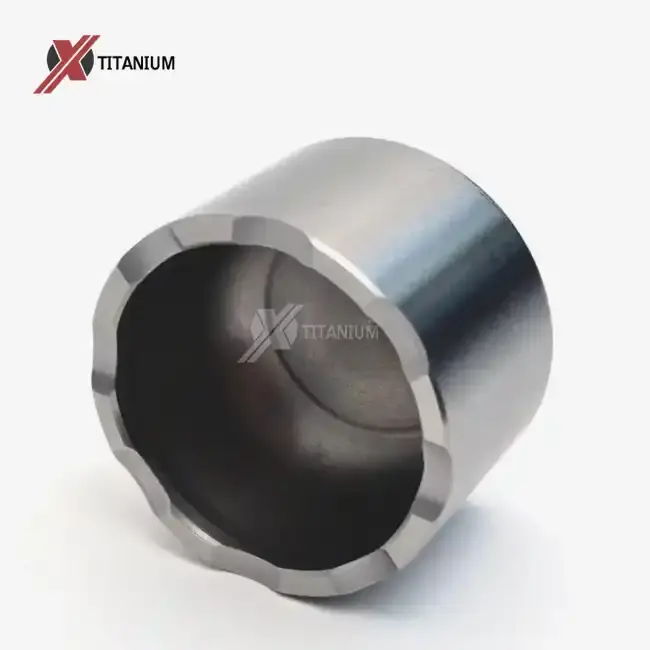
Understanding Titanium Alloy Caliper Pistons and Their Advantages
What Makes Ti-6Al-4V the Material of Choice?
The tensile strength of Grade 5 titanium (Ti-6Al-4V) is ≥950 MPa, and its mass is only 4.43 g/cm³. Because of this mechanical profile, the wall of a titanium alloy caliper piston can be kept thin, which improves the strength-to-weight ratio, without affecting its structural integrity when hydraulic pressures are high, like in four-pot or six-pot race brakes. The alloy also creates a passive oxide layer on its surface that keeps it safe from the electrochemical attack that breaks down chrome-plated steel pistons in both brake fluid and road salt.
Thermal Isolation as a Safety Mechanism
Ti-6Al-4V moves heat around at about 6.7 W/m·K, while aluminum moves heat around at about 130 W/m·K. In real life, titanium keeps the friction-heated pad and the hydraulic fluid from getting too hot. Since this feature stops the DOT fluid from boiling, it stays stable during long races like GT3 or Le Mans. This means that pedal pressure stays the same even when rotor temperatures rise above 700°C. In addition to keeping heat out, lighter pistons make the suspension respond faster because they have less unsprung mass. Engineers in the motorsports industry have found that using titanium pistons in the same caliper housing makes turn approach stability better over and over again.
Comparative Analysis: Titanium Alloy vs. Other Caliper Piston Materials
When choosing a material for brake pistons, you have to weigh the pros and cons of weight, thermal behavior, rust protection, and long-term cost. When it comes to real-world racing, these other choices compare to titanium:
- Steel pistons have a high compression strength, but they quickly transfer heat into the brake fluid, which speeds up wear when the brakes are used for long periods of time at hard stops. Their density (about 7.8 g/cm³) gives them useful spinning mass, and chrome plating finally pits in corrosive conditions, damaging seals.
- Aluminum pistons lose weight well, but they lose heat to fluid almost 20 times faster than titanium pistons. When riding at high temperatures for a long time, like on track days, mountain stages, or endurance circuits, aluminum pistons cause soft-pedal fade that titanium pistons don't cause at all.
- Ceramic and carbon pistons work best in niche applications with very high temperatures, like Formula-class race cars. However, they are very expensive, can break easily when exposed to sudden temperatures, and don't allow OEMs to make many changes to them.
Titanium alloy caliper pistons sit in the perfect performance range. They are lighter than aluminum, have mechanical strength similar to steel, are less likely to rust, and have better thermal insulation than either aluminum or steel. For OEM production runs of 5,000 to 20,000 pieces per month, they also offer a level of reliability in purchasing that rare composites don't usually give.
Manufacturing and Quality Assurance of Titanium Alloy Caliper Pistons
Precision CNC Machining to Racing Tolerances
Every titanium alloy caliper piston at Chuanglian starts with approved Ti-6Al-4V rod stock that meets ASTM B348 Grade 5. When using multi-axis CNC machining, the outer diameter must be within ±0.01 mm and the roundness must be within ≤0.005 mm. These are absolute requirements for the integrity of the hydraulic seal. Every production lot has a profilometer check to make sure that the sealing surfaces are finished to Ra ≤ 0.4 μm. After being machined, pistons are treated with a solution and aged to stabilize their mechanical properties and raise their hardness to the HRC 32–36 range, which is what brake system OEMs require.
Surface Treatment Options
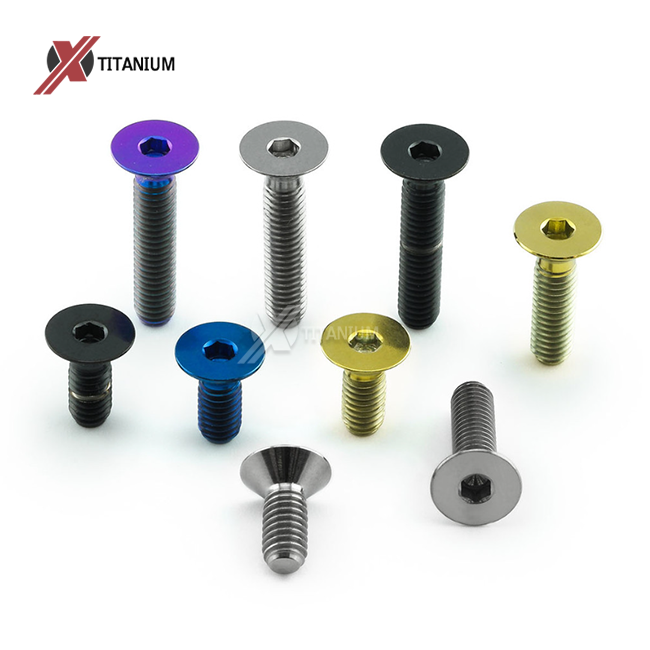
The choice of surface treatment depends on the operating environment and the needs of the OEM. Each of the choices—polishing, anodizing, PVD nitriding, and DLC coating—is used for a different reason. DLC coatings make the surface harder than 2,000 HV and the friction coefficient as low as 0.1. This keeps bare titanium from galling up against EPDM seals. Anodizing creates a thick metal layer that comes in many colors, including natural, gold, blue, green, purple, black, and rainbow. This helps quality caliper lines stand out from other products on the market. Full PPAP requirements are met by quality documentation, which includes dimensional reports, material certifications, Cpk data, and control plans. This is the whole package that auto and motorcycle OEMs need before they can approve a new component supplier.
Procurement Guide: How to Source and Evaluate Titanium Alloy Caliper Pistons?
To find a trustworthy manufacturer of titanium alloy caliper pistons, you need to look at more than just the unit price. The most important things for buying leaders and quality managers are:
- Tracking of materials: Every batch should come with Mill Test Certificates that say it meets ASTM B348 Gr5 standards. Metallurgical testing must prove that there isn't a brittle alpha-case layer, which is known to happen when titanium is made at the wrong cutting speeds.
- Verification of dimensions at scale: For caliper pistons, 100% checking with CMM reports is the norm, not AQL sampling. One piston that isn't within its limits on an assembly line can stop work and lead to an expensive recall investigation.
- Aligning production capacity: A supplier with enough CNC capacity and raw material buffer stock is needed for monthly volumes of 5,000 to 20,000 pieces. Assemble-line plans are kept safe by writing down lead-time promises before sending out a buy order.
- Customization depth: Variables like piston diameter, wall thickness, surface treatment, and color should all be able to be changed without having to pay extra for retooling when orders go over a certain minimum quantity.
Getting a source involved early in the design process, like when the drawings are being looked over and the materials are being confirmed, shortens the time it takes to qualify the project and lowers the chance of having to make expensive changes before submitting the PPAP.
Maintenance and Long-Term Performance Optimization
Titanium alloy caliper pistons don't really age when they're in normal brake fluid. They don't pit or corrode like chrome-plated steel does after winter on salty roads, and they can be cleaned and replaced during caliper rebuilds without losing any of their shape. This makes them a great choice for fleet and racing operators who want to lower their total cost of ownership.
Best practices for routine maintenance include checking the sealing surface for physical scoring after every crash, using high-temperature Viton seals for long-term track use instead of standard EPDM seals, and putting DOT 5.1 or racing-spec brake fluid on the pistons that is rated above the expected operating temperature. It is very important to choose the right fluid, because titanium's thermal insulation benefit is lessened if the fluid has a low dry boiling point. Teams that ride ADV motorcycles and superbikes say that the low friction DLC coating and the dimensional stability of titanium get rid of the "stick-slip" feedback effect that comes with corroded OEM steel pistons. This gives the lever granular modulation during trail-braking maneuvers.
Conclusion
Titanium alloy caliper pistons Grade 5 fix the two main ways that high-performance brakes fail: thermal fade and seal decline caused by rust. Because they are strong for their weight, don't conduct heat well, and don't change shape when CNC-machined, they are the best choice for OEM brake system makers who want to sell to racing, high-performance street, and premium motorcycle markets. Chuanglian provides these parts to PPAP-level quality standards, with full material traceability and scalable monthly capacity. They are set up to be a long-term strategic supplier for brands that can't afford to have their braking systems fail.
FAQ
Q1: Do titanium caliper pistons work with standard brake seals?
A: In most cases, yes. The dimensions of titanium alloy caliper pistons are the same as OEM specs, and they work with normal EPDM covers. High-temperature Viton seals are best for long-term use on the track.
Q2: Can these pistons be reused when rebuilding calipers?
A: Titanium alloy caliper pistons can be used again and again unless they get damaged by dirt. Plus, they don't rust or pit like chrome-plated steel does, so they are a good long-term investment for rebuild projects.
Q3: Will titanium pistons fix a soft brake pedal?
A: If the soft pedal is caused by fluid boiling while driving hard, thermal isolation will fix the problem. If there is air in the hydraulic line or the master cylinder fails, each needs its own analysis and fix.
Q4: What surface coatings are available for OEM applications?
A: You can choose between finishing, anodizing (in different colors), PVD nitriding, and DLC covering. Each choice is made based on the required hardness, the desired level of friction, and the brand's aesthetics.
Q5: What documentation comes with each production batch?
A: You can get full PPAP packages that come with measurement reports, material certifications according to ASTM B348, Cpk data, and control plans that are in line with OEM standards for cars and motorcycles.
Partner with Chuanglian for Precision Titanium Brake Piston Solutions
For more than ten years, Baoji, China, has been the center of titanium manufacturing in China and has given precision-machined parts to Chuanglian. As a producer of titanium alloy caliper pistons, we can do full OEM qualification, PPAP paperwork, and up to 20,000 pieces per month. You can email our technical team at info@cltifastener.com or djy6580@aliyun.com.
References
1. ASM International. Titanium: A Technical Guide. 2nd ed., ASM International, 2000.
2. Society of Automotive Engineers (SAE). SAE J1703: Motor Vehicle Brake Fluid. SAE International, 2020.
3. ASTM International. ASTM B348: Standard Specification for Titanium and Titanium Alloy Bars and Billets. ASTM International, 2021.
4. Lutjering, G., and Williams, J.C. Titanium. 2nd ed., Springer, 2007.
5. Limpert, Rudolf. Brake Design and Safety. 3rd ed., SAE International, 2011.
6. Donnet, C., and Erdemir, A. Tribology of Diamond-Like Carbon Films: Fundamentals and Applications. Springer, 2008.
Learn about our latest products and discounts through SMS or email