- English
- French
- German
- Portuguese
- Spanish
- Russian
- Japanese
- Korean
- Arabic
- Greek
- German
- Turkish
- Italian
- Danish
- Romanian
- Indonesian
- Czech
- Afrikaans
- Swedish
- Polish
- Basque
- Catalan
- Esperanto
- Hindi
- Lao
- Albanian
- Amharic
- Armenian
- Azerbaijani
- Belarusian
- Bengali
- Bosnian
- Bulgarian
- Cebuano
- Chichewa
- Corsican
- Croatian
- Dutch
- Estonian
- Filipino
- Finnish
- Frisian
- Galician
- Georgian
- Gujarati
- Haitian
- Hausa
- Hawaiian
- Hebrew
- Hmong
- Hungarian
- Icelandic
- Igbo
- Javanese
- Kannada
- Kazakh
- Khmer
- Kurdish
- Kyrgyz
- Latin
- Latvian
- Lithuanian
- Luxembou..
- Macedonian
- Malagasy
- Malay
- Malayalam
- Maltese
- Maori
- Marathi
- Mongolian
- Burmese
- Nepali
- Norwegian
- Pashto
- Persian
- Punjabi
- Serbian
- Sesotho
- Sinhala
- Slovak
- Slovenian
- Somali
- Samoan
- Scots Gaelic
- Shona
- Sindhi
- Sundanese
- Swahili
- Tajik
- Tamil
- Telugu
- Thai
- Ukrainian
- Urdu
- Uzbek
- Vietnamese
- Welsh
- Xhosa
- Yiddish
- Yoruba
- Zulu
Is titanium a good material for bolts?
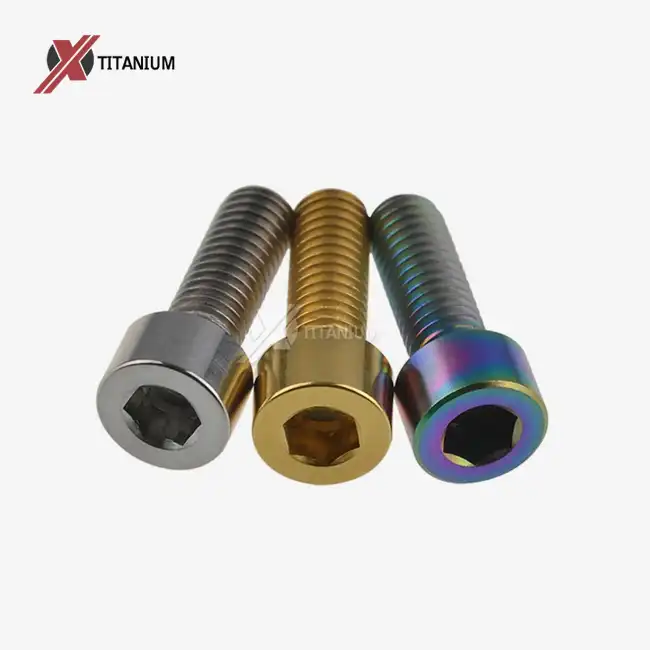
Titanium stands as one of the most exceptional materials for bolt manufacturing, particularly when precision and reliability are paramount. With a tensile strength of 900 MPa and corrosion resistance that surpasses traditional steel alternatives, titanium bolts have become indispensable in high-performance applications. Titanium bicycle bolts exemplify this excellence, offering aerospace-grade Ti-6Al-4V composition that delivers 40% weight reduction while maintaining superior mechanical properties. The material's biocompatibility, combined with its resistance to galvanic corrosion and environmental degradation, makes titanium the preferred choice for engineers and procurement professionals seeking long-term value over initial cost considerations.
Understanding Titanium as a Bolt Material
Fundamental Properties of Titanium Alloys in Fastener Applications
For difficult jobs, titanium metals, especially Grade 5 (Ti-6Al-4V), are the best when it comes to fasteners. The composition of this aerospace-grade material is 90% titanium, 6% aluminum, and 4% vanadium. It has a solid structure that makes it very strong. Its density of 4.43 g/cm³ makes it much lighter than steel, which has a density of 7.8 g/cm³, while keeping the same tensile strength numbers.
The unique way the oxide layers form on the material makes it self-healing and resistant to rusting from air and road salt. Titanium fasteners naturally form an inactive layer that stops oxidation, while steel fasteners need protective coats. This quality makes the material very useful in places like the ocean, chemical plants, and outdoor uses where other materials break down quickly.
Comparative Analysis with Traditional Fastener Materials
When looking at different types of bolt materials, titanium does better than stainless steel and aluminum in a number of dimensions. When first bought, steel nuts were cheap, but they are prone to rust and are too heavy for performance uses. Even though aluminum screws are lighter, they are not as strong or durable when loaded and unloaded many times.
Titanium bicycle bolts show off these benefits in tough riding settings where broken parts can have bad results. Titanium fasteners are used by professional bicycle teams in stem sections, brake pads, and drivetrain parts because they are reliable in all kinds of weather and reduce weight, which has a direct effect on performance.
Manufacturing Processes and Quality Standards
Titanium bolts are made using advanced methods that make sure they meet strict standards in the medical and aircraft industries. CNC machining keeps the tolerances very tight, and rolled thread formation keeps the purity of the grain flow, which makes them about 30% more resistant to wear than cut threads. Some surface processes, like anodizing, polishing, and nitriding, make things look better and work better.
Quality control procedures are in line with AS9100, ISO9001, and medical approval standards. This makes sure that the products can be tracked all the way through the production process. When a part fails in an application, these standards become even more important because it could lead to safety issues or lost work time.
Benefits of Using Titanium Bicycle Bolts in B2B Applications
Operational Performance Advantages
Titanium fasteners have practical benefits that go beyond just replacing a material. They are a critical component upgrade that affects the performance of the whole system. Titanium's high strength-to-weight ratio lets design engineers make the most of part shape while keeping the structure's integrity in high-stress situations. The material doesn't carry heat well, which is helpful in brake systems where managing heat avoids problems with thermal expansion that hurt performance.
Here are the main practical benefits that tech teams always list:
• Enhanced Fatigue Resistance: Titanium's crystalline structure can handle cycle loading conditions that cause steel fasteners to fail early, which means they last longer and need less upkeep.
• Corrosion Immunity: Complete resistance to galvanic rust means that protection coatings or replacement processes are not needed. This is especially helpful in seaside or high-humidity areas.
• Temperature Stability: Keeps mechanical qualities even at very high or very low temperatures, so it works the same way in all kinds of operating situations.
• Biocompatibility: The fact that the material is non-reactive means that you don't have to worry about it breaking down when it comes in touch with biological substances or cleaning chemicals.
These operating traits directly lead to lower total cost of ownership by extending the time between replacements and making the system more reliable.
Economic Impact and Total Cost Analysis
Titanium fasteners are more expensive than steel alternatives, but a full cost study shows that they are much more cost-effective over their entire operating lifecycle. Longer service life means less often having to buy new parts, and better corrosion protection means less work needs to be done on upkeep. When used in mission-critical situations, the dependability factor adds value by lowering downtime and business disruptions.
When looking at long-term component plans, procurement pros are becoming more aware of titanium's value proposition. The material's consistent performance gets rid of quality differences that need complicated incoming testing procedures. This speeds up the supply chain while making sure that performance results are always reliable.
Strategic Procurement Considerations
When making B2B buying choices about titanium screws, you need to look at more than just price. Supplier approval is now very important, with a focus on manufacturing skills, quality standards, and expert support resources. Titanium processing is very complicated, so it's important to work with makers who have specialized tools and metalworking knowledge.
Buying in bulk can help you save a lot of money while also making sure you always have what you need for your business. Many providers offer customization services for specific uses, which lets designers make the most of titanium's natural benefits.
How to Choose the Right Titanium Bicycle Bolts for Your Needs?
Technical Specification Evaluation
To choose the right titanium fasteners, you need to look at their mechanical features, the surroundings, and the needs of the particular application. Grade 5 titanium is the strongest grade that can be used for most bicycle uses. However, other grades may be needed for situations where the titanium will be exposed to high temperatures or chemicals. The thread pitch, head design, and length standards must all perfectly match the shape of the part and the assembly needs.
Some important standard factors are the tensile strength, the proof load, and the expected fatigue life under the expected loading circumstances. Instead of depending on conservative over-specification that raises costs without improving performance, engineering teams should compare these features to the real needs of the service.
Supplier Qualification and Assessment
To find suitable suppliers, you need to look at their manufacturing skills, quality control methods, and expert help resources. Established makers show that their products are always of high quality by using thorough testing methods and well-documented quality management systems. Certifications like the AS9100 aircraft standard or the ISO13485 medical device standard show that the production process is advanced enough for use in important situations.
Titanium bicycle bolts manufacturers should provide material certifications, measurement inspection reports, and proof of the bolts' mechanical properties. This paperwork makes it possible to track things and make sure they are of good quality, which is necessary for following the rules and making sure things work well.
Customization and Volume Considerations
Customized bolt solutions that improve performance while making assembly easier are useful for many uses. Specialized head shapes, thread treatments, and surface finishes can make fitting go more smoothly and look better. Custom anodizing colors keep the corrosion-resistant qualities of the metal while making it easier to identify parts and set brands apart.
By buying in bulk, you can save money and make sure you always have supplies. Blanket buy orders with planned releases meet the needs of production planning and get better prices at the same time. Many sellers offer services for managing goods that lower carrying costs while still allowing for just-in-time delivery.
Installation and Maintenance Best Practices for Titanium Bicycle Bolts
Proper Installation Techniques and Torque Management
Understanding the unique properties of titanium and choosing the right tools are necessary for successful bolt placement. Titanium fasteners are not as springy as steel fasteners, which changes how pressure is applied and how much preload is achieved. Using anti-seize compounds to properly lubricate avoids galling and makes sure that torque numbers are correct during installation.
When figuring out torque specs, titanium has a lower modulus of elasticity than steel, so numbers usually need to be lowered to get the same preset conditions. Digital torque wrenches are accurate enough to get regular installation results, but torque-angle ways are more accurate for important tasks.
Maintenance Protocols and Performance Monitoring
Titanium screws don't need as much upkeep as steel ones, but they should be inspected every so often to make sure they keep working at their best. Visual inspection procedures should find any signs of thread damage, surface wear, or odd corrosion patterns that could mean there were problems with the fitting or that the part was exposed to external conditions outside of what was intended.
When you clean something, you shouldn't use harsh chemicals that could damage the surface while you're cleaning dirt or trash. Simple degreasing solutions followed by rinses with clean water protect anodized finishes and keep titanium's natural resistance to rust.
Troubleshooting Common Issues
Titanium screws are very reliable, but knowing what problems could happen lets you fix them quickly and keeps system-level problems from happening. Galling is the most common problem during installation, which is usually caused by not enough lube or too fast of an installation speed. This problem is not a problem if you use anti-seize correctly and control the installation rate.
Damage to the threads typically means that the wrong tool was used or that the threads were crossed during the initial contact. Titanium's work-hardening properties make it so that broken threads are hard to fix. This shows how important it is to be careful when installing tools and keep them in good shape.
Where and How to Procure Titanium Bicycle Bolts Efficiently?
Strategic Sourcing Channels and Platform Selection
To buy titanium screws efficiently, you need to know about the different ways they are distributed and how to work with manufacturers. Industrial supply platforms give you access to many suppliers and let you compare prices and make sure that the providers meet your needs. When you work directly with a manufacturer, you can often get better technical help and make changes that are needed for difficult applications.
Because titanium production is so specialized, trade shows and industry gatherings help buyers and sellers evaluate suppliers and build relationships for products like titanium bicycle bolts. Associations for professionals often maintain approved vendor listings, making it easier to identify qualified manufacturers, verify production capabilities, and ensure consistent quality standards when sourcing these high-performance fastening components.
Cost Optimization and Procurement Strategy
Cost management that works well matches the initial buy price with the total cost of ownership. When you combine volume from several projects or apps, you can get better price terms and make managing the supply chain easier. Long-term supply deals keep prices stable and ensure availability, which is especially helpful for titanium, which has special production needs.
Titanium's long shelf life and resistance to rust should be taken into account in inventory management strategies so that smart purchases can be made when market conditions are right. A lot of sellers have consignment programs that lower the cost of moving goods while making sure they are available right away for production needs.
Quality Assurance and Supplier Management
Setting up strong quality assurance processes makes sure that products always work well and reduces the need for new inspections. Supplier audits make sure that the quality processes and production skills match the needs of the application. Performance reviews happen on a regular basis and keep track of delivery performance, quality metrics, and how quickly technical help responds.
Programs that help suppliers grow their skills and abilities can get them special treatment when supplies are low. Working together to solve problems and make things better all the time is possible through collaborative relationships. These help both parties and make technology better.
Conclusion
Titanium is clearly the best material for high-performance bolt uses, especially when reducing weight, resisting rust, and ensuring long-term reliability are critical—making titanium bicycle bolts free sample programs an effective way for buyers to evaluate quality, fit, and performance before committing to bulk orders. The Ti-6Al-4V makeup used in aircraft parts gives them great strength-to-weight ratios and keeps their performance stable in harsh working conditions.
Even though the starting costs are higher than with standard materials, a full lifecycle study shows that there are big economic benefits through lower upkeep needs, longer service intervals, and more reliable systems. Titanium is the best material for engineers who care more about performance than original cost because it is biocompatible and resistant to weather damage. This makes it a must-have for situations where a broken part could have serious effects.
FAQ
What makes titanium superior to steel for bolt applications?
When compared to steel, titanium is 40% lighter while still having the same tensile strength of 900 MPa. It doesn't need any protective layers because it doesn't rust naturally, and it's biocompatible, so it can be used in sensitive areas. Titanium, on the other hand, has an oxide layer that heals itself and stops galvanic rusting.
How does the cost of titanium bolts compare to traditional materials?
Titanium bolts are more expensive at first, but a total cost of ownership study shows that they are cheaper in the long run because they last longer, need less upkeep, and don't need to be replaced as often. The better protection to corrosion and longevity make the investment worth it in tough situations.
What grades of titanium are recommended for cycling applications?
Because it has a great strength-to-weight ratio and doesn't rust, Grade 5 (Ti-6Al-4V) titanium works best for most bicycle uses. This aerospace-grade alloy has better mechanical qualities than pure titanium types that are sold in stores because it has 6% aluminum and 4% vanadium in it.
Are special tools required for titanium bolt installation?
Titanium bolts can be worked with with regular tools, but digital torque wrenches give you the accuracy you need for a proper fitting. Anti-seize materials keep galling from happening during installation, but torque specs may need to be changed because titanium is not as springy as steel.
Partner with Chuanglian for Premium Titanium Bicycle Bolts Solutions
Baoji Chuanglian New Metal Material Co., Ltd. is a reliable company that makes titanium bicycle bolts. They offer aerospace-grade screws that go above and beyond what the industry requires. Our CNC-machined Ti-6Al-4V nuts can have different color nitriding, anodizing, and finishing applied to the surface. We guarantee consistent performance and reliable delivery for your important projects thanks to our over ten years of specialized experience and strict quality control systems. Get in touch with our professional team at info@cltifastener.com or djy6580@aliyun.com to talk about your needs and find out how our knowledge can help your product work better.
References
1. Boyer, R. R. "An Overview on the Use of Titanium in the Aerospace Industry." Materials Science and Engineering: A, 1996.
2. Lutjering, G. and Williams, J. C. "Titanium: Engineering Materials and Processes." Second Edition, Springer-Verlag, 2007.
3. ASM International. "Properties and Selection: Nonferrous Alloys and Special-Purpose Materials." ASM Handbook Volume 2, 1990.
4. Donachie, M. J. "Titanium: A Technical Guide." Second Edition, ASM International, 2000.
5. Peters, M. and Leyens, C. "Titanium and Titanium Alloys: Fundamentals and Applications." Wiley-VCH, 2003.
6. ASTM International. "Standard Specification for Titanium and Titanium Alloy Bars and Billets." ASTM B348, 2019.

Learn about our latest products and discounts through SMS or email