- English
- French
- German
- Portuguese
- Spanish
- Russian
- Japanese
- Korean
- Arabic
- Greek
- German
- Turkish
- Italian
- Danish
- Romanian
- Indonesian
- Czech
- Afrikaans
- Swedish
- Polish
- Basque
- Catalan
- Esperanto
- Hindi
- Lao
- Albanian
- Amharic
- Armenian
- Azerbaijani
- Belarusian
- Bengali
- Bosnian
- Bulgarian
- Cebuano
- Chichewa
- Corsican
- Croatian
- Dutch
- Estonian
- Filipino
- Finnish
- Frisian
- Galician
- Georgian
- Gujarati
- Haitian
- Hausa
- Hawaiian
- Hebrew
- Hmong
- Hungarian
- Icelandic
- Igbo
- Javanese
- Kannada
- Kazakh
- Khmer
- Kurdish
- Kyrgyz
- Latin
- Latvian
- Lithuanian
- Luxembou..
- Macedonian
- Malagasy
- Malay
- Malayalam
- Maltese
- Maori
- Marathi
- Mongolian
- Burmese
- Nepali
- Norwegian
- Pashto
- Persian
- Punjabi
- Serbian
- Sesotho
- Sinhala
- Slovak
- Slovenian
- Somali
- Samoan
- Scots Gaelic
- Shona
- Sindhi
- Sundanese
- Swahili
- Tajik
- Tamil
- Telugu
- Thai
- Ukrainian
- Urdu
- Uzbek
- Vietnamese
- Welsh
- Xhosa
- Yiddish
- Yoruba
- Zulu
Motorcycle Bolt Types & Their Uses – Everything You Need to Know
Knowing the different kinds of bolts on a motorbike is important for speed, safety, and durability. Steel nuts are very strong, but they are also heavy and are always fighting rust. Aluminum choices are lighter, but they can't hold as much weight when used in challenging situations. Titanium bolt kits for motorcycles solve these problems because they have higher tensile strength (up to 1,000 MPa in Grade 5 Ti-6Al-4V) and are up to 45% lighter than steel bolt kits. It is important for these screws to be reliable in harsh conditions, and they also make them easier to handle by strategically reducing mass at key mounting spots.
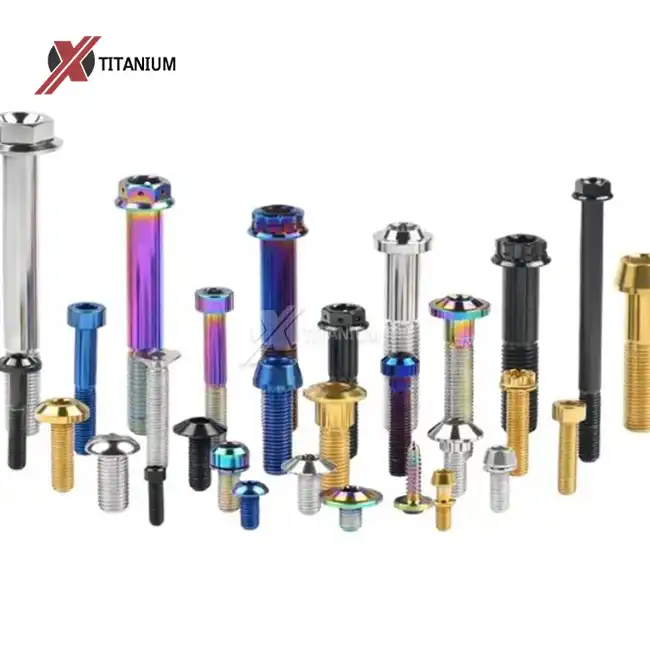
Understanding Different Motorcycle Bolt Types and Their Applications
Motorcycle makers usually use three main types of bolt materials, and each has its own engineering trade-offs. The process of choosing materials has a direct effect on how the vehicle moves, how often it needs to be maintained, and the practical safety margins.
Steel Bolts: Traditional Strength with Known Limitations
Original equipment manufacturers use steel screws most of the time because they are cheap and have reliable mechanical behavior. Steel bolts in grades 8.8 and 10.9 have tensile strengths between 800 and 1,040 MPa, which means they can be used for high-torque uses and structural links. But steel's density (about 7.85 g/cm³) makes a big difference in how much unsprung mass is in wheel systems and suspension parts. Corrosion is a risk that needs to be constantly watched, especially in marine environments or regions that use road salt in the winter. Galvanic reactions between steel gear and aluminum parts speed up wear and tear, which creates hidden failure risks in important chassis joints.
Aluminum Fasteners: Lightweight but Application-Specific
When compared to steel, aluminum alloys (usually 7075-T6) are about 65% lighter, but their compressive strengths are only 570 MPa. Because these nuts have a smaller modulus of elasticity, they stretch more when the loads are the same. This means that the torque specifications need to be carefully adjusted. Without the right lubricants, aluminum threads can gall up during installation, and the material's wear resistance drops sharply when loaded and unloaded many times. Because of these problems, aluminum bolts can only be used on non-essential bodywork pieces and fairings, not on engine cases or suspension bearing points.
Titanium Alloys: The Engineering Solution for Demanding Applications
Grade 5 titanium alloy (Ti-6Al-4V) is the best of both worlds because it is strong like steel and light like aluminum. Titanium has a density of only 4.43 g/cm³, which is less than either of the other materials. A solid layer of titanium dioxide forms on its own, giving it great corrosion resistance without any surface treatments. It stays intact in settings with saltwater spray, hydraulic fluid, and high-temperature exhaust. Racing teams specifically look for titanium replacements in turning parts. Every gram that is taken away from wheel hubs, brake calipers, and crank mechanisms leads to better acceleration reaction and fewer gyroscopic effects when changing directions.
Titanium Bolt Kits for Motorcycles – Benefits and Technical Advantages
Riders who are focused on performance are turning more and more to titanium hardware when they want to make real improvements that go beyond cosmetic changes. The qualities of the material give real benefits in a number of performance areas.
Weight Reduction and Dynamic Performance Improvements
Getting rid of 200 to 300 grams of unsprung mass by replacing key titanium bolts makes the suspension more flexible. Wheel systems have less rolling inertia, which makes it easier for dampers to control changes in the contact patch on rough surfaces. Tests on a racecourse regularly show that similar bikes with different fastener materials have faster lap times. Machines with titanium fasteners show better mid-corner stability and consistent stopping power over long sessions.
Corrosion Resistance in Harsh Operating Environments
Titanium bolts keep their shape and clamping force over years of contact, while steel screws need to be replaced often because the threads wear down. Riders who live near the coast or who store their bikes outside should avoid the common problem of bolts seizing up during regular maintenance. The substance doesn't let salt spray, battery acid vapor, brake fluid, or coolant leak through, and it doesn't get surface rusting like steel does, which weakens the hardware.
Torque Specifications and Installation Considerations
Titanium has a different friction coefficient than steel, so titanium bolt kits for motorcycles need to be installed in a certain way to avoid galling, which is a cold-welding process in which titanium surfaces stick together when they are pressed together and turned. Using molybdenum disulfide-based anti-seize compounds on threads is the right way to do it for titanium bolt kits for motorcycles. This lowers the end torque values by about 10 to 15 percent compared to steel bolt specs for the same job. Titanium has a lower modulus of elasticity (110 GPa vs. 200 GPa for steel), which means that when they are loaded, titanium bolt kits for motorcycles deform more easily. This makes them more resistant to wear in motorcycle uses with a lot of vibration.
When engineers select titanium gear, they need to think about these properties of the material when they decide what to buy. The investment saves money over the course of its useful life by reducing the number of times the system needs to be replaced and making it more reliable during important working periods.
Comparing Titanium Bolt Kits to Other Bolt Kits: How to Make the Right Choice?
When switching from regular screws to titanium options, procurement managers have to deal with a lot of complicated evaluation criteria. The decision process includes more than just comparing prices; it also takes into account the total cost of ownership and reducing operating risk.
Performance Metrics: Strength, Weight, and Environmental Resistance
When you compare two materials side by side, you can see why titanium is in the top section. Steel Grade 10.9 bolts have a tensile strength of 1,040 MPa, but they are 77% heavier than titanium bolts that have the same strength (950–1,000 MPa). Aluminum 7075-T6 is about the same weight as titanium, but it is only 60% as strong, so it can only be used for non-structural tasks. Under ASTM B117 salt spray conditions, steel fasteners show red rust within 48 hours, aluminum fasteners show white oxide corrosion within one week, and titanium samples stay the same after more than 1,000 hours of constant contact.
Cost Analysis and Long-Term Value Proposition
Titanium bolt kits for motorcycles cost 300–500% more than steel equivalents at first, but the numbers change a lot when you look at how often they need to be replaced and how much it costs to do upkeep. In harsh settings, steel screws need to be replaced every 12 to 18 months to keep their clamping strength, but titanium systems usually don't need to be serviced for more than five years. Racing teams that have to take things apart a lot to change the setup really like titanium because it doesn't damage the threads when pressure is applied over and over again. Steel hardware usually needs to be replaced after only 3–5 installation cycles under the same conditions.
Supplier Evaluation Framework for B2B Procurement
Industrial buyers must make sure that the approvals of the materials they are interested in meet aircraft standards like ASTM F136 or AMS 4928 requirements for medical-grade titanium alloys. Genuine sources give full material traceability records, which include mill test results that prove the chemical makeup and mechanical qualities of each production batch. Quality management standards like ISO 9001 and AS9100 show that the manufacturing process controls can keep the dimensions within the acceptable ranges needed for thread contact and torque retention. Reputable titanium fastener makers do lot-specific tension testing, fatigue cycle verification, and corrosion resistance validation. This paperwork protects buyers from fake goods that are becoming more common in markets for high-end components.
Custom CNC machining shows that the provider is able to work with non-standard thread pitches, head configurations, or length requirements that are common in concept development or limited-production vehicle uses.
How to Install Titanium Bolt Kits on Motorcycles: Step-by-Step Guide
Whether titanium screws live up to their supposed performance benefits or become expensive failure points depends on how they are installed. Because of the way the material is made, different steps need to be taken than when replacing steel bolts.
Preparation and Tool Requirements
Use brake cleaner or isopropyl alcohol to clean all threaded surfaces well and get rid of any oils, rust products, or thread-locking compound that is still there. Check the threads for damage or warping that could cause galling when the titanium bolt is being put in. Obtain torque tools that are calibrated and cover the right range. The specs for titanium fasteners are usually 10-15% lower than those for steel ones, so exact measurements are needed instead of "feel-based" tightening. Buy an anti-seize lubricant that works with titanium and has molybdenum disulfide or no copper in it (copper-based chemicals can cause galvanic reactions with some titanium surface treatments).
Installation Procedure for Optimal Performance
Apply a thin, even layer of anti-seize powder to the first three threads of each titanium bolt. Be careful not to use too much, as that could mess up the torque-tension relationships. Before using tool force, thread bolts by hand through at least three full turns to make sure they are aligned correctly and find cross-threading. When using a torque wrench, move it in a smooth, continuous way instead of hitting or clicking, which can cause load jumps that could lead to surface galling. Titanium's elastic qualities can cause small "settling" in joint stacks made of different materials, so wait 30 seconds after reaching the stated force before doing verification checks.
Case Study: Racing Application Performance Verification
During the course of the season, a professional motorcycle race team changed all of the steel engine case bolts with Grade 5 titanium ones. Telemetry data showed measurable changes, including 0.3-second faster lap times on a 2.1-mile track due to better handling, no fastener failures over 12 race weekends, or 47 hours of operation, and no need to remove the engine case in the middle of the season to remove corroded bolts. An inspection after the season showed that the titanium hardware had kept its original torque specs within 5%, while control bikes with steel fasteners had lost 15–22% of their clamping force and had to be completely replaced.
Purchasing and Procuring Titanium Bolt Kits: Best Practices for B2B Clients
When switching to titanium fastener projects, industrial procurement teams need structured assessment methods. Because of how much the material costs and how well it works, suppliers must be carefully screened and specifications must be matched.
OEM, Aftermarket, and Custom Solutions: Understanding the Options
Original Equipment Manufacturer (OEM) titanium bolt kits for motorcycles ensure a perfect fit and material specs that meet the needs of vehicle engineering. Aftermarket providers have a wider range of products and lower prices, but they need to be sure that the dimensions are correct by comparing them to OEM models. Custom CNC machining is used for unique tasks like making prototypes, making limited numbers of vehicles, or changing the performance of something that needs thread lengths, head styles, or surface treatments that aren't standard. For production runs of less than 500 pieces, custom orders usually have wait times of 4 to 6 weeks. When production volumes reach 1,000 units or more, prices become competitive with aftermarket options.
Quality Verification and Authentication Protocols
There are big risks in the supply chain when fake titanium screws are used. For example, steel bolts have been reported to be anodized in a titanium-colored way to trick buyers. Some ways to be sure that something is real are to test its density (a real Ti-6Al-4V measures 4.43 g/cm³), its magnetic response (titanium is paramagnetic, while steel is ferromagnetic), and to get certified mill test results that show the chemical makeup through spectroscopic analysis. Extreme skepticism should be shown to suppliers who refuse to provide tracking paperwork or who offer prices that are much lower than market rates (usually $2.50 to $4.50 per bolt for M6 to M10 sizes).
Supplier Selection Criteria for Long-Term Partnerships
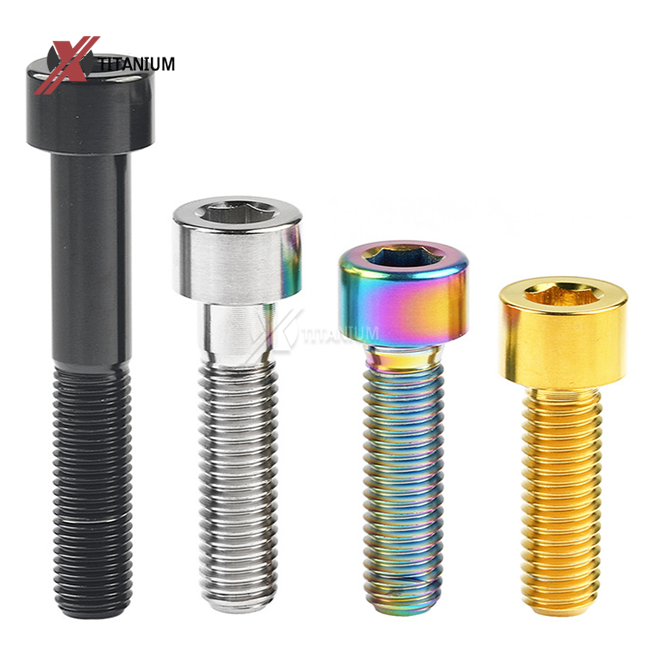
We've been doing business in Baoji City, which is known as the "City of Titanium," for more than ten years, during which time we've learned a lot about processing titanium alloys and setting up quality control systems that meet international aerospace standards. Custom thread shapes, lengths, and surface treatments are made in our CNC machine centers. These include grinding, anodizing in natural, gold, blue, green, purple, black, and rainbow finishes, and nitriding to make the surface harder. Before being shipped, each production batch is checked for tensile strength, wear resistance, rust resistance, and that the dimensions are correct. Material approvals include proof of ASTM and ISO compliance, and the whole process can be tracked from the raw titanium ingot to the final cutting steps. Technical support teams help come up with torque specifications, improve installation procedures, and figure out what went wrong if problems happen in the field during service. Bulk procurement programs offer better prices for large orders while keeping quality high over multiple years of supply deals. This helps the procurement manager plan their budgets and keep the supply chain stable.
Conclusion
Picking the right motorcycle fasteners means considering their technical performance, their ability to last in harsh conditions, and their overall cost over their entire useful life. Titanium bolt kits for motorcycles have measured benefits in terms of weight reduction, resistance to corrosion, and operating dependability that make them worth the extra cost for demanding uses. Steel bolts can still be used in low-stress, cost-effective situations, while aluminum can be used in certain non-structural situations. Knowing about the features of materials, the right way to put them, and the requirements for qualifying suppliers helps you make smart purchasing decisions that support long-term performance goals. The transition to titanium hardware represents an engineering investment rather than simple component substitution, requiring technical evaluation and specification matching to achieve optimal results.
FAQ
Does Titanium Hardware Corrode Compared to Stainless Steel?
In chloride-rich settings, Grade 5 titanium makes a stable, self-healing titanium dioxide layer on the surface that is better at resisting corrosion than 300-series stainless steels. In tests using salt spray, titanium looks the same after more than 1,000 hours, but stainless steel starts to pit after 200 to 400 hours, based on the alloy makeup.
What Torque Values Should I Use When Installing Titanium Bolts?
When using titanium screws with the same thread size as steel bolts, the force requirements should be lowered by 10 to 15 percent. A 25 Nm-torqued M8 steel bolt should be swapped out for a 21–22 Nm-torqued M8 titanium bolt. For exact application, always follow the manufacturer's instructions and only use torque wrenches that have been properly adjusted.
How Much Weight Can Titanium bolt kits for motorcycles Actually Save?
Changing the whole engine case (about 40 to 50 bolts) usually takes off 150 to 200 grams. Full motorcycle conversions that include the frame, bodywork and brake parts can achieve weight savings of 300 to 500 grams. Unsprung mass areas like wheel assemblies and brake calipers have the biggest effect on performance.
Contact Chuanglian for Premium Titanium Fastener Solutions
Baoji Chuanglian New Metal Material Co., Ltd. manufactures aerospace-grade titanium bolt kits for motorcycles engineered specifically for high-performance motorcycle applications. Our Grade 5 Ti-6Al-4V screws go through strict quality control including tensile testing, fatigue verification, and corrosion resistance validation, backed by complete material traceability documentation and ISO certifications. We offer customized solutions including non-standard thread configurations, specialized surface treatments, and bulk procurement programs with competitive lead times. Technical support teams provide torque specification guidance, installation protocol development, and application-specific engineering consultation. Contact our specialists at info@cltifastener.com or djy6580@aliyun.com to discuss your requirements with an experienced titanium bolt kits for motorcycles supplier.
References
1. Boyer, R., Welsch, G., & Collings, E.W. (1994). Materials Properties Handbook: Titanium Alloys. ASM International.
2. Donachie, M.J. (2000). Titanium: A Technical Guide, 2nd Edition. ASM International.
3. Lutjering, G., & Williams, J.C. (2007). Titanium: Engineering Materials and Processes, 2nd Edition. Springer-Verlag Berlin Heidelberg.
4. Veiga, C., Davim, J.P., & Loureiro, A.J.R. (2012). "Properties and Applications of Titanium Alloys: A Brief Review." Reviews on Advanced Materials Science, 32(2), 133-148.
5. Schutz, R.W., & Watkins, H.B. (1998). "Recent Developments in Titanium Alloy Application in the Energy Industry." Materials Science and Engineering: A, 243(1-2), 305-315.
6. Peters, M., Kumpfert, J., Ward, C.H., & Leyens, C. (2003). "Titanium Alloys for Aerospace Applications." Advanced Engineering Materials, 5(6), 419-427.
Learn about our latest products and discounts through SMS or email