- English
- French
- German
- Portuguese
- Spanish
- Russian
- Japanese
- Korean
- Arabic
- Greek
- German
- Turkish
- Italian
- Danish
- Romanian
- Indonesian
- Czech
- Afrikaans
- Swedish
- Polish
- Basque
- Catalan
- Esperanto
- Hindi
- Lao
- Albanian
- Amharic
- Armenian
- Azerbaijani
- Belarusian
- Bengali
- Bosnian
- Bulgarian
- Cebuano
- Chichewa
- Corsican
- Croatian
- Dutch
- Estonian
- Filipino
- Finnish
- Frisian
- Galician
- Georgian
- Gujarati
- Haitian
- Hausa
- Hawaiian
- Hebrew
- Hmong
- Hungarian
- Icelandic
- Igbo
- Javanese
- Kannada
- Kazakh
- Khmer
- Kurdish
- Kyrgyz
- Latin
- Latvian
- Lithuanian
- Luxembou..
- Macedonian
- Malagasy
- Malay
- Malayalam
- Maltese
- Maori
- Marathi
- Mongolian
- Burmese
- Nepali
- Norwegian
- Pashto
- Persian
- Punjabi
- Serbian
- Sesotho
- Sinhala
- Slovak
- Slovenian
- Somali
- Samoan
- Scots Gaelic
- Shona
- Sindhi
- Sundanese
- Swahili
- Tajik
- Tamil
- Telugu
- Thai
- Ukrainian
- Urdu
- Uzbek
- Vietnamese
- Welsh
- Xhosa
- Yiddish
- Yoruba
- Zulu
Nylock Nuts vs Standard Nuts: Key Differences
When choosing bolts for important jobs, the difference between Nylock nuts and regular nuts has a direct effect on how reliable the assembly is and how well it works over time. Standard nuts only use torque to keep their holding force, which means they can come loose when they are vibrated or heated and cooled. Nylock nuts have a nylon insert inside the thread that causes constant pressure, which keeps the nuts from coming loose without the need for extra locking devices. ISO 7043 Titanium Nylock Nuts are the best of this technology because they combine the self-locking nylon core with titanium's high strength-to-weight ratio and protection to corrosion. In aircraft, petrochemical, and marine uses where failure is not a choice, this mix gives the best performance possible.
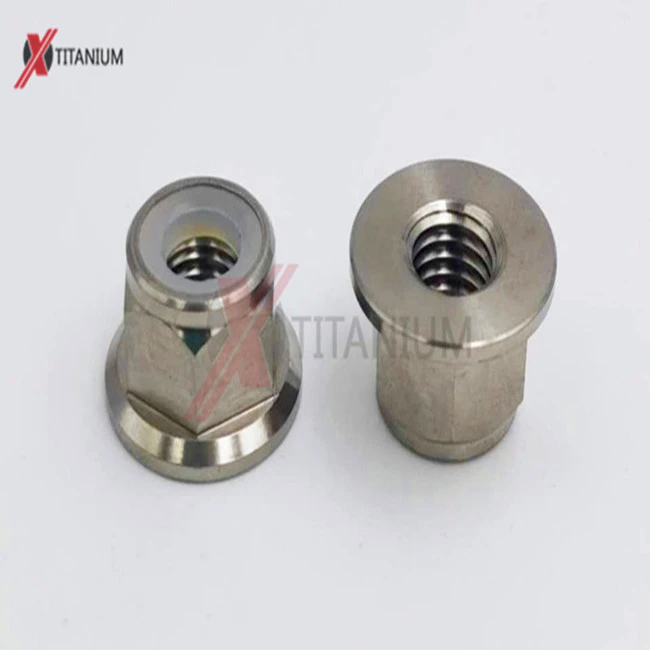
Understanding Nylock Nuts and Standard Nuts
The Fundamental Design Difference
Standard hexagonal nuts have been used to hold mechanical parts together for more than one hundred years. When you apply pressure, their internal threads connect with the exterior bolt threads to make a clamping force. The problem is that these nuts are inactive, so they can turn and come free once outside forces lower the friction coefficient between the threads that are mating. This effect is very important in situations where there is shaking, thermal expansion, or dynamic pressure.
Nylock nuts protect against this weakness by having a designed nylon ring on top of the nut. This nylon plug deforms a little when it contacts the bolt threads, causing a constant mechanical interference. This interference creates constant friction that isn't affected by the clamp load. This keeps the joint from rotating even when vibrations lower the tension in it. Nylon keeps its stretchy qualities across a wide range of temperatures that are common in industrial settings. However, temps above 250°F can make nylon less useful.
Material Variations and Their Impact
A lot of different materials can be used for standard nuts. Carbon steel nuts are strong enough for non-corrosive settings and don't cost too much. Stainless steel types offer middling resistance to corrosion, making them good for environments that are slightly corrosive or used in food processing. These materials have specific weight costs. For example, steel nuts add a lot of mass to assemblies, which is a big problem in places where weight is important, like aircraft structures or high-speed rotating equipment.
ISO 7043 Titanium Nylock Nuts change the way things work. Grade 5 titanium (Ti-6Al-4V) has a tensile strength of about 130,000 psi and a mass of only 0.16 lb/in³, which is about 40% less than steel. This metal is very resistant to corrosion in saltwater, acids, and chlorides, which quickly break down steel options. The nylon insert technology works perfectly with titanium surfaces, making a fastener that is great at both locking and having good material qualities.
Application-Specific Performance Considerations
The real-world effects of these differences can be seen in aerospace systems. Mounts for aircraft engines are always vibrating at amplitudes and frequencies that make normal nuts loose, even when the force is high. The results can be anything from higher upkeep costs to catastrophic breakdowns. ISO 7043 Titanium Nylock Nuts don't need extra lock screws or thread-locking compounds, so they are more reliable while lowering the number of parts needed and the complexity of the assembly process.
Chemical manufacturing tools adds a new layer. Standard steel nuts rust quickly in acidic or alkaline process fluids, so they need to be replaced often during routine maintenance. Other materials, like stainless steel, last longer, but they still rust in places with a lot of salt. Titanium's inactive oxide layer grows back on its own after being scratched. This protects against rust and increases service life by five to ten times compared to regular materials.
Performance and Benefits of ISO 7043 Titanium Nylock Nuts
Mechanical Superiority in Demanding Environments
When purchasing managers look at fastener specs, they find a complicated set of mechanical features. ISO 7043 Titanium Nylock Nuts have a strength-to-weight ratio that changes the way designs can be made in a basic way. Think about a distant base that is constantly hit by waves and salt spray. Steel rivets need thick coats to protect them, which make them heavier and cause the coatings to wear off over time. Titanium nuts keep the structure strong without coats, which lowers the weight of the platform—an important factor when figuring out how much weight can be put on old infrastructure.
Titanium metals' ability to fight fatigue is something that needs extra attention. In the lab, tests show that Ti-6Al-4V keeps 50% of its ultimate tensile strength after one million stress cycles. This is higher than the 35% retention rate for steel alloys of the same strength. This directly leads to longer periods between inspections and lower costs over the lifecycle. Over the course of five years, an aircraft maker found that using ISO 7043 Titanium Nylock Nuts on landing gear assemblies cut the number of unplanned repair events by 63%.
Temperature and Corrosion Resilience
Standard nylon insert nuts can only be used in certain temperatures, which limits their range of uses. When the temperature goes above 250°F, the nylon collar softens and stops closing properly in high-temperature areas like heat exchanger units or exhaust systems. ISO 7043 Titanium Nylock Nuts use high-temperature nylon versions that keep working at temperatures up to 350°F. This means that they can be used in engine rooms and industrial process equipment.
Corrosion testing shows big differences in how long things last. According to ASTM B117, salt spray tests show that normal steel nuts rust within 48 hours, while stainless steel nuts show damage after 200 to 300 hours. Titanium samples that were checked after more than 1,000 hours showed no rust at all, and the passive oxide layer stayed in place. Marine engineering companies use ISO 7043 Titanium Nylock Nuts for important below-water uses that are hard to check and have high replacement costs.
Lifecycle Cost Analysis
ISO 7043 Titanium Nylock Nuts are three to five times more expensive than normal steel ones when they are first bought. Total cost of ownership estimates, on the other hand, show a different picture. A petrochemical plant wrote about how they replaced steel fasteners on inspection ports for distillation columns, which required using scaffolds, stopping production, and going into a tight area. Every 18 months, maintenance took place, which cost $12,000 each time. After moving to ISO 7043 Titanium Nylock Nuts, inspections were done every 60 months instead of every 36 months. This saved $28,000 over five years, even though the extra fasteners cost $4,200.
When it comes to shipping, saving weight means more efficient operations. A race team for cars found that switching from steel bolts to titanium ones made the cars 6.8 pounds lighter. This change sped up lap times by 0.15 seconds, which was worth a lot more than the difference in the cost of the fasteners because of how much speed they added to the car.
How to Choose Between Nylock Nuts and Standard Nuts for B2B Procurement?
Evaluating Load Requirements and Vibration Profiles
To start the selection process, you need to know about the technical surroundings. Standard nuts and the right torque values can work well in static situations that carry steady loads without vibration. But figuring out what "low vibration" means needs measurements, not guesswork. According to accelerometers, even equipment that seems steady can have tiny vibrations at rates that slowly loosen standard fasteners over thousands of hours.
Locking methods are needed for dynamic load uses. Nylock nuts offer this level of security, but the choice of material relies on the size of the load and the conditions of the area. Stainless steel Nylock nuts work well in places with minor rust and where weight is not an issue. When requirements call for maximum stability with minimum weight, ISO 7043 Titanium Nylock Nuts are the best choice, even though they cost more to buy.
Material Compatibility and Standards Compliance
When two different metals touch each other in a solution, galvanic corrosion happens, speeding up the breakdown of the more anodic material. Titanium is in a good spot in the galvanic series, just like stainless steel. This means that there is less chance of rusting when connecting aluminum, stainless steel, or hybrid structures. When you use carbon steel bolts with ISO 7043 Titanium Nylock Nuts, you need isolation washers or coats to stop the steel from rusting faster.
Compliance with ISO 7043 provides uniformity in dimensions, which is important for interchangeability. This standard describes the thread specs, hexagonal sizes, and mechanical qualities of ISO 7043 Titanium Nylock Nuts so that they can be used instead of standard nuts without any changes to the assembly. Instead of accepting self-certification, procurement departments should use third-party certification to make sure that suppliers are following ISO 7043. This is especially important when sourcing for medical or military uses with strict traceability standards.
Strategic Procurement Considerations
Specialty titanium screws usually have a minimum order quantity of 500 to 2,000 pieces, but this can change based on size and complexity. When sellers buy in bulk, they can negotiate better prices, but procurement planning has to weigh the benefits of lower prices against the costs of keeping supplies. ISO 7043 Titanium Nylock Nuts usually take 8 to 12 weeks to arrive after an order is placed, so it's important to plan ahead and make sure that your project's schedule works with the lead times.
Certifications for suppliers give you peace of mind that the standard will stay the same. For military uses, look for companies that have AS9100 certification, ISO 13485 certification for medical devices, or ISO 9001 certification as a minimum quality management system. These certificates show that the process has been controlled in a way that keeps difference between batches to a minimum. This is very important when fasteners fail and have effects on the whole system. Shipments should come with material identification paperwork that includes heat lot numbers and test records that can be used to figure out what went wrong if problems happen in the field.
Trusted Suppliers and Brands of ISO 7043 Titanium Nylock Nuts
Evaluating Manufacturer Capabilities
Finding trusted suppliers means looking at more than just price quotes. You also need to look at how well the suppliers can make things. Well-known companies that make titanium fasteners keep an eye on where their raw materials come from and only buy mill-certified titanium bar stock from approved sellers. This control of the supply chain makes sure that the mechanical qualities stay the same and takes away the worry of using low-quality materials in production.
The level of complexity in the manufacturing process is what separates capable sellers from commodity vendors. When CNC milling titanium, you need to use very different tools, cut at very different speeds, and use coolants in very different ways than when CNC milling steel. Manufacturers who have specialized lines for making titanium show that they care about quality instead of using titanium as a rare material. To make threads that meet the dimensions required by ISO 7043 Titanium Nylock Nuts, the rolling tools must be adjusted to account for the way titanium hardens over time.
Customization and Technical Support
Catalog sizes are good for most uses, but custom measurements, thread pitches, or material grades are often needed for specific tools. How quickly a supplier responds to requests for customization shows how technically advanced they are and how flexible their manufacturing is. The best suppliers have application experts who can figure out the best way to set up fasteners based on factors like load analysis, the surroundings, and the limitations of the assembly.
When problems happen in the field, after-sales help is very important. Respondent providers offer expert support for installation torque specs, checking that the parts will work together, and failure analysis if issues arise. The provider goes from being a transactional vendor to a strategic partner who helps make the system more reliable as a whole because of this consultative partnership.
Logistics and Distribution Networks
When you buy things from other countries, shipping, customs paperwork, and following import rules become more complicated. Titanium fastener providers with a lot of experience take care of the export paperwork, such as material certificates, certificates of origin, and compliance statements that are needed in different places. Because they are familiar with HS codes and import rules, they can quickly clear customs, which keeps projects on schedule.
Each provider has a different way of handling distribution. Some keep stores in different parts of the country where they keep stock that can be shipped right away. This cuts down on wait times for repeat orders. Others ship straight from factories, which means they have lower prices but take longer to deliver. Procurement teams should weigh these trade-offs based on how they handle supplies and how flexible the project timeline is.
Practical Applications and Case Studies of ISO 7043 Titanium Nylock Nuts
Aerospace and Defense Success Stories
A big airplane maker had problems with normal steel Nylock nuts on bolts for attaching wings that kept happening. Vibration analysis showed that wing flexing during flight caused cyclic loads that slowly loosened bolts even though the right amount of torque was used for installation. Maintenance tasks like pre-flight checks and regular retorquing added to the cost of doing business. By using ISO 7043 Titanium Nylock Nuts, loosening problems were removed over a three-year monitoring period. At the same time, weight was cut by 2.3 pounds per airplane, which is a big difference when added up over a fleet of hundreds of units.
Defense applications demonstrate titanium's value in difficult settings. In the past, naval ships that worked in saltwater had to repair all of their fasteners during mid-life overhauls because rust made them less strong. Choosing ISO 7043 Titanium Nylock Nuts for important structural links increased the service life to match the operating lifetime of the vessel. This meant that fasteners didn't have to be replaced in the middle of their service life, which would have cost a lot of money in drydock fees. Along with better fuel economy and more payload capability, the weight loss also helped.
Industrial Machinery Reliability Improvements
Equipment used in chemical handling is a great example of corrosion protection in action. A chlor-alkali factory had a lot of problems with fastener rust on agitator parts that were exposed to a strong sodium hypochlorite solution. Stainless steel Nylock nuts only lasted 14 to 18 months before they started to break down in a way that was unsafe. After 48 months of constant use, ISO 7043 Titanium Nylock Nuts that were put in as replacements showed no signs of rust. Eliminating unexpected repair shutdowns created a lot of economic value that went beyond the difference in the cost of the fasteners.
Titanium screws are being used more and more in hydraulic system parts by companies that make heavy building equipment. Diesel engines' vibrations and contact with the ground during operation make it easy for fasteners to come free. Standard nuts needed thread-locking chemicals that made it harder to put together and take apart for upkeep. Chemical locking agents were no longer needed because ISO 7043 Titanium Nylock Nuts were better at resisting shaking. This cut assembly time by 40% and made technicians happier while doing fixes in the field.
Emerging Trends in Advanced Fastener Technology
ISO 7043 Titanium Nylock Nuts are being used more and more in surgical tools and implantable devices by the medical device business. Because of biocompatibility rules, most other materials can't be used. Titanium is the best choice because it is strong, doesn't rust, and can be used in MRIs. Instrument makers say that titanium Nylock nuts keep their locking force better than other materials even after being sterilized many times. This makes the instruments last longer and keeps patients safer.
In a surprising area, consumer gadgets are where ISO 7043 Titanium Nylock Nuts can be useful. Titanium fasteners are used by high-end smartphone and laptop makers to hold internal parts. These fasteners are both structurally reliable and electromagnetically compatible. The self-locking feature stops the tightening caused by the constant shaking of haptic feedback systems and speaker assemblies. This fixes a common problem that happens with devices that are handled a lot every day.
Conclusion
To choose between Nylock nuts and standard nuts, you need to look at more than just the original buy price. You also need to look at mechanical loads, environmental conditions, and total costs. Standard nuts work well in steady, non-corrosive situations, but they can come loose when they're vibrated, which adds to the cost of upkeep and lowers their trustworthiness. ISO 7043 Titanium Nylock Nuts work very well in tough situations in the medical, aircraft, petroleum, and marine industries. Their higher strength-to-weight ratio, resistance to rust, and ability to self-lock make up for their higher price by providing longer service life, requiring less upkeep, and making systems more reliable. Partnering with qualified suppliers who offer expert support, quality certifications, and on-time delivery is helpful for procurement professionals who need to make sure that fastener performance meets important application standards.
FAQ
Q1: What makes ISO 7043 Titanium Nylock Nuts different from other locking nuts?
A: The ISO 7043 standard lists the limits for dimensions, the mechanical properties, and the features of nylon inserts that make sure that all makers produce the same high-quality products. Titanium construction is better than steel or stainless steel because it doesn't rust and is stronger for its weight. This is especially important in aircraft and naval settings where weight and longevity are important.
Q2: Can titanium Nylock nuts be reused after disassembly?
A: When nylon plugs are first put in place, they deform, which makes the closing friction. Taking off and putting back on a Nylock nut lowers this friction, which makes locking less effective. In important situations, it is better to replace Nylock nuts than to use them again. In high-stakes situations, the effects of a broken bolt are much worse than the cost of a new nut.
Q3: How much force do titanium Nylock nuts need to be tightened?
A: The torque numbers rely on the thread size, the grade of titanium, and the needs of the operation. During fitting, the nylon insert adds rotational resistance, usually 30–40% more than the normal nut force. Manufacturers list the power values that work with their goods. When you over-torque, you can damage the threads or squeeze the nylon insert too much, and when you under-torque, you can't get the right clamp load.
Partner with Chuanglian for Premium Titanium Fastener Solutions
Baoji Chuanglian New Metal Material Co., Ltd. brings over a decade of specialized expertise in manufacturing titanium Nylock nuts and comprehensive fastener solutions for demanding industrial applications. Our facility in Baoji City—globally recognized as the "City of Titanium"—combines advanced CNC machining capabilities with rigorous quality control systems that meet AS9100, ISO 9001, and industry-specific certifications.
We maintain complete material traceability from mill-certified raw titanium through final inspection, ensuring every fastener meets or exceeds ISO 7043 specifications. As a dedicated ISO 7043 Titanium Nylock Nuts manufacturer, we offer customization services, competitive pricing for volume orders, and technical consultation to optimize fastener selection for your specific application requirements. Contact our engineering team at info@cltifastener.com or djy6580@aliyun.com to discuss your project specifications and receive detailed technical documentation.
References
1. Boyer, R., Welsch, G., & Collings, E.W. (1994). Materials Properties Handbook: Titanium Alloys. ASM International.
2. Bickford, J.H. (2007). Introduction to the Design and Behavior of Bolted Joints: Non-Gasketed Joints (4th ed.). CRC Press.
3. International Organization for Standardization. (2017). ISO 7043: Prevailing Torque Type Hexagon Nuts with Non-Metallic Insert.
4. Donachie, M.J. (2000). Titanium: A Technical Guide (2nd ed.). ASM International.
5. Kulak, G.L., Fisher, J.W., & Struik, J.H.A. (2001). Guide to Design Criteria for Bolted and Riveted Joints (2nd ed.). American Institute of Steel Construction.
6. Schutz, R.W. & Thomas, D.E. (1987). "Corrosion of Titanium and Titanium Alloys." ASM Handbook, Volume 13: Corrosion, ASM International, pp. 669-706.
_1751274537597.webp)
Learn about our latest products and discounts through SMS or email