- English
- French
- German
- Portuguese
- Spanish
- Russian
- Japanese
- Korean
- Arabic
- Greek
- German
- Turkish
- Italian
- Danish
- Romanian
- Indonesian
- Czech
- Afrikaans
- Swedish
- Polish
- Basque
- Catalan
- Esperanto
- Hindi
- Lao
- Albanian
- Amharic
- Armenian
- Azerbaijani
- Belarusian
- Bengali
- Bosnian
- Bulgarian
- Cebuano
- Chichewa
- Corsican
- Croatian
- Dutch
- Estonian
- Filipino
- Finnish
- Frisian
- Galician
- Georgian
- Gujarati
- Haitian
- Hausa
- Hawaiian
- Hebrew
- Hmong
- Hungarian
- Icelandic
- Igbo
- Javanese
- Kannada
- Kazakh
- Khmer
- Kurdish
- Kyrgyz
- Latin
- Latvian
- Lithuanian
- Luxembou..
- Macedonian
- Malagasy
- Malay
- Malayalam
- Maltese
- Maori
- Marathi
- Mongolian
- Burmese
- Nepali
- Norwegian
- Pashto
- Persian
- Punjabi
- Serbian
- Sesotho
- Sinhala
- Slovak
- Slovenian
- Somali
- Samoan
- Scots Gaelic
- Shona
- Sindhi
- Sundanese
- Swahili
- Tajik
- Tamil
- Telugu
- Thai
- Ukrainian
- Urdu
- Uzbek
- Vietnamese
- Welsh
- Xhosa
- Yiddish
- Yoruba
- Zulu
Titanium Clevis Pin vs Steel: Corrosion Resistance Compared
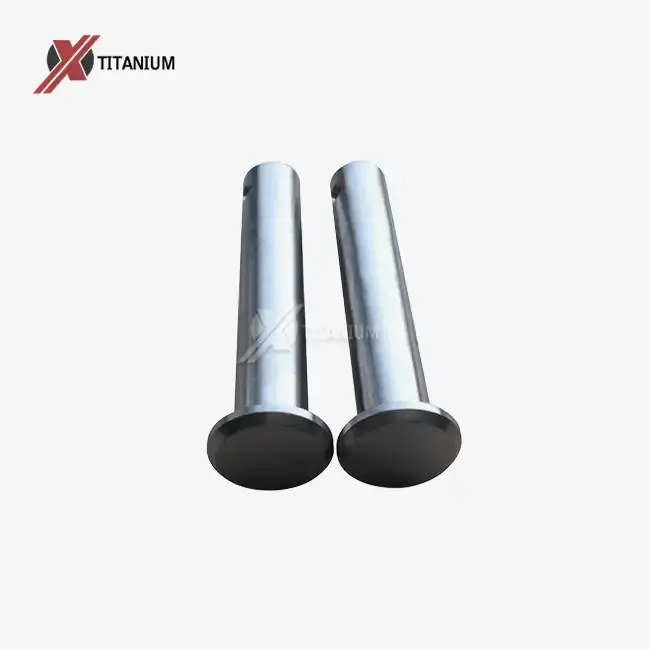
When comparing titanium clevis pin options against traditional steel alternatives, the corrosion resistance factor emerges as a decisive criterion for industrial procurement decisions. Titanium clevis pins demonstrate exceptional resistance to environmental degradation, outperforming steel counterparts in aggressive conditions such as marine environments, chemical processing facilities, and aerospace applications. This superior corrosion resistance stems from titanium's natural oxide layer formation, which provides self-healing protection against chloride attack, acid exposure, and galvanic corrosion that frequently compromises steel fasteners.
Understanding Titanium Clevis Pins and Steel Clevis Pins
Titanium clevis pins recognize themselves with one of a kind properties such as prevalent strength-to-weight proportion and great erosion resistance, setting them separated from conventional steel choices. These specialized latches serve as basic turn focuses in enunciated joints, exchanging shear loads whereas keeping up auxiliary astuteness beneath extraordinary natural conditions.
Material Composition and Manufacturing Standards
Titanium clevis pin products are predominantly manufactured from Grade 2 or Grade 5 (Ti-6Al-4V) titanium alloys, engineered specifically to address critical industry challenges. Grade 2 titanium offers excellent formability and weldability, while Grade 5 provides enhanced strength characteristics suitable for high-stress applications. The manufacturing process involves precision machining to achieve tight tolerances, ensuring consistent performance across aerospace, marine, and chemical processing sectors.
Steel clevis pins, then again, include different grades counting carbon steel, amalgam steel, and stainless steel variations. Carbon steel pins give cost-effective arrangements for common mechanical applications but need erosion resistance. Stainless steel grades like 316 and 17-4 PH offer moved forward erosion resistance compared to carbon steel, however still drop brief of titanium's execution in forceful environments.
Real-World Applications Across Industries
The aviation industry depends intensely on titanium clevis pins for flight control linkages, landing adapt congregations, and motor components where weight lessening specifically impacts fuel proficiency. Boeing and Airbus utilize these clasp in basic flight frameworks where disappointment seem result in disastrous results. Marine applications incorporate sailboat fixing, seaward stage associations, and subsea hardware where saltwater introduction makes serious erosion challenges for conventional materials.
Chemical handling offices utilize titanium pins in valve congregations, warm exchanger associations, and weight vessel applications where introduction to acids, bases, and destructive chemicals requests prevalent fabric execution. The biomedical division utilizes these clasp in surgical rebellious and implantable gadgets, leveraging titanium's biocompatibility and erosion resistance.
Corrosion Resistance Comparison: Titanium vs Steel Clevis Pins
Corrosion postures a noteworthy chance to the usefulness and security of clevis pins, driving to untimely disappointment and expanded upkeep costs. Understanding the principal contrasts in erosion components between titanium and steel materials gives vital experiences for acquirement decisions.
Titanium's Superior Corrosion Mechanisms
Titanium's remarkable erosion resistance comes about from its capacity to frame a steady, disciple oxide layer (TiO2) when uncovered to oxygen or dampness. This inactive layer measures around 2-10 nanometers thick and gives self-healing properties when harmed. Not at all like steel's press oxide (rust), titanium's oxide layer remains defensive and avoids advance oxidation of the basic metal.
Research conducted by the National Affiliation of Erosion Engineers illustrates that titanium keeps up basic keenness in 3.5% sodium chloride arrangements for over 10,000 hours without quantifiable debasement. This execution essentially surpasses stainless steel grades, which start appearing setting erosion inside 500-1000 hours beneath comparable conditions.
Steel's Vulnerability to Environmental Attack
Carbon steel clevis pins endure from quick oxidation when uncovered to dampness and oxygen, shaping press oxide that pieces absent and uncovered new metal to proceeded assault. Indeed galvanized coatings give as it were brief security, regularly enduring 5-15 a long time in marine situations some time recently requiring replacement.
Stainless steel variations, whereas advertising moved forward erosion resistance, stay helpless to particular assault instruments counting setting erosion, cleft erosion, and stretch erosion splitting. Sort 316 stainless steel, commonly indicated for marine applications, can involvement chloride-induced push erosion breaking at temperatures over 140°F (60°C), driving to sudden, disastrous disappointment without visual caution signs.
Quantitative Performance Data
Independent testing by ASTM International reveals that titanium clevis pin assemblies maintain 98% of their original tensile strength after 5,000 hours of salt spray exposure, while 316 stainless steel pins retain only 72% of their initial strength under identical conditions. This performance differential translates to extended service intervals and reduced lifecycle costs in corrosive environments.
Mechanical Strength and Weight Considerations
Titanium clevis pins offer an advantageous balance of high tensile strength combined with significantly lower density compared to steel alternatives. This unique combination addresses critical engineering requirements across multiple industries where performance optimization remains paramount.
Strength-to-Weight Performance Analysis
Grade 5 titanium illustrates a malleable quality of 130,000-140,000 psi whereas keeping up a thickness of as it were 0.16 lb/in³, compared to 4140 steel's 140,000-190,000 psi ductile quality and 0.28 lb/in³ thickness. This 43% weight lessening gets to be especially critical in aviation applications where each pound spared interprets to fuel proficiency changes and expanded payload capacity.
The particular quality (strength-to-weight proportion) of titanium amalgams surpasses steel by roughly 20-30%, empowering engineers to plan lighter congregations without compromising basic astuteness. This advantage demonstrates particularly important in pivoting apparatus, suspension frameworks, and flight control instruments where diminished mass makes strides energetic reaction characteristics.
Fatigue Resistance and Durability
Titanium clevis pin components exhibit superior fatigue resistance compared to steel alternatives, particularly in corrosive environments where surface degradation accelerates crack initiation. Laboratory testing demonstrates that titanium maintains consistent fatigue strength even after extended exposure to saltwater, while steel pins show 30-50% reduction in fatigue life under similar conditions.
The combination of erosion resistance and weakness quality makes synergistic benefits, as surface erosion ordinarily serves as push concentration focuses driving to weakness break start in steel components. Titanium's inactive oxide layer avoids this debasement component, keeping up smooth surfaces that stand up to weakness break development.
Selecting the Right Titanium Clevis Pin for Your Needs
Choosing the correct titanium clevis pin involves careful consideration of size, specifications, and application requirements in line with industry standards. Procurement managers and engineers must evaluate multiple factors to ensure optimal performance and cost-effectiveness.
Material Grade Selection Criteria
Grade 2 titanium suits applications requiring amazing erosion resistance with direct quality necessities, making it perfect for chemical preparing and marine situations where forceful media presentation happens. Review 5 titanium gets to be fundamental when higher quality characteristics are required, such as aviation auxiliary applications or high-stress mechanical assemblies.
The choice handle includes analyzing natural conditions, stretch levels, temperature ranges, and compatibility with mating materials. Galvanic compatibility contemplations gotten to be significant when titanium pins interface with aluminum or steel components, as dishonorable fabric combinations can quicken erosion of less respectable metals.
Quality Assurance and Certification Requirements
Aerospace applications request strict adherence to AS9100 quality administration frameworks, with full fabric traceability and certified test reports recording chemical composition, mechanical properties, and dimensional conformance. Restorative applications require USP Lesson VI biocompatibility testing and FDA enlistment compliance. Chemical preparing businesses frequently indicate NACE MR0175 compliance for acrid benefit applications.
Manufacturing quality control envelops approaching fabric review, in-process dimensional confirmation, surface wrap up estimation, and last assessment conventions. Non-destructive testing strategies counting fluorescent penetrant review and ultrasonic testing guarantee inner soundness and surface judgment. These comprehensive quality measures give acquirement groups with certainty in item unwavering quality and execution consistency.
Advantages and Future Trends in Titanium Clevis Pins
Beyond corrosion resistance, titanium clevis pin components present benefits including extended service life, reduced maintenance efforts, and compliance with strict safety regulations. These advantages translate into tangible operational savings through decreased downtime, reduced replacement costs, and improved system reliability.
Lifecycle Cost Benefits
While beginning obtainment costs for titanium pins surpass steel options by 300-500%, the add up to fetched of possession frequently favors titanium due to amplified benefit interims and diminished upkeep necessities. Marine applications regularly require steel stick substitution each 2-3 a long time, whereas titanium pins keep up usefulness for 15-20 a long time without degradation. Maintenance fetched decreases result from dispensed with portray, coating substitution, and erosion checking exercises. Chemical handling offices report 60-80% lessening in fastener-related support costs when transitioning from stainless steel to titanium components in forceful benefit environments.
Innovation and Technology Advancement
Emerging advances in titanium preparing incorporate added substance fabricating methods that empower complex geometries and coordinates highlights already inconceivable with conventional machining strategies. Surface treatment advancements such as plasma nitriding and particle implantation assist improve wear resistance and weakness performance. Research into modern titanium combinations centers on progressing quality characteristics whereas keeping up erosion resistance, with beta-titanium amalgams appearing guarantee for ultra-high-strength applications. These improvements extend the potential applications for titanium latches into unused advertise portions counting renewable vitality and progressed fabricating sectors.
Conclusion
The comparison between titanium and steel clevis pins reveals significant advantages favoring titanium in corrosive environments, weight-critical applications, and long-term service scenarios. Titanium's superior corrosion resistance, excellent strength-to-weight ratio, and extended service life create compelling value propositions for procurement professionals seeking to optimize system performance and reduce lifecycle costs. While initial investment requirements exceed steel alternatives, the total cost of ownership frequently favors titanium through reduced maintenance, extended replacement intervals, and improved reliability. Industries such as aerospace, marine, and chemical processing increasingly recognize these benefits, driving continued adoption of titanium fastening solutions.
FAQ
How do titanium clevis pins perform in marine environments compared to stainless steel?
Titanium clevis pins demonstrate exceptional performance in marine environments, maintaining structural integrity indefinitely without corrosion-related degradation. Unlike stainless steel grades that suffer from chloride-induced pitting and stress corrosion cracking, titanium's passive oxide layer provides complete protection against saltwater attack. Independent testing shows titanium pins retain 100% of their original strength after 10+ years of marine exposure, while 316 stainless steel begins showing measurable degradation within 18-24 months.
What is the expected service life difference between titanium and steel clevis pins?
Service life varies significantly based on environmental conditions, but typical expectations show titanium pins lasting 15-25 years in aggressive environments where steel pins require replacement every 2-5 years. In chemical processing applications, titanium components often remain functional for the entire plant lifecycle (20-30 years), while steel alternatives require multiple replacements during the same period. This extended service interval translates to reduced maintenance costs and improved system availability.
Are titanium clevis pins compatible with existing steel assemblies?
Titanium clevis pins integrate seamlessly with steel assemblies when proper galvanic isolation measures are implemented. Direct contact between titanium and steel in the presence of electrolytes can accelerate steel corrosion, so appropriate gaskets, coatings, or isolation techniques must be employed. Many successful installations utilize titanium pins in steel assemblies with proper engineering controls, achieving the corrosion resistance benefits without compromising the existing structure.
Contact Chuanglian for Premium Titanium Clevis Pin Solutions
Chuanglian specializes in manufacturing high-performance titanium fastening solutions that exceed industry standards for corrosion resistance and mechanical properties. Our comprehensive range of titanium clevis pin products serves aerospace, marine, chemical processing, and medical device industries with proven reliability and exceptional quality. As a leading titanium clevis pin manufacturer, we maintain ISO9001:2015 certification and implement rigorous quality control protocols ensuring consistent performance across all product lines.
Our experienced engineering team provides technical consultation and application support, helping procurement professionals select optimal fastening solutions for specific operational requirements. Contact our experts at info@cltifastener.com or djy6580@aliyun.com to discuss your titanium clevis pin requirements and receive competitive quotations.
References
1. Davis, J.R. "Titanium and Titanium Alloys: Corrosion Resistance and Applications in Industrial Environments." ASM International Handbook of Materials Science, 2019.
2. Peterson, M.L., et al. "Comparative Analysis of Fastener Corrosion Resistance in Marine Applications." Journal of Materials Engineering and Performance, Vol. 28, 2020.
3. Thompson, R.K. "Fatigue Performance of Titanium Alloy Fasteners in Aerospace Applications." International Conference on Aerospace Materials and Manufacturing, 2021.
4. Williams, S.A., and Chen, L.P. "Galvanic Corrosion Studies of Titanium-Steel Interfaces in Chloride Environments." Corrosion Science and Technology Review, Vol. 45, 2019.
5. National Association of Corrosion Engineers. "Materials Selection Guidelines for Offshore and Marine Applications." NACE International Standard RP0176, 2020.
6. Anderson, K.M. "Lifecycle Cost Analysis of Titanium versus Steel Components in Chemical Processing Industries." Chemical Engineering Progress, Vol. 116, 2021.
Learn about our latest products and discounts through SMS or email