- English
- French
- German
- Portuguese
- Spanish
- Russian
- Japanese
- Korean
- Arabic
- Greek
- German
- Turkish
- Italian
- Danish
- Romanian
- Indonesian
- Czech
- Afrikaans
- Swedish
- Polish
- Basque
- Catalan
- Esperanto
- Hindi
- Lao
- Albanian
- Amharic
- Armenian
- Azerbaijani
- Belarusian
- Bengali
- Bosnian
- Bulgarian
- Cebuano
- Chichewa
- Corsican
- Croatian
- Dutch
- Estonian
- Filipino
- Finnish
- Frisian
- Galician
- Georgian
- Gujarati
- Haitian
- Hausa
- Hawaiian
- Hebrew
- Hmong
- Hungarian
- Icelandic
- Igbo
- Javanese
- Kannada
- Kazakh
- Khmer
- Kurdish
- Kyrgyz
- Latin
- Latvian
- Lithuanian
- Luxembou..
- Macedonian
- Malagasy
- Malay
- Malayalam
- Maltese
- Maori
- Marathi
- Mongolian
- Burmese
- Nepali
- Norwegian
- Pashto
- Persian
- Punjabi
- Serbian
- Sesotho
- Sinhala
- Slovak
- Slovenian
- Somali
- Samoan
- Scots Gaelic
- Shona
- Sindhi
- Sundanese
- Swahili
- Tajik
- Tamil
- Telugu
- Thai
- Ukrainian
- Urdu
- Uzbek
- Vietnamese
- Welsh
- Xhosa
- Yiddish
- Yoruba
- Zulu
Titanium Exhaust Bolt Benefits: Corrosion Resistance and Less Weight
That's right, a titanium exhaust bolt doesn't rust and is also lighter. Steel bolts get stuck when they rust, but grade 5 titanium (Ti-6Al-4V) doesn't. Instead, it forms a stable oxide film that protects the surface from water, road salt, and exhaust condensate. Its density is 4.43 g/cm³, while steel's is 7.85 g/cm³, which means that every fastener weighs a lot more. All of these savings add up when you look at the flanges, brackets, and headers of a single exhaust system. I'll explain how these benefits work, what their limits are, and how to choose the right bolt below.
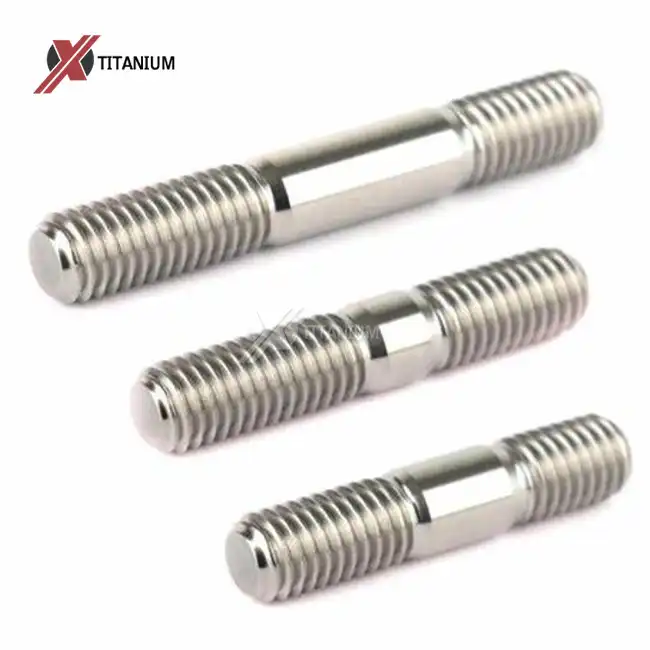
What a Titanium Exhaust Bolt Is and Why Material Matters
Material and Grade
In an exhaust system, a titanium exhaust bolt holds headers, manifolds, flanges, and mounting brackets in place. These bolts are made by Chuanglian from Grade 5 titanium alloy, which is also written as Ti-6Al-4V. This alloy has about 6% aluminum and 4% vanadium in it. That chemistry makes it much stronger than pure Grade 2 that you can buy in stores. Grade 2 is softer and better for lighter-duty parts. When it comes to clamping loads and engine vibration, I suggest Gr5. Each bolt is made on CNC machines that follow your drawing for thread shape, head shape, and length.
Why Exhaust Fasteners Fail?
The area where the exhaust bolts function is a rough area. They have to withstand repeated heating and cooling, engine vibration, water spray, road salt and acidic condensation. Steel bolts frequently corrode and seize in the head or flange. If you attempt to take a trapped bolt out, you may snap it off. Stainless steel is heavier, and may chafe. It also doesn't rust well. A bolt may come loose or break, and this can cause a pipe to collapse or a tyre to leak gas. Choosing the appropriate material and size may save the rider, and your brand.
Chuanglian Gr5 Bolt Specifications
Our product data sheet has the following main specs.
- Material and process: Grade 5 titanium alloy (Ti-6Al-4V), CNC machined to your drawing. The standard is customized, so we build to your thread, length, and head design. Sizes run from M6 to M36, which covers the M6, M8, and M10 bolts common on exhaust flanges and brackets.
- Strength and temperature: Tensile strength is 1,200 MPa, yield strength is 1,100 MPa, and hardness is 350 HV. Temperature resistance is listed up to 500°C (932°F). The sheet also lists weight about 40% below steel bolts of comparable strength, plus strong fatigue resistance in high-vibration use.
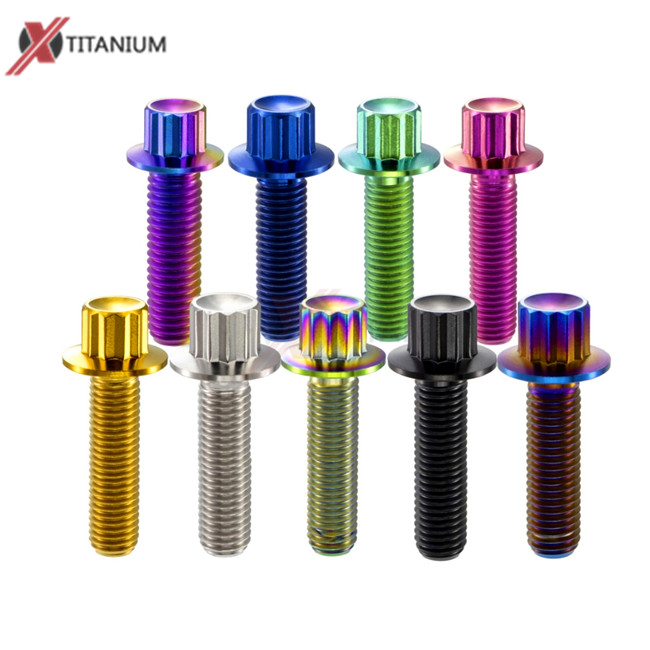
- Finish and standards: Polishing, anodizing, and nitriding are available. Colors include natural titanium, gold, blue, green, purple, black, and rainbow. Our data sheet lists ASTM B265, ISO 9001, and AMS 4928 as reference standards, and you can tell us which documents your approval process needs.
Core Benefits: Corrosion Resistance and Less Weight
How Titanium Resists Corrosion?
A titanium exhaust bolt reacts almost instantly with oxygen to make titanium dioxide, which is a thin layer that sticks together tightly. That coating prevents water, chlorides and many acids from attacking the metal, and it recovers if a scratch exposes fresh metal. That is why titanium is utilised for chemical processing and ocean equipment. You can see the clean threads on an exhaust and it functions better when you ride on snow or rainy roads. Heat tint affects the colour of the surface but does not peel off like rust on steel.
How Much Weight You Save
The density of steel is roughly 7.85 g/cm³ while the density of Ti-6Al-4V is about 4.43 g/cm³. That implies that the same volume has around 44% less mass. "These bolts weigh around 40% less than steel bolts of the same strength according to our data sheet. A single bolt may only save a few grams, but a whole exhaust has several fasteners that keep flanges, brackets and heat shields in place. If you install titanium bolts on a titanium pipe, you reduce weight by a factor of two. Less bulk , easy to manage , and speed up the automobile . So this is beneficial for tuners and racers .
Strength and Fatigue Under Vibration
Just because a bolt is light doesn't mean it won't crack or stretch. The yield strength of our Gr5 bolts is 1,100 MPa, and their tensile strength is 1,200 MPa. They are also 350 HV hard. The bolt can hold the clamp load better if it has a high yield strength, and fatigue resistance is important because engines shake the flange all day. A good thread is also important. So I ask buyers to write the thread class on the drawing. Rough thread profiles don't spread load as well as tidy ones.
Titanium vs. Steel and Stainless Steel
Weight, Strength, and Heat Limits
Carbon steel bolts are inexpensive and durable, but they weigh around 1.8 times as much as titanium bolts and need to be coated to prevent corrosion. Steel weighs the same as stainless steel yet stainless steel doesn’t rust and remains durable at high temperatures. Titanium Gr5 is in the middle. It's strong, it's light, and it won't rust. “Our bolts can withstand temperatures of up to 500°C. That’s a big caveat. Some parts may grow hotter than a motorbike slip-on joint (header collectors, turbo flanges, etc) and become weaker. Determine the maximum temperature of the flange and check it to ensure that the safety margin is correct.
Galling, Expansion, and Color
Titanium and stainless steel are equally prone to galling, which means that the threads might rip when they are forced together. With anti-seize and proper torque, that danger is reduced. Different metals grow at different speeds. Ti-6Al-4V expands at around 9 µm/m·K whereas 304 stainless steel expands at about 17 µm/m·K . Preload is a function of system temperature, which must be considered in your joint design. Exhaust heat may fade or change anodised colour thus I would suggest a natural finish or nitriding for the hot locations.
Cost and Lifecycle Value
For standard-duty exhausts, stainless steel bolts really do save you money because they cost less per piece. A titanium exhaust bolt is not always the best choice for a job. When weight savings, corrosion risk, premium positioning, or hard-to-reach fasteners matter, it's worth the extra cost. Titanium bolts can be used as a sign of quality by a brand that sells a performance exhaust, and they can also be sold as replacement parts. When you compare quotes, you should think about the size, finish, rejected parts, service returns, and how much the customer wants lighter hardware.
How to Choose, Finish, and Install Titanium Bolts?
Match Size, Thread, and Head Design
Begin with the edge. Check the diameter, thread pitch, length, head style, washer thickness, and thread engagement of the bolt. Exhaust parts often have M6, M8, and M10 threads. Our M6 to M36 range includes all of these, and we can also make parts to your exact size. Bolts that look the same can't be switched out, and a thread that's off by one pitch can strip a cylinder head. Socket, hex, or flange heads change how tools look and how easy they are to use, so choose early. Send us a print or a sample bolt, and we'll compare the sizes before we machine them.
Choose the Right Surface Treatment
Surface treatment changes how something looks and how it wears. When you polish something, it gets smooth and shiny. Anodizing makes colors like gold, blue, green, purple, black, and rainbow that look good on hardware and brand identity. Anodized color can fade in hot places, so I only use it on brackets, clamps, and covers that are kept cool. Nitriding makes a hard layer on the surface that doesn't wear away easily, and natural titanium is good for parts that will be close to hot flanges. Tell us the temperature you want to use and the look you want, and we'll suggest a treatment for you to check out.
Installation and Maintenance Steps
For the joint, good installation is the most important step. These are the steps I suggest.
- Prepare the joint: Clean the threads and mating surfaces, check thread engagement, and confirm the torque from the exhaust or vehicle maker. Start every bolt by hand so you feel any cross-threading before a tool hides it. Never force a bolt that binds in the first turns; stop and inspect the thread.
- Lubricate and tighten: Apply a high-temperature anti-seize made for titanium, since dry titanium threads can gall. Lubricant lowers friction, so you may need a lower torque than a dry steel chart shows. Tighten flange bolts in small steps and in a cross pattern with a calibrated torque wrench.
- Inspect and record: Let the system cool before removal. Check threads at service intervals for damage, loosening, or heat discoloration, and replace any bolt with galled or stretched threads. Keep torque records so your team repeats the same procedure on an assembly line or in a shop.
These easy steps will help keep your bolts from getting stuck or stripped.
Applications, Risks, and Buying Guide
Where Titanium Exhaust Bolts Work Best
Sport motorcycles gain the most from a titanium exhaust bolt because they have less weight and the parts that hold them together are open to rain and road spray. For the same reason, off-road bikes, cars, and racing platforms use titanium bolts. Exhaust brands also use them to match a titanium pipe. It is more important to test the joints on the turbo flanges and header collectors first because they can handle higher temperatures. Titanium products from Chuanglian are already used in the aerospace, marine, petrochemical, and racing industries. This gives us a good idea of how fasteners work in tough situations.
Common Mistakes to Avoid
I keep seeing the same mistakes. People only choose based on weight and don't think about temperature limits. The installers just copy the torque numbers from steel charts and don't use anti-seize. When some people order without a drawing or mix nuts and washers of different materials, the bolt ends up with the wrong pitch or length. You can easily fix each mistake: write down the highest temperature, test the torque with the lubricant you plan to use, and approve a sample before placing an order for mass production. A bench or road test followed by a small test batch on a real exhaust finds problems early on, when they are still cheap.
How to Buy in Bulk
Before you ask for a quote, make a list of the bolt's diameter, pitch, length, head style, grade, quantity, finish, needs for washers or nuts, packaging, and how it will be used. Then, when you compare suppliers, look at more than just the price per unit. Look at their tolerances, inspection records, material certificates, lead time, and willingness to make changes. Chuanglian is in charge of a dozen CNC machines and checks every step of the production process, from the raw materials to the finished product. He has sold titanium parts to well-known companies all over the world. A search for "titanium exhaust bolt supplier" will bring up a lot of results. Before approving a large order, ask each one for samples and proof.
Conclusion
Grade 5 titanium (Ti-6Al-4V) is used to make a titanium exhaust bolt that is both light and resistant to corrosion. Its oxide film protects against water, salt, and condensation, and its density of 4.43 g/cm³ is lighter than steel's density of 7.85 g/cm³. Tensile strength of 1,200 MPa and yield strength of 1,100 MPa are listed. These strengths can withstand clamping loads and vibrations up to 500°C. Planning is needed for galling, differences in thermal expansion with stainless flanges, and the color of anodized parts wearing off. When you match the size, thread, and finish to the joint, use anti-seize with controlled torque, and test samples in real life, you get good results. Titanium works best in situations where weight and corrosion are important, while stainless steel is usually enough for regular-duty exhausts.
FAQ
Q1: Does a titanium exhaust bolt rust?
A: Titanium doesn't rust like carbon steel does because it coats itself in an oxide film. The color can change with heat, but the surface stays the same.
Q2: How hot can a Gr5 bolt run?
A: The temperature range on our data sheet goes up to 500°C (932°F). Since heat makes things weaker, check any joint that is close to that point.
Q3: Do I need anti-seize on titanium threads?
A: Yes. Too much heat can make titanium threads gall, so use a high-temperature anti-seize that is made for titanium. Since lubricant lowers friction, make sure you know what the torque value is for your setup.
Q4: Can Chuanglian make custom sizes?
A: Yes. We can CNC-machine Gr5 bolts from M6 to M36, and we can make them in any size, length, or head design you want. Send us your drawing to look over.
Request a Titanium Exhaust Bolt Quote from Chuanglian
Chuanglian makes titanium exhaust bolts in Baoji, also known as the "City of Titanium." They have been making Gr5 (Ti-6Al-4V) bolts for more than ten years and check the quality of all their products, from the raw materials to the finished ones. Our team will look over your needs after you send your drawings, quantities, and operating temperatures to info@cltifastener.com or djy6580@aliyun.com.
References
1. ASM International, Titanium: A Technical Guide, 2000
2. Springer, Titanium (Lütjering and Williams), 2007
3. Advanced Engineering Materials, Titanium Alloys for Aerospace Applications, 2003
4. ASM International, ASM Handbook Volume 13: Corrosion, 1987
5. Wiley, An Introduction to the Design and Behavior of Bolted Joints (Bickford), 1995
6. ASTM International, Standard Specification for Titanium and Titanium Alloy Bars and Billets (ASTM B348), 2019
Learn about our latest products and discounts through SMS or email